
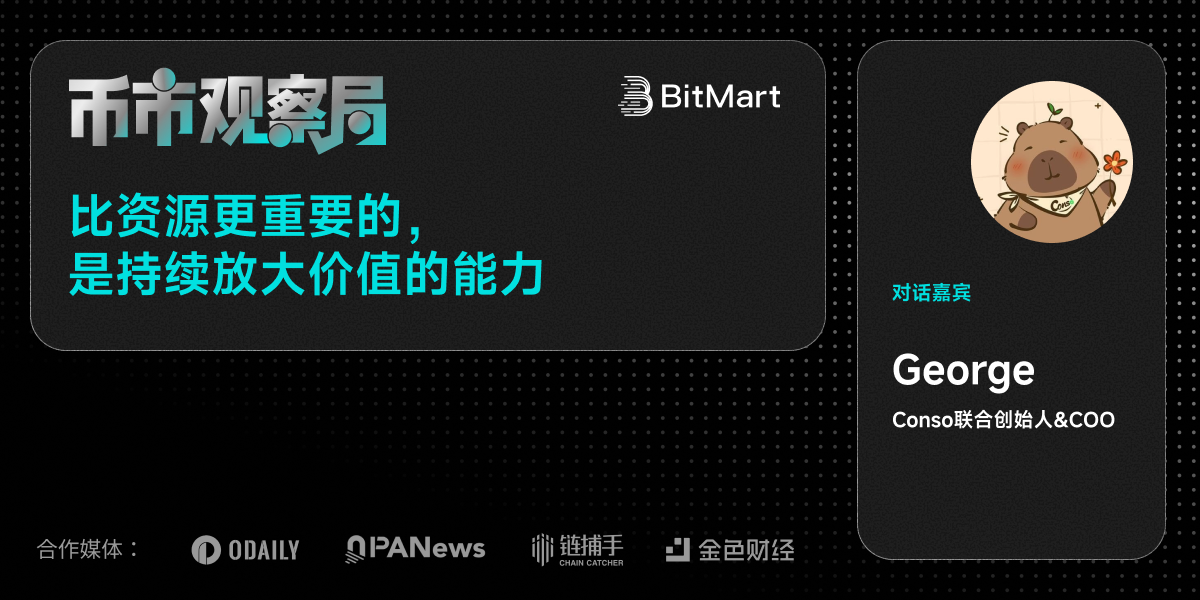
Guest: George, Co-Founder & COO of Conso
Host: yuanyuan, VP of Marketing at BitMart
An interesting phenomenon is happening in this round of the Crypto cycle.
More and more people are starting to discuss personal IP, super individuals, AI, growth methodologies, and how to acquire incremental users from Web2. Compared to the past few years when the industry focused on public chains, DeFi, NFTs, or Memes, people today seem to be more concerned about a real issue: as traffic becomes more expensive and competition intensifies, what should an ordinary person or a startup rely on for continuous growth?
From starting a business at 21 and achieving annual revenue of tens of millions, to experiencing investor withdrawal and team dissolution; from quantitative trading to wallet products, and now deeply cultivating the TON ecosystem and user growth. Over the past eight years, George has experienced several important cycles in the Crypto industry.
Rather than the race for projects, funding, or valuations, George is more concerned with how to continuously create value and amplify that value.
The biggest crisis in entrepreneurship is not lack of funds, but loss of direction
Many people feel that George's entrepreneurial experience is quite legendary. At 21, the project he founded was already generating tens of millions in revenue; later, he entered Crypto and successively ventured into quantitative trading, wallets, and games. From the outcome, this seems to be a very smooth entrepreneurial path.
But what truly left a deep impression on him was not those highlight moments, but the sudden crisis in 2022. Due to external events affecting investors, funding was rapidly withdrawn, leading to a quick break in the company's cash flow. Faced with the choice of either holding on or disbanding the team, he ultimately chose the latter—dismissing the team, compensating expenses, pausing operations, and starting from scratch.
Looking back, he believes that the hardest part was not the financial pressure, but the ensuing confusion. Copy-pasting Web2 products into Web3 does not last long, but new directions have yet to be answered. Throughout 2023, he repeatedly pondered one question: If the market environment changes, what abilities can he truly rely on long-term? In the end, he redirected his answer back to growth.
Compared to investment, trading, or chasing hot trends, he believes more in his own accumulation of user growth and market operations. It was during that phase that he redefined his future development direction—helping more Web2 users transition into Web3.
Anxiety is not a weakness, but a competitive advantage
Another term that George repeatedly mentioned during the program is anxiety. Many people want to get rid of anxiety, but in George's view, it is almost impossible for people not to feel anxious. There will always be someone more excellent than oneself, new opportunities will always arise, and changes will always happen. The question has never been how to eliminate anxiety, but how to coexist with it.
He said he has long gotten used to that "walking on thin ice" state. Because this state constantly reminds him to cherish opportunities, treat every partner seriously, and not to stop. To some extent, this continuous sense of crisis has instead become a driving force.
Many entrepreneurs, after reaching a certain stage, start to rely on resources, connections, or past accumulated advantages. But George prefers to rely on himself. That's why he always insists on long-term planning. At 18, inspired by a teacher, he set a five-year goal of tenfold growth for his life: achieving annual revenue of 1 million at 20; 10 million at 25; 100 million at 30... It sounds a bit idealistic, but the goal is not to flaunt numbers, but to help himself continuously expand his capabilities. After achieving the first 1 million, he realized that 10 million was no longer an abstract concept; after reaching 10 million, 100 million would gradually become concrete.
For entrepreneurs, the biggest growth often isn't how much money they make, but how continuously they enhance their problem-solving abilities.
The essence of growth is not investing traffic, but finding leverage
In recent years, countless growth myths have emerged in the industry. Some rely on airdrops, some on subsidies, and some on traffic dividends.
George believes that the essence of growth is finding leverage. He also shared the case of his current startup, Conso, which used a budget of about $20,000 to acquire over 1 million users. Many people's first instinct might be to think of channel dividends or lucky traffic, but he sees that what really works is actually a series of compounded levers. From TikTok's algorithm recommendations to small KOL's viral distribution; from performance-based payment models to simultaneous distribution across multiple platforms; from localized operations to user invitation mechanisms, each aspect is a fulcrum.
He firmly believes in one saying: "Give me a lever and I can move the earth." And growth is about continuously finding new fulcrums.
The opportunity of TON may not just be the public chain
Over the past year, TON has undoubtedly been one of the most watched ecosystems in the industry. But in George's view, many people's understanding of TON still stays at the public chain level. What's truly important is the user network behind Telegram.
Compared to most Crypto products, Telegram naturally possesses a user base of hundreds of millions and has already formed a mature Mini App ecosystem. For many users in developing countries, Telegram has even become a part of daily life. This means that the challenges faced by TON are not completely the same as those of traditional public chains. Most public chains primarily consider on-chain users, while TON focuses more on how to provide better off-chain services for users.
George mentioned that he is optimistic about the long-term development of Web3 financial infrastructure, and one important reason for this is precisely because of this.
In recent years, industry narratives have been constantly changing, from DeFi to NFTs, from GameFi to AI, but the truly long-lasting main thread has remained unchanged: making Web3 the new financial infrastructure. Especially in many developing countries, local currencies have long faced depreciation pressure, and cross-border payment efficiency is low; these real needs will not disappear just because the market cycle ends. Platforms that can connect hundreds of millions of ordinary users naturally have greater opportunities.
In the IP era, everyone should become their own media
Besides growth and entrepreneurship, George has also done another thing in the past year—helping creators grow.
In this process, he found that many excellent individuals actually do not lack ability, but rather lack the ability to express. Many developers, entrepreneurs, and even project leaders have impressive resumes and real achievements, yet have almost no presence on social media. It's not because they aren't excellent, but because they don't know how to convey their value to more people.
Therefore, George increasingly believes that in the future, everyone should manage their personal IP. This is not to become an internet celebrity, but to build trust. When discussing this, he mentioned the rise of young KOL Emus during this cycle. In his view, many people see only the results, but overlook the accumulation behind them. As early as 2024, Emus was already actively learning and observing in various communities, and what often differentiates people is not luck, but the ability to learn long-term and continuously output.
As industry information becomes more fragmented, a person who continuously outputs content often finds it easier to gain opportunities, collaborations, and resources. Many times, people do not believe in you because they know you, but rather because they have seen your content over time and are willing to know you.
In the past, a person's credibility came more from education, experience, and company background; today, more and more credibility comes from the content itself. What you have written, what you have thought, and what you have shared are becoming important bases for others to judge you.
For entrepreneurs, IP is not just a tool for dissemination but also a long-term accumulated asset of trust. The greatest characteristic of this asset is that it will produce compound interest over time.
AI will not eliminate you, but those who use AI will
In the AI era, work that previously required three people can now be done by one person. A large number of repetitive tasks such as design, editing, data analysis, and operations management are being redefined. George believes that the greatest value of AI is not in replacing jobs but in amplifying individual capabilities. The abilities that are truly difficult to replace will become increasingly important, such as product ability and creative ability. Because AI can generate answers, but cannot replace the one who creates the answers.
Future competition may no longer be about who has more tools, but rather who can use those tools to create more value. He also stated that AI cannot replace him, so he will not entrust his social media accounts to AI for maintenance.
Real opportunities come from continuously amplifying value
Resources may disappear, connections may change. But when a person can continuously create value, opportunities often come knocking. And perhaps this is the most important gain from George's eight years of entrepreneurial experience.
"Entrepreneurs must free themselves from dependence on resources and connections, prioritizing self-improvement," he emphasizes, because investors may leave, markets may change, and trends may rotate; what is effective today may not be effective tomorrow. The only thing that can accompany you long-term is your abilities.
Whether it is the TON ecosystem, doing growth, managing IP, or applying AI, what he truly cares about is always one thing: how to create value, how to amplify value. Because a person's ability to create and amplify value will accompany him through cycles, for entrepreneurs, for companies, and perhaps also for the entire Crypto industry.
免责声明:本文章仅代表作者个人观点,不代表本平台的立场和观点。本文章仅供信息分享,不构成对任何人的任何投资建议。用户与作者之间的任何争议,与本平台无关。如网页中刊载的文章或图片涉及侵权,请提供相关的权利证明和身份证明发送邮件到support@aicoin.com,本平台相关工作人员将会进行核查。


