Written by: Xiao Bing, Trend Research
On June 12, SpaceX will go public on NASDAQ at a price of $135 per share, with an implied valuation of $1.75 trillion. This is the largest IPO in the history of human capital markets.
Fidelity, Robinhood, and Charles Schwab have opened retail subscriptions, with 30% of the shares allocated to individual investors, with a minimum investment as low as $2000. This means almost all holders of U.S. stock accounts can participate.
The question follows: should it be bought? When to buy?
No one can provide a standard answer. However, around this IPO, the market has already formed several clear strategic frameworks, each strategy has its own logic, stakes, and historical references. Below is a breakdown for readers to make judgments based on their own risk preferences.
Key Time Points:
- June 11: IPO pricing at $135 per share
- June 12: Listed on NASDAQ, code SPCX, only 3% of shares are publicly traded
- Early July: Quick inclusion window for NASDAQ 100 (15 trading days after listing)
- September: First quarterly report (Q2 2026), disclosing the AI division's loss details for the first time
- After Q2 financial report: The first batch of lock-up period releases, some insiders can sell 20% of their holdings
- December: Large-scale lock-up period expiration, early employees, VCs, and underwriting syndicate will unlock shares
- June 2027: Musk's 366-day lock-up period expiration
Overview of Four Strategies:
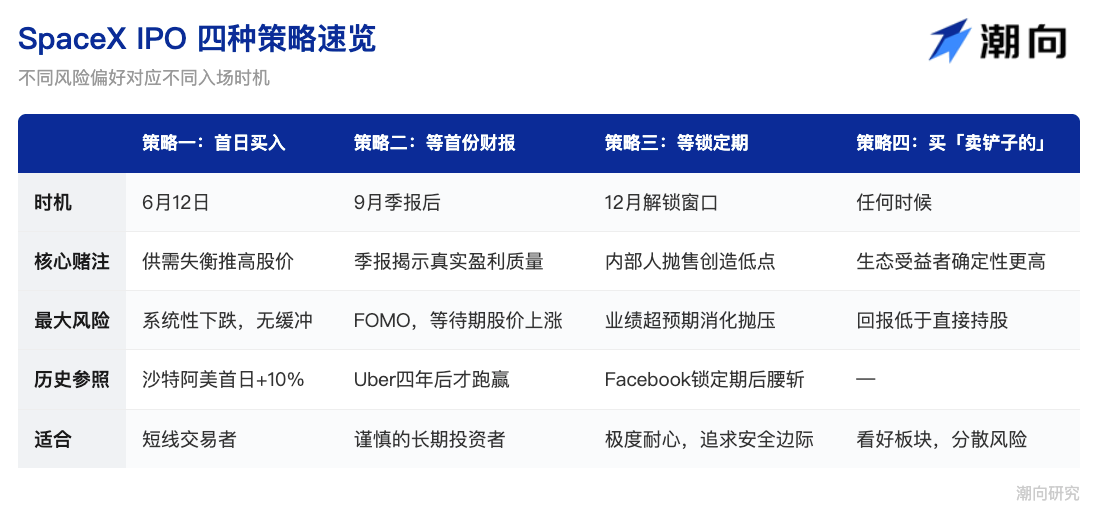
Strategy One: Buy on the First Day of Listing, Bet on Short-term Supply-Demand Imbalance
This is the most aggressive strategy, the core bet is: the supply of stocks at the initial listing is far less than the demand.
This judgment is supported by three structural factors.
First, very few shares are circulating. SpaceX is only issuing about 3% of its shares, with a large amount of equity still held by insiders and early investors, which are under lock-up. For a company with a market value of $1.75 trillion, 3% of freely tradable shares means that even moderate demand for buying could significantly push up the stock price.
Second, the quick inclusion mechanism for NASDAQ 100. According to NASDAQ's updated rules for 2024, SpaceX can be included in the NASDAQ 100 index within the quickest 15 trading days (around early July) after listing. Once included, all passive funds and ETFs tracking this index must buy in, creating a wave of certain incremental capital. Although Morningstar believes that SpaceX is overvalued by a factor of two, it also acknowledges that this mechanism may support the stock price in the short term.
Third, the line-up of the underwriting syndicate. Lead by Goldman Sachs, Morgan Stanley, Bank of America, Citigroup, and JPMorgan, with 21 institutions participating. The world's top investment banks have the motivation and ability to maintain the stock price in the early stages of the IPO.
Historical Reference: Saudi Aramco’s 2019 IPO priced at $25.6, with a 10% increase on the first day reaching the limit. However, Aramco was only listed on the domestic market in Saudi Arabia at that time, where the liquidity was far less than NASDAQ's. SpaceX is facing a direct influx of global capital.
Biggest Risk: If the market experiences a systemic decline during the IPO week (such as geopolitical shocks or unexpected hawkish moves from the Fed), even the strongest underwriting syndicate cannot withstand selling pressure. Additionally, the fixed price of $135 bypassed the traditional range inquiry process; if the actual demand is lower than expected, there is no buffer for price adjustment.
Strategy Two: Wait for the First Financial Report to Get a Clear Picture Before Acting
SpaceX's first quarterly report as a public company is expected to be released in September 2026, covering Q2 2026 performance.
The value of this financial report lies in: it will be the first time SpaceX discloses detailed loss figures for its AI business following public company standards. The roadshow PPT only provided annual summary data, but the quarterly report will require division breakdown. How much xAI is burning each quarter, whether Starlink's user growth continues, and the progress of Grok's corporate clients will all be answered in the quarterly report.
At the same time, the first financial report is also the first lock-up period release window. SpaceX has adopted a non-standard phased unlocking structure: some insiders can sell a maximum of 20% of their holdings after the Q2 financial report is released. This is much shorter than the usual 180-day uniform lock-up period in IPOs.
Historical Reference: Uber went public in May 2019, priced at $45, and dropped below the issue price to close at $41.57 on the first day. However, the real bottom came in March 2020 (pandemic low of $13.71) and June 2022 (around $20). In the four years from IPO to May 2023, Uber underperformed the S&P 500 by 116 percentage points. However, from May 2023 to now, it has outperformed by 118 percentage points. Patient investors waiting for more reasonable valuations ultimately gained better returns.
Suitable for: Those who believe in SpaceX's long-term value but are not comfortable with the $1.75T valuation, willing to trade three months for more complete information.
Biggest Risk: If the stock surges on the first day and continues to strengthen after being included in NASDAQ 100, waiting means a higher cost to buy in. FOMO (Fear of Missing Out) is the biggest enemy of this strategy.
Strategy Three: Wait for the Lock-Up Period to Expire and Buy at the Bottom During Sell-Offs
This is the most patient strategy, betting that: the concentrated sell-off by insiders will create a more attractive entry price.
SpaceX's lock-up structure is worth studying closely. Musk himself has a 366-day lock-up, ending in mid-June 2027. Other executives and early investors will begin phased releases after the Q2 financial report, unlocking all shares by the time of the Q2 2027 financial report. The first wave of larger-scale concentrated unlocking is expected around December 2026.
BitMEX's trading strategy analysis indicates that this time may see "the largest single-day insider sell-off in market history." Early employees (many with very low holding costs), early VC investors, and underwriting banks may all act as sellers at the same time.
If the losses in the AI business continue to widen in the Q2 and Q3 reports, the narrative may shift from "AI concept boost" to "AI dragging profits," further intensifying selling pressure.
Historical Reference: Facebook’s IPO in May 2012 was priced at $38, and after the lock-up period expired, it fell to $17.55 by September 2012, halving its issue price. However, investors who bought at that low and held till now have seen returns exceeding 30 times. The low created by lock-up selling pressure is often the best entry point for long-term investors.
Suitable for: Those who firmly believe that SpaceX's long-term value is determined by Starlink and are willing to wait 6 to 12 months for greater safety margins.
Biggest Risk: If SpaceX announces better-than-expected performance during the waiting period (such as successful commercial operation of Starship, Starlink surpassing 15 million users, or AI business unexpectedly turning profitable), the stock price might rise to levels that make it difficult to lower with selling pressure before the lock-up period expires. A lock-up period expiration for a good company does not guarantee a decline; both Netflix and Amazon quickly regained ground after their lock-up periods ended.
Strategy Four: Do Not Buy SPCX, Buy "The Sellers of Shovels"
Instead of directly participating in the SpaceX IPO game, invest in companies and targets that will certainly benefit from the SpaceX ecosystem.
Several directions:
In hardware supply chains, SpaceX's Colossus data center uses NVIDIA GB200 and GB300, and Starship’s avionics systems and Starlink terminals use a large number of custom chips. NVIDIA (NVDA) is the most direct upstream beneficiary, and if the Terafab chip factory is established, Intel (INTC) will also benefit.
In terms of indirect ETF exposure, Cambria ERShares Private Investments ETF (XOVR) holds a special purpose vehicle for SpaceX, which, as of April 2026, reportedly has over 40% exposure to SpaceX relative to the total fund position. The NASDAQ 100 ETF (QQQ) will also automatically gain exposure after SpaceX is included.
Suitable for: Those who believe SpaceX's public offering will boost the entire space and AI infrastructure sector but do not want to take on the concentrated risk of a single stock at the $1.75T valuation.
Biggest Risk: The returns from indirect exposure may not necessarily be higher than direct holdings. If SpaceX rises significantly after going public, bystanders’ opportunity costs could be very high.
Trend Interpretation
The above four strategies have no right or wrong distinctions; the difference lies in investors’ judgments on two variables: SpaceX's long-term value, and the time required for the market to digest the $1.75T valuation.
If one believes that Starlink's growth can support a valuation of $600B+, and that the long-term options in space computing are worth $1 trillion, then buying at any price for long-term holding makes sense. If one believes that a 94 times revenue valuation requires time to digest and that the expiration of the lock-up period and the exposure of AI losses are foreseeable pressure points, then waiting for a better entry price is a more rational choice.
No one is obligated to make a decision on the first day of the largest IPO in history. SpaceX will not disappear after June 12; its rockets will continue to launch, and Starlink users will continue to grow. The only difference is that waiting will give investors more information and a greater margin of safety.
In the capital markets, the cost of missing one rise is almost always smaller than the cost of being stuck at the wrong price.
Disclaimer: This article represents the analytical viewpoint of Trend Research and does not constitute any investment advice. SpaceX (SPCX) has not yet officially been listed for trading, and the valuations, pricing, and timelines cited in the text are based on public reports and the S-1 document, which may change. Investors should carefully read the prospectus submitted by SpaceX to the SEC before making investment decisions, fully understand the related risk factors, and make independent judgments based on their own financial conditions and risk tolerance.
免责声明:本文章仅代表作者个人观点,不代表本平台的立场和观点。本文章仅供信息分享,不构成对任何人的任何投资建议。用户与作者之间的任何争议,与本平台无关。如网页中刊载的文章或图片涉及侵权,请提供相关的权利证明和身份证明发送邮件到support@aicoin.com,本平台相关工作人员将会进行核查。


