
Written by: Jim, MSX
If a year ago someone told you that Dell, Nokia, Cisco, Corning, Western Digital, and others would become popular targets in AI trading again, you would likely think they were a bit confused...
After all, for a long time, when the market talked about AI, the first associations were usually Nvidia, storage, optical modules, power, and data centers, as they were either closely tied to GPUs or directly involved in the hottest areas of computing power expansion. In comparison, traditional tech companies like Dell, HP, Nokia, Cisco, Corning, and Seagate were often labeled as "slow growth," "old stories," and "inflexible valuations."
However, these once seemingly unappealing old-school tech stocks have recently shown impressive performance, prompting the market to start discussing them again.
The market quickly adapted and found a suitable explanation: As AI moves from model parameters to real data centers, the market naturally seeks companies with delivery capabilities and infrastructure capabilities, which is why Dell, HP, Nokia, and others are being seen again.
So, is this a genuine industry re-evaluation, or is it simply a new narrative temporarily fitted to old tech stocks?
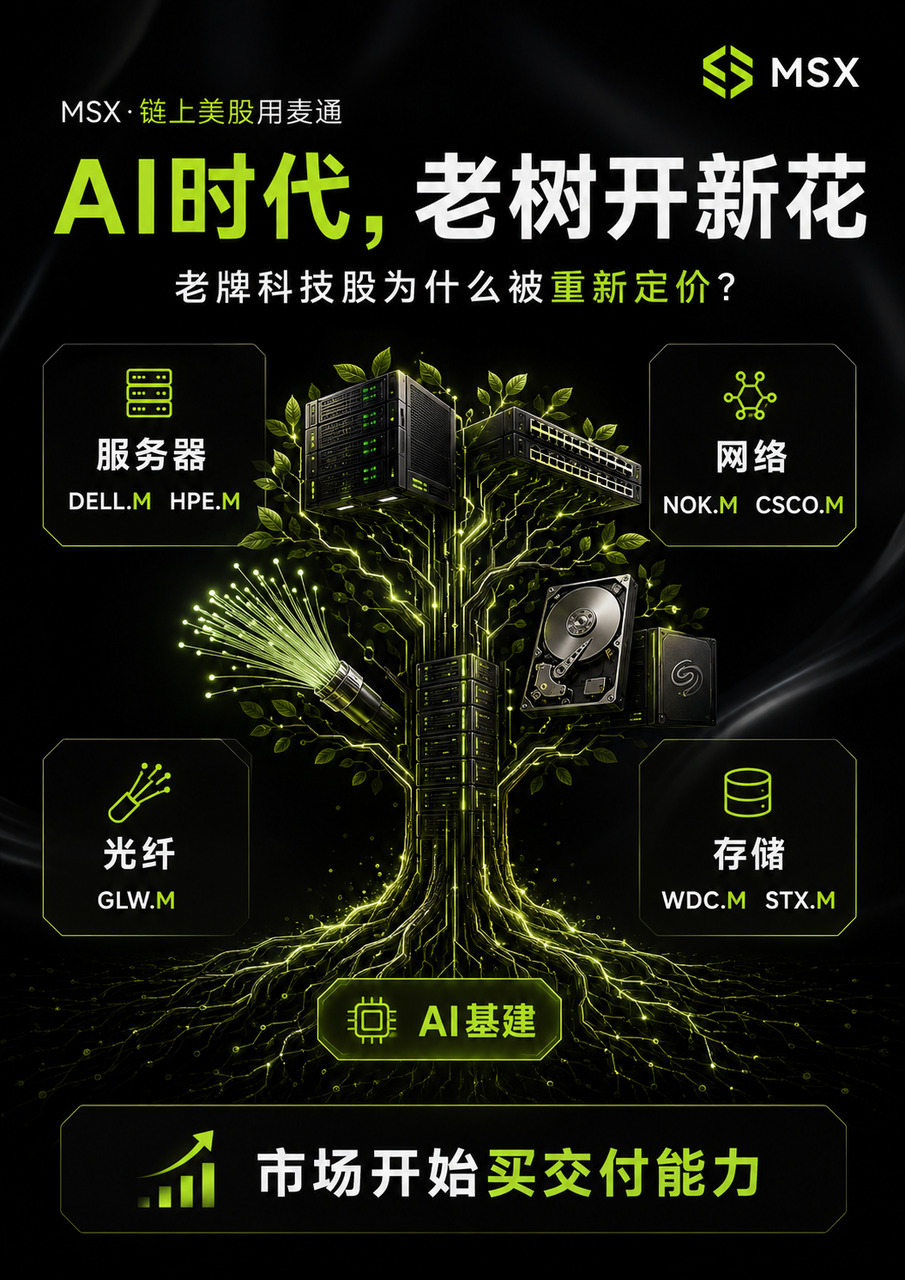
1. AI Market Shift: Why Reevaluate Old Tech Stocks?
In the past few years, the core clue of AI trading has been very clear: first look at the models, then look at the computing power.
This is easy to understand; whoever has the strongest model and the most GPUs can gain the most direct market premium. In this phase, the most desirable investment for investors is the imagination of AI, the gap in computing power supply, and core beneficiaries like Nvidia.
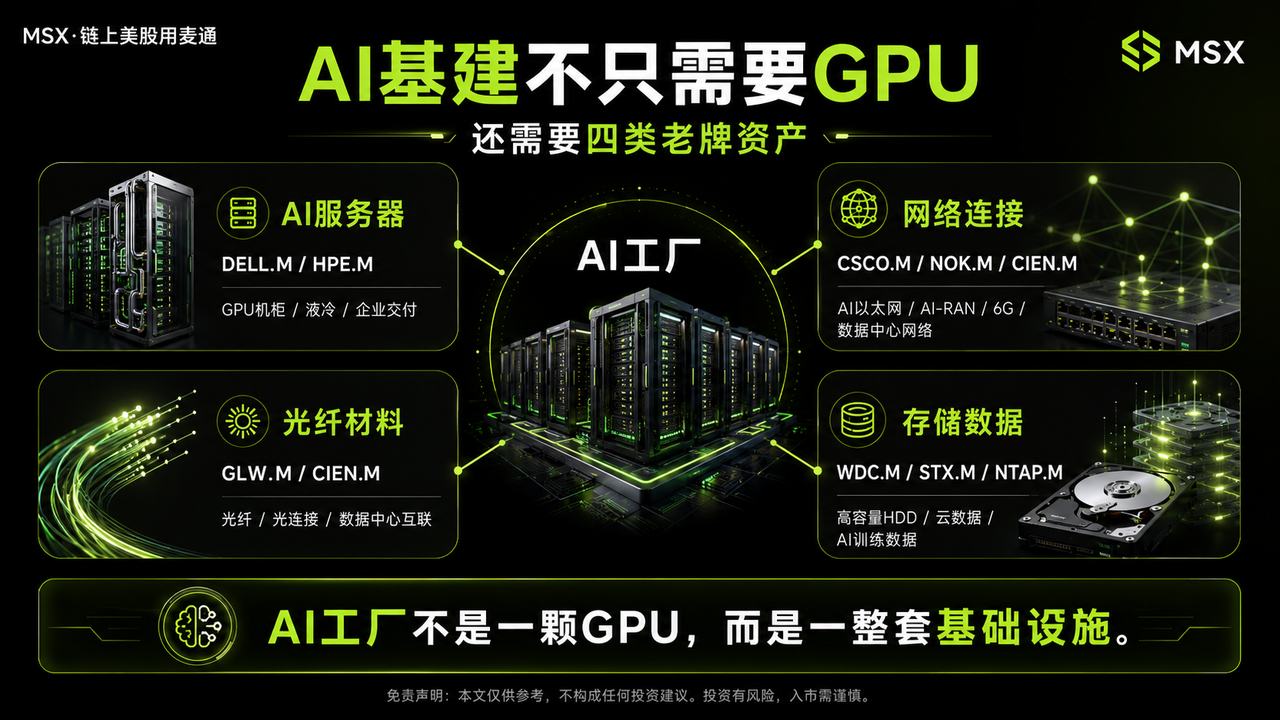
The problem is, AI cannot simply stay confined to press conferences and model parameters. After all, models need to be trained, which requires data centers; inference needs to be implemented at scale, which requires servers, networks, storage, and power; and businesses need complete IT architecture and delivery capabilities to truly use AI.
In other words, AI is not a problem that can be solved by a single GPU but rather a complex system engineering project, which is the starting point for the re-evaluation of traditional tech companies.
Previously, when the market looked at Dell, it might think of PCs and traditional servers; when looking at HPE, enterprise hardware came to mind; for Nokia, it would be old stories about 5G devices; for Cisco, traditional networking equipment; for Corning, glass and optical fiber materials; and for Western Digital and Seagate, cyclical hard drive stocks.
These labels weren’t incorrect, but their roles have changed in the AI infrastructure cycle—AI data centers need to be constructed, requiring entire server racks, liquid cooling, storage, network switches, fiber connections, data management, power infrastructures, and enterprise-level delivery capabilities. The larger the AI cluster, the higher the demands for system integration, network transmission, storage capacity, and operational capabilities.
Therefore, the essence of this re-evaluation is not that the market suddenly became nostalgic or that old companies are collectively riding the AI wave, but rather that once AI enters the order, revenue, and delivery phases, the market starts looking for "who can truly build AI infrastructure."
These companies may not be the most attractive, but they share a common advantage: the customer relationships, channels, supply chains, delivery experience, and infrastructure capabilities accumulated over decades become valuable in the large-scale deployment phase of AI.
In other words, AI is pricing a batch of "old assets" into "new demands."
2. From Servers and Networks to Storage: Old Tech Stocks Are Being Integrated into the AI Infrastructure Chain
Overall, the old tech stocks that are being reevaluated due to AI can be roughly divided into three lines: servers and system integration, networking and connectivity, storage and data management.
The first line is servers and system integration.
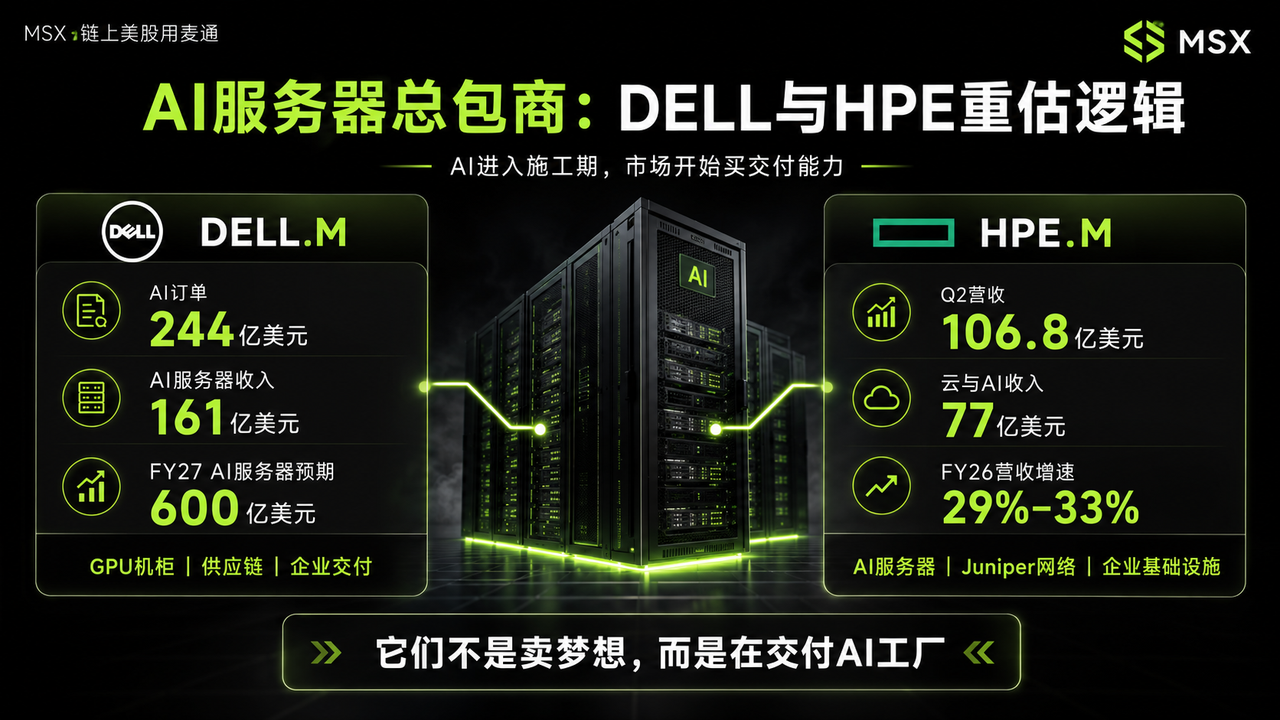
Dell is one of the most typical examples. In its latest quarterly report, Dell delivered very strong data: Q1 FY27 revenue reached $43.8 billion, with AI orders totaling $24.4 billion and confirming $16.1 billion in AI server revenue. The company also raised its FY27 annual AI server revenue expectation to $60 billion, and the median full-year revenue guidance increased to $167 billion.
This data is significant because it has changed the way the market views Dell. In the past, investors focused more on the PC cycle, traditional servers, and enterprise hardware demand. But now the market is beginning to see if Dell can become the general contractor for AI factory construction.
Its advantage does not lie in making GPUs but in its supply chain, delivery capabilities, enterprise customers, server system design, and compatibility with the Nvidia ecosystem. AI servers are not just sold with a single GPU; they must be fitted into cabinets, connected to networks, power, and liquid cooling systems, and then delivered to cloud vendors and enterprise customers.
Dell is capitalizing on this segment from chips to system implementation, and HPE follows a similar logic.
HPE's stock surged after its latest earnings report, primarily due to robust demand for AI infrastructure. The company's Q2 revenue reached $10.68 billion, a 40% year-over-year increase; its cloud and AI-related business revenue reached $7.71 billion, and it upgraded its FY2026 full-year growth expectations. More importantly, HPE's acquisition of Juniper's networking capabilities has transformed it from a traditional server company into more of an "AI networking + enterprise infrastructure" platform.
Thus, the re-evaluation logic for Dell and HPE is not that "they will become Nvidia," but rather that they are becoming extremely important system integrators within the AI factory construction teams.
The second line concerns networking and connectivity.
One of the most easily overlooked aspects of AI infrastructure is connectivity. Computing power does not exist in isolation. Data centers need high-speed internal connections, and fiber connections between data centers are required. After AI applications reach the edge and terminals, stronger telecom networks and wireless infrastructures are also necessary. The larger the scale of AI training and inference, the more crucial networks and connectivity become, not merely side roles but key infrastructure determining computing power efficiency.
This is also why Corning, Nokia, and Cisco are being discussed again in the market. Corning is a very typical example. It is not traditionally considered an AI chip stock, but its optical fibers, optical connections, and optical communication materials are exactly the essential components for AI data center expansion.
The company’s Q1 2026 core sales reached $4.35 billion, an 18% year-over-year increase; sales from optical communications reached $1.846 billion, up 36% year-over-year. The company mentioned that demand for Gen AI products and long-term agreements with new large-scale customers are significant growth drivers, indicating that AI data centers require not only GPUs but also the foundational materials to truly connect computing power.
Nokia's story has evolved from traditional 5G devices to AI-RAN, 6G, and AI-native wireless networks. Nvidia previously announced a $1 billion investment in Nokia, and both parties will collaborate to promote AI-RAN and the transition from 5G to 6G. This signal is significant because AI traffic will not solely remain in data centers; it will also flow into smartphones, cars, robots, and AR/VR terminals. As AI applications continue to spread to the edge and mobile networks, telecom infrastructure companies will regain narrative space.
Cisco's logic is more centered on data center networking, with the company’s Q3 FY2026 revenue reaching $15.8 billion, a 12% year-over-year increase; data center switching orders grew by over 40% year-over-year. It is important to note that in AI clusters, networks are not merely connecting wires but are crucial links affecting data transmission efficiency, computing power utilization, and cluster stability.
These types of companies share a common logic: as AI moves towards large-scale deployment, networks and connections become increasingly valuable.
The third line concerns storage.
This line has been widely recognized in the market over the past two months; AI requires not only compute power but also storage. In the past, the market's focus was on HBM, DRAM, and NAND, but now high-capacity HDDs are back in focus, as AI model training, inference logs, video data, enterprise data, and cold data archiving all require greater storage capacity.
Western Digital is one representative. The company's latest quarterly revenue grew by 45% year-over-year to $3.34 billion, exceeding market expectations for revenue guidance for the next quarter. More importantly, the market has noted that demand for high-capacity hard drives primarily comes from AI and cloud data centers; Seagate similarly benefits from high-capacity nearline hard drives, with an increasing proportion of data center customers.
Of course, the AI era does not mean all data must be placed in the most expensive high-speed storage. A large amount of cold data, training data, log data, video data, and archive data still requires cost-effective high-capacity hard drives, so the re-evaluation logic for WDC and STX is not that "hard drives suddenly revive," but that the explosion of AI data is making storage a necessity again.
3. What Constitutes a Real Revaluation?
However, the re-evaluation of old tech stocks due to AI does not mean that all old companies are worth mindless optimism.
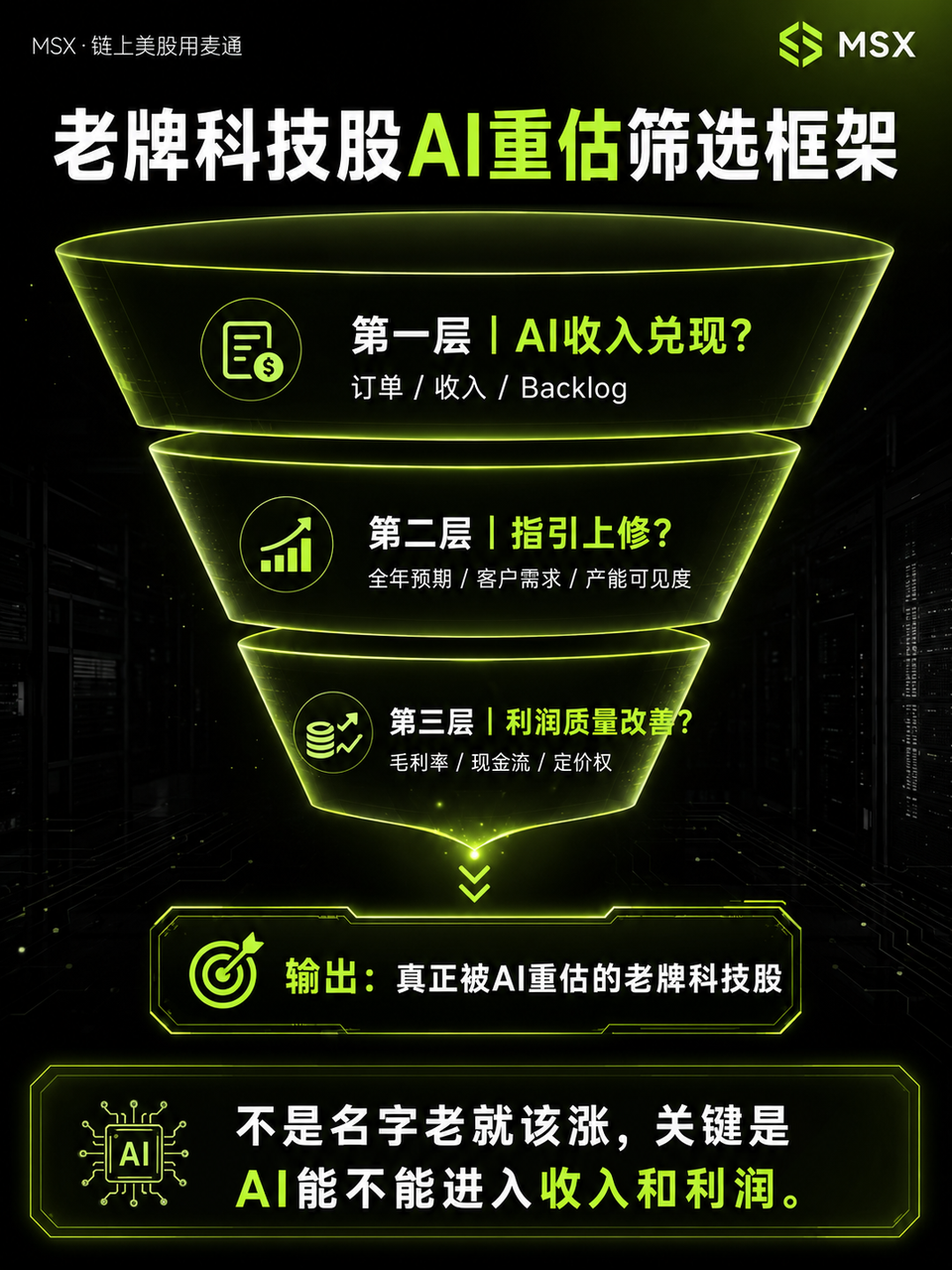
The most important distinction is that some companies truly enter the AI infrastructure chain. Therefore, to determine whether these companies are genuinely being re-evaluated, at least three criteria need to be examined:
- First, are there tangible orders and revenue recognition: For example, Dell's AI orders and AI server revenue, HPE's cloud and AI-related business, Corning's optical communication revenue, Cisco's data center switch orders, and WDC's high-capacity hard drive demand are more critical than simply telling an AI story;
- Second, have forecasts been upgraded: If AI stays confined to press conferences and product introductions, the stock price can quickly rise and then fall back. But if management is willing to raise full-year revenue expectations, growth projections, or key product shipment expectations, it indicates that AI demand is not just short-term sentiment but may be changing the company's growth trajectory, which is why the market is re-pricing companies like Dell and HPE;
- Third, can profit quality keep up: The biggest problem for traditional hardware companies has been profitability and cyclicality. Rapid growth in AI server revenue does not necessarily mean high profit elasticity; increased storage prices could also simply result from short-term supply-demand mismatches; and an increase in network equipment orders still needs to be seen if it can translate to sustained profits;
True positive revaluation should see improvements in revenue growth, order visibility, and profit quality together.
If revenue increases but profit margins are squeezed tight, or if demand is merely a short cycle of restocking, then valuation re-evaluation will be limited. The market ultimately buys not "old companies telling new stories," but rather "old assets combined with new demands, can they turn into new profits."
This is the most noteworthy aspect of this round of "old trees bearing new flowers": AI will not turn all traditional tech companies back into growth stocks; it will only filter out those truly caught in critical infrastructure segments and capable of converting AI demand into orders, revenue, and profit.
Final Thoughts
Objectively, AI trading has reached a point where it's no longer just about "who has a stronger model" or "who has more GPUs," the real change is that AI is entering a phase of actual construction.
As more AI data centers are built, server companies will be re-valued; as computing clusters become increasingly complex, networking companies will be re-valued; as data centers require more fiber connections, materials companies will be re-valued; and as AI data continues to explode, storage companies will also be re-valued.
This is why traditional tech stocks are being seen by the market again; they haven't suddenly become young again, but rather the AI era now requires the infrastructure they hold.
However, this also means that this round of re-evaluation will not be evenly distributed among all "old tech stocks."
Only those that can genuinely enter the capital expenditure chains of data centers and enterprise deployments will have the possibility of moving from "valuation repair" to "logical re-evaluation."
免责声明:本文章仅代表作者个人观点,不代表本平台的立场和观点。本文章仅供信息分享,不构成对任何人的任何投资建议。用户与作者之间的任何争议,与本平台无关。如网页中刊载的文章或图片涉及侵权,请提供相关的权利证明和身份证明发送邮件到support@aicoin.com,本平台相关工作人员将会进行核查。


