A technical path that allows data to be provable and computable without being exposed.
Written by: Nicky, Foresight News
Today, fields such as AI, DeFi, and RWA face a core challenge: how to turn off-chain facts into on-chain credible facts while protecting privacy and control. This is the backdrop for the warming of the privacy infrastructure sector, and Primus is addressing this challenge with the dual technologies of zkTLS and FHE.
Primus Labs, formerly known as PADO Labs, was established in 2022 and is headquartered in Hong Kong. Since its inception, the project has been committed to building a layer of verification infrastructure, using zkTLS and FHE (Fully Homomorphic Encryption) as its two core technologies to connect the trust relationship between real-world data, on-chain states, and intelligent systems.
In March this year, one of the Big Four accounting firms, Ernst & Young, announced the launch of the EY Blockchain Privacy Sandbox, aimed at helping businesses and developers create privacy smart contracts on the Ethereum EVM chain. In May, Ethereum co-founder Vitalik Buterin stated that Zero-Knowledge payments (ZK payments) and ZK APIs would become the core privacy solutions for AI agents processing funds on-chain.
In terms of market performance, the privacy sector token ZEC began an uptrend in April this year, reaching a peak of $688 in May, with a maximum increase of over 270%, indicating significant market interest.
Technical Architecture: zkTLS and FHE
According to the team, Primus positions itself as a layer of verification infrastructure aimed at connecting the trust relationship between real-world data, on-chain states, and intelligent systems. It seeks to solve two core problems: how to prove that a piece of data is genuine (the authenticity issue), and how to use it without exposing the data itself (the privacy and computation issue).
These two points are addressed by zkTLS and FHE technologies. zkTLS addresses the data authenticity issue, while FHE addresses data privacy and trusted computation issues. Together, they form Primus's understanding of the next generation of digital infrastructure.
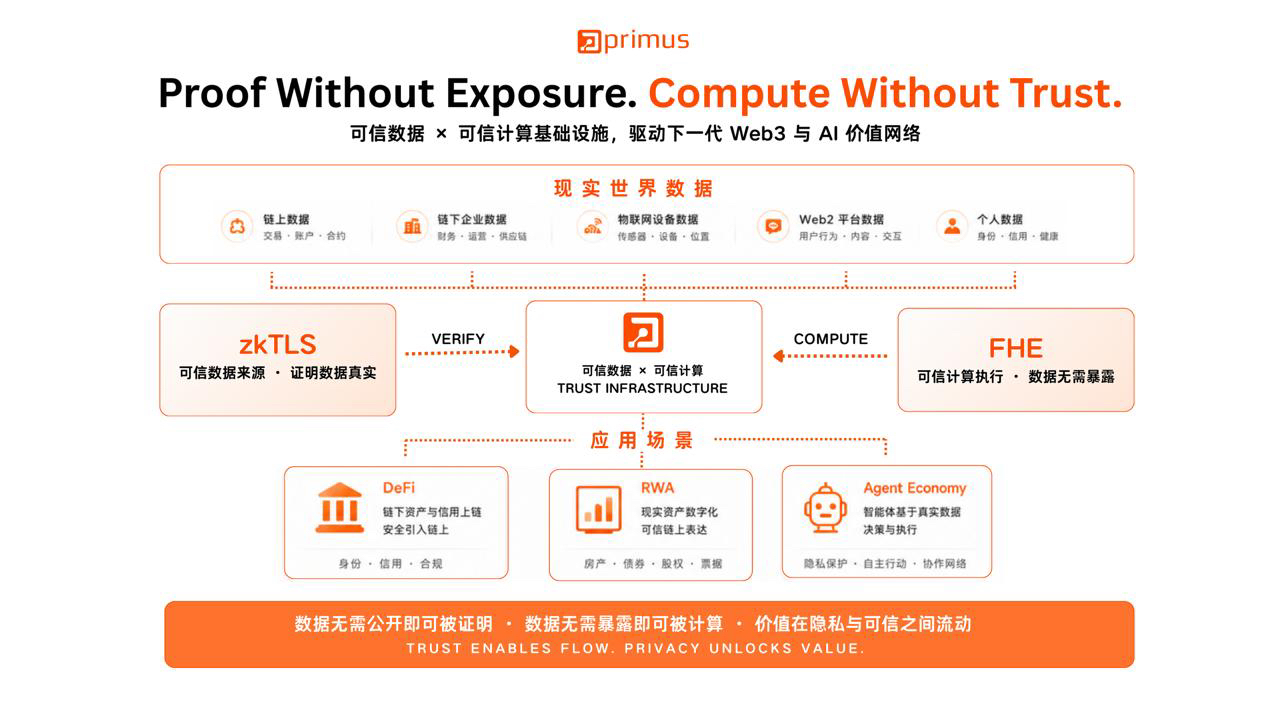
The first technology is zkTLS. Technically, it combines the cornerstone of secure Internet communication — the TLS protocol (Transport Layer Security) — with Zero-Knowledge Proofs. TLS is responsible for establishing an encrypted channel between the client and the server, while Zero-Knowledge Proofs allow one party to prove to another that a certain conclusion is true without disclosing the original data. Together, zkTLS can generate verifiable cryptographic proofs directly from data sources like banks and exchanges.
To understand this with an analogy: you want to prove to your landlord that your monthly income exceeds 20,000 yuan. The traditional approach is to hand over your bank statements, where the other party sees every transaction record; while zkTLS only extracts a mathematically signed proof from the banking system, telling the landlord, "this user’s monthly income is indeed greater than 20,000 yuan," and the landlord sees nothing else. Technical-wise, this process preserves the authenticity of the original data in the TLS channel while minimizing information disclosure through Zero-Knowledge Proofs.
The second technology is FHE (Fully Homomorphic Encryption). Its technical essence is to allow computations to occur directly on encrypted data without needing to decrypt it first. This means that data always remains in an encrypted state; computation nodes perform operations on the ciphertext and ultimately produce correct results, but the original data cannot be glimpsed during the process.
In real-world applications, hospitals can utilize external computational power to analyze medical records without disclosing patient privacy; lending platforms can verify whether your assets meet a specific threshold without seeing your exact balance and transaction history. This capability is known in cryptography as "computable encryption," which separates data ownership from computational capability for the first time.
Combining these two technologies creates a complete trusted data link: first, using zkTLS to prove the authenticity of the data from the source, then using FHE to complete computations while keeping the data encrypted, and finally validating the correctness of the computation results through Zero-Knowledge Proofs.
Currently, Primus's technological combination has been implemented in scenarios such as DeFi credit assessment and off-chain asset verification, helping users obtain reliable services without compromising privacy information.
Team and Funding
Primus is led by several senior individuals in the fields of cryptography and blockchain. Co-founder and CEO Xiang Xie holds a PhD in cryptography from the University of the Chinese Academy of Sciences and was previously a cryptography engineer at O(1) Labs (a zk technology company related to Mina Protocol), focusing on Fully Homomorphic Encryption and Zero-Knowledge Proof research.
Another co-founder, Vicky Zhang, formerly served as Chief Marketing Officer at BIT, responsible for market expansion, partner development, and ecosystem collaboration. Additionally, co-founder and researcher Fubiao Xia has a background from the University of Birmingham, previously serving as a privacy research scientist at TikTok, focusing on blockchain privacy and cryptographic protocol development.
Chief Cryptographer Xiao Wang is an assistant professor at Northwestern University, a renowned researcher in Multi-Party Computation and Zero-Knowledge Proofs, author of the EMP-toolkit, and a recipient of the Sloan Research Award, whose research results are directly applied to Primus's zkFHE protocol.
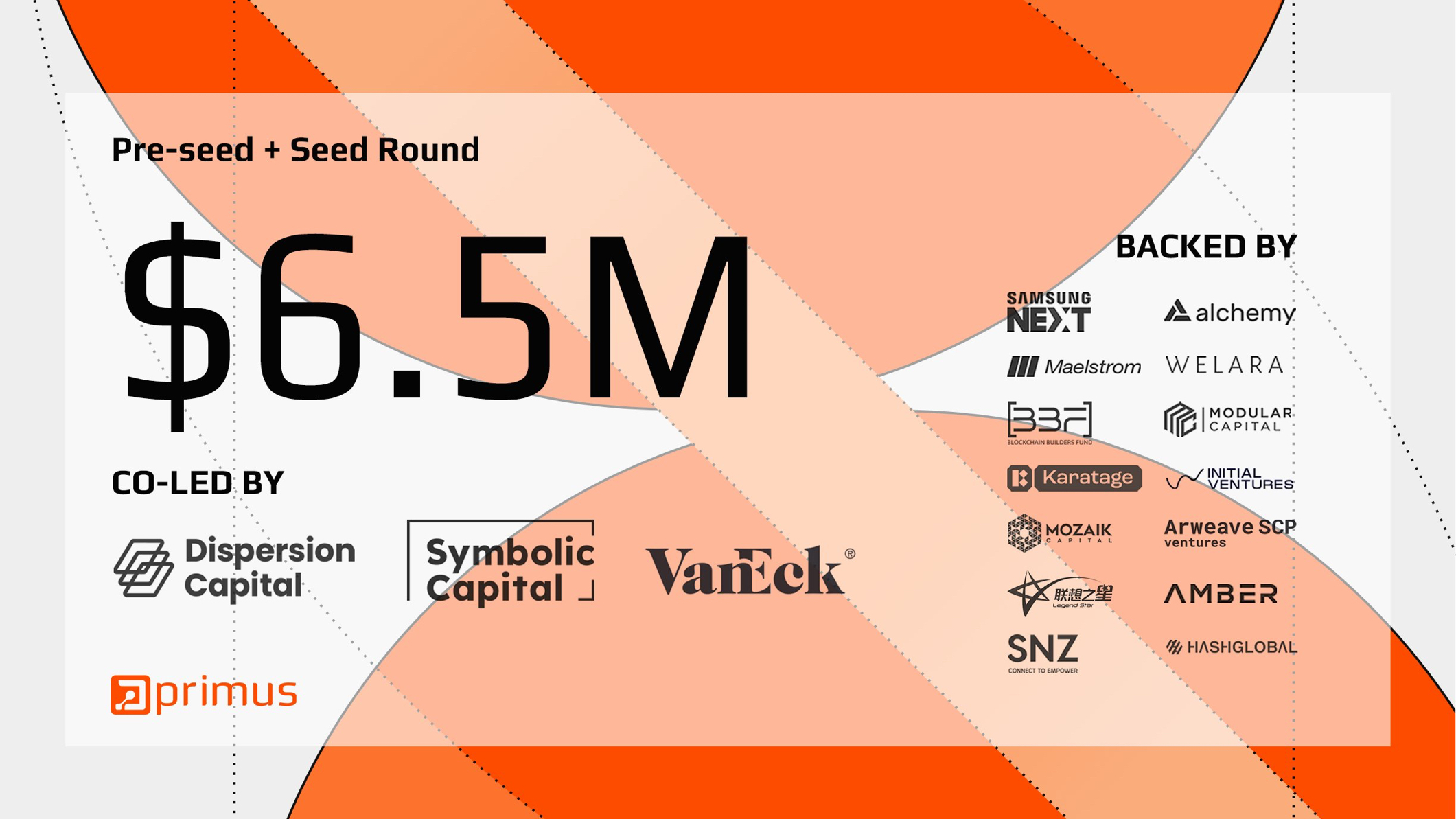
In February 2025, Primus completed a $6.5 million Pre-Seed and seed round of financing. This round was led by Dispersion Capital, Symbolic Capital, and VanEck, with participation from various institutions including Samsung Next, Alchemy, and Maelstrom Fund.
Ecological Progress
In October 2025, the Zero-Knowledge Proof computing platform Primus launched AlphaNet, a decentralized data verification network. Validators are randomly selected from a pool of participants, and each node runs in a Trusted Execution Environment (TEE) to enhance network security. There is no fixed timeline for the AlphaNet phase, and the team will continue to upgrade the network, eventually transitioning to the mainnet at an appropriate time.
Entering 2026, Primus's ecological collaborations have noticeably accelerated. In March, Primus announced a partnership with Brevis and BNB Chain to build a privacy-preserving identity layer on BNB Chain, aimed at bringing real-world credit into DeFi. This identity layer will authenticate Web2 data on user devices directly through zkTLS, such as Binance account longevity, payment records, and minimum balances. While protecting privacy, the system can generate verifiable proofs, achieving lower collateral rates and higher lending efficiency.
In May, Primus announced its participation in the 0G AI Alliance Carnival initiated by 0G Labs, and will work with projects like NeoSoul and Ghast AI to advance the integration of AI and Web3.
How Users Can Participate
Currently, Primus has not launched an official token or airdrop plan, but users can accumulate reputation points by participating in AlphaNet.
After users install the Primus browser extension, they can complete data verification tasks for accounts such as TikTok, X, and Binance to earn AlphaNet Reputation Scores. The official FAQ clearly states that this score is different from historical XP and represents off-chain social reputation. The activity is ongoing and has no deadline.
Developers can learn to build zkTLS applications through the primus-labs/skills repository on GitHub, while node operators can run Attestor Nodes to earn task fees.
Primus is gradually establishing its position at the intersection of privacy computing, AI, and DeFi. As the mainnet approaches and more partners join, whether this project can become an important part of the next generation of trusted digital economic infrastructure is worth looking forward to.
免责声明:本文章仅代表作者个人观点,不代表本平台的立场和观点。本文章仅供信息分享,不构成对任何人的任何投资建议。用户与作者之间的任何争议,与本平台无关。如网页中刊载的文章或图片涉及侵权,请提供相关的权利证明和身份证明发送邮件到support@aicoin.com,本平台相关工作人员将会进行核查。


