
Author: Damir Tokic, Professor of Finance, Seeking Alpha Analyst
Led by technology stocks, the S&P 500 index is approaching historical peak valuations, indicating a massive bubble has formed. At the same time, the Iran war is likely to trigger inflation shocks, leading to soaring oil prices and rising U.S. Treasury yields, and the current situation seems to be escalating, greatly increasing the odds of this pessimistic forecast becoming a reality. Although the Federal Reserve officials are currently still maintaining a dovish stance, the market has begun to price in rate hikes, which means the Federal Reserve's likely hawkish shift in June could very well become the spark that bursts this bubble.
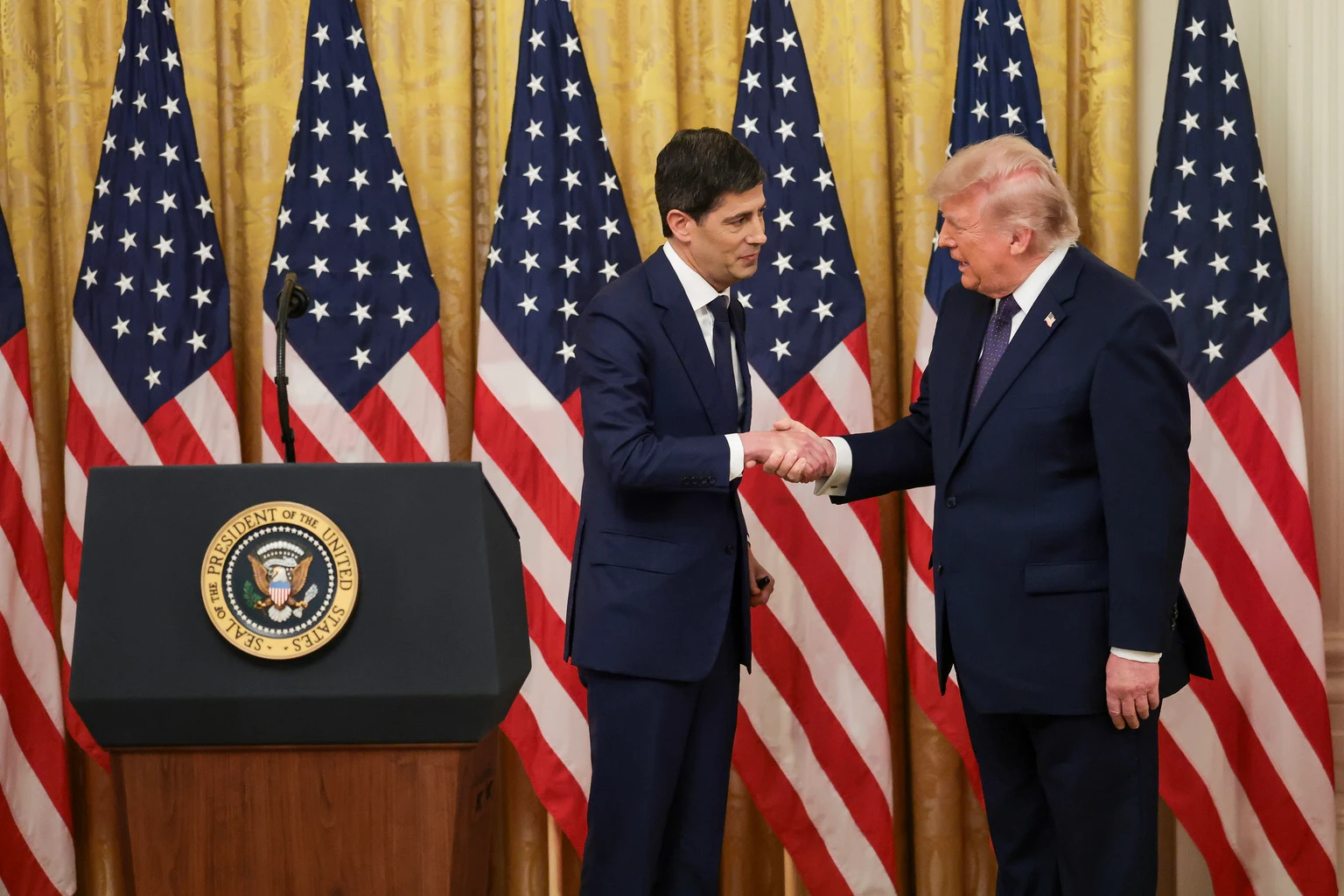
President Trump attends the inauguration ceremony of the new Federal Reserve Chair
Does the ceasefire agreement only benefit tech stocks?
Here’s how the S&P 500 Index (SPY) has performed over the past three months since the outbreak of the Iran war:
Since February 27, the S&P 500 Index has risen by 10%.
The technology sector (XLK) has surged over 37%.
The second-largest gain comes from the consumer discretionary sector (XLY), which has only risen by 3%. It’s noteworthy that Amazon (AMZN) makes up 27% of XLY and its stock price has increased by 28%; Tesla (TSLA) constitutes 20% of XLY and its stock price has increased by 8%. Both companies are essentially tech firms and are part of the “Magnificent Seven” (Mag 7).
So what is the core question now? Is the ceasefire in the Iran war solely beneficial to the tech sector, particularly in the semiconductor space (SMH)?
From my perspective, the answer is no. The market has previously blindly assumed the war was over; more importantly, the market believed we could miraculously avoid inflation shocks and the subsequent economic recession that would undermine demand. Thus, this has become a green light for speculators to significantly hype up and inflate the bubble again.
However, it must be pointed out that the current bubble is not the same as the internet bubble of 2000. The 2000 bubble was entirely driven by expectations and chaotic expansion of price-to-earnings (P/E) multiples. The 2026 bubble is far worse! It is built on “backward-looking” profits and naively expects these profits to continue indefinitely. Specifically, major mega-cap companies have spent $770 billion on AI capital expenditures, and it is evident that these profits are concentrated among the core beneficiaries of this capital expenditure, primarily semiconductor companies like Micron Technology (MU).
However, the cycle-adjusted P/E ratios (Shiller P/E) of 2000 and 2026 are almost comparable, both staying above 40 times. This means that the severity of the 2026 bubble is already on par with that of 2000.
However, the profits of tech giants are not sustainable for cashing out. The growth of AI capital expenditures is likely to slow down and eventually decline. When will this point be reached?
In my view, this $770 billion AI capital expenditure can be traced back to the early days of Trump’s second term and a meeting he had with tech executives. At that time, President Trump sat beside Zuckerberg and asked him how much Meta planned to spend on AI capital expenditures, to which Zuckerberg replied, “Sorry, I’m not ready yet... I’m not sure what number you’re looking for.”
Thus, I believe that this $770 billion AI capital expenditure is actually a “Trump Stimulus Plan” imposed on the private sector, which is unsustainable. If the Democrats win the upcoming midterm elections, this trend is likely to reverse.
Therefore, the market’s euphoric reaction following the ceasefire in the Iran war is merely a part of the “Trump Stimulus Plan,” and it is likely just a last surge. The question now is, where is the peak of this surge? And what will trigger this collapse?
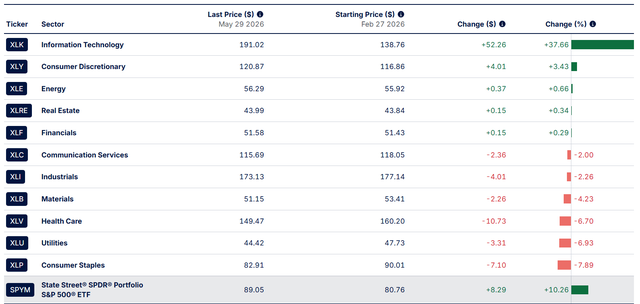
SPY sector performance (Data source: SSGA.COM)
Escalation of the Iran War and Inflation Shock
Now let's turn our attention back to the Iran war. This is a crucial variable as it is likely to trigger a classic systemic shock that could completely burst the bubble.
A classic bubble burst typically follows this trajectory: 1) Intensified inflation, 2) The Federal Reserve raises interest rates, 3) Economic recession triggers a bear market.
Let’s first examine inflation. Inflation can be demand-driven or supply-driven.
Demand-driven inflation is initially favorable to the market because companies have pricing power, usually accompanying an “overheated” economy; companies can achieve revenue and profit growth in the early stages. The Federal Reserve will then attempt to suppress demand through interest rate hikes, but this will eventually lead to higher unemployment and economic recession.
In contrast, supply-driven inflation is a major negative for the market in the early stages because companies lose pricing power—this usually occurs in a weakened or stagflation environment. The Federal Reserve is forced to raise interest rates in an already weak economy, which will inevitably result in a deeper economic recession.
The Iran war is causing a destructive supply-driven inflation as it leads to a global energy shortage; in addition, fertilizer shortages and many other derivative products and chemical shortages are causing food shortages.
Fundamentally, Iran has shut down the Strait of Hormuz, and this closure has lasted for three months. During these three months, the global economy has been using strategic oil reserves to fill the oil gap, and these reserves are expected to reach critical operational levels in June.
If Iran does not immediately reopen the Strait of Hormuz, the global economy will face the most severe energy shock in history. Due to the tangible physical shortage, crude oil prices may soar to over $200 per barrel until demand is completely destroyed and prices fall back. The destruction of demand corresponds directly to economic recession.
For this reason, Trump is very aware of the severity of the situation. Over the past two months, he has been trying to negotiate with Iran to reopen the Strait of Hormuz, but to no avail.
Currently, reaching an agreement with Iran seems almost impossible for three reasons:
First, Iran wants to maintain control over the Strait of Hormuz even after it reopens, which crosses a red line for the United States;
Second, Iran refuses to negotiate on nuclear issues and is highly unlikely to reach any nuclear agreement, which is yet another red line for the United States;
Third, even if Trump compromises on Iran’s conditions to reach a deal to reopen the Strait, Israel will step in to prevent it because Israel views a nuclear-armed Iran as an existential threat.
So what is the real situation now?
My view is that the possibility of Trump striking a last-minute deal with Iran to stop inflation shocks is becoming increasingly higher.
However, Israel absolutely disagrees with this agreement. Because part of the Iran agreement entails all fronts must ceasefire, including Lebanon. Israel could completely veto this agreement by directly attacking Lebanon. For Israel, this is also a matter of life and death since Hezbollah is indeed a tangible threat.
At the moment, we are facing a potential major escalation.
Reports indicate that Iran has currently canceled all contact with the United States, meaning all negotiations have ceased. Not only that, Iran has completely blocked the Strait of Hormuz and threatened to further close the Bab el-Mandeb Strait. If this happens, over 30% of global energy supply will directly evaporate—this would be a real disaster.
Even though Trump claims that he has been in dialogue with Israel and Hezbollah, and even states that negotiations with Iran are still ongoing, these statements alone are enough to push the tech sector to historical highs. However, so far, these claims have not received any official confirmation.
June Crash
Therefore, the probability of a crash occurring in June is becoming increasingly higher. Global oil inventories will hit critical levels in June, and once they fall below that line, crude oil (CL1:COM) prices will soar due to real supply shortages, making it very difficult to depress oil prices only with rhetoric.
As a result, as inflation expectations rise and fiscal concerns lead to higher real rates, bond yields will also surge. Additionally, when inflation surges, attempts to “dissuade” bond market sell-offs through verbal interventions will become futile.
Most importantly, the Federal Reserve must respond at the June FOMC meeting. This could likely become the final trigger for bursting the bubble. Specifically, the Federal Reserve officials are currently still signaling in the Summary of Economic Projections (SEP) that the next action will be a rate cut, maintaining a dovish policy stance.
However, the federal funds futures market has effectively priced in a tightening bias, with the market predicting more than a 50% chance of a rate hike once before December 2026, and possibly even two hikes.
The Federal Reserve will then have to comply with market expectations and make an official hawkish shift at the June meeting. This alone could cause the bubble to burst instantly. Alternatively, even if the Federal Reserve insists on maintaining a dovish stance, due to losing all market credibility, the 10-year Treasury yield may surge, triggering an even larger systemic shock.
Investment Insights
The cycle-adjusted P/E ratio of the S&P 500 index is currently nearing a new historical high, far exceeding 40 times, having formed a super bubble. The inflation shock triggered by the Iran war could burst it at any time, and the Fed's official hawkish shift in June may be the fatal bullet. Investors should prepare for a significant level of retracement, which could be as severe as the bear markets of 2000 and 2008. Remember, if it's a bubble, it will eventually burst.
免责声明:本文章仅代表作者个人观点,不代表本平台的立场和观点。本文章仅供信息分享,不构成对任何人的任何投资建议。用户与作者之间的任何争议,与本平台无关。如网页中刊载的文章或图片涉及侵权,请提供相关的权利证明和身份证明发送邮件到support@aicoin.com,本平台相关工作人员将会进行核查。


