Crypto giants, major brokerages, gambling platforms... multiple forces are flooding into the "prediction market".
Written by: Sanqing, Foresight News
Edited by: Joe Zhou
“We are working overtime to launch the prediction market feature to catch up with the World Cup.” An executive from a financial institution in Europe and America told Foresight News, “If we miss this opportunity, we might have to wait another four years.”
Seven days later, the World Cup officially kicks off. For most fans, they care about who will win the championship and who will become the new football hero.
But for exchanges, brokerages, and gambling companies, they care about another matter: who can capture the massive trading demand brought by the World Cup. The latest data shows that before the matches started, the single prediction for "World Cup Champion" on Polymarket had a trading volume of over 1.5 billion dollars.
In the past year, the prediction market has suddenly transformed from a niche lane into one of the most crowded battlegrounds in the global financial industry. Futu Moomoo, Interactive Brokers, Hyperliquid, DraftKings (a well-known U.S. sports betting platform), Robinhood, Coinbase, Binance, OKX, Bitget Wallet, Crypto.com, Gemini, Kraken, Gate.io, MEXC...
In just one year, nearly 20 financial institutions, crypto platforms, and gambling giants have entered the arena. This is rare in the financial industry. Very few markets manage to attract Wall Street brokerages, sports betting companies, crypto exchanges, and on-chain protocols to the same table.
The explosive growth of market data allows these organizations with different backgrounds to reach a consensus. By the mid-2026, the trading volume of prediction markets has exceeded 58 billion dollars, more than double that of the entire last year.
Bernstein analysts predict that by 2030, the market size of prediction markets is expected to exceed 1 trillion dollars. As more people start to express opinions, judge probabilities, and participate in events through trading, the competition for prediction markets is no longer just the World Cup. It is contending for the next generation of financial entry points. Whoever can master the user's trading interface has the opportunity to become a "toll booth" in the future financial system.
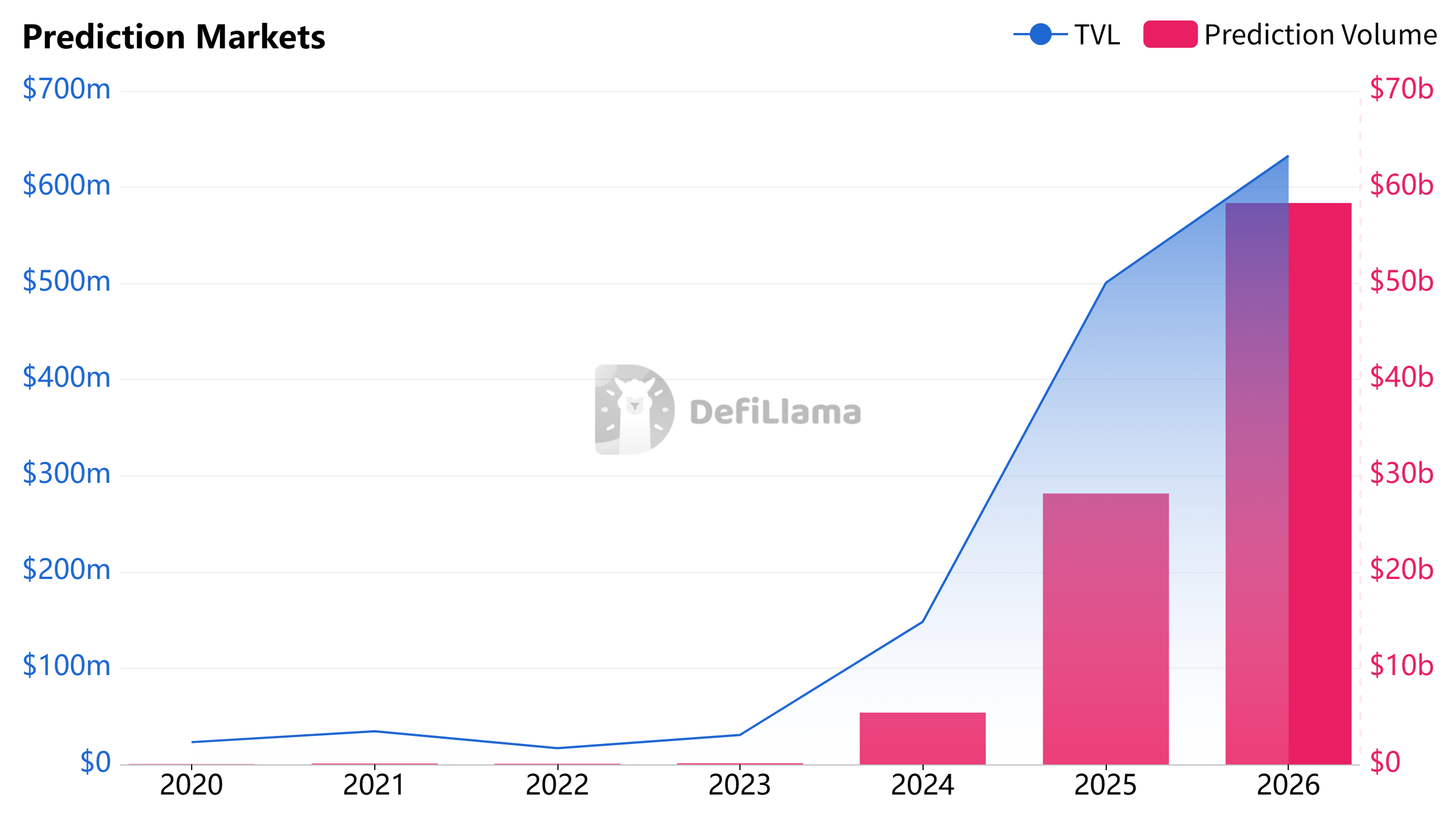
Quarterly trading volume of prediction markets | Source: DeFiLlama
Money Printing Machines for Giants
“This is one of the fastest-expanding products in Coinbase's history.” Coinbase's Chief Financial Officer Alesia Haas did not hold back on his compliments.
Coinbase's prediction market business is growing rapidly. In February 2026, Coinbase launched its prediction market business in collaboration with Kalshi. Just two months later, on May 7, Coinbase disclosed in its Q1 financial report that the business's annualized revenue has exceeded 100 million dollars.
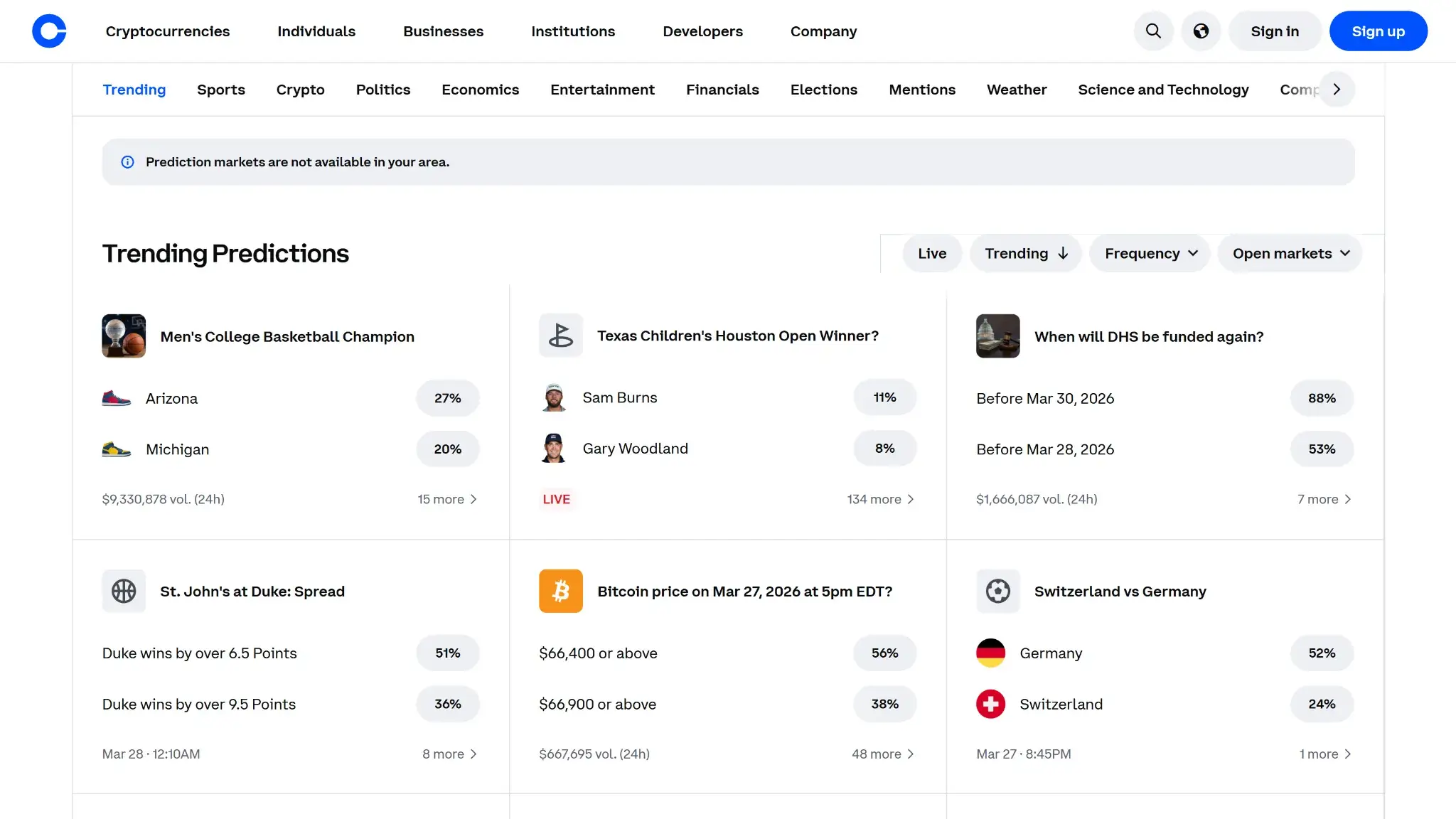
Coinbase Prediction Market | Source: CryptoSlate
While spot and derivatives fight fiercely in a saturated red sea, the prediction market is creating a new land of flow and actual profit for crypto exchanges, traditional brokerages, and Wall Street giants with astonishing monetization efficiency and user stickiness.
The most shocking case for the industry is the benchmark case, Robinhood. As a brokerage that has taken the "distribution + order flow" model to the extreme, Robinhood launched its event contract center in October 2024 by connecting to Kalshi. The official definition was that it is “the fastest-growing product line by revenue,” and its data performance is leading by a wide margin.
By the end of 2025, this business completed a total of 12 billion event contracts in just one year, covering over a million users. According to a research report published by Bernstein analyst Gautam Chhugani on April 14, Robinhood's prediction market business has now generated 350 million dollars in annualized recurring revenue (ARR) and contributes about 30% of Kalshi's total trading volume.
By the first quarter of 2026, its quarterly trading volume reached 8.8 billion contracts, with an estimated monthly trading volume in April alone to reach an astonishing 3 billion contracts. If annualizing this quarterly performance of 147 million dollars, its annualized revenue from event contracts could reach approximately 588 million dollars.
Data analysis firm Barclays has quantified the flow transfer bluntly: “In March 2026, the nominal trading volume of the prediction market industry reached 25.7 billion dollars, equivalent to about 16% of Coinbase's total Q1 spot trading volume.”
In addition to the giants' cross-border revelry, the valuation of native protocols is also soaring under the push of capital. On May 7, 2026, Kalshi officially announced the completion of a Series F funding round led by Coatue, raising 1 billion dollars, with its valuation skyrocketing to 22 billion dollars. Its business data strongly supports this sky-high valuation: trading volume soared from 52 billion dollars to 178 billion dollars within six months, institutional trading volume surged by 800%, and annualized revenue exceeded 1.5 billion dollars.
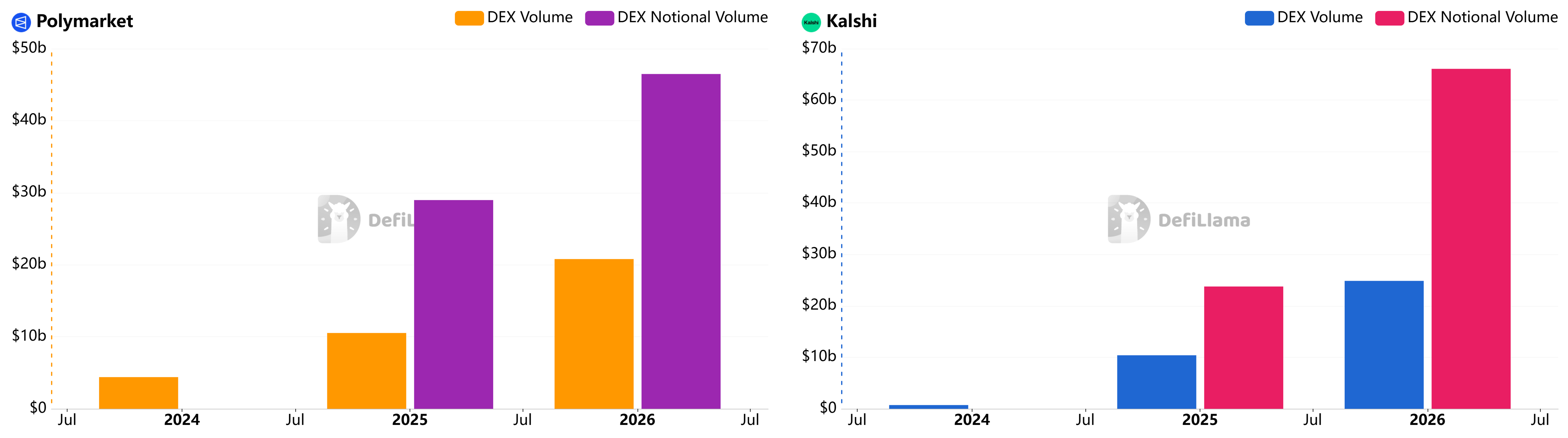
Historical trading volume and nominal trading volume of Polymarket and Kalshi | Source: DeFiLlama
Meanwhile, another major player, Polymarket, after completing a 600 million dollar financing round in March, has seen its valuation rise to 15 billion dollars and is in discussions for a new 400 million dollar financing round in April to maintain that valuation. Its business fundamentals are equally strong, with DeFiLlama data showing that since the beginning of 2026, the trading volume has reached 20.8 billion dollars, nominal trading volume 46.5 billion dollars, fee income 10.2 million dollars, and protocol revenue 6.139 million dollars.
Many other companies are vying to enter. According to Dune Analytics tracking data from April 2026, Predict.fun, Opinion, and Limitless recorded taker trading volumes of 579 million dollars, 376 million dollars, and 205 million dollars respectively that month. Along with Crypto.com, Gate.io, Binance, Bitget Wallet, OKX, MEXC, Gemini, Kraken, Futu Moomoo, Hyperliquid, DraftKings Predictions (a well-known U.S. sports betting platform), Interactive Brokers, etc., nearly 20 well-known institutions in the market have either launched or publicly announced participation in the prediction market business.
This data points to a core truth: retail investors demonstrate extremely strong user stickiness in prediction market trading. According to a report jointly released by Bitget Wallet, Polymarket, and Dune Analytics, Q1 2026 saw Polymarket with a total of 1.29 million active wallets, of which 82.8% of users had a single trade amount below 10,000 dollars, showing a typical retail-led characteristic. The average active days of users jumped from 2.5 days to 9.9 days, and the number of participating categories rose from 1.45 to 2.34, demonstrating significant stickiness.
The intensive outbreak of the prediction market war is also driven by a key variable: a shift in regulatory winds.
In December 2025, Michael S. Selig, who served as the chief legal advisor for crypto institutions including Paradigm, became the 16th chairman of the CFTC, openly advocating for the industry and launching a lawsuit against Arizona, Connecticut, and Illinois for attempting to shut down prediction markets.

Michael S. Selig swears in | Source: Banking Dive
The past frontlines were Kalshi against the CFTC; now the CFTC is actively stepping onto the battlefield on behalf of private platforms against state governments. More than 12 states have issued enforcement actions against prediction markets on the grounds of "illegal gambling," while the CFTC has filed lawsuits against Arizona, Connecticut, Illinois, and New York to intercept them head-on. Arizona's criminal prosecution has been permanently halted by a federal judge, and the Third Circuit Court has ruled for the first time at the appellate level that federal law supersedes state gambling law. However, the Fourth and Ninth Circuits remain cautious about Kalshi's inquiries, with the three courts taking different directions, likely submitting to the Supreme Court ultimately.
Three Routes, Both Enemies and Friends in the Game
As the potential of prediction markets becomes evident, the giants who previously fought fiercely over derivatives and spot markets are now frantically seeking ecological niches in prediction markets.
The first route is the compliant distribution route. This route is based on the licensed protocol Kalshi as the underlying infrastructure, focusing on integrating compliant financial institutions and fiat currency networks.
On the retail end, Robinhood and Coinbase form the core traffic entry points. Both use Kalshi as the backend licensed matching party, leveraging their large user base and compliant fiat channels to complete conversions. Additionally, Webull also launched Kalshi event contracts on its U.S. retail trading platform in February 2025; Interactive Brokers officially launched a unified prediction market interface in May 2026, integrating Kalshi, CME Group, and ForecastEx (a prediction market product under Interactive Brokers) into the same account system, supporting cross-platform real-time price comparison and automatic order routing.
The notable feature of this route lies in its deep coverage of compliant financial institutions, with giants possessing complete fiat channels and regulatory qualifications as the foundation for Kalshi's business expansion.
Institutional arrangements are also advancing. Tradeweb announced a strategic cooperation in February, integrating Kalshi's data into its institutional electronic trading platform that matches over 2.6 trillion dollars daily; afterward, digital asset broker FalconX, institutional FCM Clear Street, and Brazil's largest brokerage XP International sequentially joined its compliant distribution network.
Of course, there are potential conflicts of interest within the compliant distribution model, with internal dissent already buried within the Kalshi camp.
Robinhood formed a joint venture Rothera with market maker Susquehanna as early as the end of 2025 and acquired MIAXdx to obtain a complete set of licenses issued by the CFTC, including DCM, DCO, and SEF licenses. In the first quarter, Robinhood's construction costs in the prediction market business reached 14 million dollars, showing a clear determination.

Robinhood Prediction Market | Source: Robinhood Official Website
Rothera officially launched on May 21, and its first weekend trading volume was only 2.1 million dollars, mostly from baseball events. But six days later, it submitted four football event contract certifications to the CFTC, indicating a launch date of June 1. The relationship between Robinhood and Kalshi has shifted from channel partnership to direct competition. Coinbase has shown a similar strategic intention, having spent over 100 million dollars in December of last year to acquire The Clearing Company, intending to establish self-clearing capabilities.
The second route is the on-chain native route. It is represented by Polymarket's DeFi protocol layer and Hyperliquid (HIP-4). This route does not rely on U.S. compliance licenses, primarily establishing competitive advantages through decentralized mechanisms and globally long-tail traffic.
Polymarket's distribution network covers both on-chain users and traditional capital lines. On the on-chain channel, MetaMask took the lead in integrating through an exclusive partnership and introduced a points mechanism; Bitget Wallet accessed the network through mobile experience and AI on-chain data tracking, reaching its user base; Gate.io became the first centralized exchange to integrate this protocol directly within its mobile app. In terms of traditional capital, the parent company of the New York Stock Exchange, Intercontinental Exchange (ICE), provided a commitment of 2 billion dollars in funding, planning to make Polymarket's data an important part of its core data product line Signals & Sentiment.
However, facing the watchful eyes of channel players, Polymarket is not sitting idle. It acquired DeFi infrastructure company Brahma through a reverse acquisition to build its own wallet entry, reducing dependence on third-party distribution channels, and enhancing its direct access to end users.
The third route is the independent self-operation route. This extreme is highly complex, characterized by independence from any native protocol, either spending heavily on the complete set of compliance licenses or constructing entirely independent on-chain mechanisms.
In terms of compliance construction, Crypto.com launched an independent application OG.com relying on its CFTC DCM license, becoming the first CFTC registered platform to support parlay betting, with its weekly trading volume recording significant growth before the split. Gemini has improved its end-to-end clearing qualifications through Titan and Space Station; Kraken's parent company Payward accelerated its compliance layout by acquiring NinjaTrader (1.5 billion dollars) and Bitnomial (550 million dollars). Additionally, Futu's sub-brand Moomoo received NFA approval in May and is preparing for U.S. event contract trading. They serve as FCMs (futures commission merchants) providing access and may offer services in collaboration with regulated platforms (such as Kalshi), although it is not yet clear whether they are self-operated or have specifically announced partners.
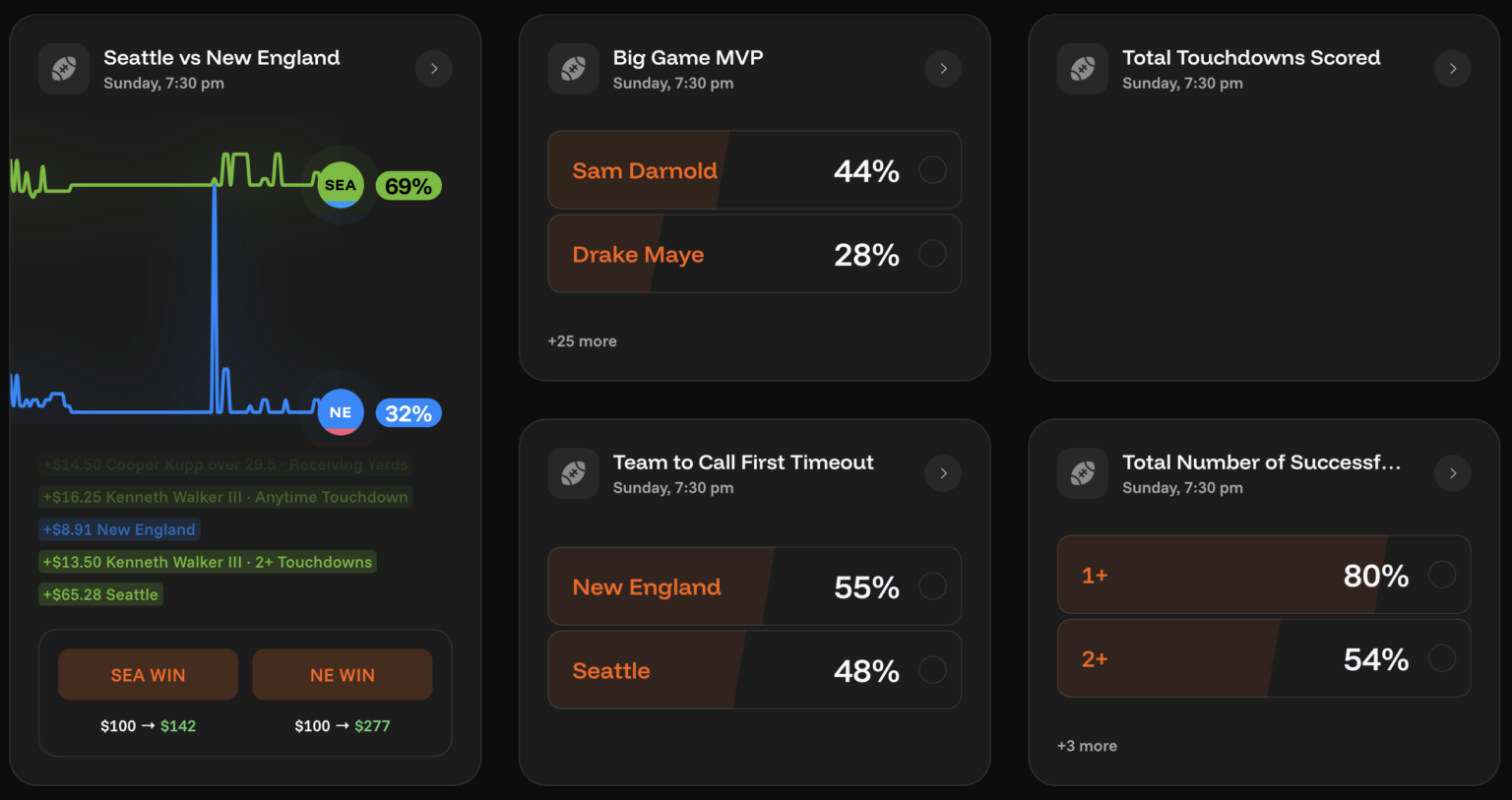
OG.com Prediction Market | Source: DeFi Rate
In trading mechanism innovation, MEXC adopts a zero-fee strategy; OKX launched an open-source Agent Trade Kit along with the launch of event contracts, supporting AI agents to automatically execute trading instructions.
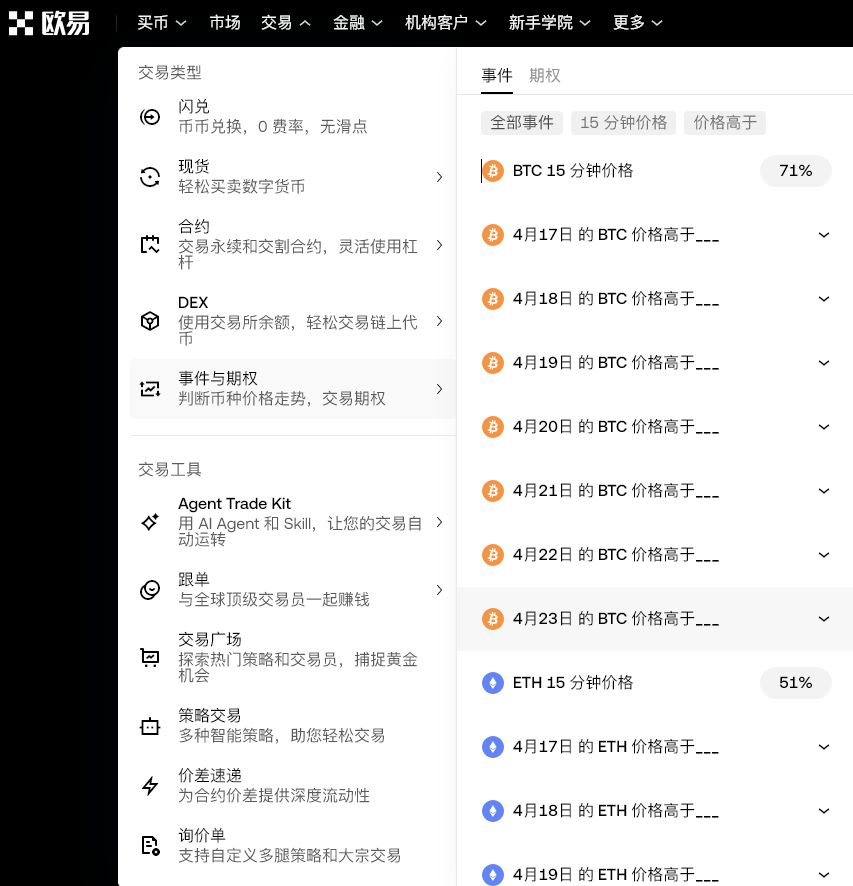
OKX Event Trading Products | Source: OKX Official Website
Binance's wallet is going further. On April 9, when integrating Predict.fun, the Binance wallet not only accessed order flow but also took on all gas fees; in late May, it integrated 42.space again, launching the Event Rush feature, allowing users to buy and sell event tokens in real time, just like trading coins, and exit midway. This tightly grips the prediction market order flow and user data on the BNB Chain.
On the surface, it is also a channel integration, but behind it is a larger chess game. YZi Labs has heavily invested in multiple prediction market projects on the BNB Chain, including Predict.fun, Probable (later acquired by Predict.fun), Opinion, and 42.space. Notably, the founder of Predict.fun, dingaling, is the former research director of Binance and co-founder of PancakeSwap, closely bound with the Binance ecosystem; 42.space also originates from YZi Labs EASY Residency Season 2.
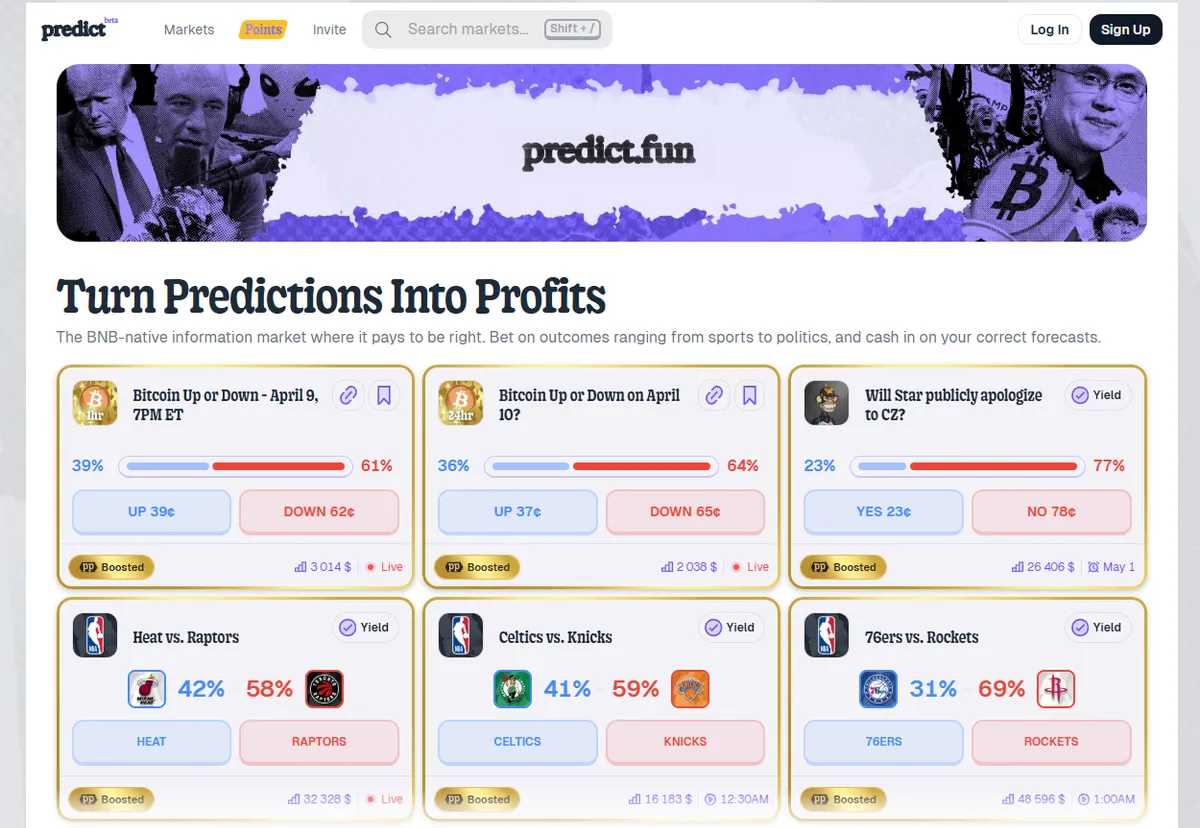
Predict.fun Prediction Market
In general, the three routes mentioned above are converging in their development path. The compliant route is gradually transitioning towards self-operated matching and clearing, while the on-chain route is attempting to establish its own traffic moat.
Whether it is Robinhood preparing Rothera to reduce dependence on Kalshi, or Polymarket acquiring Brahma to balance third-party wallet channels, it all indicates that various links in the industrial chain are engaging in a deep game over pricing power and order flow. In the ecological reconstruction of prediction markets, the cooperative relationship between pure distribution channels and protocol parties is facing a reevaluation.
Protocols are Channels, Hyperliquid Shaking Up the Scene
To launch a market on Polymarket, the platform needs to agree; to launch a market on Kalshi, the CFTC needs to consent.
On May 2, Hyperliquid officially activated HIP-4. This time, the absolute dominator of on-chain derivatives has brought a more permissive prediction market.
As planned, once HIP-4 is fully open, any user staking 1 million HYPE tokens can create a HIP-4 market, replacing manual review admission barriers with prohibitively high default costs.
The event contracts in the prediction market are essentially a form of binary options, a variant of derivatives. As platforms like Polymarket continue to extend to macroeconomic data and crypto price predictions, the business boundaries of the two markets are rapidly blurring.
HIP-4 is a fierce attempt to transform the prediction market using crypto "primitives." HIP-4 introduces fully collateralized, outcome tokens that settle at maturity (0 or 1), integrating them natively into HyperCore and being highly composable with HyperEVM L1, utilizing stablecoin settlement and efficient central order book matching.
The market has given a stunning response to this return to crypto fundamentalism. On its first day of activation, the first BTC price prediction market deployed by the third-party Outcomexyz achieved an astonishing trading volume of 6.05 million contracts within just 24 hours, capturing about 0.7% of the industry's daily trading volume directly.
Comparatively, on that same day, Kalshi recorded 546 million contracts, Polymarket 190 million, Limitless 68.26 million, Crypto.com 28.2 million, Opinion 25.72 million, and Predict.fun 11.8 million.
Hyperliquid, relying on BTC price predictions, quickly ranked seventh in the industry at the start, with significant growth afterwards. On May 25, Hyperliquid also launched its first event contract aimed at macroeconomic data (U.S. CPI inflation index).
Hyperion DeFi CEO Hyunsu Jung stated: “The first BTC result market of Hyperliquid is about three times the size of similar contracts from Polymarket and Kalshi. This proves that shared liquidity layers are effective at converting users.”
Arthur Hayes explicitly pointed out the core moat of this token primitive: “HIP-4 allows users to truly participate in the distribution of economic value on the platform through HYPE, which is precisely the fatal difference that current non-tokenized Polymarket and Kalshi cannot replicate.”
On-chain research has also shown that among over 3,000 users simultaneously using Hyperliquid and Polymarket, within the first two weeks of HIP-4's launch, 662 attempted HIP-4, with 84 completely switching over. This cohort contributed 1.67% of Polymarket's total trading volume within those two weeks. These high-net-worth core users are the assets that Polymarket is most reluctant to lose.
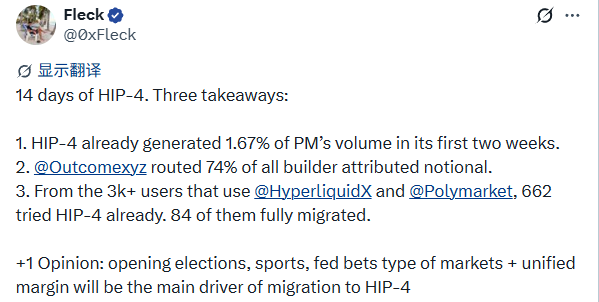
On-chain analyst Fleck's tweet
Interestingly, one of the co-proposers of HIP-4 is John Wang, the head of crypto business at Kalshi.
John Wang does not come from a traditional finance background, but rather is a seasoned crypto KOL who was poached by Kalshi to serve as Head of Crypto in August 2025. In a post titled “Why I'm Joining Kalshi as Head of Crypto” when he joined, he expressed the judgment that “Kalshi will appear in every crypto app.”
HIP-4 was co-submitted by John Wang and three others as early as September 16, 2025, and was officially released in February 2026, with Kalshi and Hyperliquid publicly announcing their partnership in March.
This means that Kalshi is not passively responding to Hyperliquid's on-chain expansion but actively choosing to leverage Hyperliquid's on-chain architecture to expand overseas, bypassing U.S. compliance boundaries and directly serving global users.
However, the sustainability of HIP-4’s popularity remains to be verified. According to third-party Hyperliquid data panel hl.eco, as of June 2, HIP-4’s historical cumulative trading volume was 65.72 million dollars, with about 1,000 average active traders over the past 30 days.
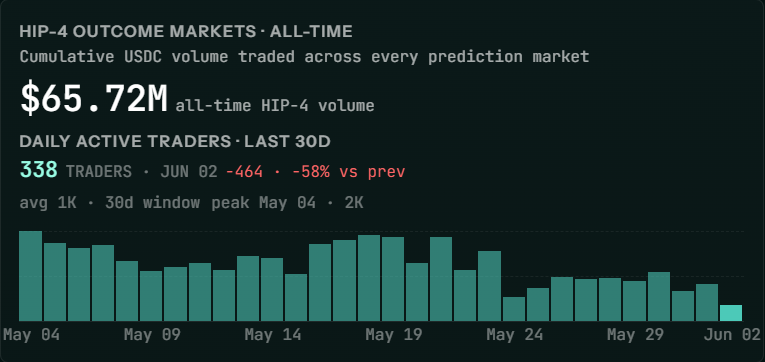
HIP-4 Trading Data | Source: hl.eco
It is expected that by mid-June, Hyperliquid will open fully unauthorized third-party deployment permissions, coinciding with the start of the 2026 FIFA World Cup. This battle will directly address Arthur Hayes's assertion that “token leverage is the biggest weapon.”
Two Strong Contestants Confirmed, The Battle Continues
The smoke has not yet cleared, but the direction of the industry has become nearly brutally clear. Vlad Tenev's prophecy is coming true, as this market is destined not to accommodate dozens of DCMs but is rapidly moving toward a highly concentrated oligopoly.
The regulatory meat grinder is still roaring, with division in circuit courts, final decisions by the Supreme Court, and legislative battles in Congress... becoming the final sieve. Players who cannot obtain federally compliant golden tickets and cannot bind user loyalty with token leverage will be ruthlessly marginalized in the next 12 months.
According to DeFiLlama's 30-day prediction market trading volume data, Kalshi ranks first with 5.964 billion dollars, followed closely by Polymarket with 3.843 billion dollars, while there is a steep drop: Predict.fun at 437 million, Opinion at 357 million, Limitless at 314 million, with the second tier collectively not even reaching one-third of Polymarket's volume. In terms of open contract volumes, according to Dune Analytics, Kalshi shows 674 million dollars, Polymarket 473 million dollars, while all other platforms are below 10 million.
According to DeFiLlama data, since the beginning of 2026, Polymarket's fee income is 102 million dollars, protocol income 6.139 million dollars; Kalshi, according to Dune Analytics' estimation based on its public fee schedule, has long occupied over 75% of the total market fees. Polymarket has historically accumulated 2.68 million independent users (according to Dune Analytics), far exceeding the sum of all other platforms.
The situation among the first tier is essentially established, with the two strong contenders having their strengths: Kalshi is a trading volume machine within the compliance system, while Polymarket holds advantages in revenue transparency and user scale.
The battle for the second tier is far from over. Predict.fun backs the global user pool of Binance, while Opinion and Limitless delve into on-chain niche scenarios, and Crypto.com continues to infiltrate with its own traffic. These few companies have a significant gap in scale compared to the two strong contenders, but the resources behind them make it hard for them to exit easily.
Robinhood's position is particularly unique. Its prediction market business currently uses Kalshi as its backend matcher, with a cumulative trading volume of 8.8 billion contracts in Q1; Rothera has launched on May 21 and is set to complete football contract certifications just before the World Cup begins. It has shifted from a distribution channel to a direct competitor, becoming the most significant variable within the compliant market.
Hyperliquid’s HIP-4 has been live for less than two months, only providing BTC price prediction contracts until May 25, with other categories gradually opening thereafter. Thus, its historical nominal trading volume of 65.72 million dollars and the daily active trader count in the hundreds are insufficient to reflect its true potential. The user binding via token mechanism and sharing liquidity with derivatives markets are pathways that traditional channel models are unable to replicate directly.
The two-strong pattern is a snapshot of the present, not the endpoint. The comprehensive competition in the trillion-dollar track has just begun.
免责声明:本文章仅代表作者个人观点,不代表本平台的立场和观点。本文章仅供信息分享,不构成对任何人的任何投资建议。用户与作者之间的任何争议,与本平台无关。如网页中刊载的文章或图片涉及侵权,请提供相关的权利证明和身份证明发送邮件到support@aicoin.com,本平台相关工作人员将会进行核查。


