On June 1, Anthropic confidentially submitted an S-1 registration statement draft to the U.S. Securities and Exchange Commission (SEC), officially starting the IPO preparation process.
Just two days earlier, on May 28, Anthropic announced the completion of a $65 billion Series H financing round, with a valuation of $965 billion (approximately 6.54 trillion RMB), marking the first time in history that its valuation exceeded OpenAI (latest valuation of $730 billion); on the same day, Claude Opus 4.8 was released.
This star company, founded in 2021 by former core members of OpenAI, is knocking on Wall Street's door at an unprecedented pace.
Upon learning of Anthropic's confidential filing for an IPO, OpenAI CEO Sam Altman stated in an interview with CNBC, "OpenAI will go public when we believe the time is right. I think there is a race happening right now, where everyone is competing to provide the best technology and build the best companies. But as you know, going public is a fundraising activity, and I don't think we are currently focusing on the specific timing of going public."
1. Confidential "Submission"
What Anthropic submitted this time is a confidential S-1 draft, not a formal prospectus.
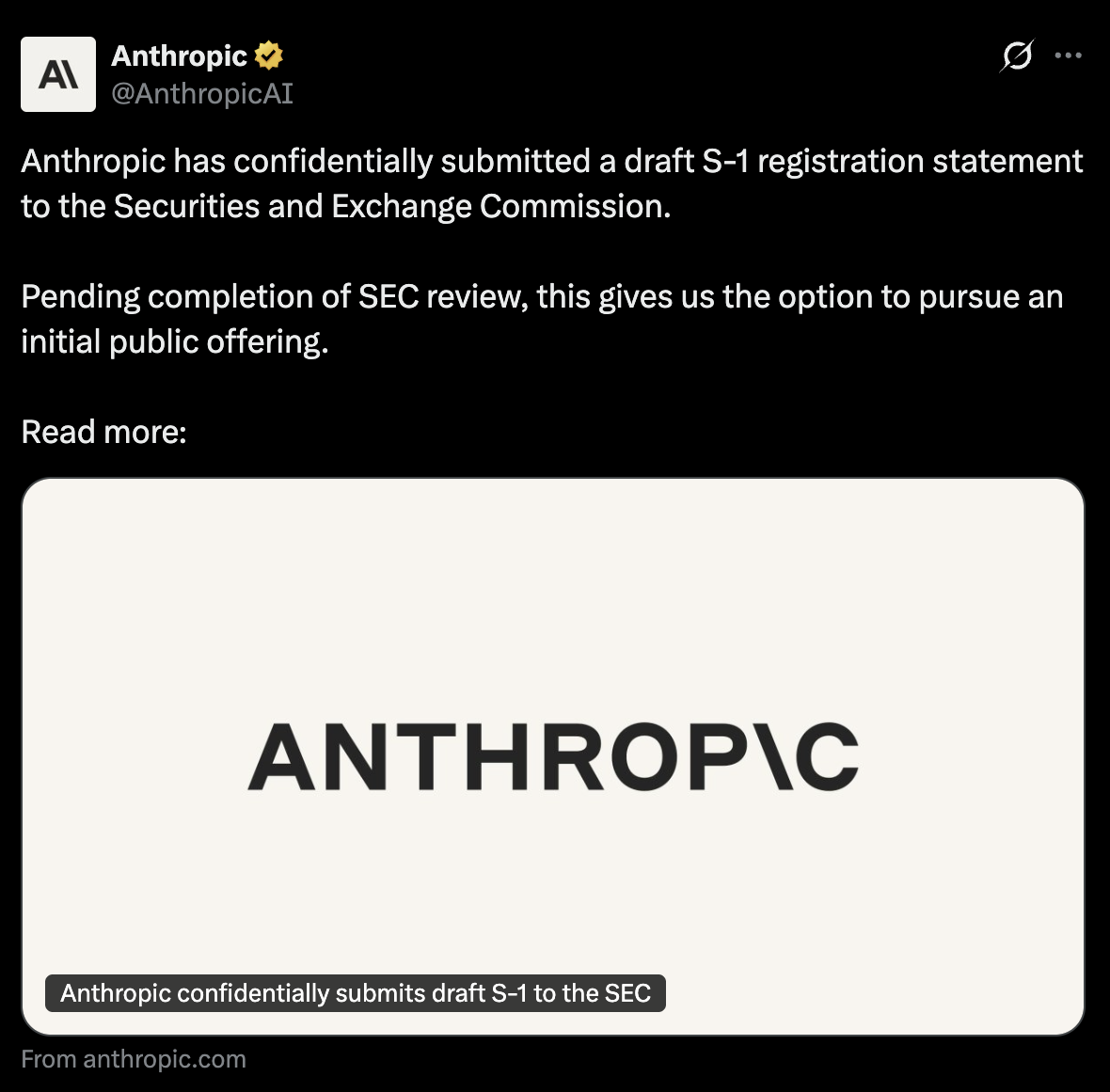
According to the SEC's confidential submission rules, this submission allows Anthropic to internally review and communicate with regulators before officially disclosing financial data. In its official statement, it mentioned that after submitting the confidential S-1 document, once the SEC completes its review, the company can choose the right time to proceed with the IPO; the specific timing and fundraising scale for the IPO have not been disclosed, and the implementation pace depends on market conditions and other external factors, with the earliest listing possibly this autumn.
Just before the submission, Anthropic had announced the completion of a total of $65 billion in Series H funding.
This round of financing not only gathered top financial investment institutions such as Altimeter Capital and Sequoia Capital, but also included three global top-tier semiconductor giants: Micron Technology, Samsung Electronics, and SK Hynix. The post-investment valuation skyrocketed to $965 billion—almost reaching the current ceiling for the valuation of unlisted AI technology companies globally.
A company would not rush to file right after completing a major round of funding with ample cash on hand, unless it sees a bigger game at play—namely the liquidity premium of the public market.
This geometrically escalating valuation also means that the pricing logic in the capital market for AI foundational model companies is changing: the market is no longer just paying for the "grand ideal of AGI," but is seeing the realistic possibility of a perfect closed loop between computing power, models, and applications.
Abandoning purely burn-money projects and prioritizing investments in leading players capable of realizing revenue and valuation support has become one of the current consensus.
2. From $965 billion to surpassing OpenAI, with $47 billion ARR
What does $965 billion represent?
If compared to the closing prices of major domestic companies on June 1, it is roughly equivalent to 1.9 Tencent (closing at $508 billion) or 3.2 Alibaba (closing at $300.9 billion). If compared to the domestic giants soon returning to the sci-tech innovation board—it's about 11.5 Zhiyuan AI (closing at $83.6 billion) and 34 MiniMax (closing at $28.4 billion) in market value.
At the same time, Anthropic's annual revenue has surpassed $47 billion, achieving explosive growth from $9 billion at the end of 2025. Behind this growth rate is a significant number of the largest global enterprises embedding Claude into their core business processes, as well as Anthropic's strong product iteration pace.
The recently released Claude Opus 4.8 version has increased its running speed by 2.5 times, significantly reduced costs by 3 times, and made substantial optimizations to the "hallucination" issues troubling enterprise clients, reducing the probability of missed code defects by 4 times.
Meanwhile, with more powerful Mythos-level models about to be pushed to customers, Anthropic is building a workflow ecosystem centered on real business implementation. When computing power costs are effectively controlled, and enterprise clients show a strong willingness to pay, Anthropic is welcoming a harvest period for its commercial value realization.
Additionally, it's worth noting Anthropic's layout in computing power infrastructure. Based on the Series H financing announcement and previous joint disclosures, the company has finalized three core computing power agreements:
A collaboration with Amazon AWS to secure a maximum of 5 gigawatts of exclusive computing power capacity, while Amazon has completed a $5 billion strategic capital infusion in this round, binding computing power procurement with equity investment;
Locked in a total of 5 gigawatts of next-generation TPU computing resources with Google and Broadcom to provide dedicated hardware support for the ongoing iteration of large models;
Achieved a deep computing power cooperation with SpaceX, connecting to the complete GPU computing cluster of Colossus 1.
At the same time, the Series H financing has also brought in three top global storage chip giants—Micron, Samsung, and SK Hynix—as strategic investors. These three companies monopolize the global mainstream high-bandwidth memory (HBM) and core storage capacity, and this equity + supply chain deep binding also locks in the stable supply of core hardware required for AI model training over the next few years, completing the entire link of computing power, chips, and supply chain.
3. The IPO gates wide open, the AI business landscape is set for a race
Anthropic, OpenAI, and SpaceX are considered the three most anticipated IPO targets in the market this year.
SpaceX submitted its IPO application in April, and Anthropic's chief competitor OpenAI is also expected to follow suit shortly—this has escalated from a contest of parameter counts and performance rankings to the ultimate competition for secondary market liquidity and funding pools.
After going public, regular retail investors will be able to invest in these top AI startups, and early investors are expected to gain tens of billions in huge exit returns.
Wedbush Securities analyst Dan Ives described it as "the gates of the IPO market wide open." The technology stock IPO market, relatively quiet over the past few years, is stirring again due to the maturity of AI.
Why now? The answer largely lies in the nearly bottomless demand of AI for computing power infrastructure. In the battle toward General Artificial Intelligence (AGI), past private funding levels of billions have become insufficient to meet the consumption of clusters exceeding thousands of cores; only Wall Street's vast funding pool can support this "arms race" of computing power and energy.
Anthropic's filing has kicked off this wave of technology stock IPO frenzy.
免责声明:本文章仅代表作者个人观点,不代表本平台的立场和观点。本文章仅供信息分享,不构成对任何人的任何投资建议。用户与作者之间的任何争议,与本平台无关。如网页中刊载的文章或图片涉及侵权,请提供相关的权利证明和身份证明发送邮件到support@aicoin.com,本平台相关工作人员将会进行核查。


