When an industry truly matures, it won’t only be left with romance.
Written by: Liu Honglin
Talking about Ethereum today is indeed a bit boring.
It doesn’t have consumer-grade applications and meme sentiment like Solana, nor does it have the “digital gold” narrative that Bitcoin enjoys. Bitcoin has ETFs, publicly traded companies buying coins, discussions on national strategic reserves; Ethereum obviously also has spot ETFs, but the ETFs haven't made Ethereum into a sufficiently simple story for the masses.
The things the Ethereum community talks about often revolve around layer-two scaling, blobs, account abstraction, interoperability, data availability, and such terms. The tech community might understand it, but for ordinary users, it’s basically a confusing maze: Which chain is my coin on? Why does it seem like there are several accounts in my wallet even though it’s part of the Ethereum ecosystem?
Criticism from outsiders is understandable, but internal critiques are even more fatal.
At the beginning of 2026, Ethereum founder Vitalik Buterin made a direct criticism of the layer-two ecosystem: If someone is just making another EVM chain with a bridge, then this kind of replicated layer-two is hard to justify its existence. He prefers two types of directions: one is the application-specific systems tightly coupled with Ethereum, and the other is chains oriented towards institutions or specific applications that submit proofs or state commitments back to Ethereum.
The Ethereum Foundation's protocol priorities for 2026 also put scaling, improving user experience, and strengthening the mainnet together, clearly indicating that account abstraction and interoperability are focal points for enhancing usability. Ethereum itself is acknowledging: solely relying on “layer two will scale” is no longer sufficient; the next step must answer what differentiated value layer two offers, what the relationship with the mainnet is, and whether ordinary users can use Ethereum as if it were a single system.
A person in their middle age typically doesn’t suddenly lose the ability to act. Instead, they have many more issues to consider that they previously didn’t have to think about. In youth, one can boast about ideals, burn the midnight oil coding, and others are willing to cheer for your imagination or suffocate in your dreams. After middle age, things become concrete: there are children to care for, mortgages to pay, health check indicators to watch, and numerous mundane matters to coordinate at work. You may not be weaker than in your youth; it’s just that you can no longer explain yourself solely with the phrase, “It’s extraordinary to have a dream.”
The awkwardness of Ethereum right now probably lies within the quandary of “the chain entering middle age.”
Ethereum Once Had Vibrancy
When Ethereum was young, its most charming aspect was that it expanded blockchain from “one coin” to “a programmable world.”
Bitcoin answered a thrilling, unprecedented question: without a central bank, can strangers jointly maintain a currency ledger that cannot be changed arbitrarily? Ethereum took a step further. It was concerned not just with transaction records but wanted to embed transaction conditions, distribution rules, and application logic into an automatically running program. Because of this change, smart contracts transformed from a technical term into an entry point for an entire generation of crypto entrepreneurs.
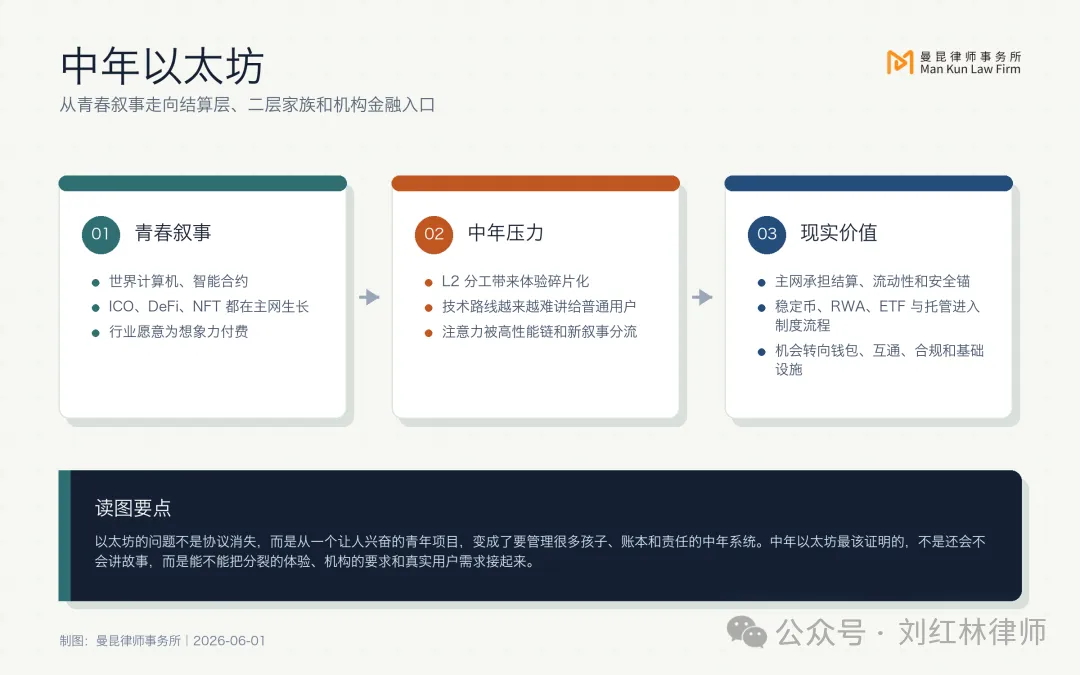
The early ICOs, the later DeFi, and then NFTs and DAOs, many of the most vibrant application narratives in the crypto industry emerged from Ethereum or its developer culture. At that time, Ethereum was like an energetic young person wanting to try everything. Finance, art, governance, gaming, identity, organizational collaboration—they all seemed to be writable into contracts on the chain.
During this stage, developers were willing to come, funds were willing to flow in, and while users had to endure high gas fees, they were willing to believe that it was an early cost of a new world. The core question back then was: What fresh and fun things can Ethereum still produce?
That question has changed now.
Today, many people ask: Why is Ethereum still so hard to use? Why is the mainnet expensive, why are there so many layer twos, and why are assets scattered across different chains? Why do I feel like I’m using several different products even though I’m clearly in the Ethereum ecosystem? Why does a regular user entering Ethereum not see “a world computer that doesn’t crash” first, but rather network choices, cross-chain bridges, transaction fee tokens, and wallet prompts?
This has gone beyond minor frictions; it resembles a family problem that Ethereum can’t avoid as it enters middle age.
The Troubles of Many Ethereum Babies
To scale, Ethereum has chosen a path that has its own personality: the mainnet does not easily sacrifice security and decentralization, while moving more transactions to Layer 2. After the Dencun upgrade introduced blobs in March 2024, the cost of sending data back to Ethereum from layer two significantly decreased; subsequent paths like Pectra and PeerDAS also continue to enhance Ethereum's capacity as a settlement base.
From an engineering perspective, this path makes sense. If the mainnet bears everything by itself, the requirements for nodes will become increasingly high, diluting Ethereum's primary concerns of openness and decentralization. Allowing layer two to handle a large volume of transactions, while the mainnet assumes the role of settlements, security, and liquidity hub, is a relatively safe scaling approach.
But from a user experience standpoint, this path is indeed not easy.
Base, Arbitrum, Optimism, Scroll, Starknet, Linea, Unichain, each have their own ecosystems, teams, entry points, and business objectives. They are nominally all part of Ethereum, but users will not naturally understand these hierarchical relationships. Users only know that their USD stablecoin USDC is on this chain, their NFTs are on that chain, and their frequently used applications are on another chain. A simple transfer might first require determining which chain holds the assets, which chain the recipient supports, whether a cross-chain operation is needed, how reliable the bridge is, and who will pay the transaction fees.
The Ethereum Foundation has also recognized this issue. When discussing the Ethereum Interop Layer, its goal is to allow multiple layer two networks to collaborate as if they were the same Ethereum. The foundation hasn’t packaged this issue prettily but acknowledges: from the user perspective, today’s experience often resembles multiple separate Ethereums. This expression is very representative.
This is the first layer of pressure for middle-aged Ethereum: the children have grown up, the family has expanded, but the shared last name doesn’t automatically bring about a shared living experience. The more layer twos there are, the stronger Ethereum’s capacity to scale; the more layer twos there are, the easier it is for Ethereum's narrative to splinter.
Previously, Ethereum could easily communicate “world computer” and be remembered in a heartbeat. Now, explaining Ethereum often cannot avoid discussing the mainnet, layer twos, rollups, data availability, sequencers, bridges, shared liquidity, account abstraction, and interoperability. Those who understand can pick out the roadmap, but regular users, upon hearing all this, will most likely start looking for the close button.
Middle-Aged People Are Not Romantic
Middle-aged people also have their own fishing buddies.
In March 2024, BlackRock launched the first tokenized fund issued on a public chain BUIDL through Securitize, with its starting point on the Ethereum network. This product is aimed at qualified investors and involves subscription, redemption, transfer agency, custody, risk documents, and compliance processes. It’s not a grassroots crypto application, but it can elucidate the issue well: when traditional financial institutions put real-world assets on the chain, the focus is no longer just on “there’s plenty of activity on the chain” but includes whether the underlying network is trustworthy enough, explainable enough, and can be supported by the existing service system.
The significance of a spot Ethereum ETF is similar. Once Ethereum enters the ETF accounts, ordinary investors receive fund shares and price exposure, not ETH controlled by their private keys. It gets integrated into a financial machine constituted of brokerage, custody, authorized participants, redemptions, disclosures, and regulatory documents. This process hasn’t made Ethereum more cyberpunk; instead, it has made it more like a class of assets that traditional finance can handle.
Visa mentioning both Solana and Ethereum in stablecoin settlement also reflects another aspect of institutions using public chains: they won’t use a chain solely for sentimental reasons; they will also look at specific settlement scenarios, partners, costs, speed, risk, and controllability of compliance. If Ethereum continues to be chosen, it will rely on long-term operation, ecological depth, liquidity, and institutional interfaces.
Therefore, Ethereum's middle age is not devoid of value; it has just become less romantic and sexy.
It is no longer just a youthful project where developers can chant “Code is Law”; it is gradually transforming into a very complex financial and technological infrastructure. Stablecoins, DeFi, RWA, ETFs, custody, audits, on-chain risk control, wallet permissions, cross-chain interoperability, will pull Ethereum into a more realistic business process. At this stage, users will not pay simply because your technical ideals are pure, and institutions will not engage just because your community culture is strong. Everyone will ask more concrete questions: Can it be used? Can it be governed? Can it be audited? Can someone be held accountable if something goes wrong?
Sunrise or Sunset?
If we expect Ethereum to always ignite the industry with a grand new concept as it did in its youth, then it indeed faces some challenges. Its narrative has been fragmented by layer twos, drawn away by new public chains and new applications, and slowed down in dissemination by its increasingly complex roadmap.
But if we see it as an infrastructure entering middle age, the answer is different.
The task of middle-aged Ethereum is to prove whether it can organize the vast ecosystem into a more usable, trustworthy system that can be integrated into real business. It needs to handle not only the imagination in white papers but also the interplay between wallets, layer twos, bridges, custody, compliance, liquidity, institutional products, and ordinary user experience.
This task is neither easy nor romantic.
But when an industry truly matures, it won’t be left with only romance.
Young Ethereum was responsible for making everyone believe that blockchain could be more than just one coin. Middle-aged Ethereum needs to answer another question: When more and more assets, applications, users, and institutions truly come in, can this system allow them to stay safely, smoothly, and in an explainable manner?
It is still called Ethereum.
But the Ethereum that used to excite everyone with its technical ideals and youthful narratives is gradually stepping away.
免责声明:本文章仅代表作者个人观点,不代表本平台的立场和观点。本文章仅供信息分享,不构成对任何人的任何投资建议。用户与作者之间的任何争议,与本平台无关。如网页中刊载的文章或图片涉及侵权,请提供相关的权利证明和身份证明发送邮件到support@aicoin.com,本平台相关工作人员将会进行核查。


