24-hour long liquidation reached 1.361 billion dollars, options are buying short-term put protection, fear and greed index has fallen into "fear," but long-term options are still betting bullish.
Written by: Sanqing, Foresight News
The cryptocurrency market is undergoing a deep correction.
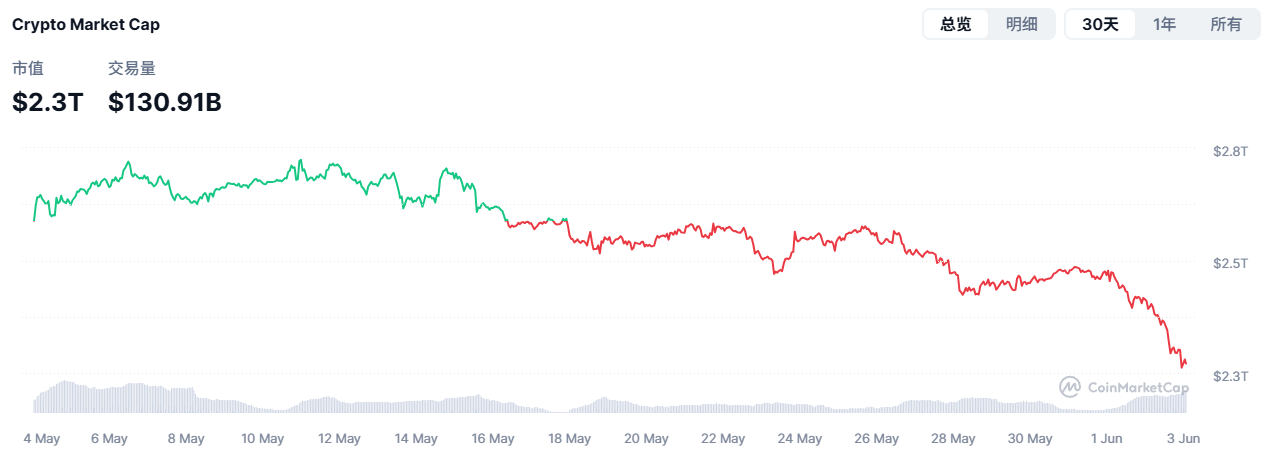
On June 3, Bitcoin was reported at about 66,458 dollars, down 6% over the past 24 hours, hitting a low of 66,186 dollars, the lowest level in over two months; Ethereum fell even more sharply, currently at 1,867 dollars, down 6.7% over the past 24 hours, hitting a low of 1,838 dollars, the lowest level in over three months. The total market capitalization of cryptocurrencies shrank by 4.82% in the past 24 hours, falling back to about 2.3 trillion dollars.
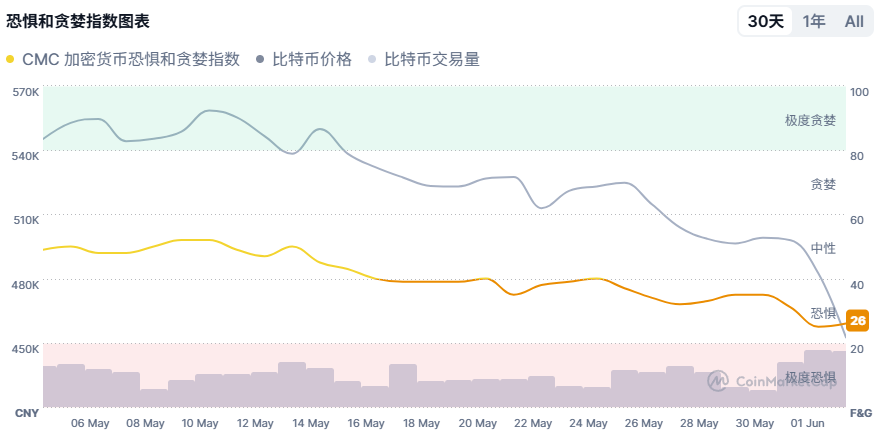
The sentiment has also turned cold. The CMC cryptocurrency fear and greed index has dropped to around 26, falling into the "fear" zone.
The derivatives market is equally harsh. According to CoinAnk data, over the past 24 hours, total liquidations across the network reached 1.515 billion dollars, of which long positions accounted for 1.361 billion, and short positions only 154 million. Long positions accounted for nearly 90%, representing a typical one-sided sell-off. By coin type, Bitcoin liquidations totaled 736 million, and Ethereum held at 349 million. The perpetual funding rate has narrowed from 0.01% to around 0.0052%. In Deribit contracts expiring on June 5 and 12, put options with strikes between 66,000 and 68,000 dollars have seen concentrated increases on the day of breakdown, while the value of 70,000 dollar call options has nearly dropped to zero (mark price down by 70%-95%).
On the macro data front, Brent crude oil slightly rose to 97 dollars per barrel (+2.48%); WTI crude reported 94.781 dollars per barrel (+3.24%). The Dow Jones Industrial Average was reported at 51,307.79 points (+0.45%); the S&P 500 Index reported 7,609.78 points (+0.13%); the Nasdaq Composite Index reported 27,093.90 points (+0.03%). Spot gold reported 4,481.5 dollars per ounce, up 0.13%; silver reported 74.8 dollars per ounce, basically flat.
Who is the culprit behind the decline?
The first catalyst for this round of decline comes from the "surrender" of the largest market long, Strategy.
On June 1, Strategy submitted an 8-K filing to the SEC, disclosing that during the period from May 26 to 31, it sold 32 Bitcoins at an average price of 77,135 dollars, totaling about 2.5 million dollars. After the sale, the company still holds 843,706 Bitcoins, with a total cost of 6.387 billion dollars, at an average price of 75,699 dollars.
The 32 Bitcoins represent 0.004% of the company’s total holdings, and the 2.5 million dollars is equivalent to about one and a half days' worth of purchases made by Strategy in the past 12 months. From a financial perspective, this transaction is almost meaningless. However, what it broke is far greater than the amount it cashed out. Since it first bought Bitcoin in August 2020, Strategy has only sold once, in December 2022, when it sold 704 Bitcoins for 11.8 million dollars at an average price of 16,776 dollars, aimed at creating a tax loss (tax-loss harvesting), and two days later bought back 810 at a lower price. That sale was essentially a tax maneuver, not a real reduction.
After the news, the stock price of Strategy fell by 10.2% during trading, now reported at about 134.5 dollars.
Furthermore, it's not just Strategy that is reducing its Bitcoin holdings; several institutions have also started to cut back. According to on-chain analyst Yu Jin's monitoring, the cryptocurrency asset management firm Abraxas Capital sold 1,000 Bitcoins (67.49 million dollars) during last night's decline, contributing to Bitcoin's drop.
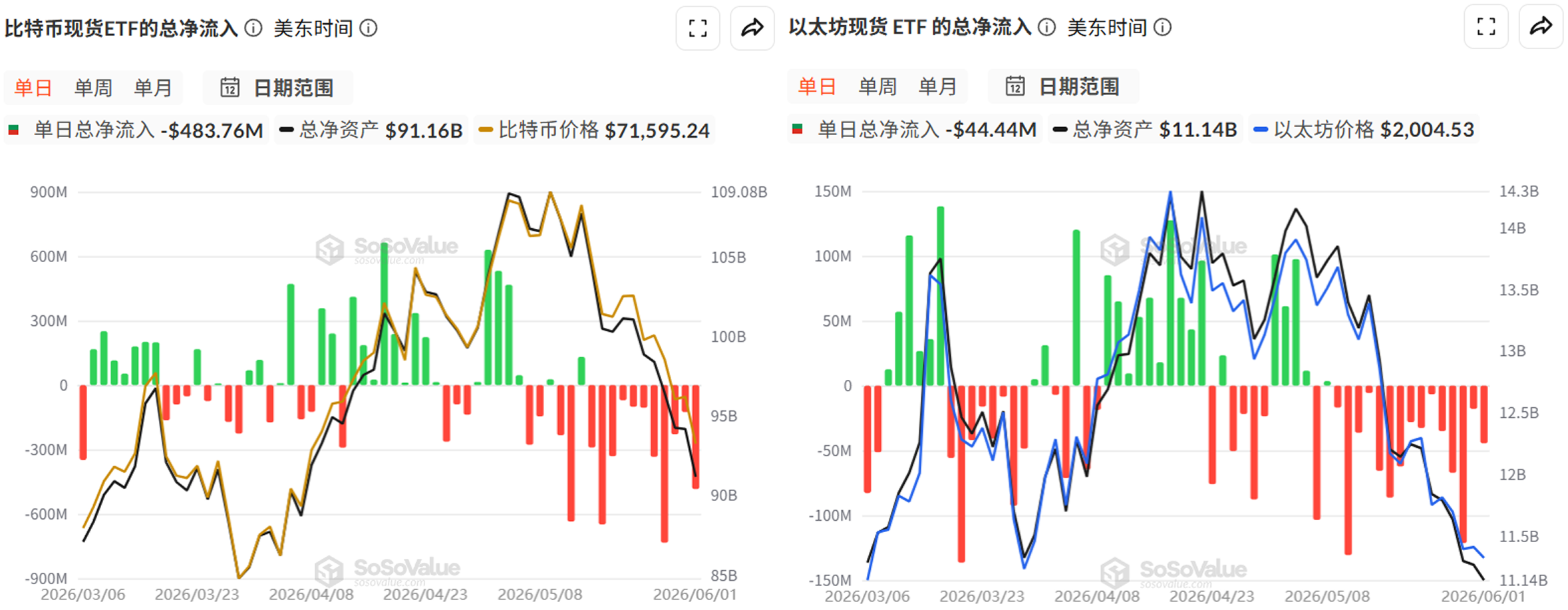
Additionally, a transfer of about 739 million dollars in Bitcoin from wallets associated with Mt. Gox also increased market risk aversion. According to SoSoValue data, U.S. Bitcoin spot ETFs have seen net outflows for 11 consecutive days, while Ethereum spot ETFs have seen net outflows for 15 consecutive days; in May, the net outflow from Bitcoin spot ETFs reached 2.43 billion dollars, setting a record for the largest monthly outflow of the year.
However, during the decline, Ethereum bull BitMine chose to continue increasing its position. According to monitoring by on-chain analyst Yu Jin, in a generally selling atmosphere among institutions, BitMine increased its holdings by 25,000 ETH (about 47.98 million dollars) through BitGo in the early morning.
The deepest drop on June 2 had its trigger from geopolitical issues in the Middle East. Iran stated it has stopped communicating with intermediaries, while the U.S. insisted that the conversations are still ongoing, leading ceasefire negotiations to become deadlocked again. Meanwhile, Israeli military airstrikes in southern Lebanon resulted in 8 deaths and threatened further strikes on southern Beirut, escalating tensions along the Lebanon-Israel border.
Related tensions in the Strait of Hormuz have also not eased, with Iran continuing to impose control over passing vessels, keeping shipping risks high. Oil prices rebounded quickly due to the disturbances of the conflict, with Brent crude once hitting 98.3 dollars per barrel.
According to CCTV News, the U.S. Central Command stated on social media that Iran launched attacks throughout the Middle East on the 2nd, with U.S. forces intercepting several Iranian ballistic missiles and drones. In response, the U.S. military conducted "defensive" airstrikes on Iran's Qeshm Island.
CCTV reported that the Iranian Revolutionary Guard stated that the U.S. Fifth Fleet headquarters was attacked by missiles and drones from the Iranian Revolutionary Guard Aerospace Force.
However, the U.S. Central Command later refuted on social media the Iranian Revolutionary Guard's claim about using missiles and drones to attack the U.S. Fifth Fleet headquarters and a U.S. airbase in the Middle East, stating that all Iranian attacks on U.S. forces had failed.
How to view the future market?
65,000 dollars is currently recognized as the lifeline for bulls and bears, with the greatest divergence in the market surrounding it.
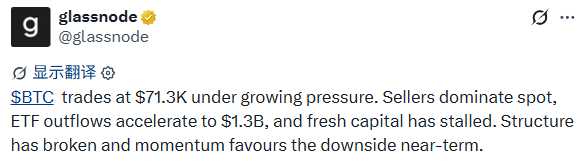
On June 1, Glassnode stated that the spot market is dominated by sellers, ETF outflows have accelerated to 1.3 billion dollars, and new funds are stagnating, suggesting that the market structure has deteriorated, with short-term momentum leaning downward. Standard Chartered also maintained a cautious stance, having lowered its 2026 target multiple times to around 100,000 dollars, warning of risks to test lower regions in the short term.
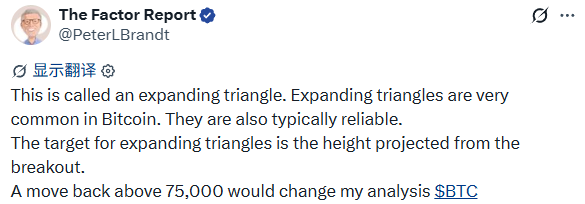
Peter Brandt believes that Bitcoin is currently in the form of an expanding triangle, and unless it reestablishes above 75,000 dollars, it may continue to fluctuate downwards, testing lower positions.
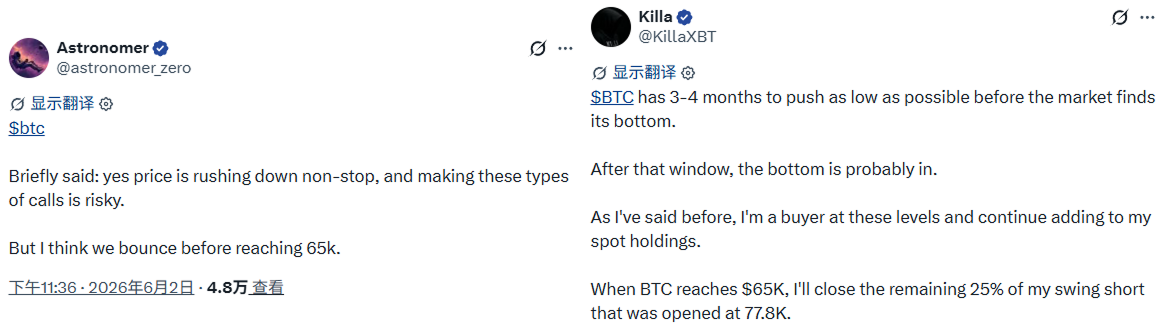
Cycle traders like @astronomer_zero admit that "calling for a rebound amidst this continuous decline is risky, but I believe prices will rebound before hitting 65K." Quantitative trader @KillaXBT judges that Bitcoin still has a three to four month window for bottoming, but has already bought in at the current position and continues to increase spot holdings; meanwhile, he indicated that when Bitcoin hits 65K, he will close out the remaining 25% of his short position opened at 77.8K. In other words, 65K is both a short position profit-taking point and a medium to long-term accumulation zone in his view.
免责声明:本文章仅代表作者个人观点,不代表本平台的立场和观点。本文章仅供信息分享,不构成对任何人的任何投资建议。用户与作者之间的任何争议,与本平台无关。如网页中刊载的文章或图片涉及侵权,请提供相关的权利证明和身份证明发送邮件到support@aicoin.com,本平台相关工作人员将会进行核查。


