Author: Jae, PANews
With the start of June, the cryptocurrency market and U.S. stocks had a chemical reaction. Cryptocurrency exchanges such as Binance, MEXC, Gate, and Bitget successively launched 24-hour trading of U.S. stock spot. However, when a user taps their finger across the phone screen, completing a transaction of "Tesla stock tokens" in an instant, few will question: What secret do these exchanges have for launching new products so quickly? How can trading be conducted 24 hours a day outside the traditional stock market?
The answer points to Alpaca, a fintech unicorn emerging from Silicon Valley, which is the invisible champion of this wave of stock tokenization.
According to The Information, this company, known as the "On-chain Wall Street General," currently monopolizes about 94% of the global tokenized U.S. stock and ETF market. Its name connects with almost every leading player in tokenized U.S. stocks, including Binance, Kraken, Ondo Finance, xStocks, and Dinari. However, it is little known that this unicorn was silent for years.
Long Dormancy: From "Struggling AI Startup" to "AWS of Finance"
Alpaca's story began in 2015, founded by CEO Yoshi Yokokawa, who came from the securitization team at Lehman Brothers.
In that era of rapid fintech development, its initial entrepreneurial direction was not an easy road. Co-founder and CTO Hitoshi Harada later admitted in a sharing session: "We started the company simply because we wanted to be entrepreneurs; that was a huge mistake." The company initially attempted to create a deep learning AI product, but lost direction by straying from real business pain points. The team applied to Silicon Valley's top incubator Y Combinator four times before finally being accepted in the winter of 2019.
The turning point came from a deep insight into industry trends. At that time, new-generation brokerages like Robinhood were igniting a wave of financial democratization, but Yokokawa keenly observed: surface celebrations could not hide the backwardness of underlying infrastructure. In the payment sector, there was Stripe connecting both parties in a transaction; in the data access sector, there was Plaid connecting bank accounts; but in securities trading and clearing, there was not a developer-friendly "brokerage API infrastructure" in the market. Without a mature technical foundation, developers wanting to build a trading app had to start from scratch to tackle a series of complex projects like acquiring a brokerage license, clearing systems, and custodial banks.
This forced the team to make a difficult choice: to completely transform and enter the clearing brokerage track.
The moat for this decision was very deep, but the cost was equally high. Transforming from a tech company focused on machine learning to a "licensed self-clearing broker" rigorously regulated by the Financial Industry Regulatory Authority (FINRA) and Securities Investor Protection Corporation (SIPC) took several years.
By early 2025, before launching its tokenization business on a large scale, Alpaca had established partnerships with over 300 institutions in more than 40 countries, supporting over 9 million brokerage accounts. Its client matrix includes financial institutions, fintech companies, and automated traders, providing comprehensive access to U.S. stocks, options, and cryptocurrencies, supporting whole shares and fractional shares trading. With its identity as a self-clearing broker and DTCC membership, Alpaca can independently complete the entire transaction clearing and settlement process, creating a highly differentiated competitive barrier among similar API service providers.
The true wealth code is often hidden behind competitive barriers, and the "plumber" that remained silent for years has ushered in explosive growth.
Turning Point: The "Unicorn" Galloping in the Tokenization Wave
The outbreak stemmed from a turn in industry trends. In 2024, the global tokenized stock sector experienced explosive growth. According to Token Terminal data, the total market value of tokenized stocks is expected to exceed $1.2 billion by the end of 2025, and Alpaca stands precisely at the intersection of traditional brokerage systems and cryptocurrency blockchain ledgers.
In October last year, Alpaca officially launched its secret weapon at the TOKEN2049 conference in Singapore: the Instant Tokenization Network (ITN). This deployment is equivalent to constructing a direct high-speed channel between the "central processing system" of traditional securities clearing on Wall Street and the "distributed ledger" of the crypto world.
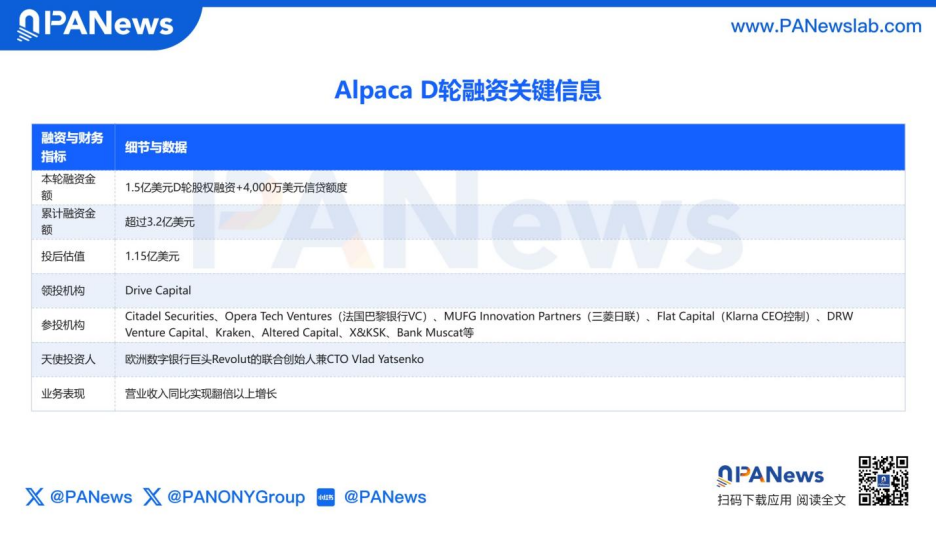
Years of accumulated brokerage licenses, self-clearing systems, and API frameworks have now formed a solid competitive barrier. According to The Information data, as of January of this year, Alpaca occupies approximately 94% of the tokenized U.S. stocks and ETF market share. This ratio is even as high as 97% in the large-cap and mega-cap tokenized U.S. stocks sector. Leading players in the tokenization sector, such as Ondo Finance, Dinari, and xStocks, rely on Alpaca for their underlying clearing and custody.
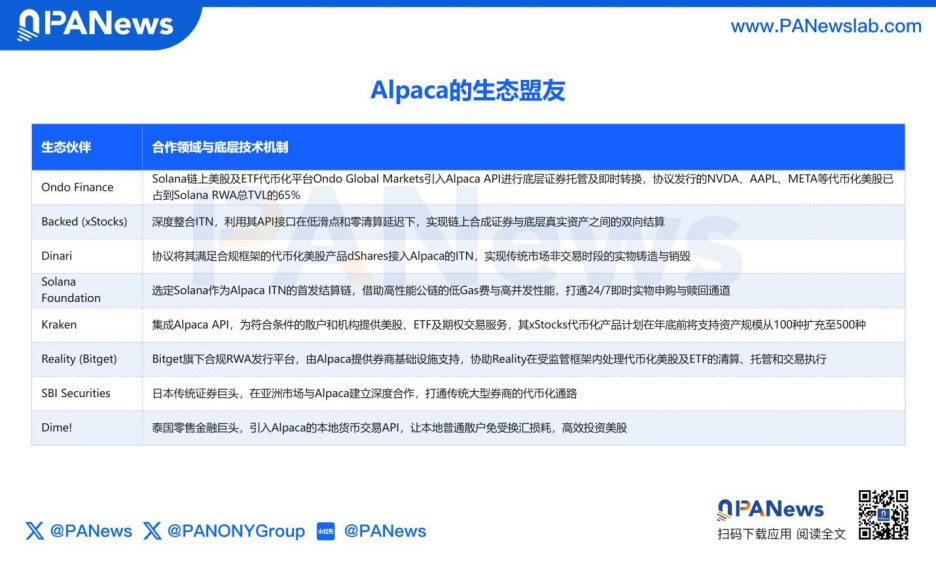
In January of this year, Alpaca announced the completion of a $150 million Series D funding round, achieving a valuation of $1.15 billion and officially entering the unicorn ranks, with total funding exceeding $320 million.
Product Deconstruction: How ITN Connects On-chain and Off-chain
To understand how Alpaca overwhelms its competitors, one must deconstruct the underlying business logic of ITN. Essentially, Alpaca plays a triple role in tokenizing U.S. stock trading: "Clearing Hub + Custodian + Issuer Partner."
Minting: Turning Real Stocks into On-chain Tokens
Off-chain Pre-deposited Assets: Institutional clients, or Authorized Participants (AP), hold real U.S. stock in Alpaca's compliant accounts or transfer in through brokerage when initiating requests.
On-chain Minting Initiation: AP initiates a request to mint tokenized U.S. stocks to Alpaca via a single API call, and its technical system receives this instruction in real-time.
Off-chain Clearing Transfers: Alpaca's clearing system immediately performs operations on the off-chain traditional securities side, deducting an equivalent amount of real U.S. stock from the initiating institution's clearing account and transferring it to the custodian account of the token issuer. This process replaces the traditional T+1 or even longer settlement cycle, completing within milliseconds in response to the API.
On-chain Verification and Delivery: Once the issuer's system receives the validation signal from Alpaca, it instantly mints and releases an equivalent tokenized U.S. stock asset to the AP's crypto wallet on the blockchain.
In contrast, the traditional model requires fund providers to prepare a large amount of cash upfront or bear high collateral costs, which is not only expensive but also creates significant liquidity consumption. The physical minting mechanism of ITN compresses the entire time lag to the millisecond level, clearing fundamental barriers for on-chain 24/7 liquidity supply.
Redemption: Canceling On-chain Tokens Back to Real Stocks
The mechanism operates in reverse. When AP destroys tokenized U.S. stocks on-chain, the Alpaca system receives the on-chain event and immediately drives the off-chain clearing system to transfer equivalent real U.S. stock back to the AP's account. The entire process requires no manual intervention across systems or long waiting periods.
Cross-chain Interoperability: Breaking the "Island" Barrier of Assets
The versatility of ITN allows it to support instant arbitrage and conversion between tokenized assets issued on different chains. When there is a price deviation for a token, traders can quickly redeem real shares on that chain and then mint a different token of equivalent value across chains, effectively helping the prices of different trading targets in the market converge towards the actual value of the asset.
It can be said that ITN essentially reorganizes the "circuit" connecting assets in the traditional world and the crypto world, allowing real value to flow frictionlessly between two entirely different financial systems.
Conclusion: The Biggest "Shovel Seller" and "The Elephant in the Room"
As the wave of tokenized U.S. stocks becomes one of the most important financial narratives of the next decade, Alpaca undoubtedly becomes the biggest beneficiary of this wave. It resembles a giant silently selling shovels during a gold rush, not directly selling any products to end users, yet controlling the underlying infrastructure of the entire sector.
For the entire cryptocurrency market, Alpaca's market share of up to 94% is both its irreplicable moat and signifies a looming "Sword of Damocles."
Once Alpaca's system encounters technical failure, a hacker attack, or service interruption due to changes in U.S. regulatory policies, the billions of dollars in tokenized assets issued by platforms like Binance, Kraken, and Ondo could face a collective crisis of liquidity depletion. When a "unified plug" becomes the only connection channel, the entire system also becomes a community of fate for this plug.
免责声明:本文章仅代表作者个人观点,不代表本平台的立场和观点。本文章仅供信息分享,不构成对任何人的任何投资建议。用户与作者之间的任何争议,与本平台无关。如网页中刊载的文章或图片涉及侵权,请提供相关的权利证明和身份证明发送邮件到support@aicoin.com,本平台相关工作人员将会进行核查。


