First Bitcoin, and now AMD chips have replaced the previous hardware for training artificial intelligence.
Written by: Thejaswini M A
Translated by: Block unicorn
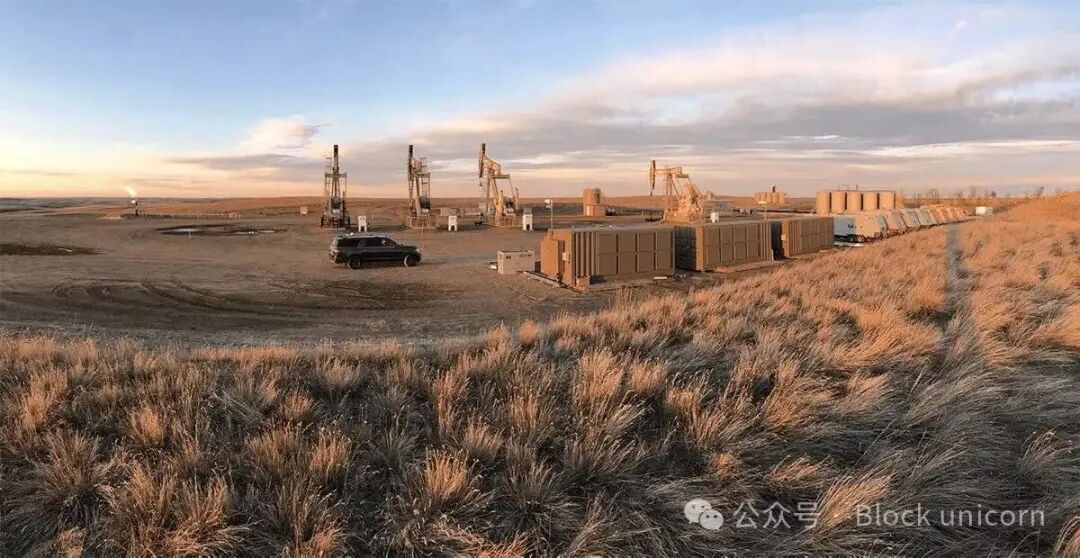
If you drive northeast from Austin for about an hour, passing barbecue shops and dry shrublands, you will reach Rockdale in Texas. If you roll down your car window before seeing the small town, you will hear: a massive, constant mechanical roar, sounding like a jet engine idling in the dirt.
You can hear this sound without stepping foot in Texas. Rockdale is home to North America's largest Bitcoin mining companies (like Riot Platforms and Bitdeer), all located in a former aluminum plant. Investigative reporters from The New York Times and Al Jazeera have documented this "jet engine-like" roar, the sound of thousands of industrial fans operating to prevent tens of thousands of ASIC mining computers from overheating and melting in the Texas heat.
Following the sound, you can find the former aluminum smelter of Alcoa. For decades, it has been a brutal and suffocating witness to 20th-century manufacturing.
Nowadays, if you walk into those once-metal warehouses, you will find not a trace of aluminum. Instead, there are miles of thick copper cables and industrial racks, with computers fully submerged in boiling synthetic oil tanks to maintain low temperatures.
First Bitcoin, and now AMD chips have replaced the previous hardware for training artificial intelligence.
Don't jump to conclusions just by staring at this mess, thinking that artificial intelligence is a bubble or that Bitcoin is dead (neither is true); you are seeing the trees but not the forest. The companies acquiring these leases don't care at all. They know that the real asset is the power transmission lines. Even if they didn't know before, they surely understand it now.
If you still want to know why, then a kilowatt-hour of power used for smelting aluminum, based on prices from the London Metal Exchange (LME), generates about $0.17 to $0.27 in gross revenue.
At current prices, Bitcoin mining using current-generation ASIC miners generates $0.05 to $0.11 in revenue per kilowatt-hour.
AI inference running on H100 GPUs is charged at cloud pricing, generating $1.27 to $3.67 per kilowatt-hour.
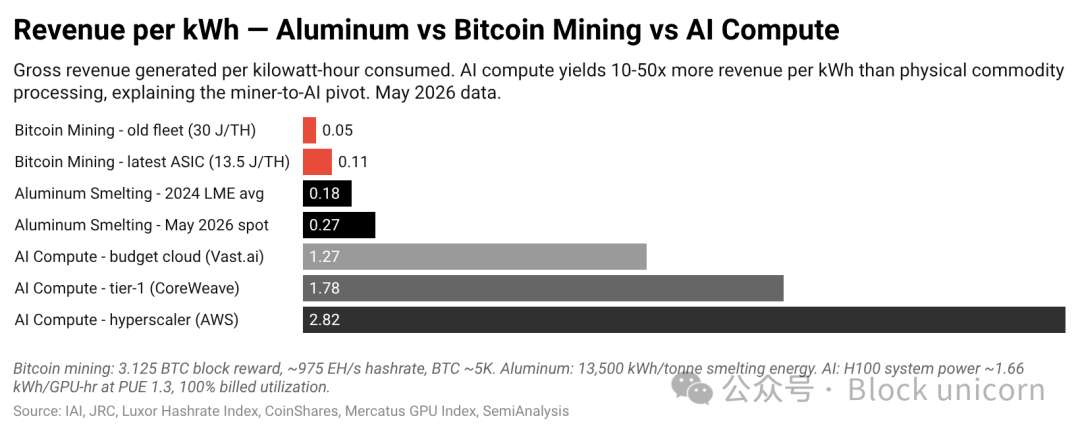
In the absence of better options, aluminum production is a way to make good use of cheap electricity. Bitcoin production also needs to rationally use cheap electricity amid compressed aluminum profit margins.
The price of Bitcoin indeed confirmed this for some time. But by 2026, regardless of the price levels that the cryptocurrency market hits this year, artificial intelligence will be a more effective way to utilize cheap electricity than Bitcoin.
If you want to understand how fast the industry landscape is changing, just look at three recent deals. They clearly show that companies are scrambling to capture any available energy, whether it is for artificial intelligence or cryptocurrency.
Riot Games has a large mining facility in Rockdale, Texas, but they are not just using it to mine Bitcoin; instead, they have rented part of the space to chip giant AMD for constructing an artificial intelligence data center project. Riot Games realized that by simply providing power connections to others, they could earn hundreds of millions of dollars.
TeraWulf did something similar, but on a larger scale. They invested $200 million to acquire an old Century Aluminum plant in Hawesville, Kentucky. They bought it because the aluminum smelter already had a massive heavy power infrastructure. TeraWulf plans to demolish the old buildings and construct a data center campus on top of those transmission lines.
NYDIG has its sights set on an old facility in eastern Massena, New York. This land once belonged to aluminum giant Alcoa and has been essentially idle for years. But it can directly tap into the 435 megawatts of cheap, clean hydroelectric power provided by the St. Lawrence River. While other companies are shifting to artificial intelligence, NYDIG purchased this land specifically to lock in cheap hydroelectric resources for Bitcoin mining. Is no one willing to start from scratch anymore?
For nearly 20 years, Bitcoin miners have journeyed everywhere to find the cheapest energy. They have camped near hydropower stations in remote areas of Washington, powered by gas flares in North Dakota oil fields, and taken over abandoned industrial power grids in upstate New York. The facilities they built can run on vast amounts of electricity around the clock without damaging hardware. They mastered the techniques of industrial cooling, low-cost power contracts, and round-the-clock uninterrupted operation.
Then artificial intelligence companies came along, and what they needed was exactly what these companies already had, and the budgets of artificial intelligence companies are much bigger.
Companies like Anthropic are consuming vast amounts of electricity. Meanwhile, Microsoft, Google, and Amazon are building data centers at an astonishing pace, so much so that power companies can't keep up with connecting power lines. All three companies are competing with Bitcoin miners for the same industrial power lines. In the past, Bitcoin miners competed against each other for power, but now, the wealthiest companies are vying for the same power resources, and we all know who the ultimate loser will be.
The data from early 2026 shows the losses. The total hash rate of the Bitcoin network has decreased for the first time in six years. The cost to produce one Bitcoin is $88,000, but during much of May 2026, the trading price of Bitcoin was about $77,000. If you are a miner paying the normal electricity bill, then every Bitcoin you mine is losing money.
So, everyone is changing jobs. Companies like Hive, Hut 8, TeraWulf, and Iren are dismantling their mining machines to make room for artificial intelligence servers. CoreWeave has completely abandoned Bitcoin to build an artificial intelligence cloud network, while MARA acquired a French tech company for a similar transformation. Those miners who once prided themselves on being industry giants have survived. On the other hand, those who fancied themselves cryptocurrency experts now face funding shortages.
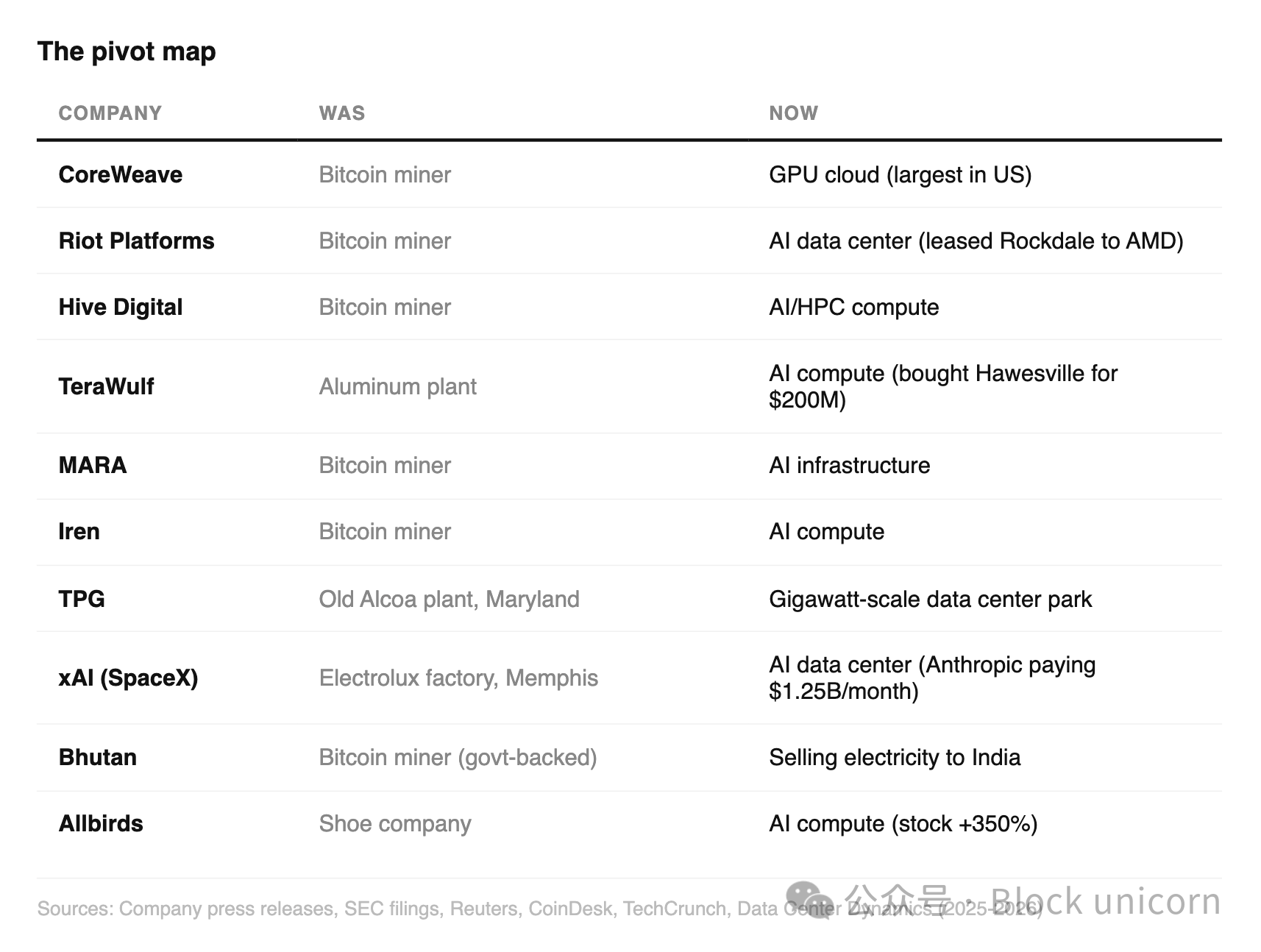
Energy analysts call it the "digital resource curse." This means that countries and companies are gradually realizing that merely owning and holding power resources is more profitable than actually developing new technologies.
The Gulf countries recognized this long before the cryptocurrency industry.
For about sixty years, Gulf governments have been selling electricity at extremely low prices. In Kuwait, the residential electricity price has been fixed at 0.7 cents per kilowatt-hour since 1966. In Abu Dhabi, the cost of producing and delivering electricity per kilowatt-hour is about 8.7 cents, and it is sold to residents at 1.4 cents per kilowatt-hour. These low electricity prices are part of the government's strategy to develop industries and attract heavy industries to the desert regions. The reason aluminum smelters, chemical plants, and steel mills are built there is precisely that electricity is almost free.
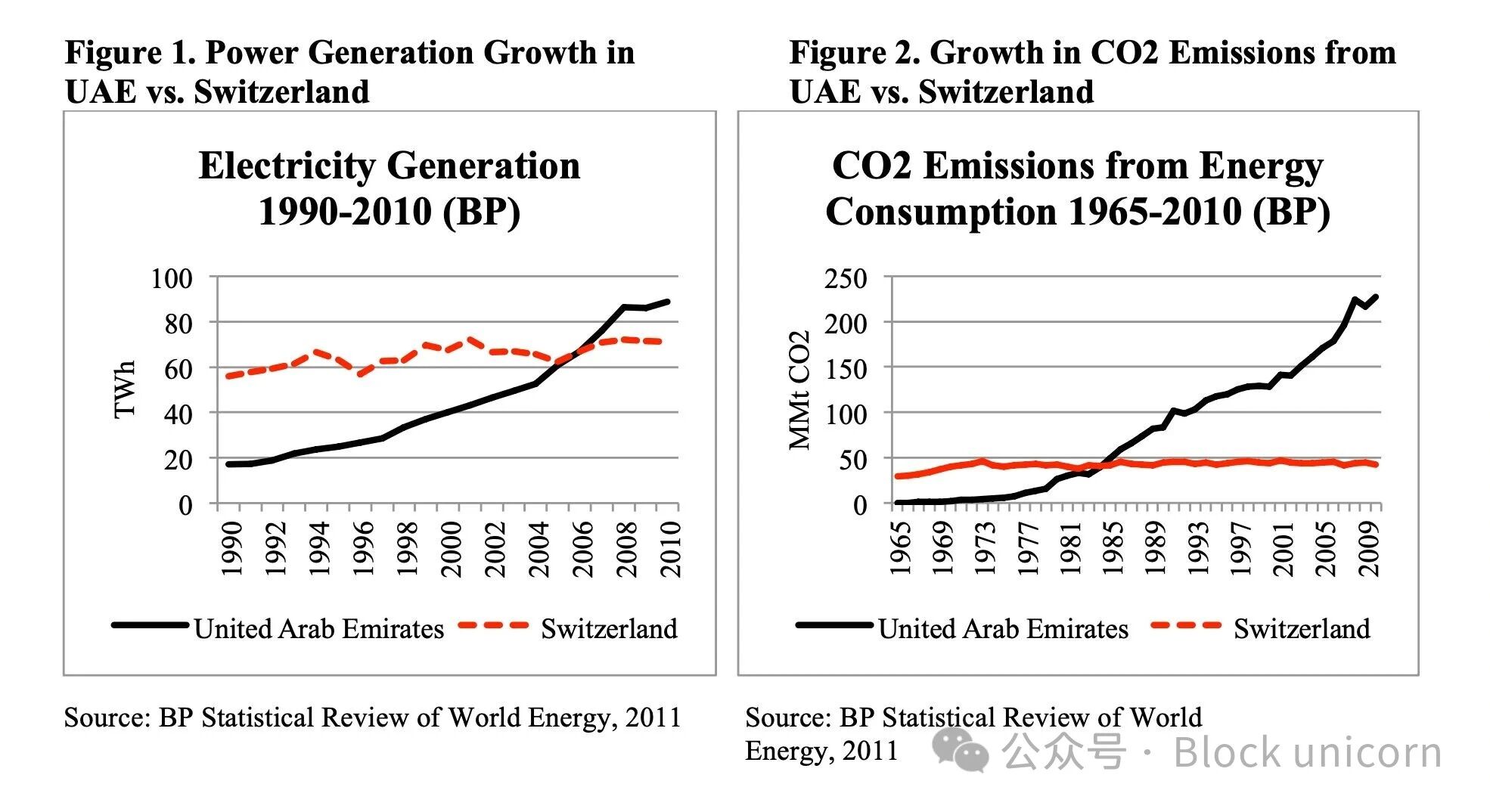
Now, cheap electricity is no longer used for aluminum smelting but for building data centers. Saudi Arabia has established a state-owned artificial intelligence investment company called HUMAIN, planning to invest billions of dollars in technology infrastructure. The UAE has broken ground on its massive 5-gigawatt "Stargate" artificial intelligence park, attracting companies like OpenAI, Oracle, and Nvidia to utilize the power grid once used for smelting aluminum. Even the NEOM "Oxagon," which originally planned to build a floating factory city, has now developed into an artificial intelligence data center campus costing $5 billion and powered by wind and solar energy.
As noted by the Carnegie Endowment for International Peace, cloud computing is becoming the new aluminum industry in the Gulf region. They are simply exporting fossil fuels and solar energy through the internet instead of transporting physical goods.
Then there is Bhutan.
Bhutan once had the cheapest hydropower in the world—this is my favorite Bitcoin mining story—and a government-supported Bitcoin mining project that was regarded as a model of sovereign mining success. Bhutan's Bitcoin holdings once reached about 13,000 coins, which later fell to 3,100 coins. The influx of mining funds stopped more than a year ago. Now it seems that this electricity is being sold directly to India.
This is consistent with the calculations of Alcoa. Is Bitcoin the maximum profit we can obtain from this electricity? When the answer is yes, Bhutan began mining. When selling electricity to the Indian grid is more reliable than exchanging it for Bitcoin at uncertain prices, the electricity flowed to India.
In low Earth orbit, solar panels can continuously receive raw sunlight. There is no night; no land costs are necessary either. Aside from the extremely low temperatures of space itself, there is no need for any cooling infrastructure, either. Moreover, the cost of launching hardware into space has decreased by 95% over the past twenty years.
SpaceX is also playing the same power game. According to its recent IPO documents, the company earns $1.25 billion per month from Anthropic. Anthropic has just signed an agreement to lease all computing power at SpaceX's Colossus 1 data center in Memphis, Tennessee. This contract is worth over $40 billion and is effective until May 2029. Just as Bitcoin miners took over the old aluminum smelter in Rockdale, SpaceX also built Colossus 1 in a repurposed Electrolux appliance factory.
Now, Allbirds is the most absurd example in this article. It was once a sustainable footwear company. At its peak, Allbirds was valued at $4 billion. Then, the direct-to-consumer brand bubble burst, and its stock price plummeted by 98%. At that time, they had some cash on hand, were publicly listed, but their footwear business was fruitless. So, they completely transformed into the field of artificial intelligence computing infrastructure. As a result, the stock price soared by 350%. The same principle applies to Allbirds. Whatever product Allbirds produces, the market seems to determine that engaging in server electricity transmission is more profitable than any other consumer goods business.
Cryptonetworks like Bittensor, Render, and Akash are working on different approaches. They do not intend to create a large single facility but instead hope to connect small computers distributed around the world.
Bittensor operates an artificial intelligence model marketplace that uses a fixed token supply based on Bitcoin, allowing AI models to compete to answer questions.
As early as December 2025, it halved its daily token issuance. Meanwhile, Render allows users to share excess GPU computing power for AI tasks, while Akash rents cloud computing space at prices reportedly 85% cheaper than Amazon Web Services.
This strategy is garnering mainstream media attention. At Nvidia's 2026 tech conference, CEO Jensen Huang compared Bittensor to Folding@home (an early internet project).
This makes sense because Folding@home arose from millions of home computers sitting idle, wasting electricity. They found a way to turn this "digital waste" into a useful resource. Bittensor is calling for people to donate idle gaming computers, leftover mining equipment, and unused cryptocurrency tokens to encourage their participation in the Folding@home project.
As I look around this scene, from the roaring fans of Rockdale to satellites orbiting the Earth chasing sunlight, I see a large-scale, frenzied reorganization of physical assets. The managers of these companies are loyal only to present interests. I bet that ten years from now, these warehouses will be completely emptied again to be used for purposes after artificial intelligence, while the underlying physical networks will remain unchanged.
Whoever can find the cheapest electricity will determine what computing programs run on it. Texas, Bhutan, and Abu Dhabi have all done this, and 250 miles above these three locations, it is still the same.
免责声明:本文章仅代表作者个人观点,不代表本平台的立场和观点。本文章仅供信息分享,不构成对任何人的任何投资建议。用户与作者之间的任何争议,与本平台无关。如网页中刊载的文章或图片涉及侵权,请提供相关的权利证明和身份证明发送邮件到support@aicoin.com,本平台相关工作人员将会进行核查。


