1. Market Overview: Price and Liquidation
On June 2, the cryptocurrency market continued its sharp decline. Bitcoin was quoted at about $71,000, with a 24-hour drop of over 3%, and the weekly decline expanding to more than 8%, briefly dipping to around $70,000 during the day, marking the lowest since mid-April. Ethereum fell below the psychological threshold of $2,000, quoted at about $1,990, with a weekly drop of nearly 10%, and its market cap shrinking to about $240 billion. Solana and XRP experienced even steeper declines, while BNB fell 5.6% in a single day, with mainstream tokens facing systemic pressure.
On the derivatives front, CoinGlass data shows approximately $523 million in liquidations across the board over 24 hours, with long positions comprising up to 75% of the liquidated amounts, affecting over 145,000 traders. Currently, the BTC contract open interest is about $54.6 billion, and the ETH contract is around $31 billion, showing no significant reduction in scale; if prices continue to be under pressure, the risk of secondary liquidation remains high.
Market sentiment has plummeted to freezing point—the Cryptocurrency Fear and Greed Index reports 23, indicating an extreme fear zone, worsening from last week's 34.

2. News: Institutional Selling and Macroeconomic Pressure
Strategy's first net sale shakes market foundations. On June 1, former MicroStrategy submitted documents to the SEC, selling 32 BTC (approximately $2.5 million) at an average price of $77,135 to pay a special dividend for STRC stock. This marks the first time the company has shifted to a net seller in nearly four years, breaking its founder Saylor's long-held "never sell" commitment, which the market interprets as a signal for a large-scale sell-off.
ETF funds have seen continuous outflows, setting historical records. The US spot Bitcoin ETF recorded net outflows for 10 consecutive trading days, totaling about $2.97 billion, marking the longest consecutive withdrawal record since the product's launch. In May alone, institutional withdrawals exceeded $2.3 billion, making it the weakest month since the end of 2025, with institutional buying support noticeably weakening.
On the macro front, interest rate cut expectations have completely reversed. The US April PCE inflation rate surged to 3.8%, and the federal funds futures market is currently pricing in over a 50% probability of rate hikes within 2026, sharply shifting from last year's "rate cut consensus," significantly compressing expectations for liquidity easing, putting pressure on the cryptocurrency market first and foremost.
Geopolitical risks have simultaneously intensified. Iran has suspended dialogue with the US through intermediaries and plans to blockade the Strait of Hormuz, causing international crude oil prices to spike by 6%, exacerbating global risk aversion and further pulling capital out of risk assets.
It's worth comparing that during the same period, US stock indices S&P 500 and Nasdaq both reached historical highs, highlighting a divergence in trends between the cryptocurrency market and traditional finance, indicating that capital is selectively withdrawing from digital assets and flowing back into mainstream markets.
3. On-Chain Data: Structural Differentiation
Exchange Holdings: Buying Power Exhausted. Between April 25 and June 1, the Bitcoin reserves of the world's largest exchange, Binance, increased from 617,000 to 648,600 (up 5.1%), while ETH holdings rose from 3.35 million to about 3.7 million (up 10.4%). However, during the same period, the balance of USDT + USDC on the platform decreased by about $3.87 billion, indicating a significant reduction in stablecoin purchasing power—more crypto assets are entering exchanges, but the available purchasing power is declining, leading to a supply-demand structure leaning towards sellers in the spot market.
Exchange Differentiation: OKX Shows Contrasting Outflows. OKX's latest reserve report indicates net outflows in both BTC and ETH on the platform, while USDT demand is rising, suggesting a shift in user preference towards stablecoin hedging. The directional flow of funds between different exchanges reflects a reassessment of platform risk preferences among market participants.
On-Chain Activity: Significantly Shrinking, Retail Investors Exiting. The daily active addresses for Bitcoin fell from about 1.12 million in May 2021 to around 624,000, and the number of new wallets dropped from about 489,000/day to approximately 278,000/day, an overall decline of about 44%. Analysts point out that the rise of spot ETFs has diminished the necessity for direct on-chain participation, and the correlation between price volatility and on-chain activity has historically decoupled.
A noteworthy positive signal: When market sentiment drops to "extreme fear," it has historically often served as a reference point for left-side positioning. Additionally, the outflow of BTC reserves at OKX alongside increased stablecoin accumulation may be an early signal that some capital is positioning itself at lower levels.
Chu Yu Chen: June 2 Bitcoin ETH contract trading reference
Market Structure Judgment: This round of decline is a multi-dimensional resonance—expectations of tightening macro liquidity (interest rate hikes), continuous withdrawals of institutional capital (10-day net outflows from ETFs), geopolitical risk aversion (tensions between the US and Iran), and the first reduction in the largest "Bitcoin accumulation narrative" target—four overlapping bearish factors leading to concentrated liquidations among bulls. From the perspective of on-chain selling pressure versus buying power disparity, stablecoin liquidity still shows no significant signs of returning, and more confirmation signals are needed for short-term stabilization.
In my recent articles, I have been emphasizing the short-selling strategy, choosing to short from around 78,000, and as of this morning, still holding short positions, having advised exiting around $70,000. The recent operations have accurately followed the trend and executed effectively, resulting in substantial profits. Friends who have been following my trades have multiplied their capital several times.
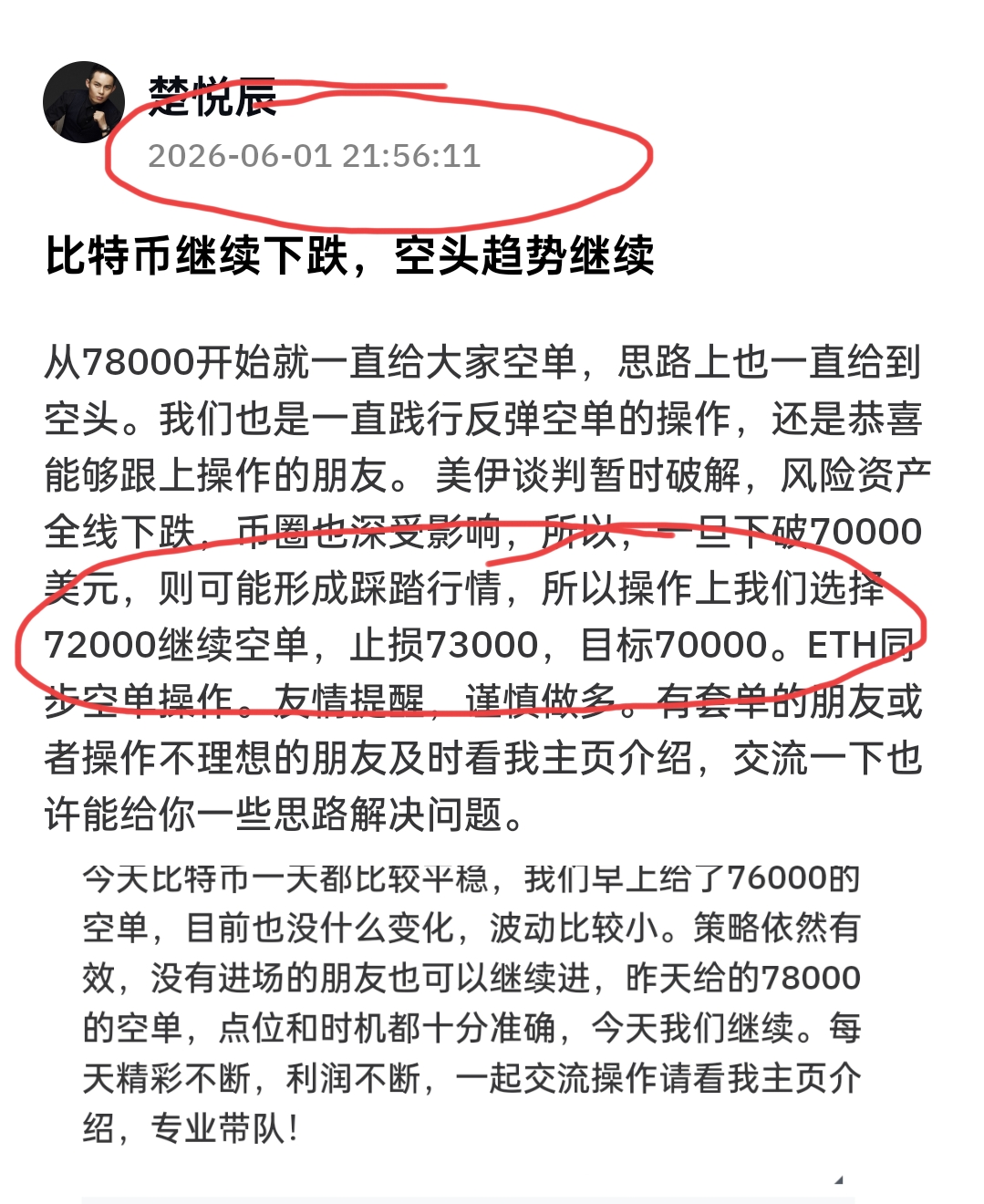
The current short-term pressure is around $71,000, with psychological support at $70,000 below, and a strong resistance level around $72,500 as a conversion of highs and lows. For short-term contract operations, one could continue to position short around $71,000, and if the price approaches $72,000, increase the short position, with a stop-loss at $72,500. If the price effectively breaches $70,000, the next significant support level will be around $65,000.
For ETH, the same operation: initial short position near $2,000, increase short position near $2,030, with a stop-loss at $2,050, targeting $1,950—$1,900.
Feel free to privately message for timely trade discussions; I will promptly provide reminder orders. Don't miss profit opportunities when they arise, and only rest when there are none. So, refrain from complaining about the market; the market is always right, it just depends on how you act.

免责声明:本文章仅代表作者个人观点,不代表本平台的立场和观点。本文章仅供信息分享,不构成对任何人的任何投资建议。用户与作者之间的任何争议,与本平台无关。如网页中刊载的文章或图片涉及侵权,请提供相关的权利证明和身份证明发送邮件到support@aicoin.com,本平台相关工作人员将会进行核查。


