

Author: Zen, PANews
You spent six months getting ChatGPT to understand your work habits, writing style, and long-term projects. It knows how you like to modify articles, which companies you frequently pay attention to, and gradually understands your preferences regarding content structure, tone, and information density.
But one day, a more powerful new model appeared. You opened Claude, Gemini or DeepSeek, and found everything had to start over. The new model does not recognize you, does not know the work context you have accumulated over the past few months, nor does it know how you think, how you write, or how you make decisions.
In the past two years, the most important competition in the AI industry has revolved around "model capabilities." Who has stronger reasoning, longer context, and better coding abilities has almost decided everything. But now, a new question is emerging: AI understands you better and better, but to whom do these "understandings" really belong?
Role Change: AI Transforms from Chat Tool to Personal Digital Assistant
In November 2022, the AI chatbot ChatGPT made its debut. After going live, it sparked a global chat trend, reaching over 100 million monthly active users in just two months, becoming the fastest-growing consumer application in history. At that time, large models were more like a "high-end search." Users asked questions to AI, it generated answers in real time, and once the conversation ended, the relationship was broken.
But in the past two years, the role of AI has undergone significant changes. As reasoning abilities, coding capabilities, and tool invocation capabilities have continued to improve, AI has begun to penetrate into real workflows. More and more people are using it to write code, organize materials, analyze data, plan trips, manage schedules, and even engage in long-term content creation and business decisions.
In many cases, users are no longer just "asking AI questions," but collaborating with AI for the long term. It begins to understand your work style, expression habits, and long-term goals, and starts to consistently participate in the same project, the same set of workflows, and even gradually take on certain execution tasks. To some extent, AI is evolving from a one-time Q&A tool to a long-lasting personal digital assistant.
As model capabilities have greatly improved, leading products are increasingly close, and with the long-term, widespread use of AI, new questions have begun to arise.

Once AI begins long-term collaboration, the "memory," which stores and recalls past experiences to improve decision-making and overall performance, is no longer just an irrelevant database. In many application scenarios, the bottleneck is no longer the model's reasoning level, but the capability regarding long-term memory and context management. Cloudflare has also directly described agentic memory as the biggest challenge facing current AI infrastructure, as well as one of the fastest-growing fields.
Leading AI companies have also realized that long-term memory is becoming part of the product experience. OpenAI has broken down ChatGPT's memory into saved memories and Reference chat history, the former storing information users wish to keep long-term, while the latter allows ChatGPT to extract useful content from past conversations for subsequent personalized responses. Gemini has also begun to learn user preferences based on previous conversations. Claude launched memory and supports import and export of memories.
Platform Silos Make AI "Memory" a New Battlefield for the Industry
But the problem is that these memory capabilities still generally revolve around their respective platforms, belonging only to independent account systems and product environments of each platform, still being isolated islands. Although Anthropic has supported memory import and export, it is currently more like a migration tool for Claude rather than a common memory standard adopted by various companies.
What ZetaChain aims to fill is precisely this gap. After fully transitioning to AI, ZetaChain began to extend the concept of "ownership," which originally belonged to the crypto world, further into AI memory and user context. What it hopes to build is not just a chat product, but a privacy memory layer independent of model platforms, allowing users to truly own their long-term memories, behavioral preferences, and AI contexts.
ZetaChain's AI consumer product Anuma advocates for users to have a set of encrypted private memories, supporting seamless transitions between mainstream AI models like ChatGPT, Claude, and Gemini. Users do not have to re-establish background, preferences, and work habits each time they switch models; instead, permissions are controlled by the users, carrying their historical memories across different models and agents.
As AI gradually accumulates user usage preferences, writing habits, workflows, and historical dialogues, the so-called "memory" will increasingly resemble a layer of "personality reflection." It can not only determine if the model's response aligns with user preferences but may also decide whether the model's future decisions act along the user's habits and values.
In addition to giving users memory ownership and allowing selection of models with different specializations for different tasks, Anuma is also building a programmable, auditable, and revocable permission system, which allows AI agents to read records at once, and permissions can be revoked at any time, with all permission changes being recorded and tracked on-chain.
Moreover, users' memories and knowledge graphs will become shareable, authorized, and monetizable assets without exposing the original data. This allows professionals such as investors, doctors, lawyers, and developers to package their expertise into agents and publish them on the agent marketplace, earning revenue when others call upon them.
Why Did ZetaChain Transition from Cross-Chain to Cross-AI Platforms?
The functionality and utility of the ZETA token have also adjusted along with ZetaChain's strategy. In the past, ZETA was more like a traditional public chain token, primarily serving gas, validation, and cross-chain network security functions, lacking significant innovation in mechanism design. But under the new narrative, ZETA will become an "AI infrastructure token," and its utility will significantly increase.
According to ZetaChain's current description, ZETA will serve several purposes in the future:
First, there is access permission for AI models and agents. Some advanced models, specialized AI tools, or agent services will require ZETA to unlock or pay for invocation fees.
Second, there will be payment settlement between agents. ZetaChain mentions that interactions between different AIs and applications in the future will complete on-chain payments via the x402 protocol. Its goal is quite clear: if AI will automatically invoke other AIs in the future, then a native payment system will also be needed for machines.
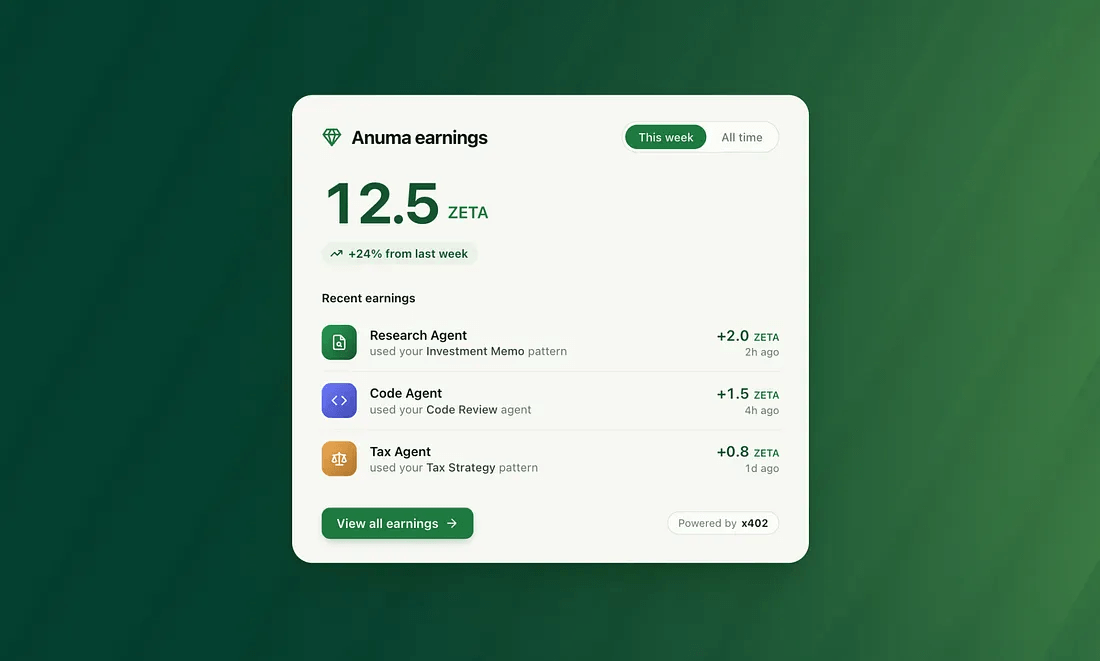
Third, there will be on-chain operations for permission and memory updates. Future modifications to permissions, access control, and memory status may all become on-chain records.
Fourth, there is the creator economy. ZetaChain hopes that in the future, developers, researchers, lawyers, doctors, and other professionals can package their knowledge into AI tools or agents and earn income through calls, while ZETA plays a role in the value transfer.
However, it should be noted that this part is still largely in the narrative stage. The AI agent economy itself is still far from mature, and truly large-scale "AI invoking AI" and "agent autonomous payments" have yet to emerge. Concepts like x402, on-chain permissions, and AI identity are currently more about future-proofing the infrastructure rather than being validated large-scale demands.
But the reason ZetaChain and its product logic are worth focusing on is not merely that it has created an infrastructure with accompanying AI products, but because it intends to redefine whose memory, identity, context, and AI permissions truly belong to the platform, versus belonging to the user themselves. What ZetaChain seeks to do is essentially return these elements to the user, no longer controlled by the platform.
免责声明:本文章仅代表作者个人观点,不代表本平台的立场和观点。本文章仅供信息分享,不构成对任何人的任何投资建议。用户与作者之间的任何争议,与本平台无关。如网页中刊载的文章或图片涉及侵权,请提供相关的权利证明和身份证明发送邮件到support@aicoin.com,本平台相关工作人员将会进行核查。


