In June 2026, SpaceX revised its prospectus before going public.
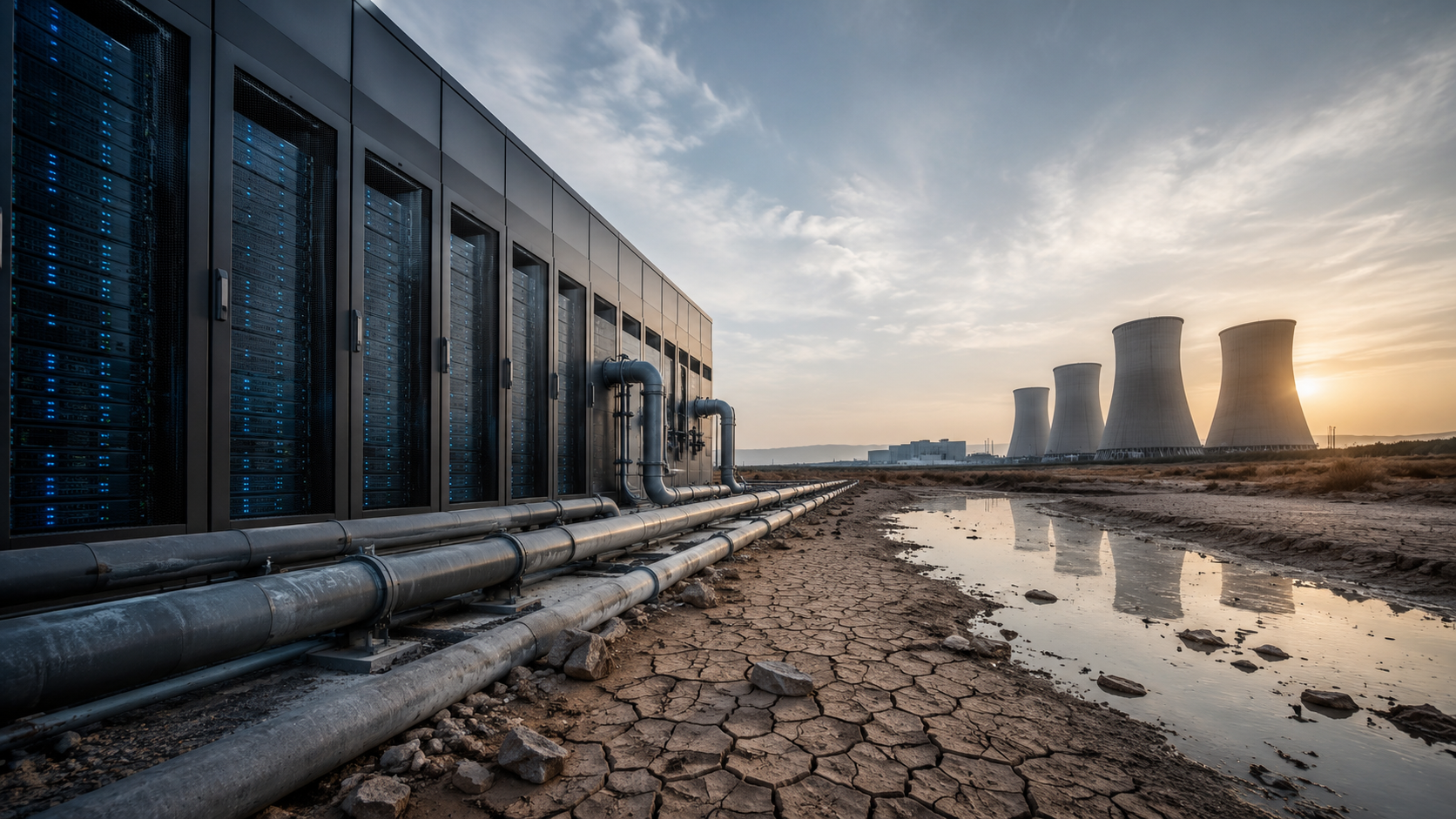
The revisions did not concern rocket technology, satellite internet, or Mars colonization plans. The new risk warnings pointed to a more basic issue—water. The document indicated that water scarcity, drought, competition for local water resources, or regulatory restrictions could limit the company's ability to obtain sufficient cooling water, thereby slowing the expansion of data centers or even forcing the adoption of more expensive alternative cooling solutions. Electricity, processors, and water resources are listed together in the document as the core resource constraints for AI computational power expansion.
This is the first time SpaceX has systematically emphasized water resource risk in public documents. A company known for its Starships and Falcon rockets reminds potential shareholders to pay attention to the stability of the tap when disclosing such information.
The original wording of that risk warning was: "water scarcity, drought conditions, competition for local water resources, or regulatory restrictions on water use could limit our ability to obtain sufficient water for cooling... delay or limit expansion... or require us to implement alternative cooling techniques that may be more costly." The wording is plain, in the restrained tone of standard legal documents. But the mere presence of this in an IPO document is significant.
The main body of SpaceX's AI business is xAI. According to a TechCrunch report in May, xAI incurred a loss of $6.4 billion in 2025, with annual revenue of $3.2 billion and capital expenditures continuing to rise sharply. This rate of burn corresponds to the rapid expansion of data centers, servers, and computing clusters. When hundreds of millions of dollars in hardware and infrastructure investments per quarter become the norm, fluctuations in the supply of any physical resource are no longer just a cost item for operations to optimize. It turns into a risk that must be explained to investors.
Water has shifted from being an operational cost to being included in the risk disclosure framework, and this shift is noteworthy.
Operational costs are something companies can manage themselves; they can save money or change technical solutions. But risks are different. Risks are external variables that a company may not be able to control. Drought is a weather issue, tightening local government permits for water use is a policy issue, while opposition from local residents is a political issue. These problems are not necessarily solvable by simply spending more money.
TechCrunch pointed out in its report that this revision reflects that the AI industry’s dependence on natural resources is sparking new attention from regulators and investors. Analyzing this judgment requires first answering a more fundamental question: How much water do AI data centers actually use?
17 billion gallons, just for direct cooling
The Lawrence Berkeley National Laboratory provided a set of estimated data. In 2023, U.S. data centers consumed approximately 17 billion gallons of water directly for cooling, which is about 64 billion liters. This is just for direct cooling. The operation of data centers relies on electricity, and the electricity generation process itself also consumes a lot of water. The cooling of thermal and nuclear power, along with the evaporation from hydropower, adds up to indirect water use, which one estimate shows could be as high as 211 billion gallons.
17 billion gallons for direct water use, 211 billion gallons for indirect water use. The latter figure is more than 12 times the former. When discussing the water footprint of AI, the direct cooling data seen is merely a small part of the iceberg above the waterline.
This estimate also provided a trend forecast: by 2028, the direct cooling water use for U.S. data centers could double to quadruple. The large span of the figures is due to factors such as the expansion rate of AI computational power, choice of cooling technology, and the location distribution of new data centers. Doubling is the most conservative scenario, while quadrupling is the aggressive expansion scenario. Regardless of which one, the direction is steeply upward.
These figures are abstract in themselves. When applied to specific companies, the scale becomes clearer.
Google disclosed in its sustainability report that it consumed 6.4 billion gallons of water in 2023, with 95% of that used for data centers. This means that just Google’s data centers alone consumed approximately 6 billion gallons of water that year. One of its sites, a data center in Council Bluffs, Iowa, consumed 1 billion gallons of drinking water in 2024 alone.
Meta's data is slightly smaller, but equally significant. In 2023, Meta consumed 813 million gallons of water globally, with 95% also attributed to data centers.
Putting these figures together, the amount of water consumed by Google's single data center is roughly equivalent to more than one-third of the Lawrence Berkeley Laboratory’s estimate for the total direct cooling water used by all U.S. data centers. The annual water usage of the stand-alone site in Council Bluffs, Iowa, could support a medium-sized city.
Where does this water go?
Most large data centers use evaporative cooling technology. The principle is not complicated: water in a cooling tower contacts hot air, evaporating and carrying away heat, turning into water vapor released into the atmosphere. This process is called “consumptive water use.” The water is used up and does not return to rivers, lakes, or underground aquifers. This is different from residential water use, where shower water and dishwater can flow back after treatment. The cooling towers of data centers release steam. When it's consumed, it is a literal consumption.
A study published in 2021 by npj Clean Water, a journal under Nature, provided a technical measure: a typical 1 megawatt IT-load data center, using traditional evaporative cooling technology, consumes about 25.5 million liters of water annually. One megawatt of IT load corresponds to the computing power of a few hundred servers. Large data centers often range from dozens to hundreds of megawatts. At this scale, a 50-megawatt data center cluster can easily consume over 1 billion liters of water for cooling each year.
In arid regions, the implications of this consumption level are obvious.
Building water hogs on the edge of deserts
In April 2025, an investigative report by The Guardian pointed out that Amazon, Microsoft, and Google were operating and expanding data centers in some of the driest regions in the world, with expectations that the scale of these three companies’ data centers would jointly expand by 78%. Behind these figures lies a series of ongoing conflicts.
In the central Mexican state of Querétaro, 17 out of 18 municipalities are experiencing severe drought. At the same time, the state has become a cluster for data centers of international tech giants. Local residents are holding signs outside the data centers, stating: “No queremos centros de datos, queremos agua”—we do not want data centers, we want water. BBC covered this conflict in detail.
In Mesa, Arizona, according to a report by Business Insider in June 2025, Meta reached a water agreement allowing its facilities to use up to 4 million gallons of water per day. What does 4 million gallons mean? Based on the average daily water usage of about 82 gallons per resident in the U.S., this is equivalent to the daily water use of nearly 49,000 people. Arizona itself is one of the most water-stressed regions in the U.S., with the Colorado River's water levels declining for years, and states arguing over water allocation. A data center drawing 4 million gallons of water daily is legal and compliant, but that does not mean there is no controversy.
Similar sentiments have surfaced in Australia. A report by The Guardian’s Australia edition in December 2025 noted that as large-scale data center construction accelerates, drinking water supplies in some areas are facing direct competition. In developed countries with relatively mature water resource planning systems, the sudden surge in water usage by data centers can also have severe impacts, indicating that this is not just a local governance issue but a universal contradiction between scaling up and limited resources.
The commonality of these disputes does not lie in tech companies "illegally using water." There are no violations of any kind. Every water use agreement has been legally approved, and every fee for water resources is duly paid. The root of the problem is: the existing framework for water resource allocation was established when data centers had not yet become significant water users. When a data center's daily water usage equals that of a town, compliance itself becomes a problem. The system has not kept pace with the growth of water hogs.
The Guardian's investigative report in October 2025 revealed another dimension. Amazon has long refused to disclose detailed water usage amounts for its data centers, accused of strategically concealing its complete water footprint. Google discloses site-specific data, and Meta releases aggregated global data, while Amazon provides the least information. This divergence in disclosure has begun to be seen by analysts as a variable in risk assessment. The less willing a company is to disclose its water usage, the more likely its water consumption will trigger controversy.
Projects get halted, water is the reason
Water resource disputes are no longer limited to the realm of public opinion. They are substantively hindering project implementation.
A report from Data Center Watch indicated that over the past two years since mid-2024, data center projects valued at approximately $64 billion in the U.S. have been blocked or delayed due to local community opposition. Water consumption is one of the core reasons for protest, alongside electricity usage and noise pollution. The report documented 142 bipartisan grassroots opposition organizations spread across different states in the U.S. that reached a rare consensus in opposing giant data centers.
Water is becoming a new weapon in the NIMBY (Not In My Backyard) movement. In the past, NIMBY campaigns primarily targeted substations, waste treatment plants, and highways. Now, data centers have joined that list. The reasoning has changed, but the logic remains: Residents' logic is simple: You say your data center contributes to the economy, but if the cost is a decrease in my household water pressure, an increase in my water bill, or a drop in groundwater levels, I do not accept that cost.
Once such opposition is formed, it cannot be resolved by corporations conducting a few community presentations or promising a few jobs. Electricity can be sourced from new power plants, fiber optics can be newly laid, and land can be purchased at a premium. But in the eyes of residents, water has no substitutes. For things without substitutes, the space for negotiation is extremely limited.
Throughout 2025, industry statistics indicated that about half of the data center projects originally planned to launch in 2026 were canceled or delayed. This proportion is enough to prompt any company planning AI infrastructure expansion to reconsider site selection logic. The previous priority order for data center site selection was: electricity, fiber optics, land prices, climate. Now, the weight of water is catching up.
The University of California, Berkeley's Center for Law and Energy published a dedicated report in February 2026, exploring how to regulate water use for data centers in California. This is the first time academia has systematically addressed this issue in a special report. The release of this report itself is an indicator: when top law schools and energy policy think tanks start to systematically study the regulatory framework for data center water use, it indicates that this issue has crossed the boundaries of industry internal discussions and entered the public policy agenda.
Investors start to count the water bills
The capital market is also catching up.
In April 2026, a report by Journal Record stated that investors formally urged Amazon, Microsoft, and Google to disclose more data regarding data center water usage. The report also cited a set of macro data: North American data centers consumed nearly 1 trillion liters of water by 2025.
1 trillion liters is a difficult figure to grasp intuitively. To express it differently: this is approximately equal to the storage capacity of a large freshwater lake. The estimates released by the Lawrence Berkeley Laboratory in 2023 are already significant, but in the face of the actual consumption in 2025, they may be conservative.
The change in the investment community's attitude is traceable. In the past, water resources appeared in ESG reports alongside other environmental indicators, often as a form that the corporate social responsibility department needed to fill out. Now it's different. Water resources have moved from the “corporate image” section to the “operational risk” section. Shareholders are not concerned about environmental protection but whether there is enough water to keep the servers running. When the stability of water supply begins to affect revenue expectations, it no longer becomes an ESG topic but rather a financial topic.
Different companies have shown clear divergences in their response strategies. Google continues to publish site-specific water usage data and claimed in 2024 that it returned 4.5 billion gallons of water through water replenishment projects. Meta publishes aggregate data. Amazon, after the release of The Guardian's investigative report, has still not disclosed detailed water usage amounts for each site. This differentiation further reinforces the viewpoint that the transparency of water usage data itself is becoming a variable for analysts to assess the risk exposure of AI infrastructure companies.
Companies are also attempting technical responses. Switching to air cooling can reduce direct water usage but often increases electricity consumption. Liquid cooling technology can use higher temperature water (NVIDIA's Vera Rubin platform supports cooling at 45°C), but system deployment costs are higher. Each technical route weighs water consumption against electricity consumption, with no perfect universal solution. The ultimate decision for what cooling solution a data center will use may depend not on the technically optimal solution but on local water prices, electricity prices, and policy tolerances. Technical choices become compromises under resource constraints.
A ironic contrast
In March 2026, OpenAI CEO Sam Altman said a widely circulated statement during a public speech. According to Business Insider, he expressed it this way: “We see a future where intelligence becomes a utility like electricity or water, and people buy it from us per meter.”
This statement sparked extensive discussion regarding copyrights and business models, but it has a more pertinent implication. When Altman compares AI to water and electricity, the actual physical operation of AI is consuming real water in the real world. The industry’s imagination of the business model is packaging AI as an inexhaustible infrastructure, billed by quantity like turning on a tap. At the same time, SpaceX’s prospectus is candidly acknowledging: without enough water, AI might not operate.
A service being compared to water and electricity has already generated huge bills in water and electricity for its infrastructure before it existed as such. This contrast itself is the most accurate description of the state of awareness in the AI industry in 2026.
Looking back at this narrative path in chronological order, the context is clear.
From 2023 to 2024, the annual water usage data of the world’s leading cloud companies was passively disclosed through sustainability reports. The Lawrence Berkeley National Laboratory released estimates, providing the first macro view of water use by data centers across the U.S. Community conflicts in areas like Querétaro, Mexico, and Mesa, Arizona, began to enter the mainstream media's sight.
In 2025, The Guardian and BBC conducted systematic investigative reports, pushing the relationship between data center expansion in arid regions and local water stress into public discussion. Data Center Watch published quantitative statistics showing $64 billion in projects blocked. Investors started formally requiring increased transparency on water footprints.
In 2026, SpaceX pulled this thread from public discussions and industry reports and placed it in the “Risk Factors” section of its IPO prospectus. This is the formal transition of the water issue from a public debate topic to an investment pricing factor. Before subscribing to SpaceX stock, an investor needs to sign to confirm they are aware that this company's AI business may face issues due to a lack of water.
This is how capital markets price resource constraints. They do not care about sentiment, corporate pledges, or visions of sustainability in public relations statements. They only care about one thing: what could cause expected returns to fall short under what circumstances. Water supply can be affected by weather, water prices can be influenced by policy, and access to water can face community opposition—these three things are beyond a company’s control. What cannot be controlled is risk. Risks need to be documented, to remind investors.
This mechanism itself is reshaping the logic of AI infrastructure expansion.
In recent years, the narrative mainline of the AI race has been a computing power arms race. Chips, electricity, and talent are the three essentials. Water has been an implicit condition, assumed to be available locally. Now that assumption is being shaken. In arid regions, in cities where local water is already strained, and in places where regulations are tightening water quotas, the assumption that “water is available locally” can no longer be automatically assumed to hold.
The expansion of AI infrastructure is no longer just a game of technology and capital. It is entering a phase that requires simultaneous negotiations with local residents, local governments, regulatory agencies, and investors regarding resource allocation. The speed of the power race may not be determined by the fastest company but by the slowest water meter.
免责声明:本文章仅代表作者个人观点,不代表本平台的立场和观点。本文章仅供信息分享,不构成对任何人的任何投资建议。用户与作者之间的任何争议,与本平台无关。如网页中刊载的文章或图片涉及侵权,请提供相关的权利证明和身份证明发送邮件到support@aicoin.com,本平台相关工作人员将会进行核查。


