Transform "trusting a person" into "trusting cryptography." The Interfold has modest ambitions, but its target is very precise.
Written by: angelilu, Foresight News
On-chain voting is the most attractive aspect of decentralized protocols—transparent, public, and open for anyone to participate. However, public does not mean it can fully represent the consensus of the community. The existence of "governance bribery markets" like Votium allows anyone with sufficient funds to directly bid to voters before the voting deadline. The result is that the direction of the protocol is often decided not by community consensus but by the highest bidder.
A protocol called The Interfold chooses to tackle this issue from its roots.
Confidential Coordination Infrastructure
The Interfold (formerly Enclave) positions itself as a "confidential coordination infrastructure" aimed at allowing multiple independent participants to jointly produce a verifiable result without exposing their individual input data.
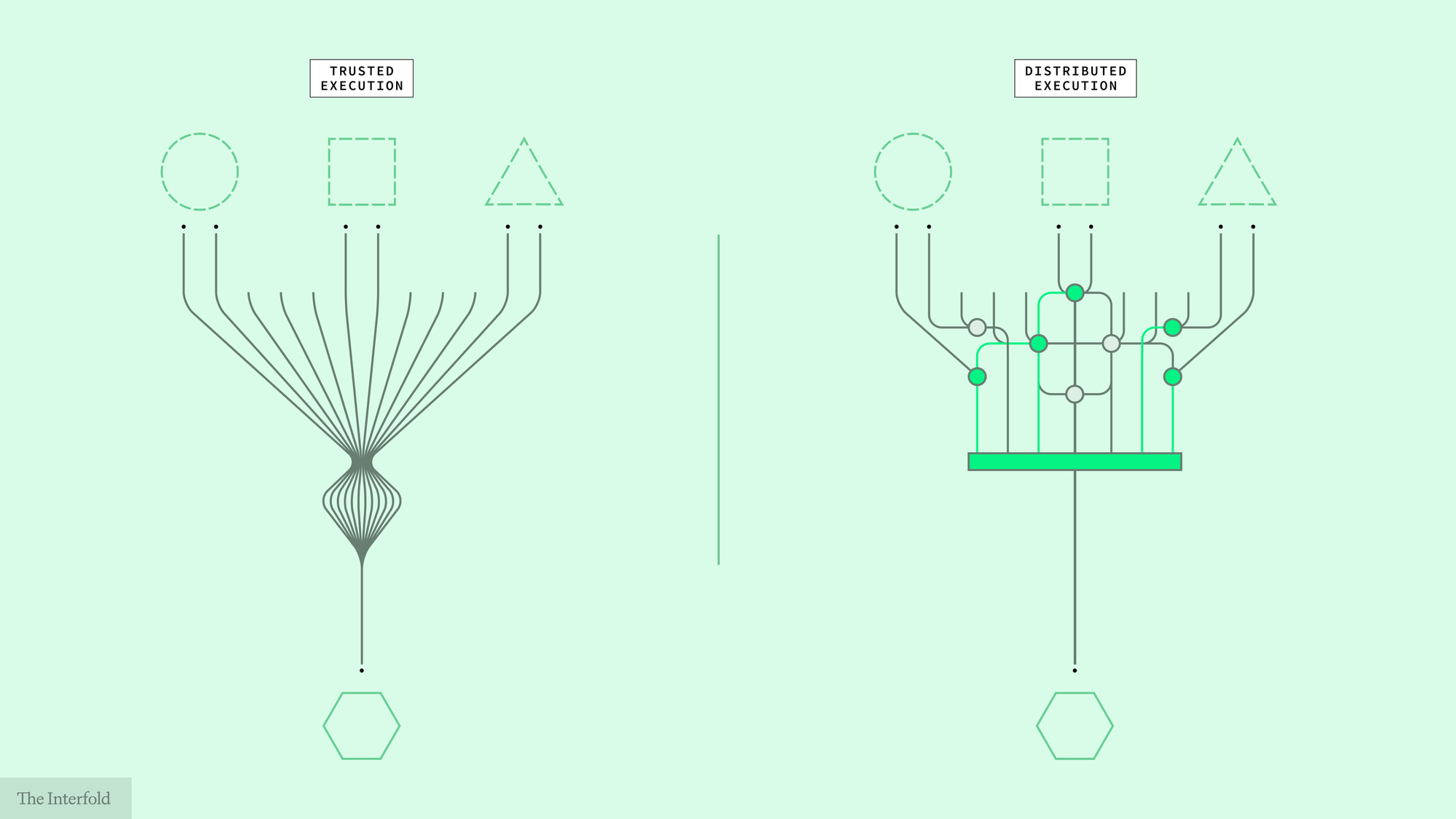
The core concept of The Interfold is E3 (Encrypted Execution Environment). Its principle is that computational tasks are assigned to a distributed network composed of "cipher nodes." User inputs always exist in encrypted form, calculations are performed directly on the ciphertext, and ultimately, only the aggregated result is decrypted and made public. Throughout the whole process, no party can see the raw data of others.
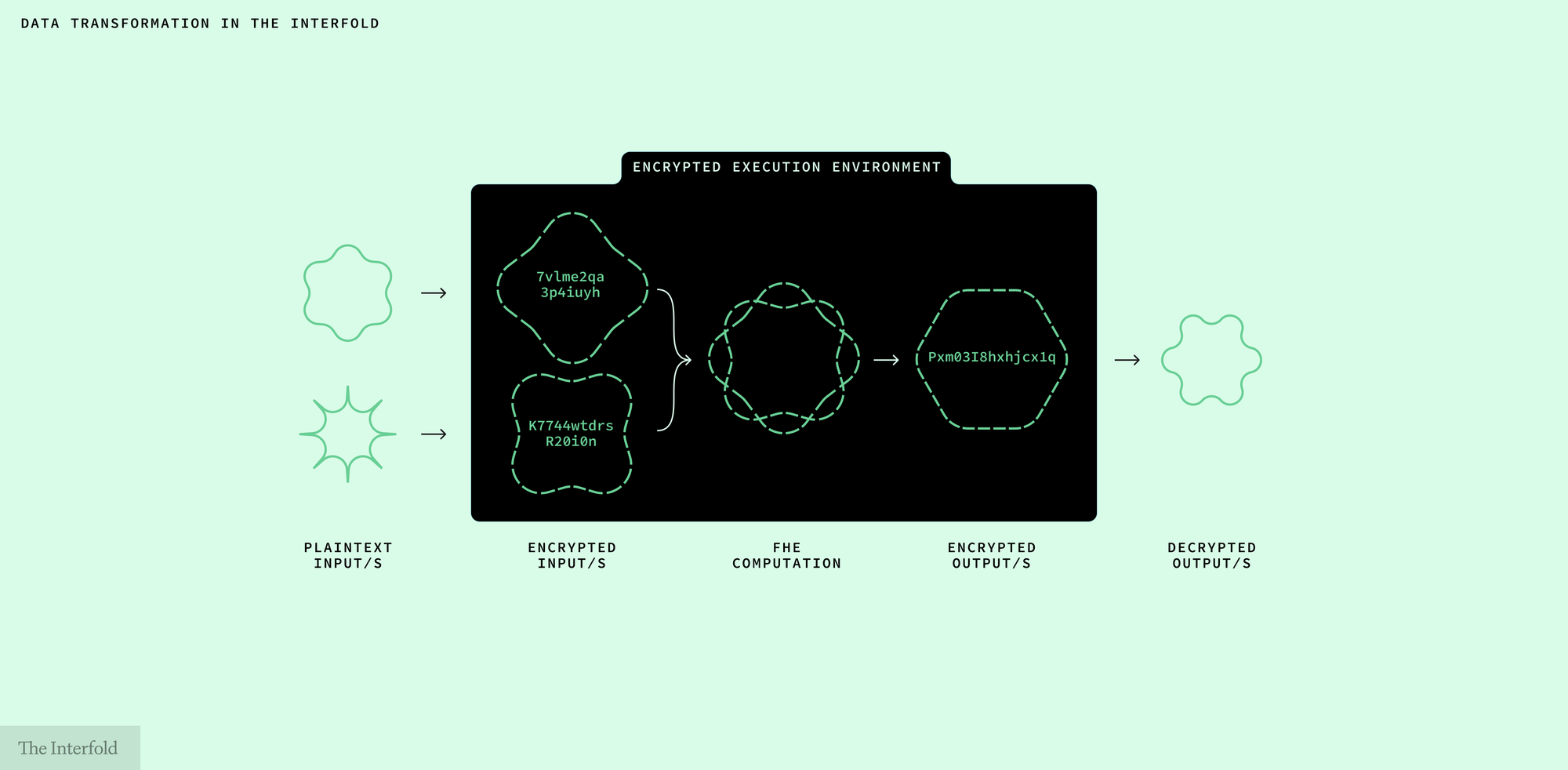
The technology stack supporting this mechanism is made up of three layers: FHE (Fully Homomorphic Encryption) allows calculations to be performed directly on encrypted data; ZK proofs (Zero-Knowledge Proofs) verify whether the computation process is executed honestly; DTC (Decentralized Threshold Cryptography) distributes decryption rights across multiple nodes, eliminating single-point trust risk.
The application scenario that The Interfold currently promotes is CRISP (Coercion-Resistant Impartial Selection Protocol), specifically designed for voting scenarios in DAO governance. CRISP accomplishes three things: voting is encrypted throughout the process, no one can view individual votes before the counting; "receipt-free voting," meaning users cannot prove to third parties what they voted for, fundamentally cutting off bribery pathways; and ZK proofs ensure the verifiability of the counting results.
Currently, two demonstration versions of CRISP have gone live, and the team is in the system integration and internal test net validation phase. Confirmed ecological collaborations include: the privacy governance tool Zecret Ballots from the Zcash community, the mobile DAO governance application Goverland, and joint integration with Aragon and Status App.
Currently, The Interfold does not have a native token, and the official has not released any Token Generation Event (TGE) plans. Early participation revolves around the test net, and whether points can be exchanged for actual rights is presently unknown.
Vitalik's Public Endorsement
On-chain governance bribery is not a new problem, but its measurable scale is rapidly expanding after 2024. In the Curve ecosystem alone, the total amount of bribes circulating through platforms like Votium in 2024 will exceed 120 million dollars; meanwhile, the median voter turnout for various DAO proposals is still hovering in the single digits.
The Ethereum community is not unaware of this issue. In 2019, Vitalik published a research post on ethresear.ch, proposing the concept framework of MACI (Minimal Anti-Collusion Infrastructure), envisioning using cryptographic means to eliminate vote bribery. This post has since been repeatedly cited, but progress in practical implementation has been limited—the MACI scheme relies on a trusted "coordinator" role, who can see all the votes; once the data leaks, the privacy protection immediately fails.
On May 28, 2026, Vitalik publicly endorsed The Interfold on the X platform, stating: "It is basically what I've been shouting for nearly a decade for someone to do, and now it's being realized in a universal form."
The core bet of The Interfold is that a single trusted coordinator is the fundamental bottleneck of MACI, and distributed threshold decryption is the correct path.
Team Background
The Interfold is developed by Gnosis Guild, a team that has long focused on Ethereum DAO infrastructure and is previously well-known in the industry for its modular DAO toolkit Zodiac. Zodiac is one of the most widely used permission and execution frameworks in the Ethereum DAO ecosystem, partnering with several leading protocols. The specific names of core members have not been publicly disclosed through official channels, and the project has no publicly disclosed institutional financing records.
Compared to larger general privacy protocols like Aztec and Zama, The Interfold is a "small but beautiful" project that does not attempt to become a universal privacy infrastructure, but instead focuses on a specific, long-unresolved issue—making on-chain voting truly unpurchaseable. It has modest ambitions, but its target is very precise.
From MACI to The Interfold
Vitalik proposed the concept framework of MACI (Minimal Anti-Collusion Infrastructure) in 2019, which has been deployed in scenarios such as Gitcoin, but it has always had a structural flaw: it requires a trusted coordinator, whose private key, if leaked, invalidates the entire privacy protection framework. The Interfold is a generalized realization of this framework—replacing a single coordinator with a distributed network of cipher nodes, transforming "trusting a person" into "trusting cryptography."
免责声明:本文章仅代表作者个人观点,不代表本平台的立场和观点。本文章仅供信息分享,不构成对任何人的任何投资建议。用户与作者之间的任何争议,与本平台无关。如网页中刊载的文章或图片涉及侵权,请提供相关的权利证明和身份证明发送邮件到support@aicoin.com,本平台相关工作人员将会进行核查。


