When attention, liquidity, and user trading desire are shifting toward AI stocks and traditional assets, crypto exchanges will certainly not just wait in place for the next round of new coin narratives.
Written by: Liu Honglin
Recently, there has been an interesting change in the crypto community.
In the past, many people in the crypto space looked down upon the US stock market. They criticized it for being slow, for having insufficient price increases for stimulation, for needing to open and close, and for not being able to trade 7 days a week, 24 hours a day like on-chain assets.
At that time, people preferred to discuss public chains, DeFi, NFTs, memes, and the next cycle of hundred-fold narratives. The US stock market was seen as a representative of the backwardness of the crypto circle; in many people's eyes, it was a product of traditional finance, too conventional and too boring.
But things are different now. More and more crypto traders are starting to focus on names like Nvidia, Microsoft, Apple, Tesla, and OpenAI. Entrepreneurs are looking at AI, investors and speculators are watching Nasdaq, and exchanges are starting to incorporate traditional financial assets such as US stocks, ETFs, gold, and foreign exchange into their crypto account systems.
There is somewhat of an "once indifferent, now learning frame by frame" feeling.
Of course, partners in the crypto community have not suddenly fallen in love with value investing. The reality is that the narratives within the crypto market have decreased, and liquidity is not as abundant as before. After the Bitcoin ETF, mainstream assets are increasingly priced by macro funds and traditional financial products; the continued allure of altcoins, memes, and purely on-chain stories is diminishing; the AI wave has brought the hottest global money, the strongest entrepreneurs, and the best storytellers back to the traditional market.
When attention, liquidity, and user trading desire are shifting toward AI stocks and traditional assets, crypto exchanges will certainly not just wait in place for the next round of new coin narratives.
Thus, this round of on-chain US stocks heating up is not only a re-narration of RWA but is also a learning experience for crypto exchanges regarding reality: if users are no longer satisfied with just buying coins, then the platform must bring in the assets that users want to trade.
Attention has shifted to US stocks
The impact of AI on the crypto industry is not just about whether the "AI + Crypto" track has gained traction. A more direct impact is that it has changed the direction of market attention.
In the past, the crypto market excelled at creating new asset symbols. A new public chain, a new protocol, or a new economic model could attract funding pursuits. But this time, AI is different. It features real companies in the traditional market, has income growth, investments in computing power, cloud service orders, supply and demand for chips, and company financial reports. Investors may not understand the intricacies of large model training, but they can understand how much Nvidia has risen, how much Microsoft has invested, whether Apple will engage with AI, and whether Meta will continue to spend money on computing power.
This poses a real pressure on the crypto market.
Previously, the attention of many entrepreneurs, investors, and speculators naturally fell on new on-chain assets. Now, the same group of people spends time on AI companies, traditional US stocks, options, stock indices, gold, and macro trading. The strongest capability of the crypto circle used to be the ability to generate the imagination of "the next big thing"; however, when a stronger big event arises in the external world, the internal narratives in the industry are obviously not compelling enough.
Exchanges are the first institutions to feel this change. If users do not come to trade, the platform earns no transaction fees; if users only want to trade BTC and ETH, the platform's growth is limited; if users' funds and attention run to US stocks, AI stocks, ETFs, and gold, the platform must find a way to bring these assets back into its account system.
This is also why different exchanges have been actively promoting the tokenization of assets such as US stocks recently.
Exchanges start to learn
On-chain US stocks may sound like "putting stocks on the chain," but the truly difficult part does not lie in the words "on-chain."
The difficulty lies in the entire set of traditional financial rules behind the stocks. Who holds the underlying stocks? Where are the assets held in custody? Is what users are buying stocks, certificates, derivatives, or just internal price exposure from the platform? How are dividends, stock splits, mergers, trading suspensions, and delistings handled? After a platform goes bankrupt, do users have rights to the underlying assets? Which regions' users are prohibited from buying? How is identity verification and suitability managed?
Many in the crypto circle did not care for these questions in the past. People preferred to discuss decentralization, permissionlessness, and free movement. But once the underlying assets become Apple, Nvidia, Tesla, and S&P ETFs, exchanges cannot simply use a set of "on-chain freedom" rhetoric to solve all problems. They must learn frame by frame from traditional finance: how brokers manage custody, how funds disclose information, how exchanges handle corporate actions, and why regulators care so much about investor protection.
For example, when it comes to on-chain US stocks, mainstream exchanges currently have several different development models:
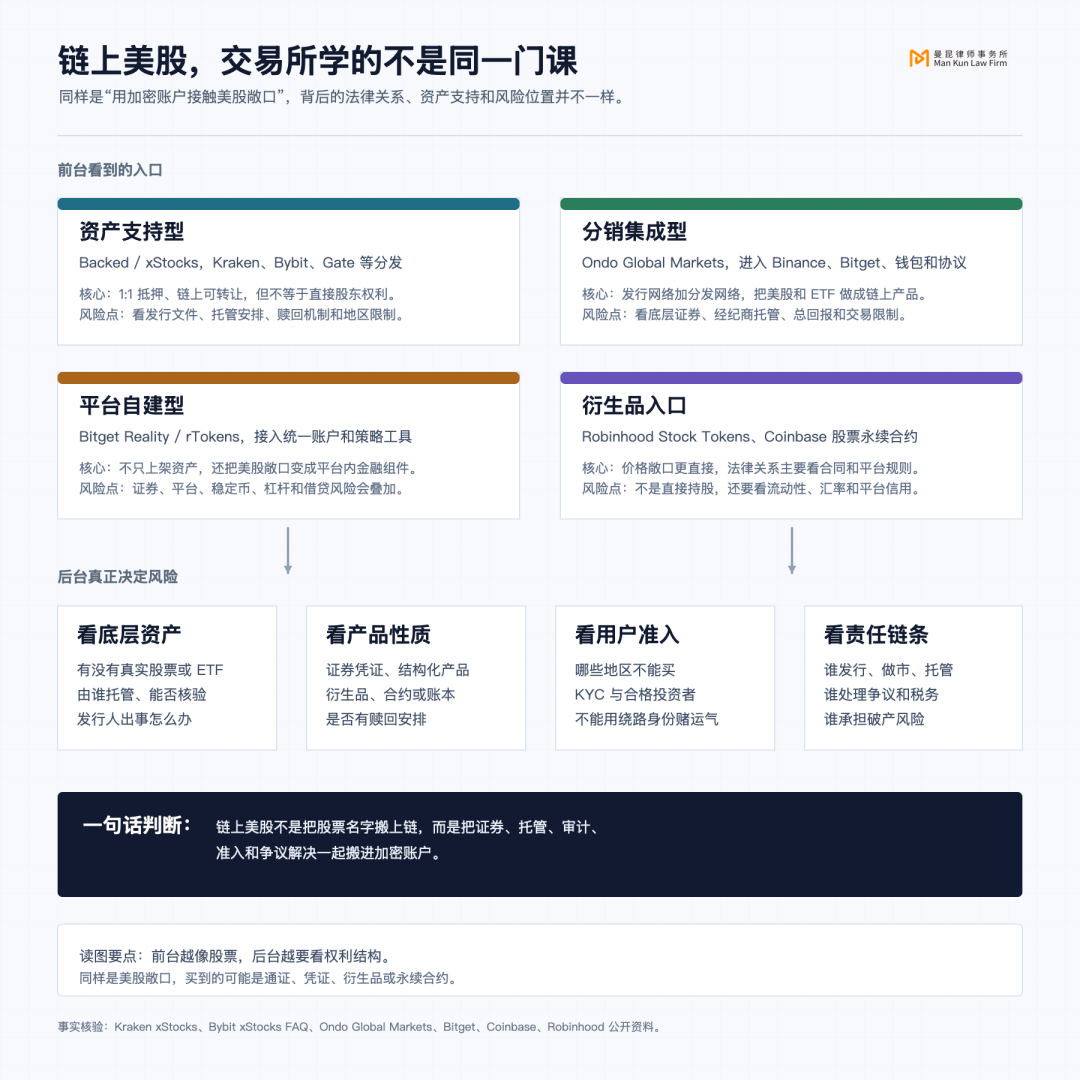
On-chain US stocks; exchanges are not all taking the same course
These product fronts may look quite similar: users see stock codes, real-time prices, price changes, buy and sell buttons, and settle with stablecoins like USDT and USDC. But the legal relationships behind are entirely different.
The models are different
The first type is the asset-backed path like xStocks under Backed. The core logic of xStocks is to create on-chain transferable tracking certificates for publicly listed stocks or ETFs. Kraken’s page indicates that xStocks is available to select non-US users, can be traded 24/5 on Kraken, and can be transferred on-chain 24/7 after mentioning self-custody wallets. Kraken also clearly states that xStocks is not open to users in the US, Canada, the UK, Australia, and other regions, and holders obtain price exposure rather than traditional voting rights in stocks.
The xStocks FAQ on Bybit also addresses the issue directly: investing in xStocks does not equate to direct investment in the underlying stocks or companies, and holders will not gain voting rights, dividend rights, or legal claims against the underlying shares during corporate liquidation. Bybit further distinguishes between xStocks spot and stock CFDs, or contracts for difference, into two different entry points. This distinction is important because, while both relate to the prices of Apple and Nvidia, the rights relationships behind the spot tokens and the contract products are entirely different.
The second type involves models like Ondo Global Markets, which use an issuance and distribution network. Ondo disclosed on May 11, 2026, that the total locked value of Ondo Global Markets has exceeded $1 billion, covering more than 260 US stocks and ETFs, and reaching users through networks like Solana, Ethereum, and BNB Chain, as well as wallets and exchanges such as Binance, Bitget, and MetaMask. It emphasizes that each token is backed by underlying securities held by a registered broker-dealer in the US and tracks total return, including dividends.
This model's key point is the collaboration among the issuer, custodian, on-chain contracts, wallets, and exchanges to form a distribution network. Exchanges play more of a role as entry points and liquidity providers, allowing users to access traditional financial assets within a familiar crypto interface.
The third type is a more platform-based approach, like that of Bitget. In 2026, Bitget categorized US stock trading into two major categories: tokenized stocks and USDT-margined perpetual stocks. Its clear intent is to allow users to trade crypto assets, stock-related products, ETFs, gold, and other assets within a single so-called Universal Exchange account without leaving their crypto accounts to open brokerage accounts.
In March 2026, Bitget further integrated tokenized stocks and ETFs from Ondo Global Markets into the spot market, covering names like Tesla, Nvidia, Apple, Microsoft, Amazon, Meta, and AMD. By May 2026, it launched Reality, focusing on rTokens, on-chain certificates pegged 1:1 with US stocks or ETFs. Public information indicates that Reality aims to connect functionalities like underlying asset custody, proof of reserves, dividend distributions, stock splits and mergers mapping, unified account margining, grid trading, copy trading, and lending and borrowing.
This step is quite representative. It indicates that exchanges are not satisfied with merely "listing a stock token trading pair," but rather want to convert the US stock exposure into financial components within the platform. What users buy is not just a price symbol, but it might also be used as margin, in strategies, and participation in lending. While convenience indeed increases, risks also accumulate: security risks, platform risks, stablecoin risks, leverage risks, and liquidity risks will intersect within the same account.
The fourth type is a path more focused on derivatives or compliance market entry, like Robinhood and Coinbase. In 2025, Robinhood launched Stock Tokens in the EU, currently showcasing over 2,000 stock tokens related to US stocks and ETPs (exchange-traded products), but it also clearly states: Stock Tokens are derivative contracts between users and Robinhood, reflecting the price of the underlying securities but not conferring rights to the underlying securities, and it involves risks like liquidity, currency exchange, and bankruptcy of service providers.
Coinbase takes a somewhat different path. In March 2026, it launched perpetual contracts for stocks, providing qualified users outside the US with a 24/7 leveraged synthetic exposure to US-listed stocks, settled in USDC, and integrated with the derivatives system of Coinbase International Exchange. This path does not give users direct possession of on-chain stocks but leverages the perpetual contract engine familiar to crypto exchanges to meet users’ trading needs for US stock prices.
When looking at these categories together, one can see that exchanges focusing on on-chain US stocks do not mean they are all doing the same thing. Some platforms are creating securities tokens, some are doing distribution, some are building multi-asset accounts, and some are engaged in synthetic derivatives. They collectively learn about the traffic and trading demand for traditional financial assets, but their chosen legal structures and risk management approaches differ.
Opportunities are in the back end
For entrepreneurs, on-chain US stocks certainly present opportunities, but the opportunities do not lie in "helping retail investors circumvent the traditional route to buy US stocks."
If a team promotes on-chain US stocks to domestic users, teaching them how to register, how to deposit funds, conducting commission-based lead generation, providing Chinese customer service, organizing community investment advisory, handling trading instructions, or providing software, website operations, customer service, and marketing support for offshore platforms within the country, changing the entry from a brokerage app to a wallet and the settlement currency from dollars to stablecoins does not automatically change the nature of risks involved.
More realistic opportunities may lie in the back-end.
Issuers need underlying asset custody and proof of reserves, independent audits, KYC, AML (anti-money laundering), and KYT (on-chain transaction risk monitoring). Trading platforms require address risk scoring, sanctions list screening, user regional restrictions, qualified investor determinations, suspicious transaction monitoring, risk disclosure, and transaction behavior records. Wallets and protocols need oracles, price deviation alerts, liquidation modules, transfer restrictions, smart contract audits, handling of corporate actions, and tax reconciliation tools.
These tasks may not sound as lively as "buying Nvidia on-chain," but they are much closer to long-term chargeable infrastructure businesses.
Especially for Chinese Web3 teams, if you are serving compliant offshore issuers, licensed brokers, asset management institutions, custodians, wallets, or exchanges, and if your business structure is clear, does not touch user funds, does not facilitate trading for domestic users, does not market to the domestic public, and does not make yield promises, the compliance space will be much larger than directly engaging in C-end trading channels.
However, claiming "I am just a tech provider" cannot serve as an all-purpose shield. Entrepreneurial teams need to reverse look at their revenues and system integration positions: who are the clients, what data does the system process, whether it transmits trading instructions, whether it interacts with user funds, whether it charges based on transaction volume or commissions, whether it know that the counterpart is acquiring users uncompliantly, and whether it actually helps the platform achieve domestic sales through content and community. A compliance risk management tool and a system that helps offshore platforms acquire users, open accounts, deposit, and trade domestically have entirely different legal natures.
Personal players should take note
For individual users, the main reminder about on-chain US stocks is not to confuse a "trading page resembling stocks" with "I already own stocks."
First, one must check what exactly is being bought. Is it a certificate supported by underlying stocks, a structured product, a platform derivative contract, or a perpetual contract for stocks? Is there a redemption mechanism? Are there voting rights? How are dividends handled? When the platform or issuer goes bankrupt, do users have rights to the underlying assets? These questions do not reside in the price candlesticks but in legal documents, risk disclosures, and product terms.
Second, one must consider their identity limitations as a purchaser. Many products target non-US users, but "non-US" does not mean "anyone in the world can buy," and it definitely does not mean that residents in mainland China can circumvent platform restrictions to buy directly. If a user accesses the platform through a VPN, an offshore phone number, a nominee identity, or a false identity, it may seem successful in the short term, but once risk control, freezing, clearance, or disputes are triggered, the difficulty of protecting rights will significantly increase.
Third, one must be mindful of the compliance of fund sources. Domestic individuals purchasing foreign exchange and investing in offshore securities already have boundaries. If a person originally cannot legally use their personal exchange quota to buy offshore stocks, changing the game to first convert to stablecoins and then buy on-chain US stocks does not make the fund's purpose compliant just because there is an extra layer of wallet routing. On February 6, 2026, the People's Bank of China, the China Securities Regulatory Commission, and six other departments released an announcement warning against the risks of virtual currencies (Yin Fa [2026] No. 42), clearly stating that virtual currency does not hold equivalent legal status to fiat currency, and listing activities such as exchanging fiat for virtual currency, exchanging between virtual currencies, token issuance financing, and trading of financial products related to virtual currencies as strictly prohibited illegal financial activities under the law. The document also includes the tokenization of real-world assets within the regulatory framework. In the context of on-chain US stocks, if domestic users access offshore stock tokens using stablecoins, the risks may simultaneously cross over from securities investments, foreign exchange questions, virtual currency trading, anti-money laundering, taxation, and cross-border disputes.
US regulations have not treated "going on-chain" as magic. The US Federal Securities Age's statement on tokenized securities issued in January 2026 posits that if a financial tool qualifies as a security, it does not change the applicability of US federal securities laws even if it is represented as a crypto asset or ownership records are maintained on one or multiple crypto networks.
Learning frame by frame
The matter of on-chain US stocks is not merely about "the crypto circle can finally buy US stocks," but rather that the crypto industry is beginning to acknowledge that it must learn traditional finance.
Once, people considered traditional finance to be slow, cumbersome, conservative, and paperwork-heavy. Looking back now, many of those frustrating aspects are precisely the foundations that allow financial products to operate over the long term. Custody, auditing, suitability, investor protections, corporate actions, taxation, and dispute resolution may not seem sexy when viewed individually, but if any link is missing, truly asset transactions on-chain could turn into an appealing but dangerous trading page.
Therefore, I do not think that on-chain US stocks are just a short-term fad. They reflect a change in the identity of crypto exchanges: exchanges no longer just want to be places for trading crypto assets but are transforming into comprehensive financial gateways. In the future, users might view BTC, ETH, Nvidia, S&P ETFs, gold, forex, and stablecoin yield products all within the same account. If this direction is successfully pursued, crypto accounts could increasingly resemble a global financial operating system.
However, this process will not become simpler just because blockchain is being used. Quite the opposite, the closer it approaches real financial assets, the more it must confront genuine financial rules.
For entrepreneurs, opportunities lie in infrastructure and compliance services, not in finding regulatory loopholes to help users. For individual users, the value is in understanding the new asset forms, not treating it as a new avenue to circumvent securities, forex, and virtual currency regulations.
In the past, the crypto market liked to say it would change traditional finance. Now it is beginning to learn frame by frame from traditional finance.
This is the lesson the crypto market must supplement as it transitions from a narrative-driven market to a financial market.
This turn may not be romantic, but it is very real.
免责声明:本文章仅代表作者个人观点,不代表本平台的立场和观点。本文章仅供信息分享,不构成对任何人的任何投资建议。用户与作者之间的任何争议,与本平台无关。如网页中刊载的文章或图片涉及侵权,请提供相关的权利证明和身份证明发送邮件到[email protected],本平台相关工作人员将会进行核查。
