344 million USDT has been frozen, and the whereabouts of the remaining 656 million remain a mystery.
Written by: Gino Matos
Translated by: Saoirse, Foresight News
Key Points Summary
- Finance Minister Scott Bessent stated that the U.S. has seized approximately $1 billion of Iranian crypto assets, but did not disclose the related wallet addresses and token composition.
- Asset classification is crucial: Bitcoin, after being legally confiscated, can be included in Trump’s strategic Bitcoin reserve, while the remaining tokens will be disposed of separately.
- There is no conclusion on whether the assets are in a frozen, seized, or formally confiscated stage; the legal status directly determines whether the funds can be included in the reserves.
Finance Minister Scott Bessent stated at the Reagan National Economic Forum that the U.S. has seized approximately $1 billion of Iranian crypto assets. This seizure of Iranian assets has become the first practical test after the launch of Trump’s crypto reserve system. Bessent added that the U.S. "directly took over the wallets involved," and CBS reported that he characterized this asset as funds stolen from the Iranian people. However, Bessent did not disclose the types of assets and corresponding wallet information, and this key information directly determines whether the funds can flow into Trump’s strategic Bitcoin reserve.
According to an executive order issued by Trump in 2025, digital assets under the U.S. government are categorized into two independent accounts: the strategic Bitcoin reserve, which is specifically for Bitcoin confiscated through civil or criminal judicial procedures or collected through civil fines. The decree clearly states that Bitcoin deposited into this account is permanently banned from being sold; the other account is the U.S. digital asset reserve, which stores non-Bitcoin digital assets that have been finally confirmed confiscated. This classification rule makes the seizure of Iranian crypto assets a classification test: Bitcoin can only be included in the strategic Bitcoin reserve after completing the final confiscation process; all other types of tokens are classified into the U.S. digital asset reserve.
If the seized Iranian assets include Bitcoin and the legal confiscation is successfully completed, they can be included in the reserves; if they are stablecoins or other types, they will most likely be classified into the reserve. Another possibility exists: the assets may only be in a frozen state, meaning the U.S. has not yet acquired legal ownership of the assets.
Clarifying the Actual Legal Meaning of the Term "Seizure"
As early as April, the U.S. Treasury imposed sanctions on several wallets associated with Iran, and Tether simultaneously disclosed that it cooperated with U.S. regulatory authorities to freeze two addresses totaling $344 million USDT. Blockchain risk management firm TRM Labs verified that the aforementioned wallets are linked to the Iranian Central Bank, the Quds Force, and Hezbollah; the remaining approximately $656 million in assets has no public details broken down by wallet or by type.
"Actual seizure" ≠ "Legal ownership," OFAC sanction rules clearly state: blocked assets are only subject to account freezing, and the U.S. does not automatically acquire ownership of the assets. Taking USDT, a type of stablecoin, as an example, the issuer cooperating with the authorities to lock the addresses constitutes a sanctioned frozen account, not a judicial confiscation in the criminal sense; law enforcement’s seizure only represents temporary government control over the assets, and ownership is still subject to waiting for a confiscation lawsuit ruling.
Final confiscation is a hard threshold for assets to be included in the reserves: after the assets complete the confiscation process, amounts for victim compensation, law enforcement special expenses, fund allocation to local law enforcement agencies, and legal exemptions for return must be deducted; only the remaining assets qualify for inclusion in the reserves or reserve accounts. Bessent's statements to the public raise doubts about the legal status of this asset.
Based on the current Bitcoin price of approximately $73,000, if the $1 billion is entirely in Bitcoin, that equates to about 13,632 BTC. Data from 2025 shows that the U.S. government has retained approximately 200,000 compliant Bitcoins through past judicial procedures; if this amount of BTC is included, the increment would account for 6.8% of the current reserve volume. Currently, the only public record is the frozen case involving 344 million USDT, while there are no public disclosures regarding the token types or the legal confirmation process of the remaining $656 million; no assets have completed the legal confiscation procedures.
Basis for the Industry Scale of the 1 Billion Seized Amount
From the scale of the Iranian crypto industry, the seized amount of $1 billion is reasonable, but the asset composition remains opaque.
Chainalysis estimates that in 2025, the total volume of crypto transfers in Iran will reach $7.78 billion. In the fourth quarter of 2025, funds related to the Iranian Revolutionary Guard accounted for 50% of the country’s total crypto trading volume; TRM Labs also estimated that Iran’s total annual crypto activities would be nearly $10 billion. Iran’s leading exchange, Nobitex, has about 11 million users and handles 70% of domestic crypto trading. Investigations show that this platform has long processed hundreds of millions of dollars in transfers for sanctioned entities such as the Iranian Central Bank and the Revolutionary Guard.
Combining the above industry data, the U.S. enforcement actions and the issuer's frozen accounts totaling $1 billion in assets are reasonable within industry logic, but the specific asset details cannot be verified. The declared 344 million USDT only accounts for 33% of the total amount, and the remaining 65.6% of the funds' whereabouts remain a mystery.
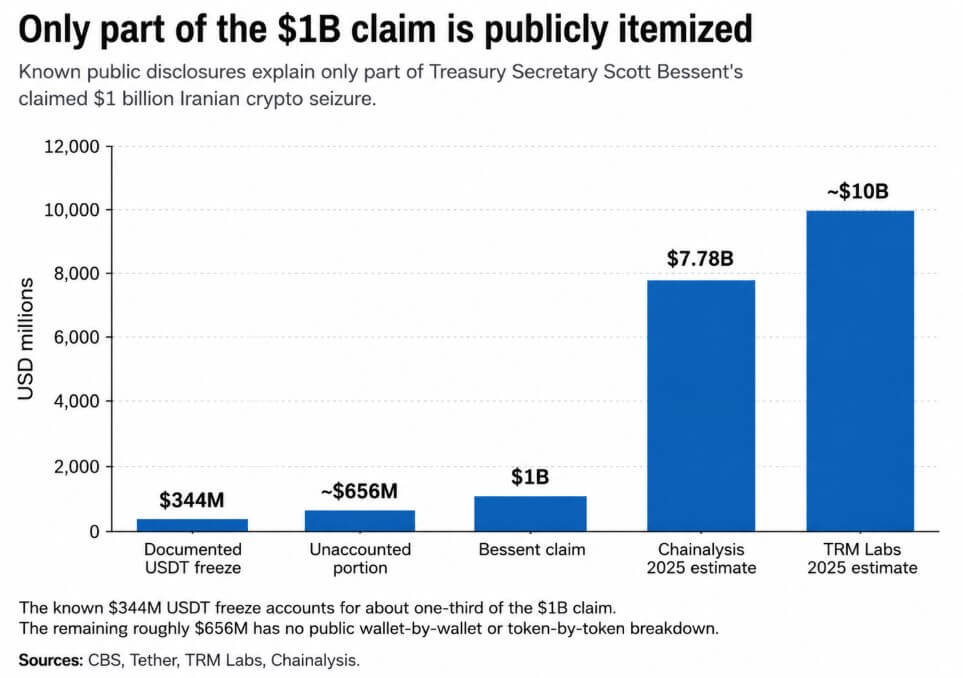
The known 344 million USDT frozen only accounts for 33% of the $1 billion Iranian crypto asset seizure amount claimed by Bessent, with 656 million dollars remaining unaccounted for.
Speculation on the Structure and Direction of the Seized Assets
If the $1 billion includes a substantial amount of Bitcoin, and the U.S. completes the property confiscation without compensation to victims or reallocating for law enforcement expenses, the corresponding Bitcoin would enter the strategic reserves where selling is prohibited. Originally used by Iran to circumvent U.S. financial sanctions, the crypto assets would be transformed into sovereign reserve assets of the U.S. through sanction enforcement.
The only confirmed asset at present is the 344 million USDT, frozen at the cooperation of Tether with regulatory authorities. If the remaining 656 million is also primarily stablecoins, the essence of this incident is a compliance regulatory case for stablecoins. The frozen USDT will continue to be locked; non-Bitcoin assets will move to the digital asset reserve after completing confiscation, with the Finance Minister fully responsible for subsequent disposal plans. A complete list of wallets and token types would directly change the nature of the event: either it is a tangible accumulation of U.S. sovereign coins, or just the compliance regulation of stablecoins, while Bessent has not disclosed any details at this stage.
The executive order also stipulates that confirmed assets can be returned to the rights holders, allocated for case expenses, profit-sharing to state law enforcement agencies, and legally exempted from return; any of these situations will block the assets from entering the reserves. These provisions create multiple checkpoints for assets to transition from "seized" to "treasury reserve," which can be triggered at any point before or after confiscation.
The institutional framework established by Trump’s reserve decree means that all future crypto seizures targeting hostile nations will become matters of U.S. sovereign asset management.
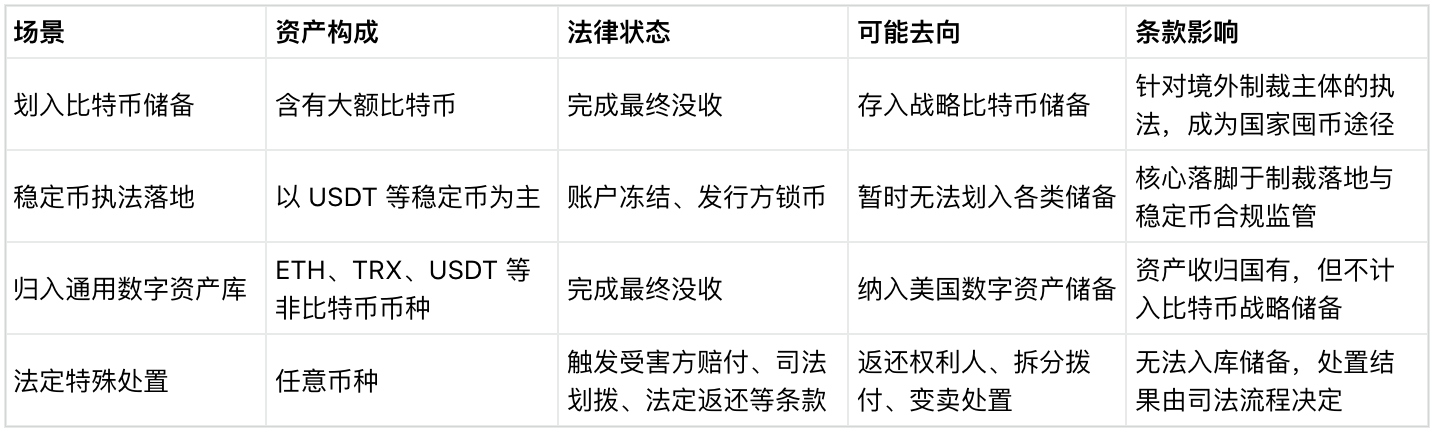
In the future, every crypto enforcement action by the U.S. against sanctions subjects like Iran and North Korea will involve three determinations: type of coin, legal status, and which treasury account it falls into. Only if all three major conditions are met — the object is Bitcoin, the legal confiscation is completed, and there are no compensation and allocation exemptions — will this Iranian asset be expected to supplement the U.S. strategic reserves. As long as it successfully navigates the two thresholds of confiscation process and legal exemptions, the crypto assets originally used to bypass U.S. financial controls will, in turn, become part of U.S. sovereign assets.
免责声明:本文章仅代表作者个人观点,不代表本平台的立场和观点。本文章仅供信息分享,不构成对任何人的任何投资建议。用户与作者之间的任何争议,与本平台无关。如网页中刊载的文章或图片涉及侵权,请提供相关的权利证明和身份证明发送邮件到support@aicoin.com,本平台相关工作人员将会进行核查。


