Author: Cosmo Jiang
Compiler: Deep Tide TechFlow
Deep Tide Guide: Pantera Capital's annual report reveals the brutal truth about the crypto market in 2025 — this is not a year driven by fundamentals, but dominated by macroeconomic conditions, positioning, and market structure. Bitcoin only fell 6%, but most tokens plummeted 60%, leading to extreme market fragmentation. For investors and practitioners looking to survive in 2026, understanding these drivers is more important than blind optimism.
2026 Market Outlook
The returns of the crypto market in 2025 were not driven by fundamentals. It was a year dominated by the macro environment, positioning, capital flows, and market structure effects — especially for assets outside Bitcoin.
Looking back at the timeline of significant macro and policy turning points throughout the year helps explain why the market has been so incoherent.
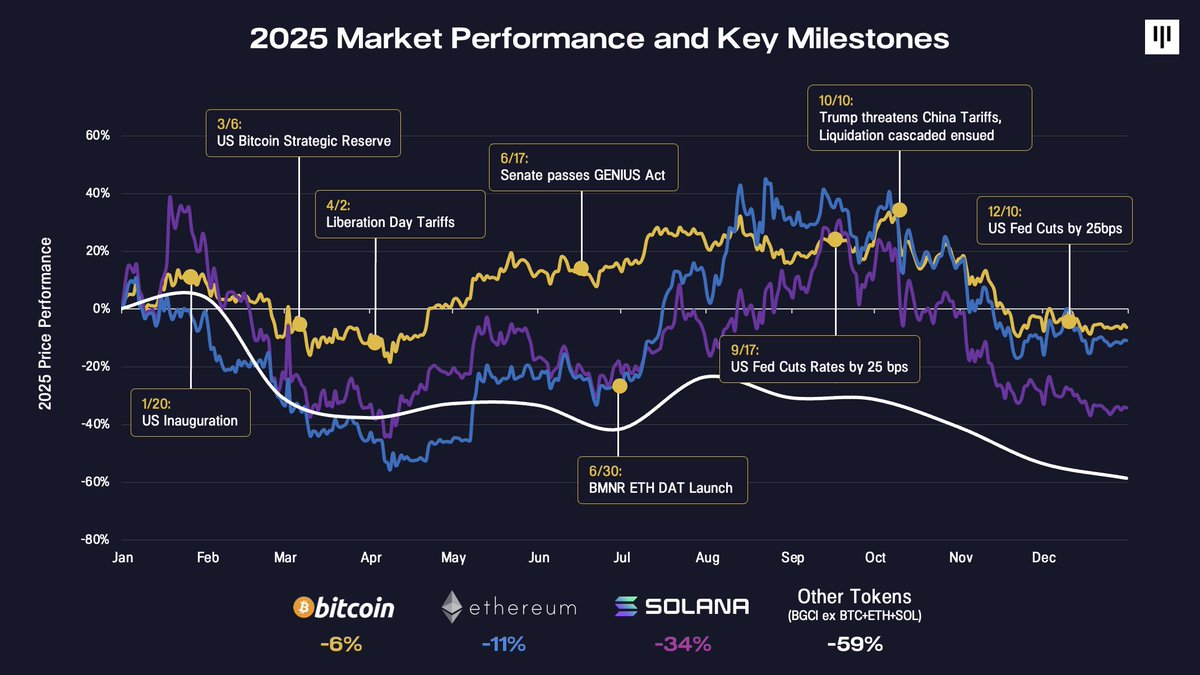
The year kicked off with the inauguration of the U.S. President, which ultimately proved to be a classic "sell-the-news" moment, and an early warning for volatility. For the following months, risk appetite fluctuated — from optimism over the U.S. strategic Bitcoin reserve announcement to renewed pressures brought by the "Day of Liberation" tariffs. Mid-year saw constructive progress, including the passage of the GENIUS act, the rise of Digital Asset Treasuries (DATs) like Bitmine Immersion, and the Fed beginning to cut interest rates, stabilizing market sentiment for several months.
The fourth quarter brought a decisive turning point with multiple challenges emerging simultaneously. The sell-off on October 10 triggered the largest wave of liquidations in crypto history — surpassing the Terra/Luna collapse and FTX bankruptcy period — wiping out more than $20 billion in nominal positions. The market needed time to absorb this shock. Meanwhile, key marginal buyers (DATs) for the year began to exhaust their incremental purchasing power. This downward momentum was exacerbated by seasonal pressures, including tax-loss selling (especially within ETFs and DATs), portfolio rebalancing, and year-end systematic CTA flows.
Bitcoin ended 2025 slightly down, falling about 6%. Ethereum dropped approximately 11%. After that, the performance dramatically worsened. Solana fell 34%, and the broader token universe (BGCI excluding BTC, ETH, and SOL) saw a decline of nearly 60%.
This was an extremely narrow market. When observing the return distribution of the token universe, this fragmentation becomes even starker.
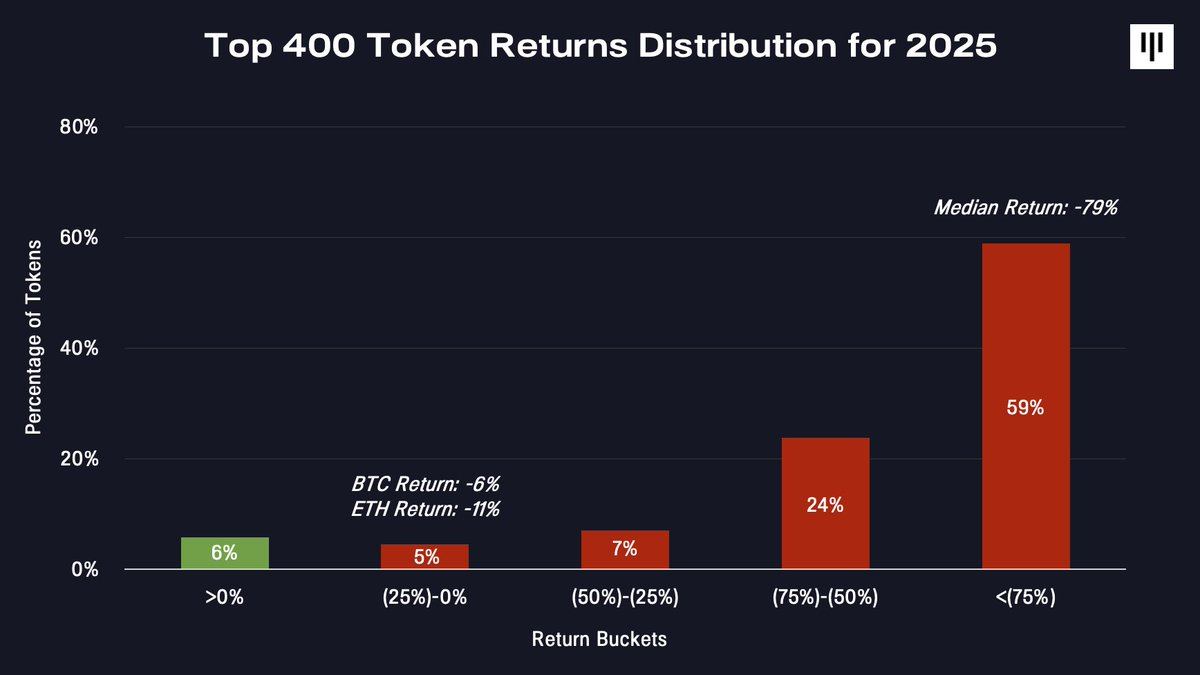
Only a small fraction of tokens generated positive returns. The vast majority experienced deep drawdowns — the median token dropped by 79%.
A Year-Long Altcoin Bear Market
The most underestimated reality of 2025 might be that the non-Bitcoin token market actually entered a bear market back in December 2024.
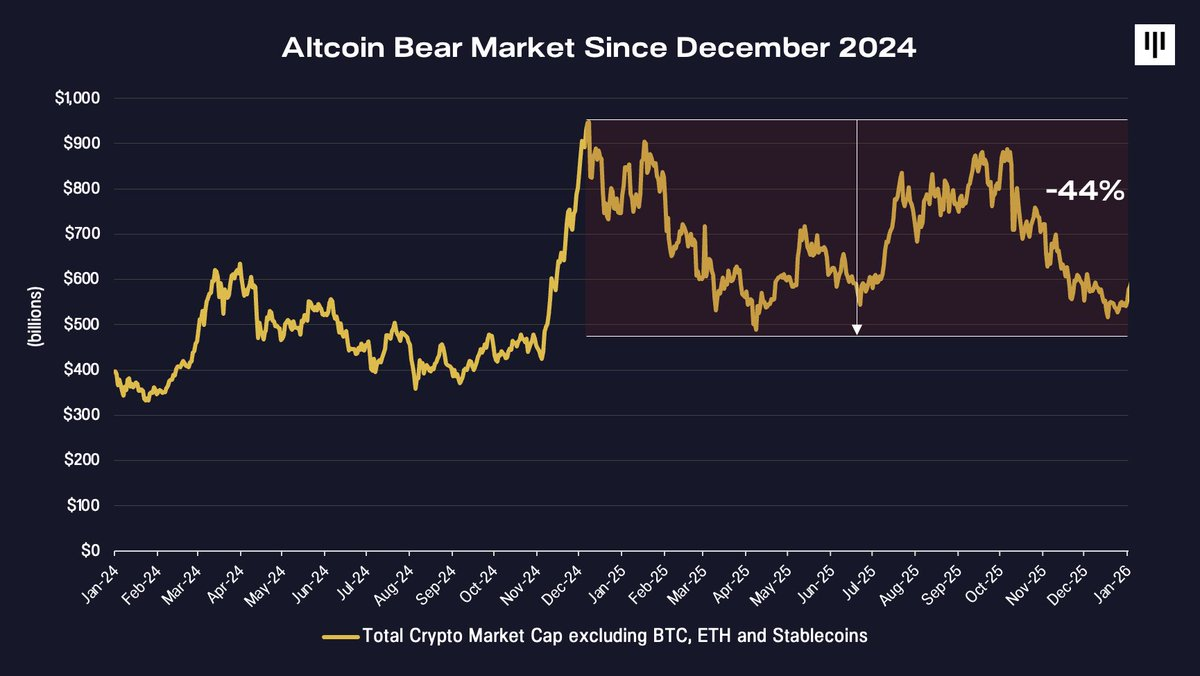
Excluding Bitcoin, Ethereum, and stablecoins, the total cryptocurrency market cap peaked at the end of 2024 and has since been on a slow decline — dropping about 44% by the end of 2025. From this perspective, a year that looked at least somewhat good for Bitcoin was a continuation of an unresolved bear market for other parts of the market.
Portfolios heavily exposed to mid and small-cap tokens faced structural challenges.
The divergence between Bitcoin and the broader token market reflects fundamental differences. Bitcoin benefits from a single, widely understood narrative — digital gold — and increasingly from mechanical demand driven by sovereign nations, governments, ETFs, and corporate treasuries. In contrast, other tokens represent a heterogeneous array of disruptive technologies with less standardized access, less institutional support, and more complex value capture dynamics.
This divergence is clearly manifested in prices.
Structural Resistance Facing Tokens
In 2025, multiple forces increased the pressure on the broader token complex.
1. Value Accumulation and Investor Rights
One of the most persistent challenges is the unresolved issue surrounding value accumulation. In traditional stock markets, shareholders benefit from clear legal claims to cash flows, governance, and residual value. In contrast, tokens often rely on protocol-level mechanisms that are enforced by code rather than governmental institutions.
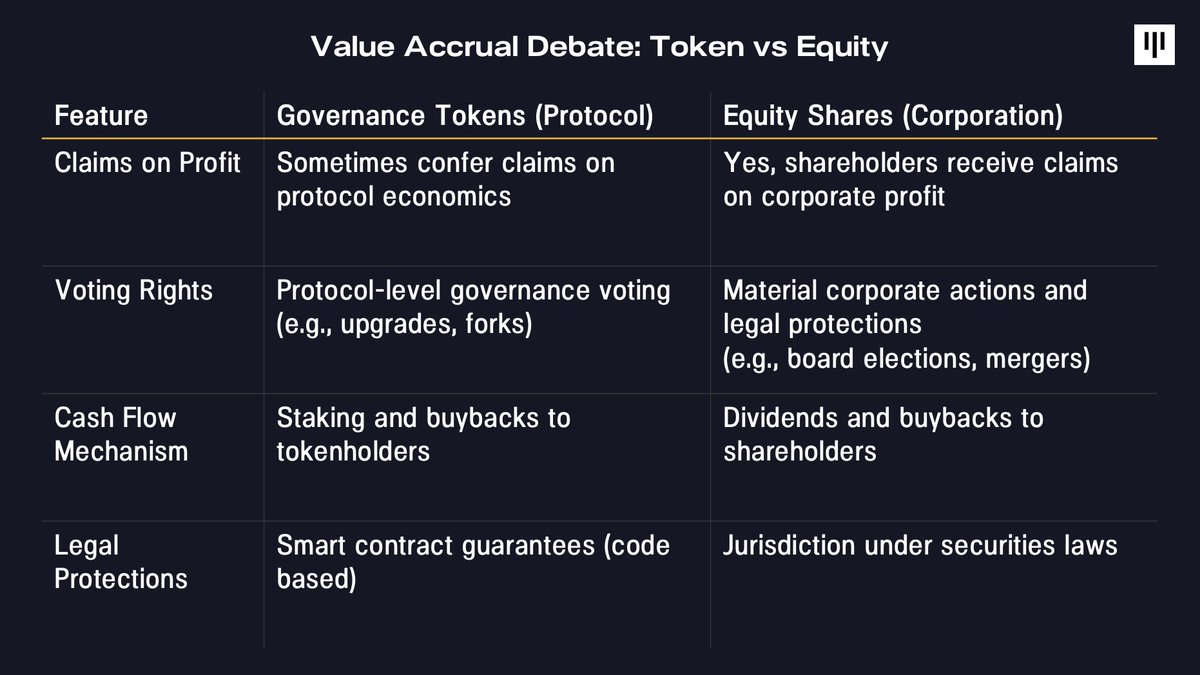
This year, several high-profile cases brought this tension to the forefront, especially when token-based ecosystems were acquired or reorganized without direct compensation to token holders, including Aave, Tensor, and Axelar. These events resonated throughout the market, even undermining confidence in projects with relatively robust tokenomics.
In this context, digital asset equities outperformed tokens, benefiting from clearer pathways to value capture when investors were already seeking defensive plays.
2. On-Chain Activity Slows
The on-chain fundamentals also softened in the second half of the year.
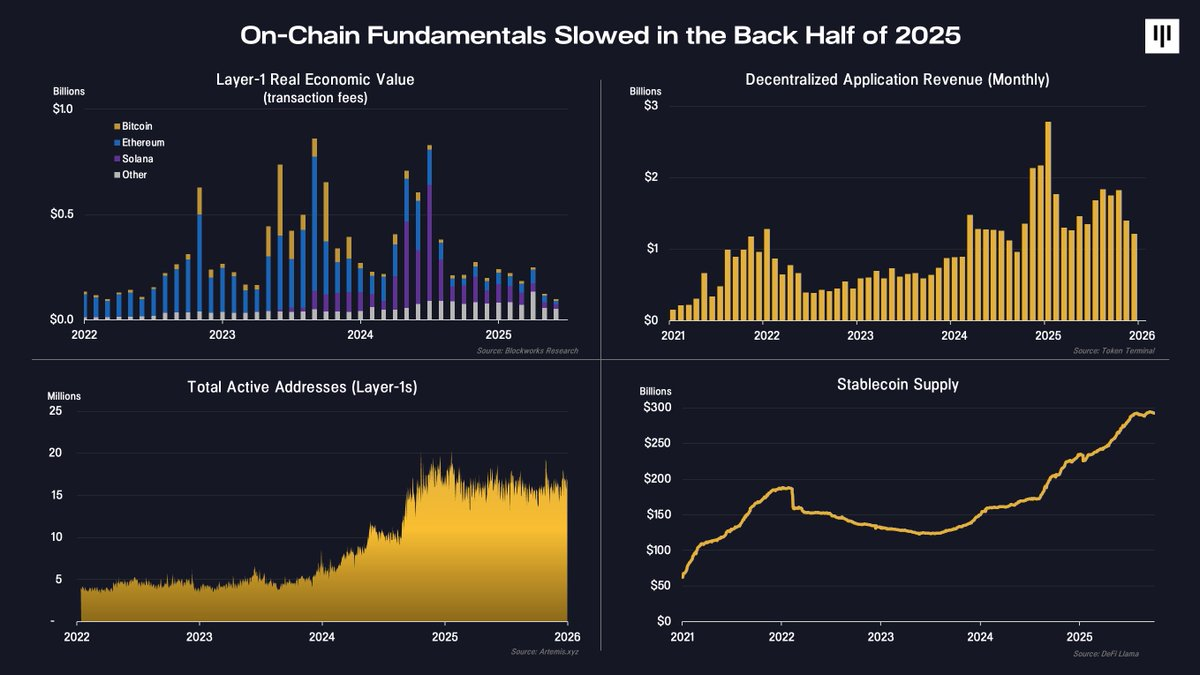
On key metrics — including layer one network revenue, decentralized application fees, and active addresses — activity slowed. Notably, stablecoin supply continued to grow, indicating ongoing adoption of blockchain for payments and settlements. However, much of the economic value related to stablecoins flowed into off-chain equity-based businesses rather than token-based protocols.
In practice, the underlying layer of usage persists, but marginal, pro-cyclical activity has declined. This shift is directly reflected in token price trends.
3. Rotation of Speculative Capital
Finally, capital flows reversed. The marginal capital supporting the broader token space has historically been speculative retail. While institutional adoption continues to grow, it remains primarily concentrated in assets accessible via ETFs, including Bitcoin, Ethereum, and Solana towards the end of the year.
In 2025, speculative attention shifted to other areas.
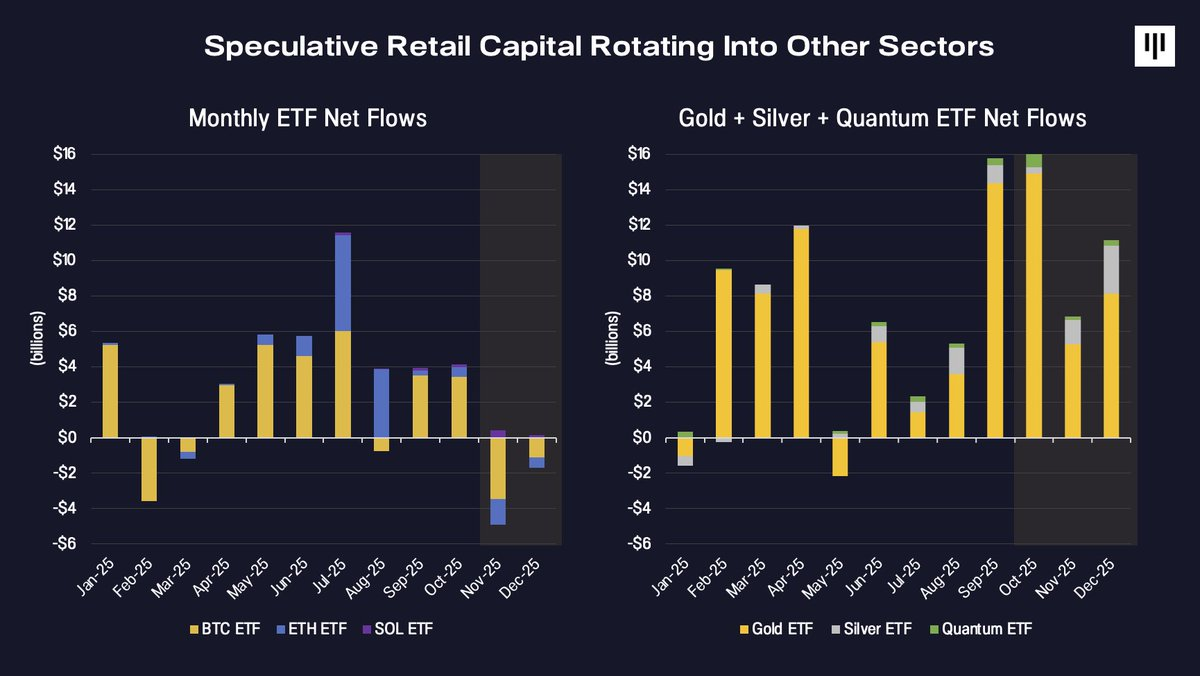
Significant inflows into ETFs for gold, silver, and emerging thematic trades like quantum computing occurred, while funds flowing into digital asset ETFs slowed and turned negative by year-end. This rotation coincided precisely with the deterioration in token breadth, reinforcing downward momentum.
Sentiment, Positioning, and Historical Context
By year-end, sentiment compressed to levels historically associated with capitulation.
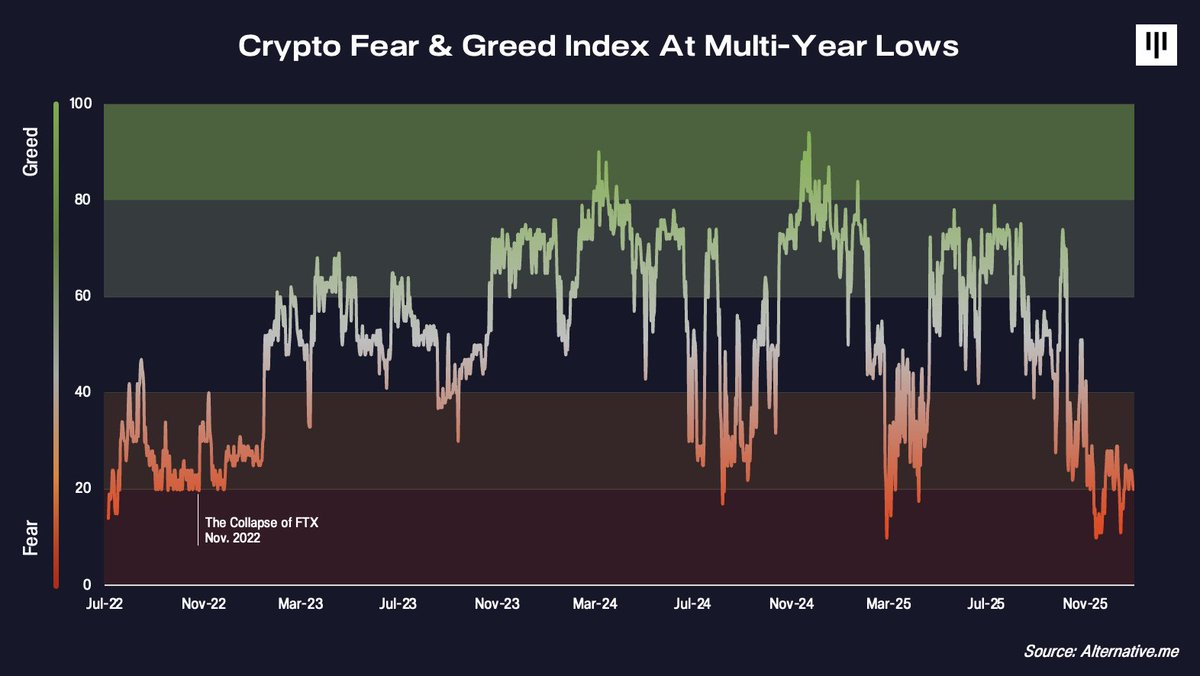
The Fear and Greed Index reached readings last seen during acute stress periods (including after the FTX collapse). Meanwhile, perpetual futures funding rates fell, indicating reduced leverage and diminished speculative excess.
Seasonal factors also played a role. December has historically been a weak month for Bitcoin and the broader crypto market, with tax loss selling, portfolio rebalancing, and liquidity constraints exerting mechanical pressure independent of fundamentals.
Importantly, from a longer-term perspective, the duration of the current non-Bitcoin drawdown aligns closely with previous cycles.
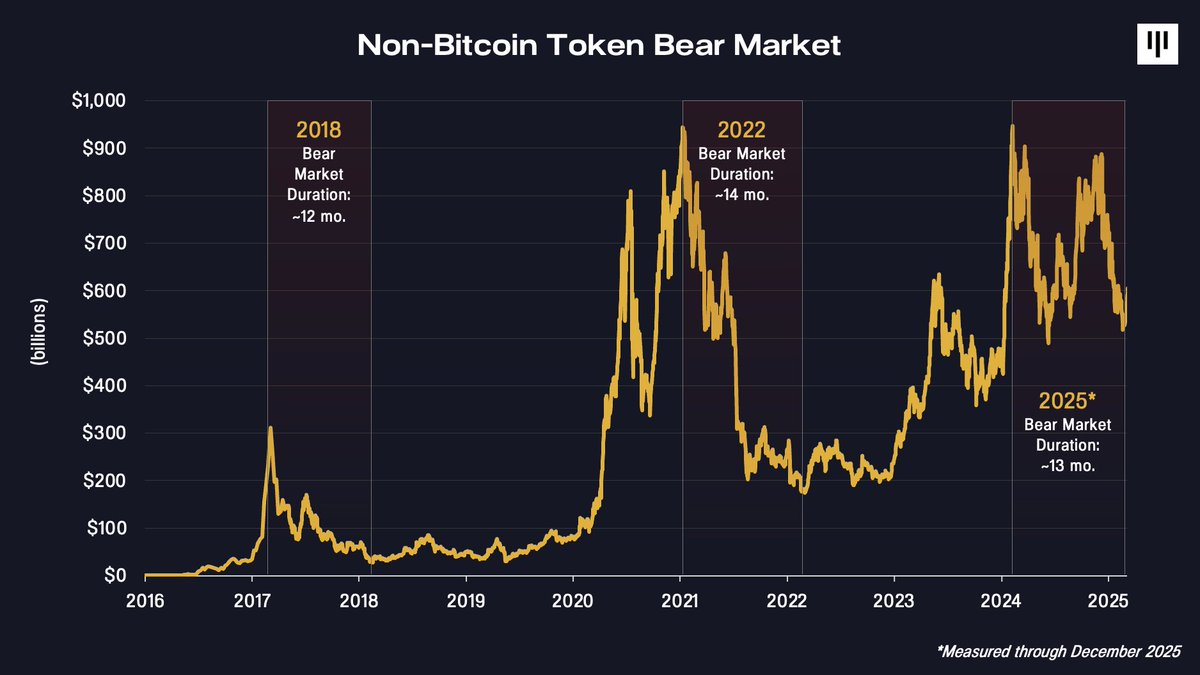
The bear markets of 2018 and 2022 lasted approximately 12 to 14 months. Calculating from the peak at the end of 2024, the current drawdown is now within the same time range. This does not guarantee a bottom, but it does indicate that significant time and price compressions have occurred.
Why the Outlook Begins to Improve from Here
Despite the challenges of 2025, there are several reasons to remain constructively optimistic about the future.
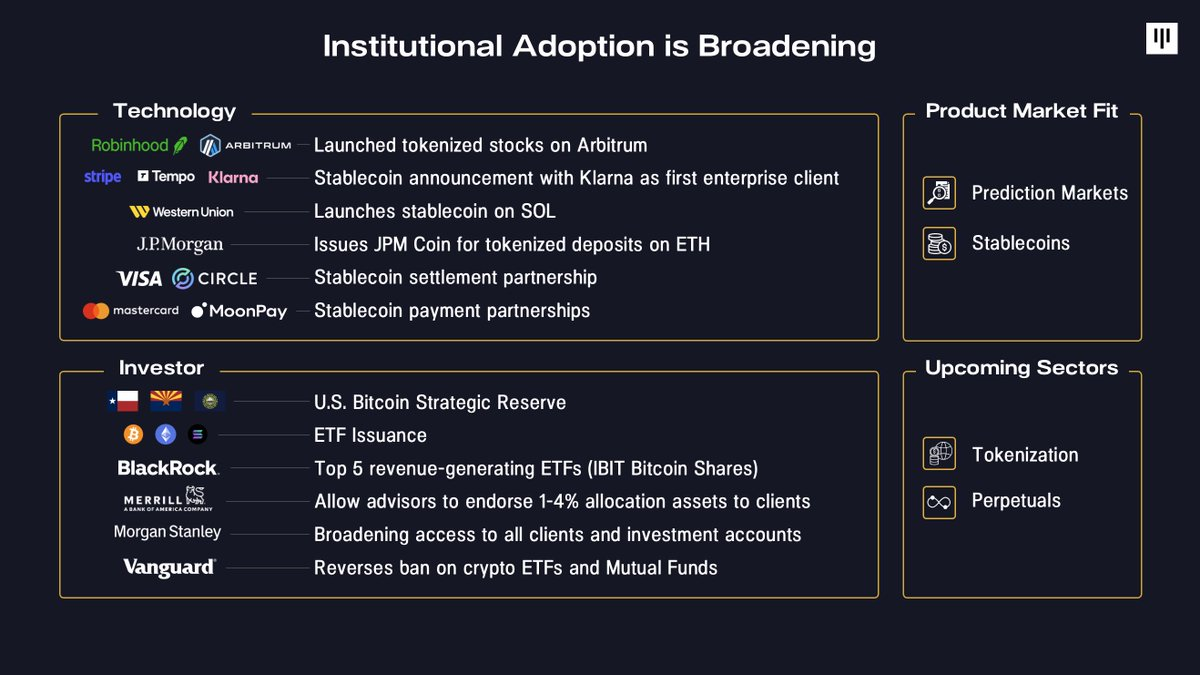
First, institutional adoption continues to expand. Companies are increasingly integrating blockchain into their core products — from Robinhood's launch of tokenized stocks to Stripe developing stablecoin infrastructure, and JPMorgan tokenizing deposits. On the capital side, sovereign reserves have been established, and brokerages, retirement platforms, and large asset managers have significantly lowered the barriers to entry.
Second, product-market fit is becoming clearer. Stablecoins and prediction markets gained breakthrough attention and adoption as standout use cases in 2025, while broader tokenization and perpetual futures are showing early signs of product-market fit.
Third, the macro backdrop is supportive. The U.S. economy remains resilient, with wage growth outpacing inflation and corporate profit expansion. Now that the Fed has stopped quantitative tightening, liquidity conditions are improving. The decline in long-term yields combined with loose monetary policy has historically been constructive for risk assets, including digital assets.
Finally, penetration rates remain astonishingly low. As Bitmine's Tom Lee noted: there are only 4.4 million Bitcoin addresses holding over $10,000 in value, compared to 900 million traditional investment accounts globally. According to a Bank of America survey of institutional investors, 67% still have zero exposure to digital assets. Even a moderate shift in allocation over time represents a significant source of potential demand.
Conclusion
2025 was a difficult year for most of the token market, characterized by extreme fragmentation, stronger performance of mainstream coins, and long-term weakness outside of Bitcoin. However, it was also a year that advanced institutional adoption, clarified product-market fit, and compressed valuations in many areas of the ecosystem.
The robust fundamental backdrop following a year-long bear market in the broader token space may present opportunities. With sentiment clearing, leverage reduced, and significant repricing already behind us, forward-looking allocations appear increasingly asymmetric — provided fundamentals stabilize and breadth returns. Historically, periods of turmoil lay the foundation for the next phase of growth.
[1] The performance of the Bloomberg Galaxy Crypto Index (BGCI) does not include fees that would detract from performance. Any index is for reference only and serves as an illustration of general market performance. No index can be directly compared to the performance of Pantera funds, in part because the indices are not actively managed. The investment results of Pantera funds are not intended to predict or imply future returns for Pantera funds.
PANTERA Review - Looking Back at 2026
Author: @JonathanGieg
As we kick off 2026, we anticipate a more exciting year for cryptocurrencies than the last. But before turning the page, we want to take a moment to reflect on what 2025 brought.
2025 was a landmark year for Pantera. We deployed more capital than ever before, dominating our new investments and expanding our global footprint in industries and regions we believe will define the next decade of cryptocurrency. Meanwhile, our portfolio received strong public market validation with four portfolio companies going public and significant strategic acquisitions.
Read about our progress in 2025:
Nine Predictions for 2026
Author: @veradittakit
#1 Real World Assets (RWA) Take Off
As of mid-December 2025, the total locked value (TVL) of RWAs reached $16.6 billion, accounting for about 14% of the total DeFi TVL.
Predictions:
· Government bonds and private credit could at least double.
· When the SEC rolls out the anticipated "innovation exemptions" under the "crypto projects," tokenized stocks and equities might grow even faster.
· An unexpected sector (carbon credits, mineral rights, or energy projects) will boom. This sector may be characterized by dispersed liquidity, global distribution, and lack of standards, while blockchain-based markets will help address these issues.
#2 AI Innovation Enhances On-Chain Security
AI security and blockchain development tools become incredibly powerful. Real-time fraud detection, 95% accurate transaction Bitcoin tagging, and instant smart contract debugging are now available, identifying millions of dollars worth of blockchain vulnerabilities.
Prediction: In 2026, imagine a larger shift towards on-chain intelligence, with deterministic, verifiable rules taking over smart contract-based governance. This application will scan code nearly in real-time, immediately catch logical errors and vulnerabilities, and provide instant debugging feedback. The next major unicorn will be an innovative on-chain security company that improves safety by 100 times.
#3 Prediction Markets Become Acquisition Targets
In the first 10 months of 2025, $28 billion was traded, as prediction markets consolidate around institutional infrastructure. The week of October 20, we hit a historical high of $2.3 billion.
Prediction: The industry will see acquisitions exceeding $1 billion that do not involve Polymarket or Kalshi. Winning platforms will build in embedded liquidity tracks, embedded market discovery intelligence pointing out where funds are hidden and why. Forget shiny new buttons. This is all about effortlessly empowering users: instant access to hidden pools, smarter routing, and predictive order flow.
Sports-focused platforms like DraftKings and FanDuel have become mainstream, collaborating with media to distribute real-time odds. New entrants focused on sports like NoVig will expand vertically, and new startups will emerge in the Asia-Pacific region as it is a key area to watch.
#4 AI Becomes Your Personal Crypto Co-Pilot
As systems mature, providing ultra-personalized experiences that meet customized expectations, consumer AI platform usage will surge. Seamless integration makes advanced AI feel effortless, shifting from clunky to instant.
Prediction: Platforms like Surf.ai will attract a crowd from crypto curious to active traders in 2026 with intuitive advanced AI models, proprietary crypto datasets, and multi-step workflow agents. I believe the combination of complex technology and accessible design makes Surf the preferred crypto research tool, delivering market insights supported by blockchain up to 4 times faster than other types of platforms.
#5 Banking Giants Prepare: G7-Linked Stablecoins Are Imminent
Ten major banks are in the early stages of exploring the issuance of alliance stablecoins pegged to G7 currencies. Financial institutions are determining whether industry-wide stablecoins can provide the benefits of digital currencies to individuals and institutions in a compliant, risk-managed way. Meanwhile, a group of ten European banks is investigating the issuance of euro-pegged stablecoins.
Prediction: Major bank alliances will launch their own stablecoins (whether these pilot projects achieve results in 2026 or different alliances do so).
#6 Privacy, Payments, Perpetual: The Institutional Triad
Privacy technology is flourishing in institutional use, with the transparency-confidentiality combo of Zama, Canton, and other protocols, though retail use has not found traction or scalability. Stablecoins currently stand at $310 billion, having more than doubled in market cap since 2023, expanding for 25 consecutive months. Perpetual swap contracts now account for about 78% of crypto derivatives trading volume, with the gap between perpetual contracts and spot options continuing to widen.
Prediction: For privacy, the gap between institutional and retail will widen in 2026. Stablecoins will have a long road to over $2 trillion, achieving at least $500 billion next year, and the momentum for perpetual contracts will continue into 2026.
#7 Institutional Macro Perspective
As of December 15, 17.9% of BTC holdings are now held by public companies, private companies, ETFs, and nations.
Prediction: 2026 will not be about hype or memes. It will be about consolidation, real compliance, and institutionally driven funds backed by public market liquidity. Cryptocurrencies will integrate into mainstream platforms, upgrade financial rails, and challenge incumbents.
#8 The Biggest Year for Crypto IPOs Ever
In 2025, there were 335 IPOs in the U.S., an overall increase of 55% compared to 2024; many of which were crypto-friendly, including nine blockchain IPOs. This includes crypto-native companies like Circle Internet Group (which went public on May 27, 2025) and crypto-inclusive companies like SPAC; for example, Bitcoin Infrastructure Acquisition Corp went public on December 2, 2025.
Prediction: 2026 will be a bigger year for digital asset IPOs. Coinbase noted that 76% of companies plan to add tokenized assets in 2026, with some looking at over 5% of entire portfolios. Morpho serves as an example protocol, with a TVL of $8.6 billion in November 2025.
#9 Accelerated Consolidation of Digital Asset Treasuries
As of 2021, fewer than ten public companies held Bitcoin. By mid-December 2025, 151 public companies held a total of $95 billion, including 164 companies at the government level and $148 billion in digital assets.
Prediction: 2026 will see brutal trimming. In each major asset class, only one or two participants will dominate. Everyone else will either be acquired or left behind, apart from one long-tail token winner that follows. It is a global trend as well. Japan's Metaplanet has already been aggressive, so the U.S. no longer retains this trend as the global treasury landscape diversifies.
Wishing you all the best in 2026.
For more, read our Pantera Blockchain Letter.
免责声明:本文章仅代表作者个人观点,不代表本平台的立场和观点。本文章仅供信息分享,不构成对任何人的任何投资建议。用户与作者之间的任何争议,与本平台无关。如网页中刊载的文章或图片涉及侵权,请提供相关的权利证明和身份证明发送邮件到support@aicoin.com,本平台相关工作人员将会进行核查。


