Author: DWF Ventures
Translation: Deep Wave TechFlow
Deep Wave Introduction: The average time for companies to go public has extended from 5 years in the 1990s to 12 years today, which means that the most valuable growth stages of star companies like SpaceX and OpenAI have all been completed behind closed doors in the private markets. Cryptocurrency is breaking this barrier through tokenization, but the reality is that Pre-IPO tokens generally trade at a premium of 20-40%, have poor liquidity, and unclear regulation. For investors, this is both a new channel for participating in early projects and a potential new trap for paying for the illusion of liquidity.
Key Points
The time companies remain private has significantly increased, with the average time to IPO doubling since the 1990s. This has concentrated the most valuable growth stages in the private markets, driving retail demand toward on-chain alternatives.
Currently, there are three distinctly different investment structures: SPV-backed tokens, synthetic perpetual contracts, and closed-end funds. Each structure varies in its support mechanisms, price anchoring, redemption, and regulation, catering to investors with different risk preferences.
Pre-IPO stocks typically trade at a lasting premium of 20-40% over the most recent private market valuations, with most platforms lacking short-selling mechanisms to correct the prices.
As demand grows beyond the retail level, platforms that can address liquidity and all the risks outlined in this report will face enormous opportunities.
Market Background
The birth of public markets is based on a simple premise: to provide ordinary investors with democratized wealth accumulation tools. Traditionally, IPOs have been a way for startups to access larger pools of capital, raising funds for further development and increasing visibility. This allows investors to tap into early-stage companies and realize returns as these companies grow. However, with more private capital and institutions entering the scene, enhanced price discovery has been confined to the private markets.
This distorts the so-called "free market" nature of the stock market, turning IPOs from a financing tool into liquidity events for institutional exit. Cryptocurrency has emerged as a field aimed at leveling the competitive landscape, with ICOs and tokens becoming the first step for any project launch, providing permissionless access to anyone globally. This spirit has extended beyond crypto-native assets, with tokenization becoming a key use case on-chain. Public stocks, commodities, and now the Pre-IPO market are being brought on-chain, becoming new venues for price discovery, surpassing the infrastructures that have historically dominated these markets.
Current Market Status
The exponential growth of the Pre-IPO market can be attributed to the substantially longer time it takes for companies to go public now compared to before. The average time for companies to IPO is now 12 years, whereas it was 4-5 years in the 1990s. With companies like SpaceX, OpenAI, and Anthropic preparing to file for IPO at record valuations, the demand for access to private markets is unprecedented. The secondary market for private equity is thriving, and Hiive's Pre-IPO market status report shows that the Hiive50 secondary market index measuring returns has outperformed the S&P 500 index.
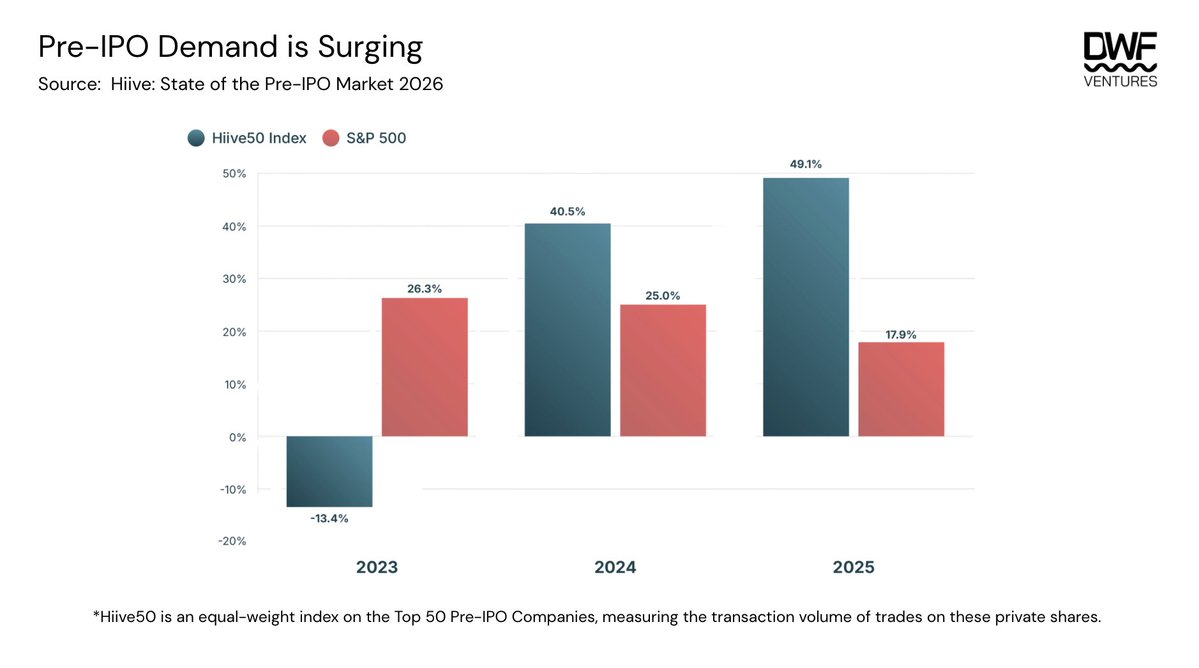
Demand is primarily concentrated in several sectors—cryptocurrency, AI, and fintech. The AI sector has the largest number of companies in the index, while crypto companies see much higher stock demand per company. Hiive's trading volume has hit all-time highs, with premiums for top companies soaring between 100-200%.
The average trade size on the Hiive platform for 2025 exceeds $1 million, indicating that its market primarily serves institutional buyers. This may be due to regulations, as the platform is limited to accredited investors, who tend to write larger checks and have longer investment horizons. Therefore, retail demand for Pre-IPO investments remains an underserved market, and on-chain competition has already begun to emerge.
Democratized Price Discovery
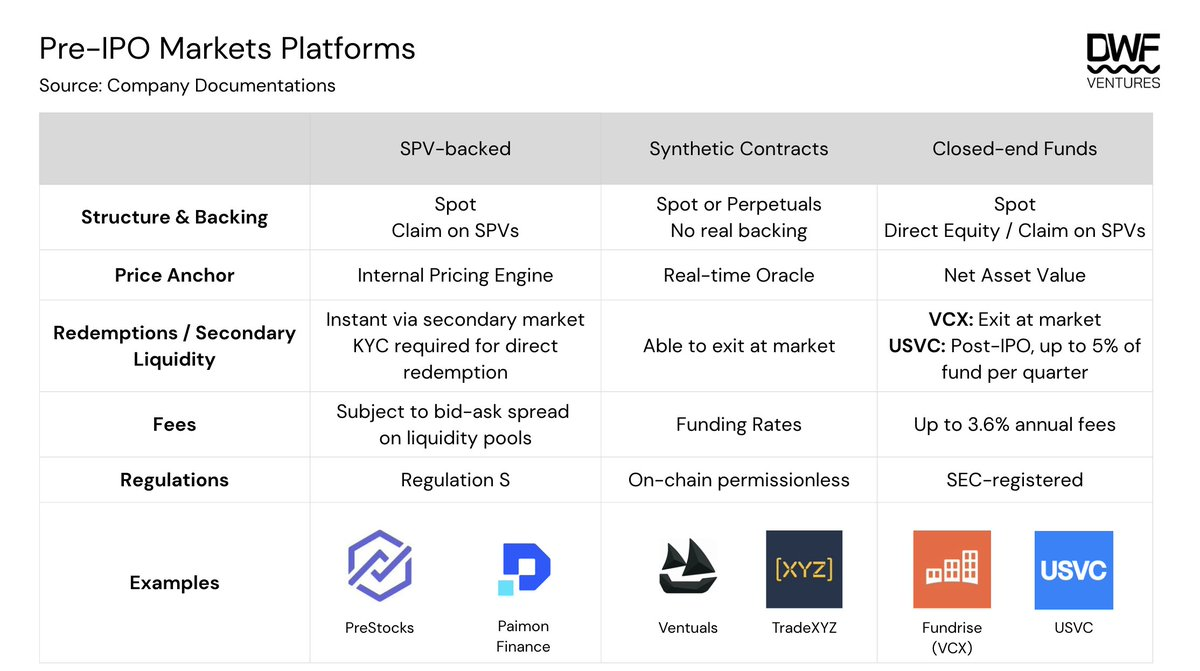
The types of investments available to users can be categorized into three main types: SPV-backed, synthetic contracts, and closed-end funds. The table below shows the differences in structure, support, pricing and redemption mechanisms, fees, and regulation for each category.
Structure and Support
Investors can access investments through spot or perpetual markets, with the latter currently available only on-chain. Platforms offering spot investments typically also have real backing for these stocks, either through Special Purpose Vehicles (SPVs) or direct equity from the company. Theoretically, this creates a price floor, providing investors with greater confidence since these tokenized stocks can ultimately be redeemed for USDC or actual shares after the company's IPO.
Meanwhile, synthetic contracts provided through perpetual contracts anchor only to real-time oracles, without any backing or claim to the underlying assets. Closed-end funds like VCX and USVC involve more indirect and opaque underlying structures. Although VCX holds direct equity in companies, those rights do not transfer to investors in VCX. The structure of USVC allows for direct allocation or holdings in VC funds that invest in Pre-IPO companies, adding additional layers on counterparty and introducing illiquidity upon final redemption.
Price Anchoring
The price oracles of these platforms typically derive from off-chain price signals (recent trades on private secondary market platforms) and a mix of on-chain mark price moving averages based on demand. Methods and update frequencies vary by platform: PreStocks' oracles do not have a fixed cadence, while Ventuals updates every three seconds. For SPV-backed platforms and registered funds, net asset value serves as a pricing benchmark, although tokens and stocks may still trade at a premium over net asset value, depending on investor interest, as the issuance supply is limited.
Ventuals applies additional constraints to limit volatility, capping mark price movements at 1% updates every three seconds, and keeping mark prices within a ±20% range of the oracle prices. Since the oracle prices are a mix of off-chain data and the 2-hour EMA of mark prices, this creates a bullish market where the mark price moves upward through a reflective feedback loop between mark and oracle, as short-selling liquidity is thin. The outstanding contracts (OI) of available assets are also capped between 5-7.5 million, limiting meaningful scale and price discovery. When limits are reached, existing holders also face pressure to reduce positions due to rising funding rates, making it difficult to maintain large investments over the long term.
Ventuals has modified its funding rate mechanism, where funding rates increase exponentially as the mark price approaches the ±20% price cap to incentivize short selling. This helps to lower the intensity of reflective cycles, ensuring that the trading experience remains optimal.
Redemption and Secondary Liquidity
On-chain platforms provide instant exits through secondary market liquidity, although pool depth limits the scale of any single exit, with most trades also incurring a 0.5-1% slippage. As a fund, VCX offers comparable flexibility through its NYSE listing, allowing investors to exit at market price on any trading day.
Direct redemption models are more limited and carry higher risks. Redemption through SPVs for USDC can only occur once the underlying positions are sold on private secondary markets, which is a lengthy process with no timeline confirmation. The underlying fund structure introduces further constraints. USVC has no obligation to repurchase shares from investors, and even if a repurchase is offered, it is limited at 5% of net assets per quarter at the discretion of the management. In environments where net asset value decreases post-IPO, investors may ultimately wait years to fully exit, with no guarantee of capital return.
Fees
Funds charge management fees, and when funds are allocated through underlying fund managers, fees can accumulate rapidly, stacking a second layer of fees on top of the initial rates. For USVC, the estimated fees may reach 3.61% annually after accounting for underlying fund fees, a figure that is not significantly disclosed and could impact net returns for investors unfamiliar with the structure.
On-chain platforms do not charge fixed fees, but costs are embedded in the bid-ask spread for each swap, meaning that trade size and pool liquidity determine the effective cost of entry and exit. Synthetic contracts on Ventuals bear extra costs in the form of funding rates, settled every eight hours, unlike the hourly settlements of most crypto perpetual exchanges. The longer settlement intervals are designed to make holding costs more manageable for investors in long-term positions awaiting IPO events.
Regulation
SPV-backed platforms primarily operate under Regulation S, which is a U.S. securities exemption limiting access to non-U.S. investors. Aside from this constraint, most are accessible globally, although individual platforms may impose additional exclusions for certain countries.
SEC-registered funds like VCX operate under a completely different framework. As a closed-end fund listed on the NYSE, VCX is open to any investor with a brokerage account, allowing for the broadest coverage in a regulated manner.
Synthetic contracts are unregulated, as they are offered on-chain without permission.
Other Potential Risks
The transfer rights of tokenized equity: This poses greater risks for fund structures like USVC compared to on-chain platforms. OpenAI and Anthropic have publicly condemned unauthorized tokenized investment products and have indicated intentions to implement strict controls on equity transfer rights. Given that funds rely on the integrity of underlying SPV positions to build net asset value, funds may face situations similar to bank runs, where reported valuations cannot be realized during redemption.
Poor performance of closed-end funds: The fund structure pools investments into indices, preventing investors from controlling individual company allocations. If allocation decisions do not align with actual returns, the fund may underperform relative to concentrated single name positions.
Lack of short-selling mechanisms: Structural gaps in the market prevent investors from expressing short views on spot or hedging on perpetual contracts. This leads to continuous premiums on these assets relative to the last known private market valuations. Ventuals is one of the few places offering short investments through synthetic contracts, though short-selling liquidity remains thin due to the lack of natural counterparty hedge trading elsewhere in the market.
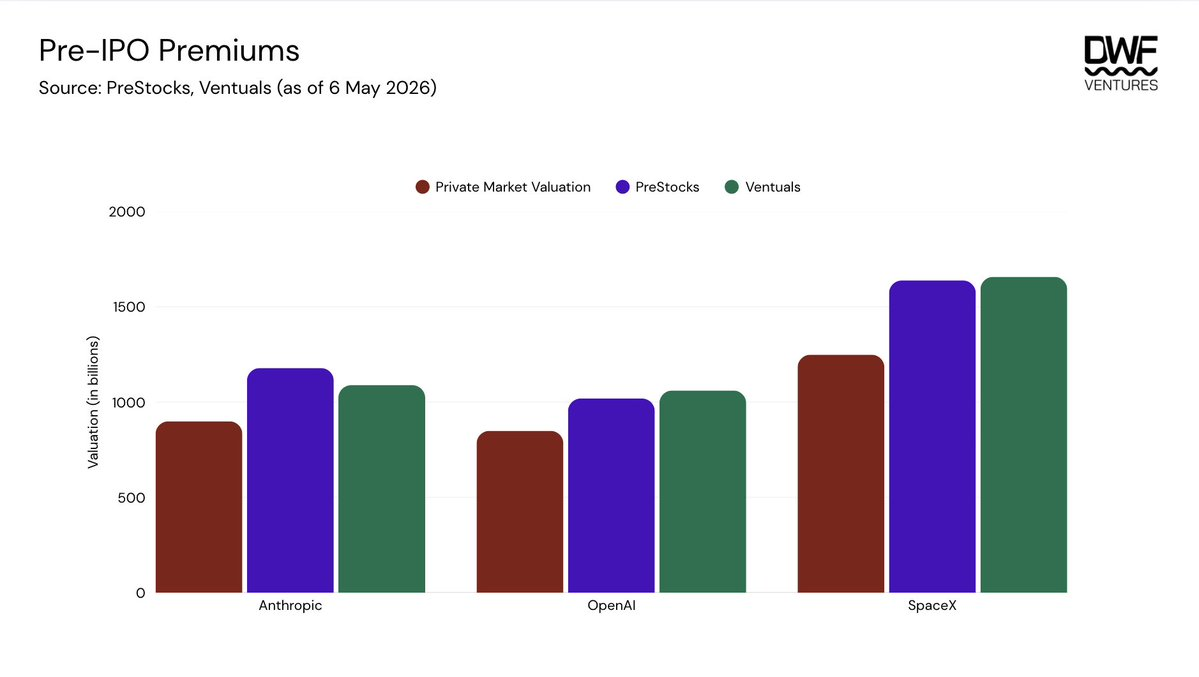
What happens when the company actually IPOs? Many of these Pre-IPO assets currently trade at a 20-40% premium on PreStocks/Ventuals over the last known private market valuations. There is no guarantee of immediate liquidity during the IPO, especially for shares held in SPV structures, which require a separate liquidation process. Historical IPO performance adds further pressure, as the average public listing valuation is about 25% higher than IPO financing, which leaves investors who entered at a premium with very narrow margins before trades turn negative. For funds, net asset value compression may exceed capital returns, exposing investors to risks during this gap period.
Market for New Entrants
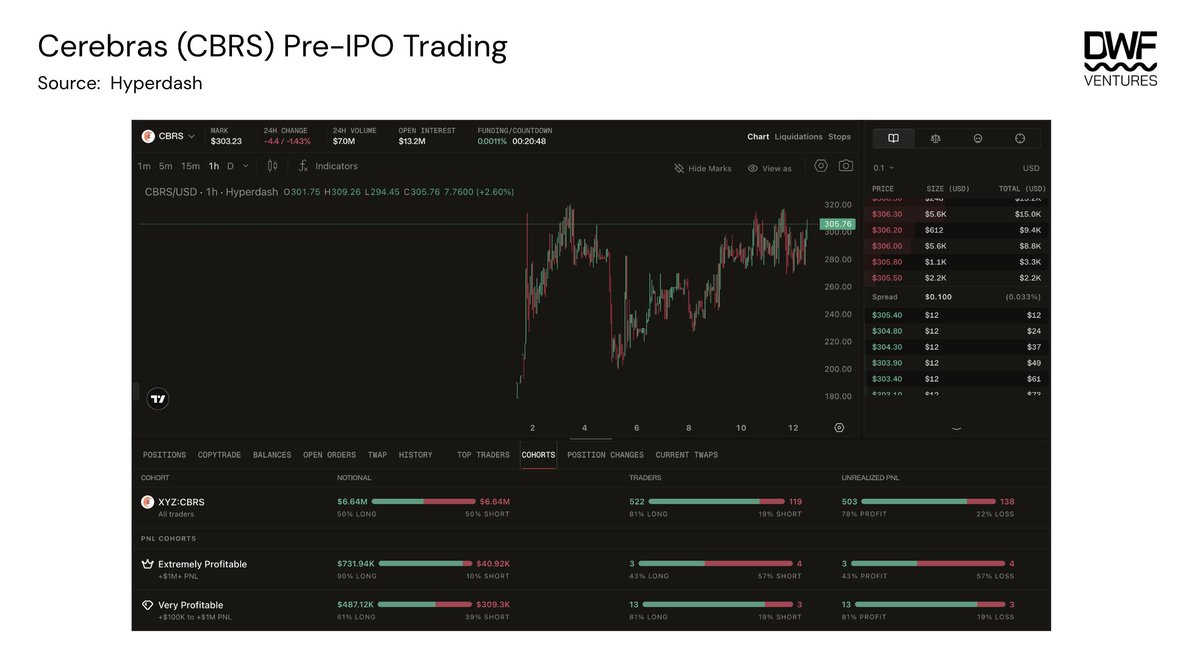
This expanding market competition is heating up. Exchanges like Binance and Bitget are launching their own tokenized versions of Pre-IPO stocks by integrating with PreStocks or having their synthetic contracts. On-chain participants are also accelerating, with TradeXYZ recently launching Pre-IPO perpetual contracts last week, achieving daily trading volumes of about $7 million, currently trading at a premium of about 90% over expected IPO valuations (around $160 per share).
New categories are also emerging. Backpack is launching an on-chain IPO supported by Superstate and Solana, offering real investment to investors as the issued shares are legally recognized securities. IPOs are typically reserved mainly for institutions and accredited investors, thus actual regulated issuance on-chain will offer significant breakthroughs for retail investors.
Where Value is Flowing
The tokenization of assets will only become more rampant—the longer companies remain private, the greater the market demand for such investments. Interest in such investments has surpassed the retail level. Governments, institutions, and funds are all vying for a piece of the pie. For instance, the South Korean government recently launched a "National Growth Fund" aimed at allowing citizens to participate, with the goal of investing in emerging local AI and semiconductor industries. It is expected to raise $160 billion in capital from IPOs this year, and the competition for demand for these liquidity events will be enormous.
Every new entrant validates the demand for this market, but given that there has yet to be a real stress test, questions around the structure, regulation, and viability of these assets remain. We believe that platforms capable of addressing liquidity issues in the short term will prevail, but regulation will remain key in the long term. The SEC-CFTC released a comprehensive report on how federal securities laws apply to digital assets—once the underlying securities are listed, many of these tokenized SPV wraps will face scrutiny and enforcement risks. Therefore, platforms that can optimize under all conditions will inherit a massive market.
免责声明:本文章仅代表作者个人观点,不代表本平台的立场和观点。本文章仅供信息分享,不构成对任何人的任何投资建议。用户与作者之间的任何争议,与本平台无关。如网页中刊载的文章或图片涉及侵权,请提供相关的权利证明和身份证明发送邮件到support@aicoin.com,本平台相关工作人员将会进行核查。


