Source: Wall Street Insights
The most worry-free trading strategy on Wall Street over the past year may not be AI, nor interest rate cuts, but five words: following Trump. (Related reading: Trump's Q1 "stock trading operations" exposed! New purchases include these stocks)
On social platforms, the investment account TheAIInvestor summarized it rather plainly: One of the best-performing strategies over the past year is "trading by following Trump." Translated into a more down-to-earth version, it may be: Don’t look at financial reports, first check who the White House praised today.
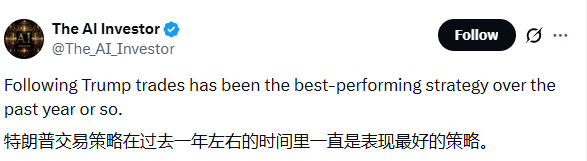
If further simplified, it boils down to a supply chain: first appear in the portfolio, then on the lips, and finally in the candlestick chart.
Intel, Micron, Dell, recently rose significantly in turn. One valued reassessment relies on government equity investment, one is praised by the president as "great", and one is explicitly named "go buy a Dell; they are great."
The script is simple, but someone always pays
Dell is the standard model of "presidential marketing," while Micron is the accelerated version of "praise after purchase."
On February 10, Trump bought $1 million to $5 million of Dell stock.
Nine days later, he stood on the podium in Georgia, earnestly telling the audience:
Go buy a Dell computer; they are great.
Then he praised the Dell family in a video on the White House YouTube channel, casually mentioning, "They invested a lot of money"—the implication being that this stock, you know what I mean.
Dell's stock surged 38% in after-hours trading, reaching an all-time high, after already rising steadily beforehand.
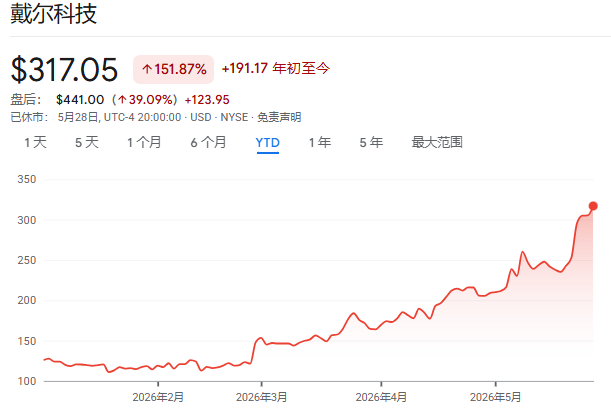
Of course, Dell's stock price rising isn't solely due to words. The demand for AI infrastructure is real, and corporate server and data center expenditures are substantial. Mizuho analyst Vijay Rakesh maintains a "outperform" rating on Dell and raises the target price from $215 to $260, citing the expansion of AI infrastructure demand.
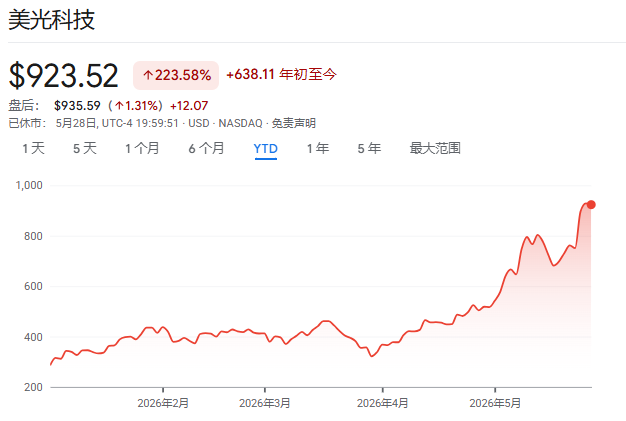
Micron's storyline has a finer time granularity. On March 25, Trump bought $50,000 to $100,000 of Micron stock.
The next day, he called into Fox News program "The Five," suddenly becoming enthusiastic:
I just met with Micron's head; this is one of the hottest companies.
By May 22, he added: Micron is "great."
Four days later, Micron's market value broke $1 trillion for the first time. UBS accordingly raised its target price from $535 to $1,625, with an increase of over 200%. The industrial logic behind Micron's rise is the demand for high-bandwidth memory in AI servers, the expansion of capital expenditure in data centers, and the improvement in supply and demand in the storage industry.
This script has been played out by Apple and Thermo Fisher as well.
Intel: Mouthpieces aren't enough; finances need to step in
Dell and Micron are more like a cross between personal holdings and public statements, while Intel is a more advanced version: not only is it named by the president, but policy funds also personally enter the scene.
Materials show that government equity investment has driven Intel's approximately 200% rise this year. The White House stated on May 18 that this government stake acquired at $8.9 billion is now worth over $50 billion.
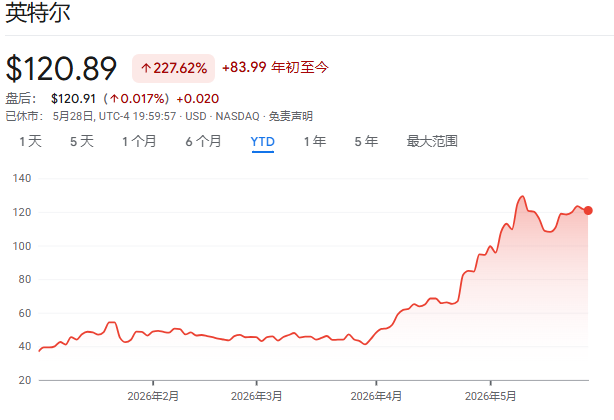
In other words, Intel is not simply "being praised and rising," but is being lifted into the spotlight by policy, industrial security, and state capital together.
The significance of the Intel case lies in that it expands the so-called "Trump trade" from personal investment portfolios to the policy capital market.
Investors should look not only at what Trump bought and praised but also at what the government is preparing to invest in, rescue, and support.
This makes trading quite characteristic of the new era: reading financial reports while listening to presidential speeches; observing orders while watching Treasury Department actions; monitoring candlestick charts while scrolling through Truth Social.
3,711 trades: Was it machines sweeping the market, or the stock god opening the market?
What truly made this lively is the financial disclosure document publicly released by OGE on May 14.
The document shows that Trump conducted 3,711 securities trades in Q1 2026, with the scale of trades between $220 million and $750 million.
3,711 trades in one quarter, averaging more than 60 trades per trading day.
If you think this is a national leader busy with everything in the Oval Office while managing the Middle East situation and watching candlestick charts, then you might not be very familiar with the term "direct indexing."
Samir Vasavada, co-founder of investment platform Vise, points out that the individual stocks disclosed in the filing overlap about 90% with Russell 3000 index components, which is a typical feature of the "direct indexing" strategy—holding the underlying stocks directly rather than buying index funds, then conducting systematic trading for tax loss harvesting.
The logic is this: When stocks drop, the system automatically sells to lock in losses and then buys similar stocks in the same industry, creating realized losses on paper that are deductible, while keeping the overall position basically unchanged, but the number of trades is systematically amplified.
March 23 was the second busiest trading day reported, coinciding with adjustments to S&P 500, 400, 600, and 100 index component stocks on the same day, with new stocks being added to the FTSE Russell benchmark as well. On February 12 and March 18, the S&P 500 dropped more than 1% on both days, triggering 155 and 124 sell orders, respectively.
The timeline matches, and the logic holds.
The official explanation from the White House is also this: the president's investments are independently managed by third-party financial institutions and executed through "automated, model-driven portfolios and direct indexing strategies," with Trump himself, his family, and companies not participating in investment decisions.
Therefore, the 3,711 trades themselves may not be the problem. The issue lies in the fact that there are 625 trades tagged as "non-discretionary orders."
625 "non-discretionary orders": Too many coincidences make it seem less like a coincidence
"Non-discretionary orders" means: initiated by the client instead of being suggested by the broker.
In other words, these 625 trades were not automatically generated by the system; someone placed these orders actively.
These 625 trades are almost all concentrated in March, with the vast majority being buy orders, significantly increasing on the first trading day after the U.S. attack on Iran. Compared to other systematic trades, they appear more temporary and more random—or rather, it seems like someone had a specific desire to purchase a specific target at a specific moment.
The key is that many timelines are too smooth.
On March 11, Trump visited Thermo Fisher's Ohio factory, calling it a "great company." On the same day, he bought $15,000 to $50,000 of Thermo Fisher stock, tagged: non-discretionary order.
On the same day, he praised Apple CEO Tim Cook in a speech in Kentucky. That day, he purchased $250,000 to $500,000 of Apple stock, also tagged: non-discretionary order. Throughout March, he cumulatively purchased $2 million to $7.2 million of Apple stock, with five of those being non-discretionary orders.
On March 25, Micron was bought, marked as a non-discretionary order. The next day, he said on Fox Live that Micron is "one of the hottest companies."
On February 10, Dell was bought. Nine days later, he told all Americans to "go buy a Dell computer."
These trades do not fit into the system's automated logic.
The market is starting to trade on "the next name"
The market has already begun to guess the next "lottery ticket."
In the stockholdings disclosed in OGE's Q1 document, there are also companies like ServiceNow, Adobe, and Texas Instruments. Investors are already beginning to speculate on who will be the next lucky one to be publicly praised.
Oracle is one of the hot candidates. It has both the political business relationship with Larry Ellison and is involved in the Stargate AI infrastructure project.
Broadcom also fits the script well. The company's valuation has surpassed $2 trillion, providing customized chips for U.S. data centers, which are an important part of the government's technology agenda.
Motorola Solutions is taking a different route: police radios, dispatch software, and public safety monitoring equipment, perfectly fitting the narrative of law enforcement and border security.
On May 26, Trump specifically posted on Truth Social to support the prediction market industry, calling for the CFTC to maintain "exclusive jurisdiction" over platforms like Kalshi and Polymarket.
免责声明:本文章仅代表作者个人观点,不代表本平台的立场和观点。本文章仅供信息分享,不构成对任何人的任何投资建议。用户与作者之间的任何争议,与本平台无关。如网页中刊载的文章或图片涉及侵权,请提供相关的权利证明和身份证明发送邮件到support@aicoin.com,本平台相关工作人员将会进行核查。


