
Author: Jae, PANews
On May 28, with less than a month before SpaceX's listing on Nasdaq, market enthusiasm was high, yet its Pre-IPO assets experienced a "cliff-like crash" overnight: the price of the preSPCX stock token on Bitget plummeted by about 80%; the SpaceX perpetual contract on Perp DEX (decentralized perpetual contract exchange) Hyperliquid flash crashed by 45% within 30 minutes, leading to over 400 retail investors being liquidated.
Before the bell for SpaceX's listing has rung, the market has already written a cautionary note for the Pre-IPO assets.
Bitget: 80% drop, the truth is token split
Yesterday, many traders glued to their computer screens gasped. The price of the preSPCX/USDT spot trading pair on Bitget suddenly displayed an 80% vertical black candle. Such extreme volatility could lead uninformed investors to think that the exchange had manipulated the price to profit at their expense.
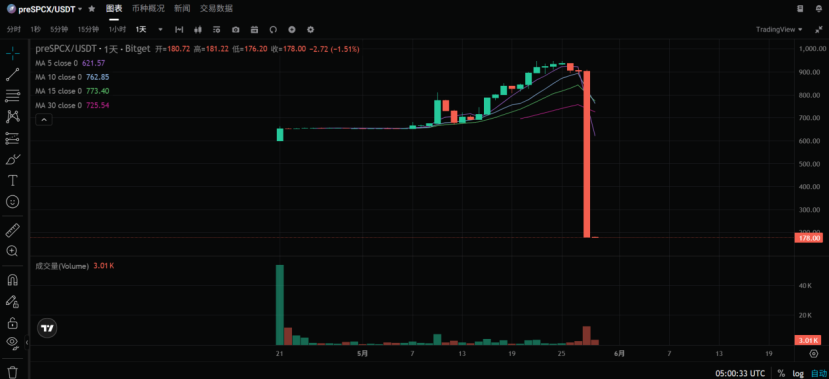
According to PANews' investigation, this "crash" was essentially not caused by a sudden deterioration in the asset's fundamentals, but rather a pre-announced token split.
According to an official announcement by Bitget, the platform suspended the trading of the original Pre-IPO stock token preSPAX at 2 PM on May 28 and implemented a split at a ratio of 1:5, after which the asset code was updated to preSPCX.
A 1:5 split means the number of tokens an investor holds is multiplied by 5. While the total value of the holdings remains unchanged, the unit price of the split tokens is calculated as one-fifth of the original, appearing as an 80% nominal price drop on the trading chart.
At that time, with trading prices around $900, the adjusted price after the split was about $180.
Although this was merely a technical adjustment on the books, upon reopening trading, the trading interface's candlestick chart failed to sync with historical prices, causing a visual representation of a “crash.”
For inexperienced, emotionally sensitive, or information-asymmetric retail investors, this visual shock could be misinterpreted as “assets collapsing.”

Hyperliquid: 45% flash crash in 30 minutes, oracle anomaly triggers domino liquidation
In contrast to Bitget's “technical adjustment,” the SPACEX perpetual contract flash crash on Hyperliquid was a real disaster caused by oracle errors, thin liquidity, and leveraged liquidations.
At 11 PM last night, the SPACEX-USDH contract on the HIP-3 Ventuals market dropped from $2,277 to a low of $1,254 within just 7 minutes, a decrease of 45%, nearly halving. Although the price quickly recovered to around $2,200 within the next 10 minutes, the liquidation of positions had already occurred, resulting in heavy losses for many traders.
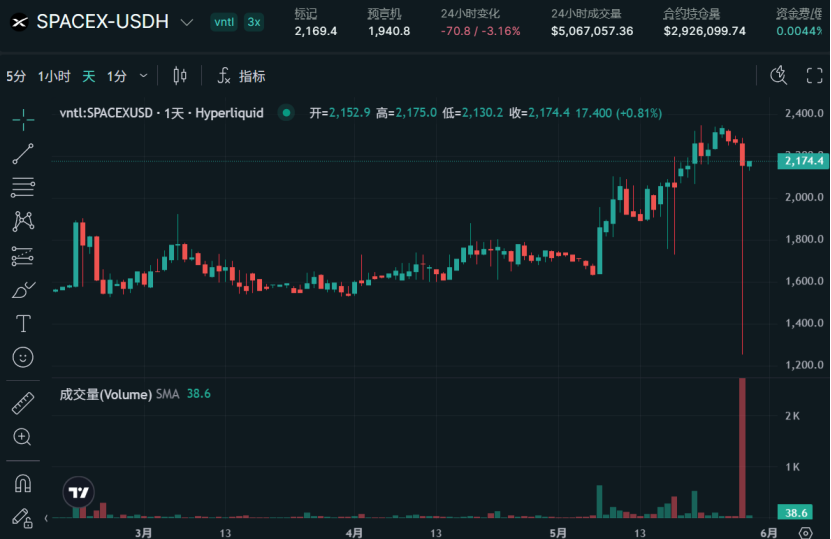
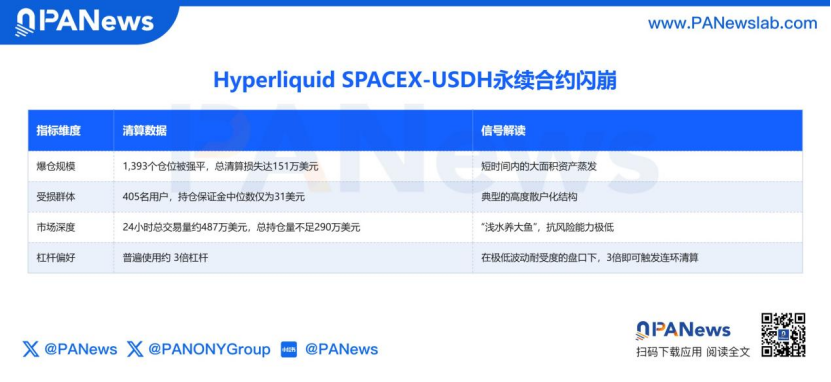
As a result, a total of 405 users' 1,393 positions were force liquidated, with a cumulative nominal loss of about $1.51 million. The median margin of the liquidated positions was only $31, mainly involving retail participants.
This flash crash stemmed from abnormal liquidations caused by erroneous oracle pricing. According to Hyperliquid's Ventuals response, the incident was due to erroneous data returned by the off-chain data provider used by the oracle component, resulting in sharp fluctuations between the market oracle price and the marked price, which triggered the forced liquidation of some user positions. Emergency measures have been taken, and the development team is assessing the impact of the event on users. Ventuals later updated that affected users would receive compensation within the next 48 hours.
At the same time, the deeper underlying reason for this crash lies in the general problems of insufficient order book depth and weak market liquidity associated with Pre-IPO assets, compounded by a cascading collapse of retail leverage that further amplified market stampede effects, accelerating the decline.
This is a quite "shallow" market, much like a pond that barely covers the ankles; throwing in a slightly larger stone can splash a lot of water.
In a market with a total position of less than $3 million and a 24-hour trading volume of only over $4 million, a sell order worth hundreds of thousands can instantly wipe out large buy orders; as prices drop, longs trigger liquidation thresholds, leading to market orders smashing the price down further and breaking deeper price support; late night liquidity exhaustion triggers a domino effect.
In less than 20 minutes, a game of leverage turned into a forced exit for retail investors.
Conclusion
It cannot be denied that Pre-IPO assets represent one of the most imaginative innovative directions in the crypto industry: allowing ordinary people outside the high walls of the private equity market to touch the value mapping of top unicorns in advance. In a sense, this both expands the boundaries of market participation and provides a new price discovery mechanism for non-public assets.
However, before real assets officially land in the public market and trading depth is sufficiently cultivated, such assets are destined to be accompanied by high volatility, high speculation, and pricing distortions. Due to the lack of unified valuation benchmarks, mature arbitrage mechanisms, and sufficient market depth, their prices are often more easily influenced by emotion, liquidity, and leverage. The dramatic fluctuations of SpaceX synthetic assets have once again exposed the vulnerabilities of Pre-IPO products in the market.
As more popular unicorns are brought on-chain in the future, more speculative funds will continue to flow in, and whether the Pre-IPO sector can establish a more mature pricing mechanism, liquidity system, and risk control framework in the future will remain a problem the industry must continuously face.
免责声明:本文章仅代表作者个人观点,不代表本平台的立场和观点。本文章仅供信息分享,不构成对任何人的任何投资建议。用户与作者之间的任何争议,与本平台无关。如网页中刊载的文章或图片涉及侵权,请提供相关的权利证明和身份证明发送邮件到support@aicoin.com,本平台相关工作人员将会进行核查。


