Author: Winnie, CryptoPulse Labs
On May 28, Samsung Securities announced that it would spend approximately 306.37 billion Korean Won (about 203 million USD) to acquire about 2% of Dunamu, the operator of South Korea's largest cryptocurrency trading platform Upbit.
This is not just a regular equity investment; it may signify a profound shift in South Korea's financial system. Recently, Korean regulators have begun to signal that they may relax the "separation of banking and cryptocurrency" policy, which has long restricted the relationship between financial institutions and the virtual asset industry.
Samsung Securities' investment essentially positions traditional financial capital in South Korea ahead in the next generation of digital financial entry points.
1. South Korean Financial Capital Officially Enters the Cryptocurrency Industry
For a long time, South Korea has been one of the most active cryptocurrency markets globally.
Young people in South Korea have a very high level of participation in crypto, whether it be Bitcoin, altcoins, meme coins, AI Agents, or trending on-chain topics; the South Korean market is often one of the most active trading regions in the world. Upbit is almost at the core of the South Korean cryptocurrency market.
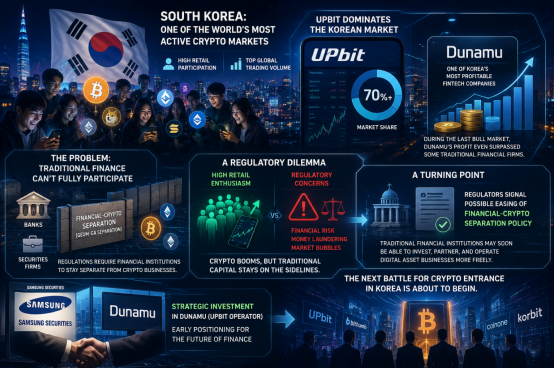
As South Korea's largest cryptocurrency trading platform, Upbit has long dominated a significant portion of the country's trading volume, and its operator, Dunamu, is one of the most profitable fintech companies in South Korea.
During the last bull market, Dunamu's profits even surpassed those of some traditional financial institutions in South Korea.
However, there has been a persistent issue over the past few years. Although traditional financial institutions in South Korea are aware of the tremendous traffic and profits within the cryptocurrency industry, they have been unable to participate deeply.
This is due to South Korea's long-standing policy of "separation of banking and cryptocurrency." Simply put, financial institutions must maintain a certain degree of separation from the virtual asset industry, and traditional financial entities like banks and brokerages cannot directly enter the crypto industry chain.
This regulatory logic essentially reflects South Korea's long-term reliance on and concern about the cryptocurrency industry. On one hand, retail trading enthusiasm in South Korea is extremely high; on the other, regulators are worried about financial risks, money laundering, and market bubbles.
Thus, over the past few years, South Korea has formed a very unique situation. The crypto market is extremely prosperous, but traditional financial capital has long been absent. Now, this situation is beginning to change.
Recently, South Korean financial regulatory authorities have started hinting that they may gradually relax the separation of banking and cryptocurrency policy in the future. This means that traditional financial institutions may be able to invest, collaborate, or even operate in digital asset businesses more freely. Samsung Securities' investment in Dunamu essentially means securing a position early.
Because all traditional financial institutions know that once regulation truly loosens, there will definitely be a new round of competition for crypto entry points in the Korean financial industry.
2. Why Is Samsung Securities Betting on Upbit Now?
Samsung Securities' investment in Dunamu may seem like mere financial investment at first glance. However, it actually reflects the anxiety of traditional financial institutions in South Korea about changes in the future financial system.
Over the past decade, the most significant change in the global financial industry is not internet finance, but financial digitization. For example, payment digitization, electronic securities, ETF creation, and stablecoins. An increasing number of financial behaviors are gradually migrating on-chain.
Moreover, cryptocurrency trading platforms have begun to evolve from purely speculative platforms into the next generation of financial infrastructure. Whether it is Coinbase, Robinhood, Hyperliquid, or Upbit, they are no longer just trading platforms.
They resemble new types of brokerages, new asset issuance platforms, new payment entry points, and even core nodes of future on-chain financial networks. What traditional Korean brokerages are most worried about is that young users are gradually moving away from the traditional securities market.
Now, more and more young users are no longer enthusiastic about traditional stocks. Instead, they are more focused on crypto, stablecoins, and on-chain assets, and these new financial activities are attracting a large number of young participants.
For Samsung Securities, if it continues to cling to traditional business logic, it may gradually lose its voice among young users and the new financial market in the future. Therefore, investing in Dunamu is essentially like purchasing a ticket for the future digital financial era.
Moreover, Upbit possesses not only trading business. It has South Korea's largest cryptocurrency user base, the most mature system for Korean Won deposits and withdrawals, the strongest virtual asset liquidity, and the most comprehensive entry point into the Web3 ecosystem in Korea.
In the future, whether it's RWA, stablecoins, on-chain securities, or digital ETFs, Upbit could become one of the most critical financial entry points in South Korea.
Samsung Securities' early investment essentially binds it to the future digital financial infrastructure of South Korea. It is also worth noting that the shares being sold this time are mainly from Kakao's capital, not from the Dunamu founding team.
This indicates that Dunamu is not seeking financing due to a lack of funds, but rather a capital adjustment at the shareholder level. In other words, Samsung Securities is actively buying in at a high valuation stage.
This instead indicates that traditional financial institutions are beginning to genuinely view crypto favorably for the long term. Because only those who truly believe in the future would be willing to lay the groundwork while there are still controversies in the industry.
3. South Korea Is Entering the Era of Comprehensive Financial On-Chaining
When we broaden our perspective, we can see that what is happening in South Korea is strikingly similar to the trends observed in the United States over the past two years.
The most significant change in the U.S. over the past few years has not been the rise in Bitcoin prices.
Instead, Wall Street has begun to fully embrace crypto. BlackRock is pushing for Bitcoin ETFs, Fidelity is laying out digital asset custody, Morgan Stanley is opening up crypto asset allocation, and more U.S. banks are researching stablecoins and on-chain settlements. Essentially, the U.S. has begun to integrate crypto into the traditional financial system.
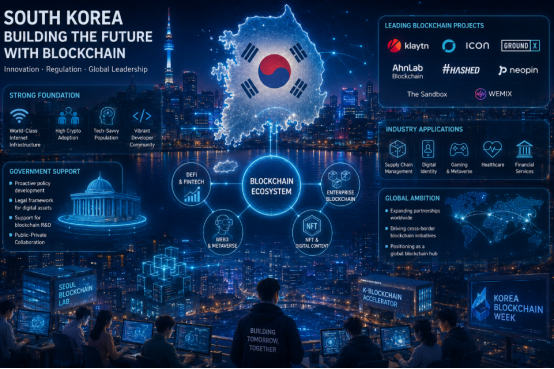
South Korea is now on a similar path. Samsung Securities' investment in Dunamu essentially represents the traditional brokerage model combined with Coinbase in South Korea.
In the coming years, several significant trends may emerge in the South Korean market.
First, traditional financial institutions will fully enter the virtual asset industry, including crypto ETFs, digital asset custody, and on-chain securities.
Because all financial institutions understand that the next round of financial infrastructure upgrades may very well take place on-chain.
Second, cryptocurrency trading platforms will further financialize. Many trading platforms in the past primarily served as matchmakers for transactions. In the future, they may gradually evolve into comprehensive financial platforms.
Not only can they trade crypto, but they may eventually even trade on-chain stocks, digital bonds, and stablecoin yield products.
Third, South Korea may become a new on-chain financial center in Asia. In the past, the competition for digital finance in Asia has mainly focused on Hong Kong, Singapore, and Dubai. However, South Korea has a strong retail foundation, internet culture, and a highly active trading ecosystem.
Once regulations are truly relaxed, South Korea is likely to rapidly become one of the most important on-chain financial markets in Asia. Especially in terms of young user participation, the South Korean market may even be more aggressive than Japan.
Moreover, the valuation of approximately 15.3 trillion Korean Won for Dunamu sends a very critical signal. The capital market has begun to redefine cryptocurrency trading platforms.
In the past, many believed that trading platforms were merely cyclical businesses with high volatility and risk. However, more and more capital is now viewing them as the next generation of financial infrastructure.
What is truly valuable is no longer merely a token. Instead, it is the users, liquidity, asset issuance capabilities, and entry positions in the future digital financial world.
From this perspective, what Samsung Securities has bought is not just a 2% stake in Dunamu. It is more like purchasing a seat in the next generation of the financial order in South Korea.
Conclusion
Over the past few years, there has been a debate in the cryptocurrency industry. Will crypto replace traditional finance, or will it ultimately be absorbed by traditional finance?
Now the answer seems clearer; the future financial world will likely not be traditional finance versus crypto, but rather the comprehensive on-chaining of traditional finance.
Samsung Securities' investment in Upbit is a typical epitome of this trend. South Korean financial capital has officially begun to enter the deep waters of crypto.
免责声明:本文章仅代表作者个人观点,不代表本平台的立场和观点。本文章仅供信息分享,不构成对任何人的任何投资建议。用户与作者之间的任何争议,与本平台无关。如网页中刊载的文章或图片涉及侵权,请提供相关的权利证明和身份证明发送邮件到support@aicoin.com,本平台相关工作人员将会进行核查。


