Following a Wyoming LLC's attempt to assert ownership of approximately 3.8 million dormant Bitcoin through a New York lawsuit, Cardano founder Charles Hoskinson responded angrily to one of the most bizarre legal theories the cryptocurrency industry has seen in years.
Absurdity of the case
Hoskinson provided a direct summary of the case: "If you keep money in your safe for too long, we are coming after it," and criticized lawyers for even considering such cases.
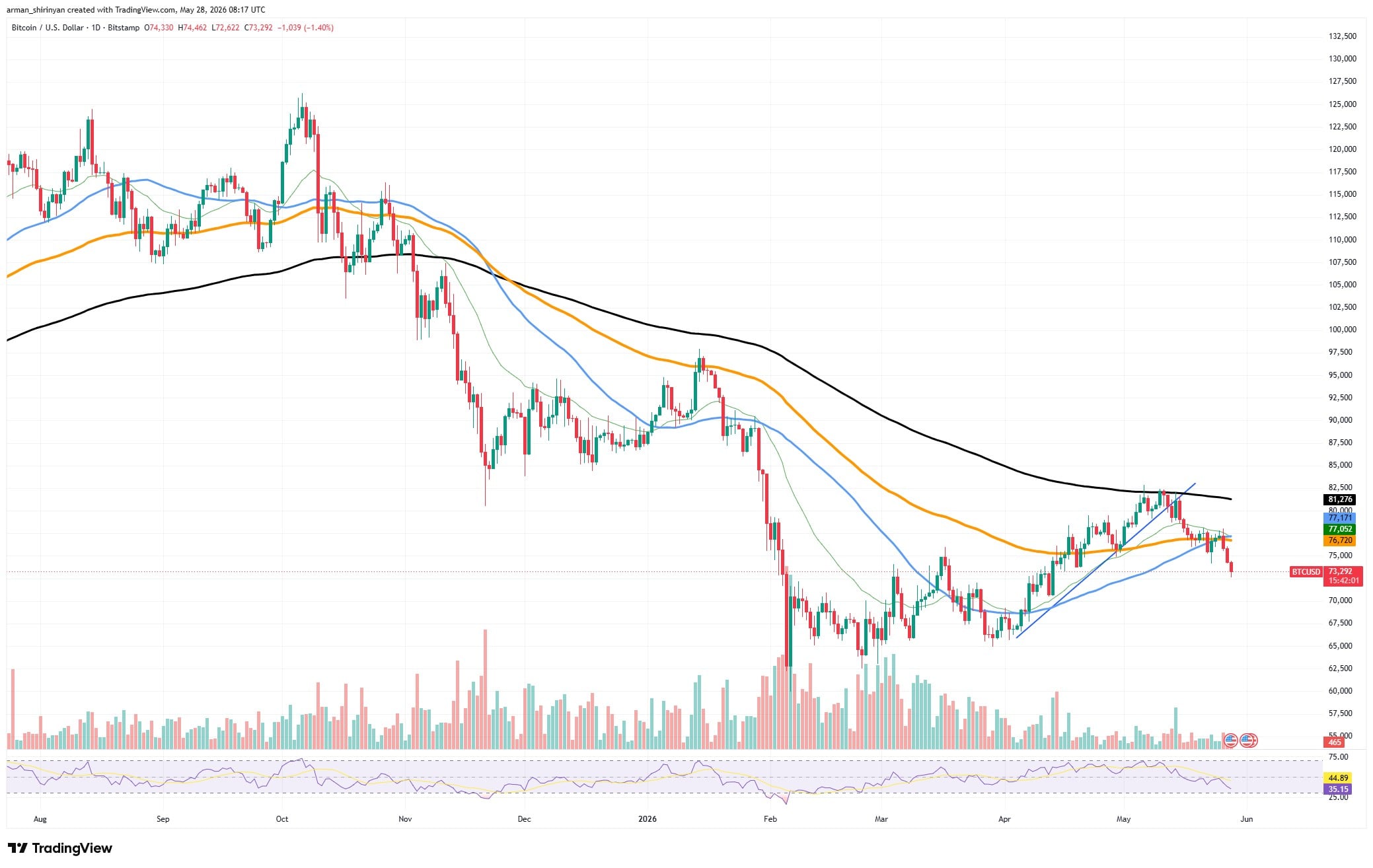
BTC/USDT Chart by TradingView
The lawsuit sounds almost unreal. Under the alias Noah Doe, a plaintiff asserts that they have created an algorithm that can recognize Bitcoin wallets that haven't been used in at least five or six years. The plaintiff allegedly filed found-property reports with the NYPD after flagging over 42,000 wallets and made an effort to inform wallet owners via press releases, public web postings, and OP_RETURN messages (function used to embed arbitrary data into blockchain transactions) integrated into the Bitcoin blockchain.
HOT Stories Bitcoin (BTC), Near (NEAR), Dogecoin (DOGE) and Stellar (XLM) Price Analysis for May 28: Healthy Improvement on Cryptocurrency Market XRP Hits $1.4B in ETF Cash
You Might Also Like

Wed, 05/27/2026 - 18:51 'You Know What Happens Next': Analyst Warns of Bitcoin VolatilityByAlex Dovbnya
Despite the removal of wallets that subsequently displayed activity, the plaintiff asserts that 39,069 wallets are still abandoned. The lawsuit now requests that the New York Supreme Court use abandoned property law to give the plaintiff legal ownership of those wallets and the Bitcoin they contain.
The magnitude is astounding. According to the complaint, the wallets collectively contain about 3.8 million Bitcoin, which, depending on market value, could be worth hundreds of billions of dollars.
Fundamentals of Bitcoin at risk
Hoskinson's critique focuses on the fundamental legal premise of the case, which holds that inactivity equates to abandonment. Self-custody without middlemen, one of the fundamental tenets of Bitcoin, is directly at odds with that argument.
Bitcoin wallets don't need regular activity, account maintenance, or institutional supervision like traditional bank accounts do. Whoever has the private keys to a wallet can keep it completely theirs for ten years.
You Might Also Like

Thu, 05/28/2026 - 08:10 'Knitted Sweater' Model: Ripple CTO Emeritus Projects Tax-Defensible XRP Staking ConceptByGamza Khanzadaev
There is no claim that the plaintiff has any private keys. Because Bitcoin ownership is essentially cryptographic rather than merely declarative, that detail is extremely important. Without legitimate keys, courts cannot move coins or create signatures, but they can grant ownership judgments. In reality, even a successful decision may not be legally enforceable.
Additionally, the case poses dangerous precedential concerns. Long-term cold storage, one of Bitcoin's most crucial security measures, may theoretically be subject to aggressive legal interpretation if inactivity alone is used as justification for legal seizure attempts. The notion that Bitcoin exists outside of conventional custodial property systems would be compromised by that.
As of right now, the lawsuit appears to be less of a practical route to obtaining dormant Bitcoin and more of a provocative legal experiment. However, Hoskinson's response reflects a wider industry worry that the technical realities of decentralized ownership may increasingly clash with established legal frameworks.
免责声明:本文章仅代表作者个人观点,不代表本平台的立场和观点。本文章仅供信息分享,不构成对任何人的任何投资建议。用户与作者之间的任何争议,与本平台无关。如网页中刊载的文章或图片涉及侵权,请提供相关的权利证明和身份证明发送邮件到support@aicoin.com,本平台相关工作人员将会进行核查。


