As the scale of AI usage expands, the gap between token consumption costs and actual business value is becoming apparent. Uber executives bluntly stated that "the line between AI spending and product improvement does not yet exist." Data shows that for every $1 spent on tokens, only 18 cents generates real value. This is not a 1999-style bubble, but the narrative that "increased token consumption equals successful AI transformation" will ultimately be debunked.
Written by: Bao Yilong
Source: Wall Street Watch
The reasonableness of corporate AI spending is undergoing severe scrutiny, as token consumption continues to rise while quantifiable business value is hard to find.
On May 22, Andrew Macdonald, the Chief Operating Officer of Uber, with a market value of over $200 billion, publicly stated on a podcast that there is "no line that exists" between the increase in token consumption and actual product improvement.
Macdonald pointed out that it is becoming increasingly difficult for the company to justify the continuously rising AI expenditures. He even coined a term for waste within the engineering teams: "tokenmaxxing."
Earlier in mid-May, Microsoft began to reduce internal Claude Code licensing due to "unsustainable" token billing.
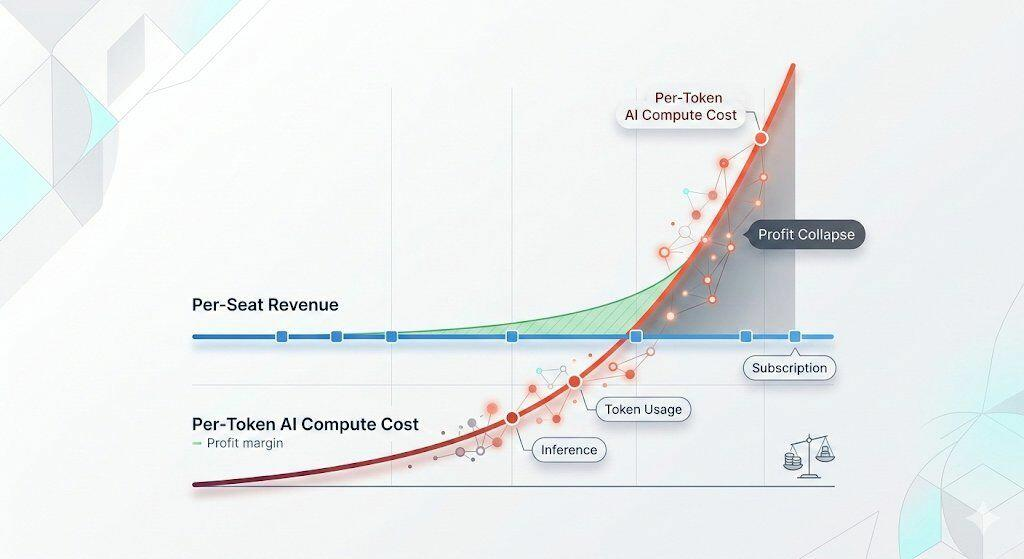
The combination of these two events forces the market to confront a previously overlooked variable. Token economics, or the unit economics of token consumption at the scale of enterprises, has risen from a marginal topic to a core supporting pillar of the entire AI investment discussion.
Five sets of data create a new picture
Since April, multiple sets of data have emerged, collectively sketching a concerning picture.
In April of this year, Uber's Chief Technology Officer publicly stated that the company had burned through its entire annual Claude Code budget in just four months.
Among 5,000 engineers, monthly usage rates ranged between 84% and 95%, with individual monthly bills varying from $150 to $2,000; reportedly, the CTO himself consumed $1,200 worth of tokens in a two-hour internal presentation.
Macdonald described his shock upon learning of this number as "literally speechless."
According to The Verge’s Tom Warren’s Notepad report, Claude Code quickly gained popularity among Microsoft’s internal engineering teams, but the token-based billing model made it difficult to sustain large-scale spending, leading Microsoft to cut related licenses.
GitHub announced that starting June 1, all Copilot plans would shift from a fixed subscription model to a pay-per-use billing model.
An official discussion thread gathered nearly 900 opposing votes, as some users calculated that a single programming session with the AI agent typically consumed $30 to $40, meaning a $10 monthly plan would be exhausted in a single use.
The developer productivity platform Entelligence.AI found, after aggregating data from 2,444 companies, that:
- For every $1 spent on AI tokens, only 18 cents generated actual value reaching users.
- 44 cents were spent on fixing bugs introduced by the AI itself; 27 cents went to rework; 11 cents were consumed on review friction.
According to Bloomberg's Silicon Data LLM Token Expenditure Index, token prices have risen by approximately 65% since the end of February this year, while U.S. AI software prices have increased by 20% to 37% over the past year.
The Bull-Bear Debate: The Same Fact, Two Interpretations
The same data points to completely different conclusions under different analytical frameworks.
The bulls believe that the current chaos is merely a period of growing pains for a successful transformation.
According to Goldman Sachs' Jim Schneider's analysis in early May, by 2030, agent-based AI is expected to drive a 24-fold increase in token consumption, reaching approximately 120 quadrillion tokens monthly, with the gross margins of major cloud service providers and model vendors expected to turn positive within the next 3 to 12 months.
Goldman Sachs’ Rich Privorotsky believes that Q1 2026 may mark the peak of "token maximization" as a KPI, and the industry is transitioning from a focus on consumption to a healthier metric of "cost per effective action unit."
Economic research from JPMorgan has also found that early 2026 will see an exponential increase in new and updated Python packages on PyPI, a trend that did not appear when ChatGPT launched in 2022, indicating that real productivity gains are occurring.
Furthermore, the current P/E ratio of the Mag 7 is about 20 times future earnings, significantly lower than the 52 times at the peak of the 2000 tech bubble, 67 times in the 1989 Japan market, or 34 times in the "Nifty Fifty" era. By historical bubble measures, this does not constitute a bubble.
The bear case was most systematically articulated by Goldman Sachs semiconductor analyst Jim Covello in an April report.
He pointed out that nearly all value in the AI supply chain is flowing to semiconductor companies, a phenomenon unprecedented in history and unsustainable. Chip companies should benefit when their customers profit; however, in this cycle, their prosperity has come at the expense of consumption upstream in the entire industry chain.
Nvidia's net profit has increased about 20 times since the launch of ChatGPT; large-scale cloud service providers have burned through operating cash flow and have begun to incur debt—data center-related debt issuance is expected to reach approximately $182 billion in 2025, doubling from 2024.
MIT's Nanda research shows that 95% of companies investing in generative AI report zero returns. This decoupling may sustain for a while but cannot last forever.
The Hidden Risks of Circular Financing Structures
This discussion also involves a more complex layer: the financial cycle between large-scale cloud service providers and AI labs.
According to corporate disclosure documents compiled by The Information, OpenAI and Anthropic together account for more than half of the approximately $2 trillion future cloud service commitments from Microsoft, Oracle, Google, and Amazon. Specifically:
- Of Microsoft's $627 billion in cloud service backlog, $280 billion is tied to OpenAI;
- In Oracle’s $553 billion pipeline business, 54% (approximately $300 billion) is committed by OpenAI;
- From Google's $467.6 billion, Anthropic accounts for 43% (approximately $200 billion);
- Amazon's corresponding exposure is also 51% of its $464 billion backlog.
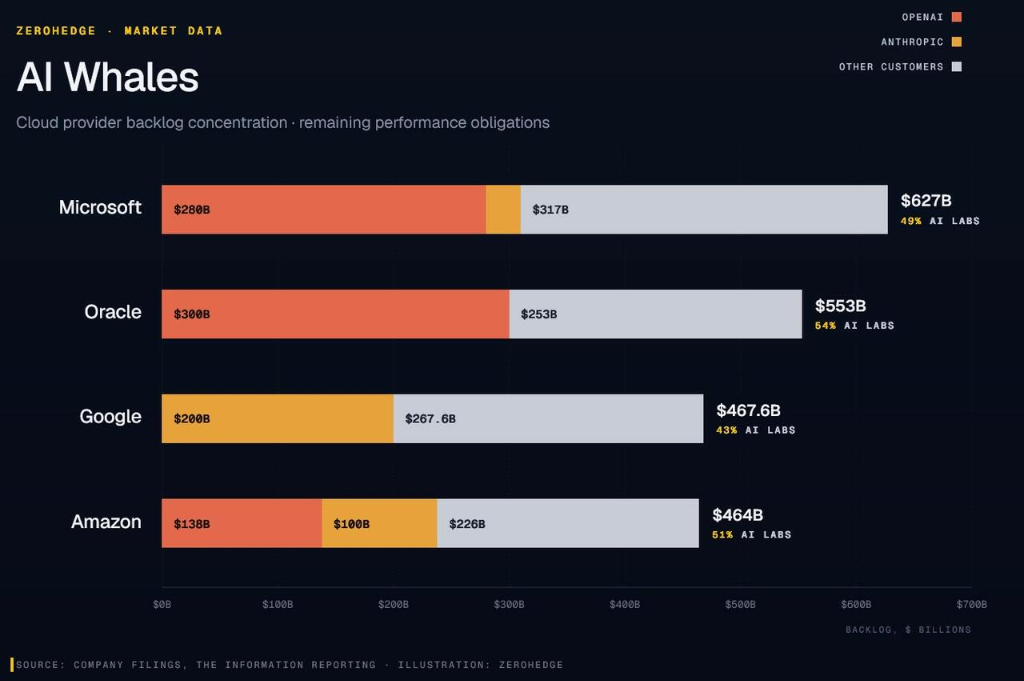
This financing structure has an endogenous circularity. Microsoft's $13 billion investment in OpenAI is primarily executed in the form of Azure credits, which OpenAI uses to purchase Azure computing power, and Microsoft subsequently accounts this as cloud revenue.
Similarly, the large-scale cloud service providers are both equity investors in AI labs and service providers that bill for computing power.
This structure is also reflected in profit data. Alphabet reported a record $62.6 billion profit for Q1, of which about $28.7 billion, nearly half, came from the book appreciation of Anthropic stock.
Amazon's Q1 profit of $30.3 billion includes $16.8 billion in pre-tax unrealized gains from Anthropic, while its free cash flow plummeted 95% to $1.2 billion due to data center capital expenditures reaching $44.2 billion during the same period.
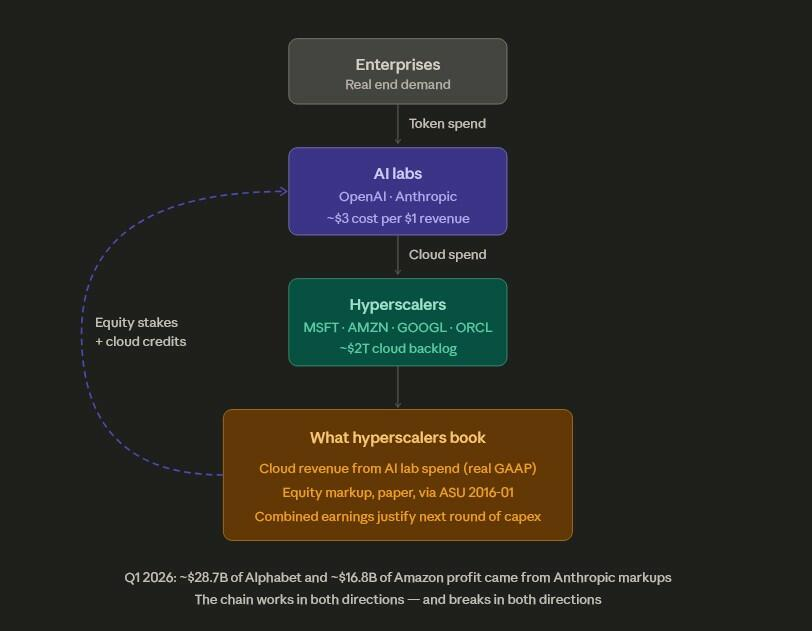
The sustainability of this system depends on the AI labs' continued ability to secure external financing to fulfill cloud computing commitments, which, in turn, relies on corporate clients' continued willingness to pay rising token bills.
Reports indicate that Anthropic currently incurs costs of up to $3 for every $1 earned. If the pace of financing slows down, the credibility of cloud revenue predictions will decline, putting downward pressure on the valuation multiples of large-scale cloud vendors.
This cycle of two-way transmission may also break in both directions.
This is not 1999, but the problems are real
The current situation does not constitute a typical bubble setting.
In terms of valuation multiples, the "Seven Giants" of technology correspond to about 20 times future earnings, far below the 52 times during the peak of the 2000 tech bubble, 67 times in the 1989 Japan market, or 34 times in the "Nifty Fifty" era.
The AI technology itself is real. For heavily reliant user groups, the data on productivity enhancements is also verifiable. OpenAI has an annual revenue of about $20 billion, while Anthropic has about $4.3 billion; both labs are not going to disappear.
Now, token costs (computing expenses) have become the key factor determining the success or failure of AI, while just six months ago, this topic was hardly discussed.
Back then, everyone only cared about "whether the technology works." Now the answer is clear: in the eyes of specific jobs and specific groups, the technology does indeed work.
But new questions arise: can the money that downstream companies save by using AI be timely passed up the chain, outpacing the valuation window that the capital market gives to AI labs and cloud giants?
Proponents of AI believe that as long as the technology continues to mature, corporate ROI (return on investment) will turn positive within 1 to 1.5 years.
Bearish individuals, on the other hand, believe that more executives like Macdonald will publicly complain that the AI ROI is too low and begin to cut budgets.
Both of these possibilities are happening, and victory remains undetermined. The only certainty is that the past lie that "as long as token consumption is rising, AI transformation is successful" has been debunked.
A large volume of token consumption does not equate to commercial value; these two bubbles must ultimately be popped. The AI bills have come due, but who will ultimately foot the bill? This remains an unknown.
免责声明:本文章仅代表作者个人观点,不代表本平台的立场和观点。本文章仅供信息分享,不构成对任何人的任何投资建议。用户与作者之间的任何争议,与本平台无关。如网页中刊载的文章或图片涉及侵权,请提供相关的权利证明和身份证明发送邮件到support@aicoin.com,本平台相关工作人员将会进行核查。


