Summary
In 2026, the crypto industry is undergoing a profound infrastructure-level transformation—TradFi assets are migrating to the chain at an unprecedented speed. According to CoinGecko's Q1 2026 report, the total locked value of tokenized real-world assets (RWA) has surpassed $31 billion, growing nearly four times from $7.8 billion at the beginning of 2025, with a market capitalization reaching $19.3 billion. The market capitalization of tokenized stocks surged from $2 million to $486 million, with Q1 spot trading volume reaching $15.1 billion, exceeding the entire trading volume for the second half of 2025 in a single quarter; the trading volume of RWA perpetual contracts in Q1 reached as high as $524.8 billion, far exceeding the full-year figure of $313 billion in 2025. At the same time, the BlackRock BUIDL fund has reached a size of $2.3 billion and has newly filed for two tokenized funds, marking the transition of the world's largest asset manager's tokenization strategy from pilot projects to product family development. HTX, as a core participant in the crypto exchange sector, officially launched TradFi perpetual contracts for products such as NVDA, AAPL, MSFT, META, and SPY in 2026, providing crypto users with access to 24/7 trading of core US stocks. The Boston Consulting Group predicts that by 2030, the global tokenized asset scale could reach $16 trillion, while McKinsey provides a conservative estimate of approximately $2 trillion. The chainification of TradFi assets is no longer a "future narrative" but a structural transformation that is occurring; crypto exchanges are evolving from single crypto asset trading platforms to "comprehensive asset class trading infrastructures."
1. Definition of TradFi and the Evolution Logic of the Crypto World
TradFi, or Traditional Finance, refers specifically in the crypto context to the introduction of traditional financial assets—including stocks, bonds, commodities, foreign exchange, ETFs, etc.—into the crypto market through tokenization or synthetic assets for trading. This concept did not appear in 2026 but has gone through three distinct phases of development. The first phase is the "synthetic asset experimental period" from 2020 to 2022. During this time, Mirror Protocol and Synthetix first launched on-chain synthetic US stocks, and FTX and Binance provided tokenized stock trading services through partnerships with licensed brokers. However, following the collapse of FTX in 2022 and increasing global crypto regulation, most tokenized stock businesses were forced offline, culminating this phase in industry rectification. The second phase is the "government bond leading period" from 2023 to 2024. In a context of aggressive interest rate hikes by the Federal Reserve, DeFi protocols such as MakerDAO began using US government bonds as underlying RWA assets. BlackRock launched the BUIDL fund in March 2024, with initial seed funding of $100 million, which quickly surpassed $1 billion within a few months, marking the formal entry of Wall Street giants.
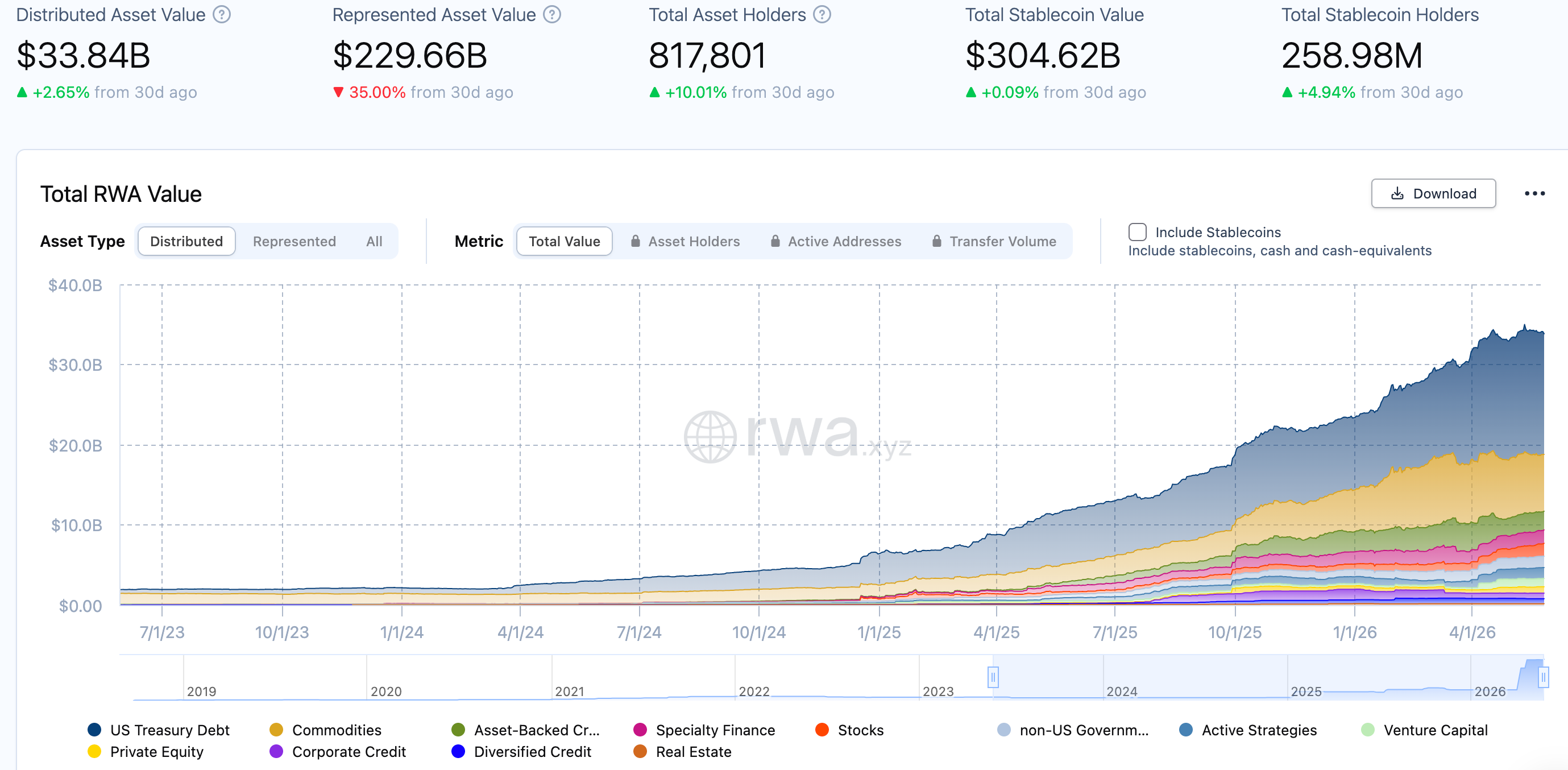
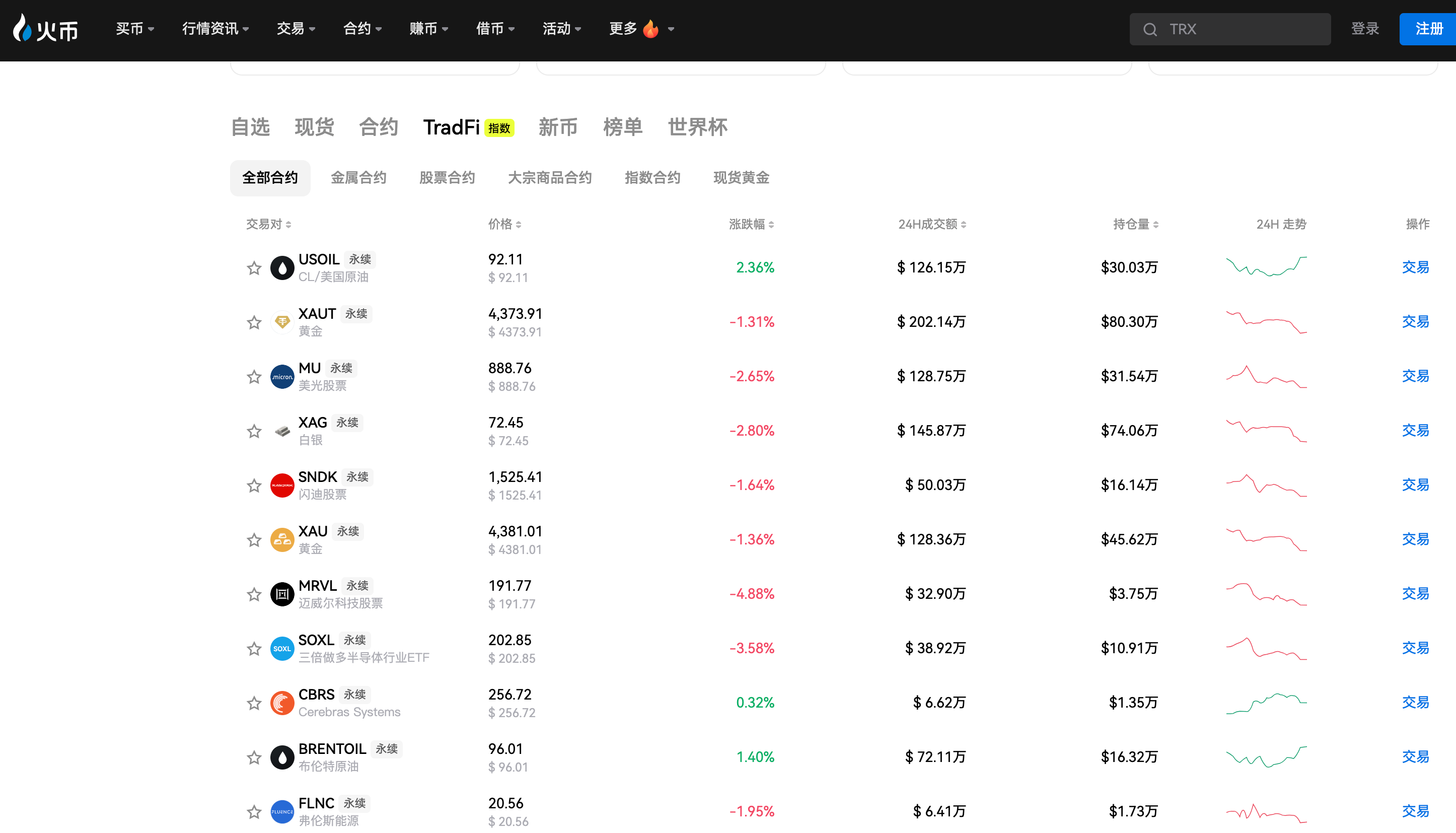
The third phase is the "full-asset acceleration period" from the second half of 2025 to now. Tokenized stocks have re-entered a growth curve, MyStonks completed compliance filings for US STO, and Backed Finance has issued real asset-backed xStocks on nine chains, requiring whitelist access but no KYC. More importantly, crypto exchanges are no longer satisfied with simply listing tokenized assets; they have directly introduced TradFi perpetual contract products, bringing traditional assets like US stocks, gold, and government bonds into a 24/7 on-chain trading ecosystem in derivative forms. HTX, as a veteran platform in the crypto industry, was the first to lay out the TradFi perpetual contract product line during this phase, using core US stock targets such as NVDA, AAPL, MSFT, META, and SPY to provide crypto users with a new path to trade global core assets without leaving the on-chain ecosystem. The internal logic of this evolution is that the crypto market requires new incremental capital and user groups, and traditional financial assets serve as the most effective bridge connecting the $75 trillion global stock market and the $130 trillion bond market. For HTX, the introduction of TradFi assets means a strategic upgrade from a crypto-native platform to a comprehensive asset trading platform.
2. Market Structure and Competitive Landscape
The current TradFi encryption market exhibits a competitive landscape with three main racing tracks developing in parallel. The first track is "tokenization of real assets," represented by BlackRock BUIDL, Ondo Finance, Backed Finance, and MyStonks. Features include that assets exist on-chain in the form of ERC-20 tokens, corresponding 1:1 with underlying real assets, and are managed by licensed custodians. Among these, BlackRock BUIDL occupies an absolute leading position in the tokenized government bond sector with $2.3 billion AUM, accounting for approximately 25% to 30% of the tokenized government bond sub-market; Ondo Finance's OUSG has developed to a multi-billion-dollar level; Backed Finance's xStocks has operated on nine chains without requiring KYC but with whitelist access. The second track is "TradFi derivatives perpetual contracts," which has experienced the most rapid growth in 2026. Coinbase launched US stock perpetual contracts in March 2026, targeting non-US users, supporting individual stocks like Apple, Microsoft, Nvidia, and Tesla, as well as ETFs like SPY and QQQ, with up to 10x leverage for individual stocks and up to 20x leverage for ETFs, settled in USDC and available for 24/7 trading. HTX has also launched TradFi perpetual contracts for NVDA, AAPL, MSFT, META, and SPY, providing users with US stock derivatives trading services settled in USDT. Hyperliquid holds a 28.6% market share in the RWA perpetual contract sector through the HIP-3 protocol. The trading volume of RWA perpetual contracts reached $524.8 billion in Q1 2026, surpassing the $313 billion for the entire year of 2025.
The third track is "TradFi comprehensive trading infrastructure," aiming to provide a unified trading interface for traditional and crypto assets. Some leading platforms are integrating contracts for difference (CFD) through third-party systems like MT5, while others are independently developing index-based perpetual contract products that bundle multiple traditional assets for trading. From market data, the tokenized RWA market's TVL has reached $31 billion to $34 billion in May 2026, growing nearly threefold from about $11 billion a year ago. Tokenized gold increased from $1.43 billion to $5.55 billion, an increase of 289%; tokenized stocks increased from $2 million to $486 million, growing over 200 times. BCG predicts that by 2030, the global tokenized asset market could reach $16 trillion, accounting for about 10% of global GDP; McKinsey's conservative estimate is about $2 trillion. Regardless of whether the predictions are optimistic or conservative, there remains significant growth potential of several dozen to several hundred times between the current market scale and future prospects.
3. Core Risk Analysis
Despite the broad prospects of TradFi encryption, the risks it faces are equally significant. These risks are potential traps for investors and core challenges that platform operators need to manage prudently. First is compliance and regulatory risk, the biggest source of uncertainty currently. Tokenized securities fundamentally belong to security issuances and must comply with the securities laws of various countries. The SEC's stance on on-chain securities remains ambiguous, and Coinbase's US stock perpetual contracts are only available to non-US users, a strategy that itself reflects the complexity of the regulatory environment. The fragmentation of cross-border regulation means that the same tokenized asset could face completely different compliance requirements in different jurisdictions, posing ongoing compliance challenges for globally operating crypto exchanges. HTX also needs to manage the operational complexities brought by regulatory differences when laying out its TradFi perpetual contracts. Secondly, there is liquidity risk. Despite RWA perpetual contracts reaching $524.8 billion in trading volume in Q1, the total market capitalization of tokenized spot stocks is only $486 million, resulting in significant discrepancies in liquidity depth between the spot and derivatives. This structural liquidity mismatch could lead to severe price deviations during extreme market conditions, increasing the risk of liquidation for traders. Additionally, the misalignment between US stock trading hours and the crypto market's 24/7 trading model may lead to insufficient price discovery during non-trading periods, increasing the risks of slippage and abnormal volatility. Thirdly, there is the risk related to smart contracts and technology. Tokenized assets rely on the accurate execution of smart contracts, and any contract flaw could result in asset loss. While institutional products like BlackRock BUIDL are supported by technology platforms like Securitize, tokenized assets at the DeFi protocol level still face risks from inadequate contract audits and oracle manipulation. Fourthly, there is custody and settlement risk. The tokenization of real assets requires a reliable custodian as support; if the custodian faces credit risk (like a repeat of the FTX incident), token holders may find that the underlying assets cannot be redeemed. Although mainstream solutions currently use traditional custodians like Fidelity and Swiss Bank, the legal correspondent relationship between on-chain tokens and off-chain assets has not yet received clear judicial support in many jurisdictions. Fifthly, there is foreign exchange and interest rate risk. TradFi perpetual contracts are typically settled in USDT or USDC, but the underlying assets are valued in USD, and exchange rate fluctuations could affect the actual returns for non-USD users. Simultaneously, changes in the Federal Reserve’s interest rate policy may directly impact the performance of US stocks, thereby affecting the price fluctuations of TradFi perpetual contracts.
4. Innovation Trends and Track Opportunities
The TradFi encryption track is exhibiting four major innovation trends, which present strategic growth opportunities for crypto exchanges like HTX. The first trend is the rapid expansion of perpetual contract product matrices. After Coinbase first launched US stock perpetual contracts, more and more crypto exchanges are adding US stock perpetual contract product lines, expanding the underlying assets from the initial 5 to 10 blue-chip stocks to include semiconductor ETFs, crypto concept stocks, industry-themed ETFs, and more. HTX has launched contracts for NVDA, AAPL, MSFT, META, and SPY, and is expected to cover more TradFi targets in the future, building a complete trading matrix for core US assets. From the competitive landscape perspective, exchanges that can establish a complete TradFi product matrix first will gain a first-mover advantage in user acquisition and trading fee revenue. The second trend is the maturation of institutional-grade infrastructure. BlackRock BUIDL has rapidly expanded from $100 million in seed funding to $2.3 billion AUM, with new filings for two tokenized funds signaling a shift toward product family development, conveying Wall Street's top institutions' long-term commitment to tokenization. Participation by traditional custodians like Fidelity and Swiss Bank and compliance platforms like Securitize providing KYC, whitelist, and on-chain issuance and redemption services are lowering the barriers for institutional entry. Franklin Templeton's Benji fund has consistently operated since its launch in 2021, and Ondo Finance's OUSG has grown to a multi-billion-dollar level, indicating that the institutional tokenization product line is taking shape. This institutionalization trend means that TradFi encryption is moving from "marginal experimentation" to "mainstream configuration," and the value of crypto exchanges as a bridge between institutional capital and on-chain assets will rise accordingly. The third trend is the rise of permissioned DeFi pools. This is the most noteworthy structural innovation in the RWA sector of 2026. Institutions create DeFi liquidity pools with KYC/AML whitelist systems on public chains, allowing qualified participants to engage in 24/7 tokenized government bond trading while implementing automated compliance checks through smart contracts. This model retains the composability and efficiency advantages of DeFi while meeting regulatory requirements for investor suitability, being seen as a key bridge for large-scale institutional entry. The fourth trend is the gradual clarification of regulatory frameworks. The EU's MiCA regulations will be fully implemented in July 2026, and the US's GENIUS Act was enacted in March 2025. Globally, 72 jurisdictions have established regulatory frameworks for crypto assets, and 58 countries have adopted FATF travel rules. The clarity in regulation is shifting from the "gray area" to "clear rules," providing institutional support for the long-term development of TradFi encryption. For HTX, the clarification of regulations means more confidence in investing resources to build TradFi product lines without worrying about business interruption risks caused by sudden policy shifts.
5. Participation Strategies and Investment Logic
For investors, the TradFi encryption track offers multi-layered investment participation paths. The first layer is direct participation in TradFi perpetual contract trading. Platforms like HTX have launched US stock perpetual contracts, allowing investors to trade on NVDA, AAPL, SPY, and more with USDT as margin, available for leverage trading within the 24/7 timeframe. The advantage of this path is its low trading threshold, enabling global core asset trading without opening traditional brokerage accounts, but caution is necessary regarding the volatility of perpetual contract funding rates and the risk of forced liquidation. Especially, the misalignment between US stock trading hours and the crypto market's 24/7 model may lead to insufficient price discovery during non-US trading hours, increasing trading risks. The second layer is investing in protocol tokens of the RWA sector. Ondo Finance (ONDO), as a leading protocol in the tokenized government bond sector, has its token value correlated with the growth of on-chain government bonds. Other RWA infrastructure protocols like Centrifuge are also worth attention. The third layer is positioning with crypto exchanges that provide TradFi trading infrastructure. With the explosive growth of TradFi perpetual contract trading volume—reaching $524.8 billion in Q1 2026—exchanges that launch TradFi products will directly benefit from increased trading fee revenue. HTX is tapping into the $75 trillion incremental space in the US stock market by launching US stock perpetual contracts, which has structural significance for its platform revenue and user growth. It is particularly important for investors to pay attention to exchanges' compliance qualifications and risk control capabilities. Coinbase, being a publicly listed company on NASDAQ, has an inherent advantage regarding compliance; other exchanges avoid direct regulatory conflicts by targeting non-US users. Regarding risk warnings, TradFi encryption is still in its early stages; the liquidity depth of tokenized assets is far behind that of traditional markets, and the price discovery mechanism is still immature. Investors should strictly control their positions, prioritize investing in tokenized products backed by real assets, and avoid participating in high-leverage synthetic asset trading without compliance support. It is also necessary to monitor the impact of exchange rate fluctuations on non-USD users, as well as the transmission effect of changes in the Federal Reserve's interest rate policy on US stock movements.
6. Conclusion and Outlook
TradFi encryption is reshaping the boundaries of the crypto industry. From the synthetic asset experiments in 2020 to the institutional entry of BlackRock BUIDL in 2024, and now to the comprehensive layouts of exchanges like Coinbase and HTX for US stock perpetual contracts in 2026, this track has completed its leap from "concept validation" to "product matrix development" within six years. The current key data is already compelling: the RWA market's TVL has surpassed $31 billion, the quarterly trading volume of RWA perpetual contracts exceeds $500 billion, and the market capitalization of tokenized stocks has grown over 200 times in a year, with Wall Street giants like BlackRock incorporating tokenization into their core product strategies. Standing at mid-2026, we judge that TradFi encryption is still in the "early acceleration stage of the growth curve." Although there is a significant gap between BCG's forecast of a $16 trillion future space and McKinsey's conservative estimate of $2 trillion, even the conservative outlook suggests that the current market scale has several dozen times of growth potential. In the short term, the expansion of the product matrix for US stock perpetual contracts, the institutional landing of permissioned DeFi pools, and the comprehensive implementation of regulatory frameworks like MiCA will become three major catalysts for market growth. HTX, as an important player in the crypto industry, has already secured a favorable position in this track by launching TradFi perpetual contracts for NVDA, AAPL, MSFT, META, SPY. In the medium to long term, when the trading depth and user experience of TradFi assets on-chain reach levels comparable to those of traditional brokerages, crypto exchanges will truly complete their transformation from "crypto asset platforms" to "comprehensive asset trading infrastructures." This is not merely a technical upgrade but a fundamental transformation of financial infrastructure paradigms. For HTX users, this means the era is approaching where one account can trade both crypto and global core traditional assets.
免责声明:本文章仅代表作者个人观点,不代表本平台的立场和观点。本文章仅供信息分享,不构成对任何人的任何投资建议。用户与作者之间的任何争议,与本平台无关。如网页中刊载的文章或图片涉及侵权,请提供相关的权利证明和身份证明发送邮件到support@aicoin.com,本平台相关工作人员将会进行核查。


