The breakdown of negotiations has led to a stalemate, rising oil prices are driving inflation, and the risk of interest rate hikes in 2026 is at its highest.
Written by: Dong Jing
Source: Wall Street Journal
The trajectory of the situation in Iran and the outlook for the Federal Reserve's monetary policy are becoming the two most critical main lines influencing global markets.
Deutsche Bank's economic research team, in its latest report, systematically outlines the potential impacts of three possible outcomes related to the ceasefire negotiations in Iran on the Fed's policy path—from a recent reduction in interest rate hike risks, to multiple rate hikes in 2026, to a policy direction facing dual uncertainties, with each scenario corresponding to vastly different market logics.
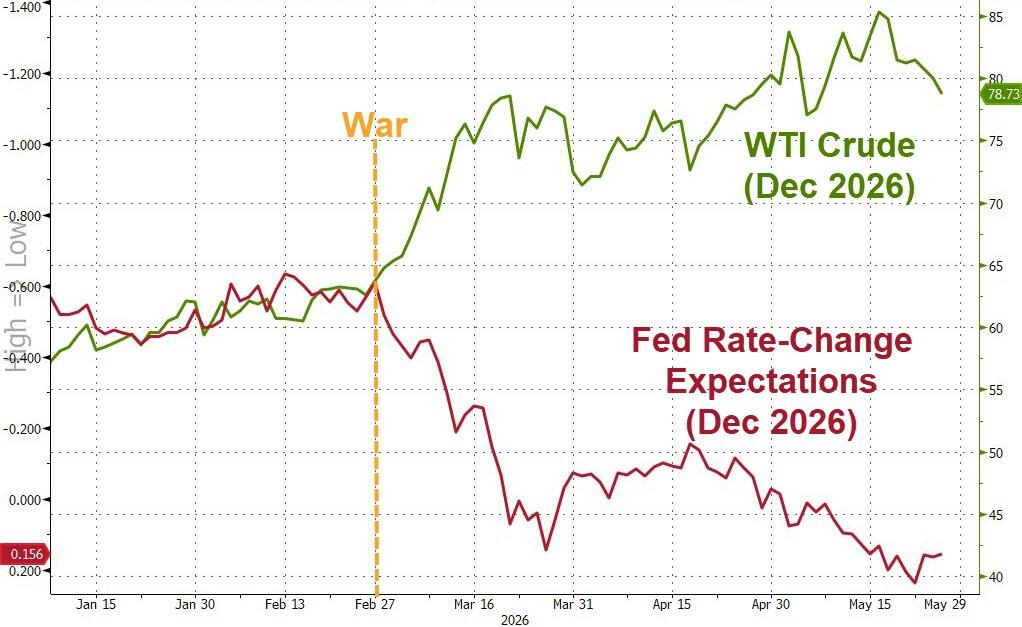
The analysis points out that the movement of oil prices will directly affect the degree to which inflation expectations are anchored, and hence determine whether the Fed needs to restart interest rate hikes. In its view, the current situation to be most wary of is not the most extreme conflict escalation scenario, but rather the intermediate state of "negotiations breaking down, and a stalemate"—in this scenario, persistently high oil prices are most likely to force the Fed into substantive tightening actions in 2026.
Currently, the latest developments in the geopolitical situation show that negotiations concerning the extension of the ceasefire agreement and the reopening of the Strait of Hormuz have made some progress, and the market has reacted optimistically. Brent crude futures have fallen below $100 per barrel, hitting a near month-low; the 10-year U.S. Treasury yield has also significantly retreated, erasing most of the previous week's gains. However, the details of the negotiations still contain uncertainties, and core controversies such as Iran's nuclear program remain unresolved.
Scenario One: Reaching a Peace Agreement—Recent Rate Hike Pressure Eases, but Mid-term Risks Remain
In Deutsche Bank's first scenario, negotiations break through, the Strait of Hormuz reopens, and oil prices continue their recent downward trend, albeit still above pre-war levels; U.S. Treasury yields further decline, and the risk asset market strengthens overall due to the elimination of tail risks, leading to looser financial conditions.
Against this backdrop, the pressure on the Fed to raise rates at its upcoming meeting will be significantly reduced. With overall inflation data softening and short-term inflation expectations falling, Fed officials are inclined to regard the recent core inflation pressures as temporary disturbances from energy price shocks, choosing to "look through" rather than respond immediately. Deutsche Bank expects that the newly appointed Fed Chairman Warsh will reinforce this tendency.
However, the bank simultaneously warns that the baseline narrative of "inflation not being persistent" requires time to be falsified, and the risks of rate hikes have not disappeared. If the labor market continues to remain tight and inflation expectations rise further, or if inflation remains high despite the alleviation of tariff and energy pressures, the risk of an increase in policy rates is more likely to materialize in 2027.
Scenario Two: Negotiations Break Down, Stalemate—Highest Risk of Rate Hikes in 2026
Deutsche Bank characterizes the second scenario as having the "highest risk of rate hikes" among the current three scenarios. In this scenario, peace negotiations fail, the Strait of Hormuz remains closed for a long time, but conflicts do not further escalate, and oil prices remain high rather than skyrocketing.
Persistently high oil prices will more significantly transmit to core inflation, while inflation expectations face a greater risk of decoupling. Meanwhile, oil prices in this scenario are insufficient to seriously damage demand, thus preventing the Fed from shifting its focus to the labor market, which means the Fed will face unilateral inflation pressure while lacking justification to "remain inactive due to economic downturn."
The bank believes that the Fed is unlikely to take rate hike actions before the September meeting—policy shifts need to go through several steps including the removal of easing tendencies (June), public discussions by some officials about the possibility of rate hikes (July to September), and forming a consensus within the committee.
However, it also notes that Fed Governor Waller recently stated that if "inflation does not fall quickly," raising rates might be a reasonable choice, implying that the Fed may be willing to tighten policy more rapidly. Therefore, the possibility of multiple rate hikes in 2026 should not be ruled out.
Scenario Three: Conflict Escalates Again—Policy Outlook Faces Dual Risks
The third scenario envisions a resurgence of the situation in Iran, leading to a larger and more sustained rise in oil prices. Deutsche Bank believes that this scenario does not necessarily mean the Fed will unilaterally move toward rate hikes, but it will bring dual uncertainty to the policy outlook.
On one hand, the escalation of conflict will push overall inflation to rise more significantly and persistently, with core inflation facing more notable transmission risks and the possibility of inflation expectations decoupling realistically increasing. The Fed will then need to communicate its willingness to tighten policies clearly to address the risk to price stability.
On the other hand, the significant and sustained rise in oil prices will increase the risk of non-linear shocks to the real economy and eventually affect the labor market.
Deutsche Bank points out that consumers can currently withstand energy prices close to the current level, and tax reduction policies have somewhat mitigated the pressure from rising oil prices; however, if oil and gas prices rise further significantly, this buffer will be exhausted. At that point, the labor market may slide out of the current "low hiring, low layoffs" fragile equilibrium, leading to further contraction in demand or the arrival of a wave of layoffs.
In this scenario, the Fed's ultimate policy direction will depend on the sequence of realization of the two types of risks mentioned above: if the economy remains resilient while inflation expectations decouple first, strong tightening will be needed in response; if cracks appear in the labor market first, the Fed may instead lean towards rate cuts citing softening forward-looking price pressures.
Overall, the analysis framework from Deutsche Bank reveals a clear logical chain across the three scenarios: the situation in Iran determines the trajectory of oil prices, the trajectory of oil prices determines the nature and duration of inflation pressure, and whether inflation expectations decouple ultimately determines the Fed's policy space.
The current signals to focus on include: substantive progress in ceasefire negotiations, whether Brent crude can stabilize below $100 per barrel, and the wording changes of Fed officials in upcoming meetings—especially whether they start to remove easing tendencies or if any officials publicly discuss the possibility of rate hikes. These signals will be key observational windows for assessing the probability distribution of the three scenarios mentioned above.
免责声明:本文章仅代表作者个人观点,不代表本平台的立场和观点。本文章仅供信息分享,不构成对任何人的任何投资建议。用户与作者之间的任何争议,与本平台无关。如网页中刊载的文章或图片涉及侵权,请提供相关的权利证明和身份证明发送邮件到support@aicoin.com,本平台相关工作人员将会进行核查。


