Author: OpenSea
Translated by: Deep Tide TechFlow
Deep Tide Guide: When an AI Agent is denied by the API due to insufficient permissions, it independently purchases an NFT on the blockchain and then successfully retries - this is not science fiction, the newly merged ERC-8257 standard from OpenSea makes all this possible. For NFT holders, the JPG in your hands may suddenly become the key to the Agent economy; for developers, tool publishing, pricing, and access control are all on-chain, no longer needing the endorsement of centralized platforms.
The App Store provided developers with a space to publish tools, a place for users to browse, and built-in access control and payments. The tool ecosystem for AI Agents also requires the same infrastructure.
However, today, Agent tools are scattered across documentation, GitHub repositories, and centralized directories. Without an open tool registry and standardized access control, Agents cannot browse available tools and acquire them as needed.
Watching a software autonomously pay another software to gain access, without any human involvement - it does feel a bit strange. But that is the crux of the matter.
ERC-8257: Agent Tool Registry is the foundational layer that makes all this work. This is our newly merged Ethereum open standard: an on-chain registry where anyone can publish tools, declare access rules and pricing, allowing Agents to autonomously meet these requirements.
For tool developers: Publish once, set access thresholds for your NFT holders, offer subscription packages, limit the number of seats, and enable them to trade in the open market. Your rules, executed on-chain.
For Agents: Browse the registry, see what is needed, and then proceed. Purchase an NFT, mint a subscription, sign a payment. No human intervention required.
Imagine this scenario
An AI Agent is helping you assess the price of an NFT. It tries to call a professional pricing tool. The tool responds: access denied, you need to hold a specific NFT to get the discounted price. The Agent immediately goes on-chain to buy one, retries, and gets the answer.
In seconds, not days. No human involvement throughout.
This is the world that ERC-8257 makes possible. Not five years from now. It is today.
Why go on-chain
Cryptography is the only infrastructure that can make access rules both rich and self-service. x402 proves this: pay-per-use, instant access. But pay-per-use is just one form of access. Transaction signals may require limited seats. Partner APIs may be open only to holders. Research subscriptions may require tiered pricing. ERC-8257 can handle it all.
How it works
You register a tool with a listing (tool functionality, invocation method, fee) and an "access predicate." The access predicate is a smart contract that simply answers one question: does this address have access?
The predicate can check any condition: NFT ownership, active subscriptions (ERC-5643), whitelists, ZK proofs, DAO votes, stake amounts. Predicates are pluggable, following the same pattern as Seaport zones and Uniswap v4 hooks: an extension point with open design space.
ERC-8257 is responsible for discovery and access control. Payments are handled by the most suitable protocol: x402 for small payments, MPP for metered billing, with other protocols joining as needed. These layers are combinable.
What this means for NFTs
Every NFT series just gained new potential utility.
Holding the right token allows your Agent to utilize cheaper API packages. Minting a limited seat gives your Agent access that others can't buy for any amount of money. PFP series, membership passes, CC0 artworks, any on-chain asset could become the key for Agents to complete their tasks.
Projects that built identities around communities now have a way to extend membership into the Agent economy.
Its position in the tech stack
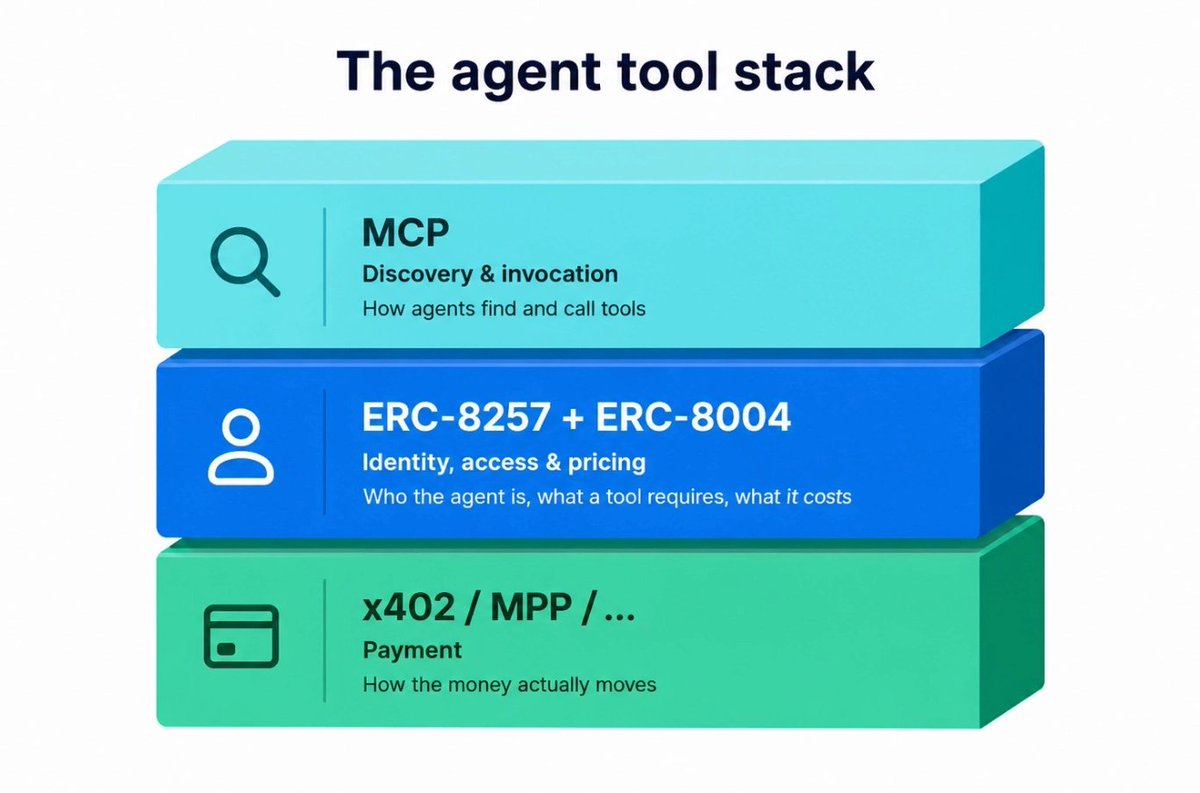
MCP tells your Agent what tools exist. ERC-8004 defines your Agent's identity. ERC-8257 explains how to actually use the tools. x402 handles payments. Each layer is combinable.
Agents registered with ERC-8004 can link restricted tools from the ERC-8257 registry in their services array. You do not have to choose between them. They are different layers of the same tech stack.
Watch it run
nft-appraisal-tool: point to any NFT, it will return a price assessment, including low/mid/high ranges, confidence, recent transactions, and comparable cases. Two tiers: anyone $0.05 per call, CHONK holders on Base $0.01 per call.
An Agent without CHONK calls the holder endpoint. Response: 403 - predicate gate denied. You need CHONK on Base.
The Agent buys one, retries, and the same call returns successfully.
$ npx @opensea/tool-sdk pay https://nft-appraisal-tool.vercel.app/api/holder --auth siwe \
--body '{"chain":"ethereum","contractAddress":"0x79fcdef22feed20eddacbb2587640e45491b757f","tokenId":"4707"}'
Wallet: 0x3184...0465
Response (403):
{"error":"Predicate gate: access predicate denied","toolId":"2","predicate":"0xc872..."}
The predicate clearly tells it what is needed: CHONK on Base. The Agent buys one on OpenSea and retries, the call goes through.
$ npx @opensea/tool-sdk pay https://nft-appraisal-tool.vercel.app/api/holder --auth siwe \
--body '{"chain":"ethereum","contractAddress":"0x79fcdef22feed20eddacbb2587640e45491b757f","tokenId":"4707"}'
Wallet: 0x5eca...e2a8
Response (200):
{
"low": {"amount": "1.8", "currency": "ETH", "usd": 5460},
"mid": {"amount": "2.3", "currency": "ETH", "usd": 6970},
"high": {"amount": "3.1", "currency": "ETH", "usd": 9400},
"confidence": "medium",
"reasoning": "Comparable Squiggles in this color band sold between 1.9 and 2.6 ETH...",
...
}
No human involvement from 403 to 200. Whoever holds the access NFT has access.
What can be built next
Professional pricing oracles. On-chain analytics subscriptions. Research subscriptions. Partner whitelisting APIs. Limited seat tools that trade on the open market like other assets.
These didn't even need to exist a year ago. The moment the registry went live, they all became possible.
Start building
Launched on Ethereum and Base.
@opensea/tool-sdk handles the underlying details, providing scaffolding, access control, registration, deployment to Vercel, Cloudflare, or Express. Including available examples.
npx @opensea/tool-sdk init my-tool
See the full specification at 8257.ai.
Get involved
ERC-8257 is still in draft stage. Help us improve the specification before we release the official version of registry 1.0. Publish a tool, even if it's small. We will promote interesting projects.
Join the Telegram group t.me/ERC8257, and discuss ERCs, tool SDKs, and other topics with the authors @CodinCowboy and @ralxz.
Disclaimer: This content is for reference only and does not constitute financial or trading advice. Mentioning specific projects, products, services, or tokens does not constitute endorsement, sponsorship or recommendation by OpenSea. OpenSea does not guarantee the accuracy or completeness of the information presented, and readers should independently verify any claims before taking action. Readers should conduct their due diligence and assume full responsibility before making any decisions.
免责声明:本文章仅代表作者个人观点,不代表本平台的立场和观点。本文章仅供信息分享,不构成对任何人的任何投资建议。用户与作者之间的任何争议,与本平台无关。如网页中刊载的文章或图片涉及侵权,请提供相关的权利证明和身份证明发送邮件到support@aicoin.com,本平台相关工作人员将会进行核查。


