
Author: Little Cake, Deep Tide TechFlow
On May 22, after the China Securities Regulatory Commission planned severe penalties for three overseas brokers, Futu, Tiger, and Changqiao, their stock prices plummeted.
However, in Futu's own APP community, the atmosphere changed drastically; it became not just a platform for stock exchanges but a matchmaking platform for investors overnight.
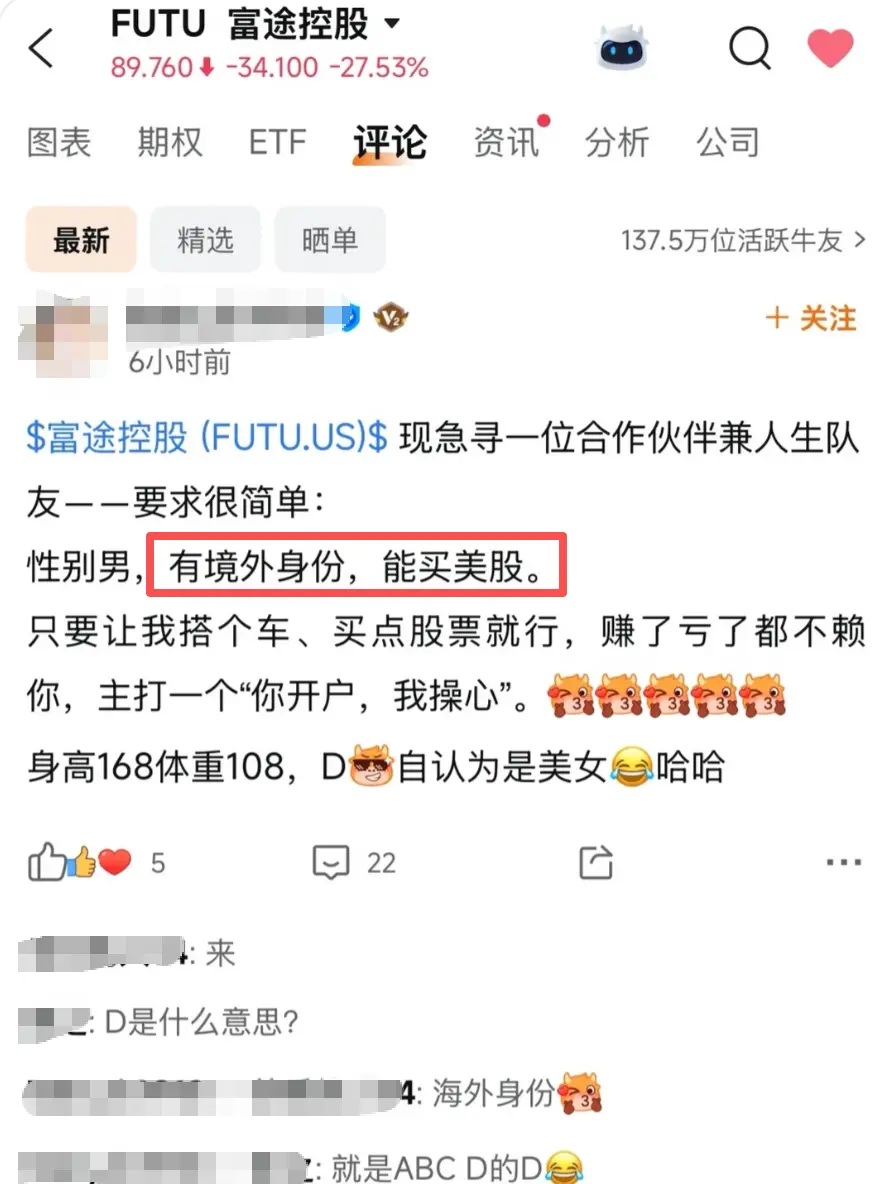
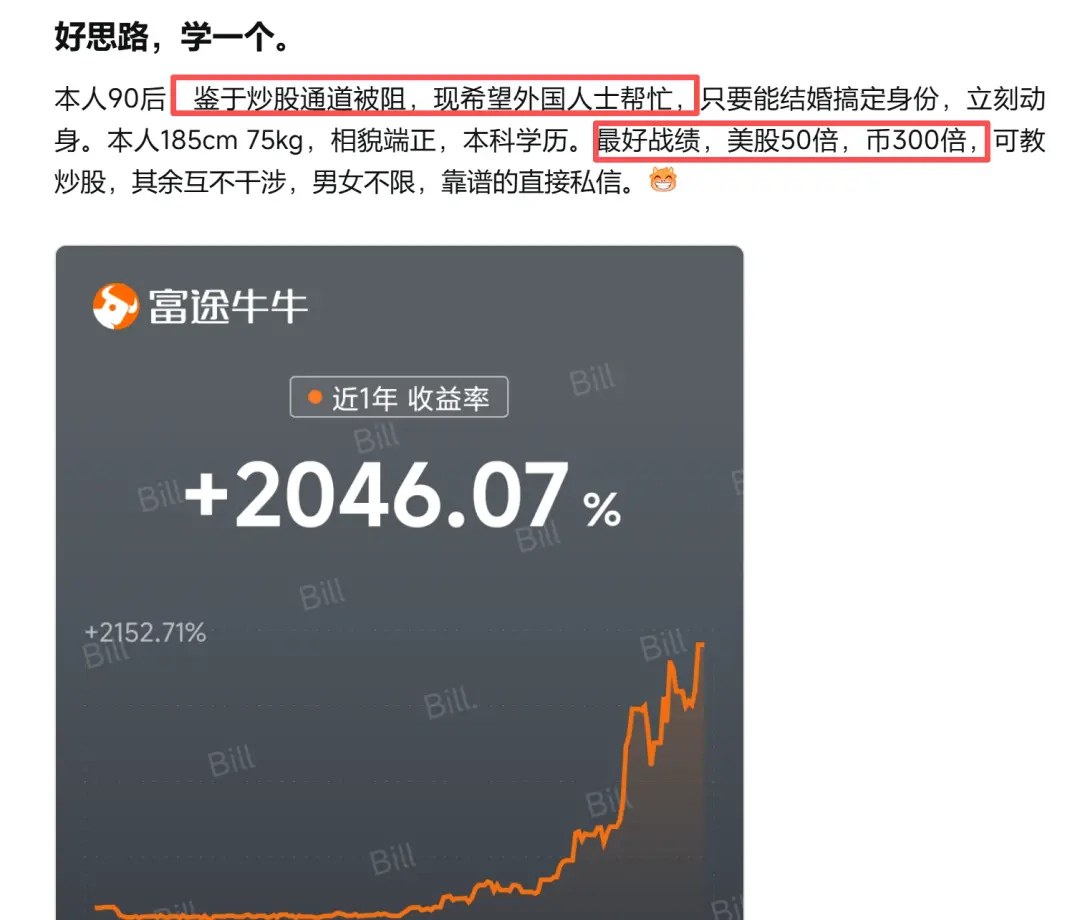
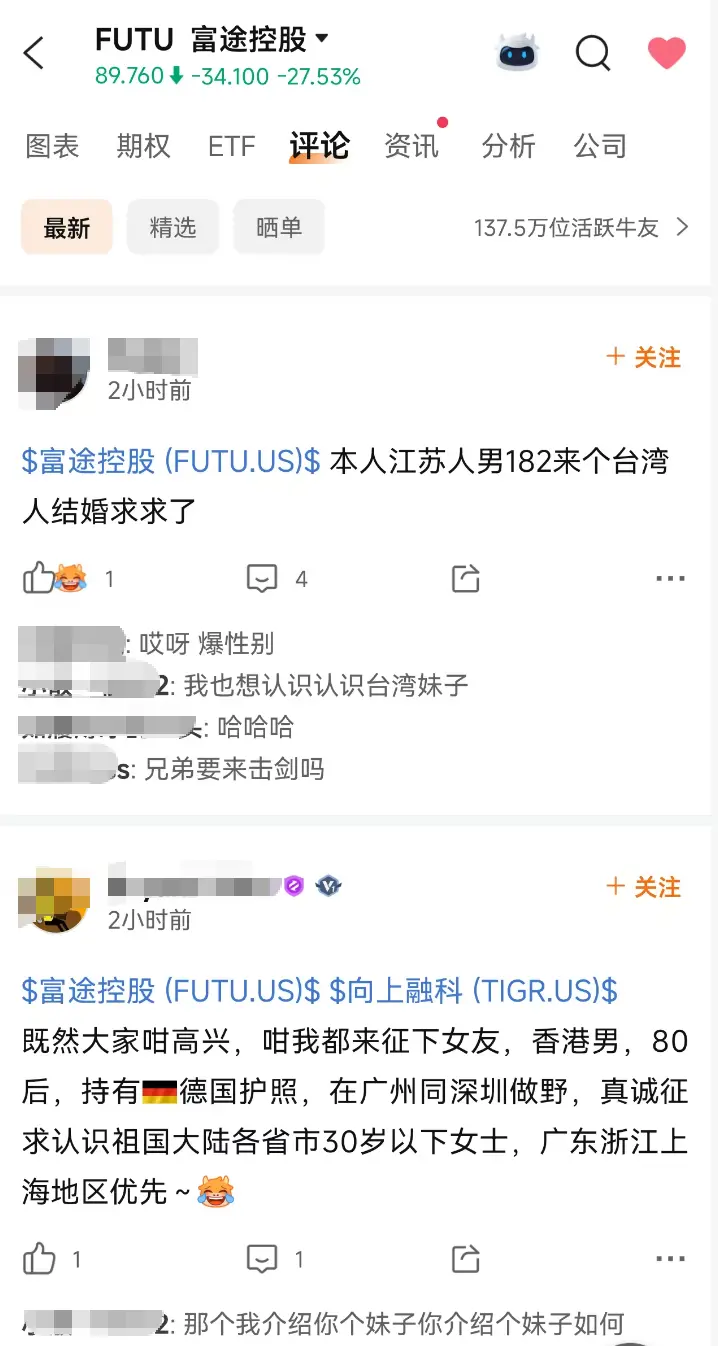
A mainland girl claiming to be a D-cup beauty is seeking overseas men; a post-90s mainland individual with a 2046% return is willing to accept "gender non-restricted" identity swaps; a Hong Kong man holding a German passport is selectively choosing "priority for Guangxi, Zhejiang, and Shanghai"...
This is not just a joke; what you see is an emergent implicit marriage and relationship market taking shape in the Futu community. Demand, supply, pricing preferences, geographic filtering criteria... are spontaneously forming. This is the most honest natural language leak of the mindset of China's middle-class investors in 2026.
Regulatory Hammer
On May 22, the China Securities Regulatory Commission and seven other departments jointly issued the "Implementation Plan for Comprehensive Rectification of Illegal Cross-Border Securities, Futures and Fund Operating Activities", and on the same day announced severe penalties for the three overseas brokers: Futu Holdings is set to be fined approximately 1.85 billion yuan; Tiger Securities is expected to be fined 411.2 million yuan; Changqiao is similarly included. Both Futu and Tiger dropped over 30% in pre-market U.S. trading.
The brokers' responses were restrained. Futu stated that as of the end of the first quarter of 2026, accounts funded from mainland China accounted for approximately 13% of the company's total funded accounts; Tiger said that the assets of mainland Chinese clients accounted for about 10% of the group’s global total assets. Both emphasized that "business operations in all regions outside mainland China remain normal".
However, for mainland users who already hold U.S. stocks in their Futu or Tiger accounts, the truly painful message can be summarized in one sentence:
Only sell, cannot buy.
This means that for a period of time ahead, if you want to open a new U.S. stock account to buy Nvidia, Tesla, or an S&P 500 ETF, you must first have proof of identity as a non-mainland Chinese resident.
Looking back over the past three years, the threshold for opening accounts with overseas brokers for mainland users has been raised step by step:
- At the end of 2022, the regulatory commission first named specific companies;
- In May 2023, the APP was removed from mainland app stores;
- Starting in 2024, only "mainland residents actually working or living abroad" will be accepted, needing to provide overseas utility bills, credit card statements, tax documents, etc.;
- By September 2025, the threshold was raised to "proof of overseas permanent residence ID";
- By the end of 2025, only "non-mainland Chinese ID documents" will be accepted;
- In May 2026, direct penalties were issued to the brokers.
The threshold for opening accounts has gone from a utility bill to an overseas passport or permanent residency card. On the other side of this curve is the process of identity being repeatedly repriced in the investment market.
Overseas Identity, the New Hard Currency for the Middle Class
For the domestic middle class in 2026, overseas identity has become a form of implicit asset class. It cannot be bought or sold like real estate, nor does it have a public quote like stocks, but it possesses all the basic properties of "hard currency".
First is scarcity. The Hong Kong talent scheme will approve around 140,000 applicants in 2024, most of whom come from mainland China. Although it sounds like a lot, in the context of a 1.4 billion population base, the penetration rate is less than one in ten thousand.
Unlike real estate, overseas identity will not be discounted due to population outflow, policy adjustments, or rising interest rates. At any given point in time, it corresponds to a definite set of rights and has a very high rate of return. It does not unlock a particular stock, but an entire dimension of asset allocation: U.S. stocks, overseas real estate, offshore insurance, foreign currency deposits, compliant channels for cryptocurrency assets.
The most attractive is that it is non-transferable. This asset of identity cannot be arbitraged on the secondary market like stocks; it can only be held by the individual or transferred through marriage, childbirth, or inheritance—three ancient methods.
School district housing once created a complete gray industrial chain: intermediaries, transfer companies, registered residence connections, sham marriages, and sham divorces. The overseas identity industrial chain is replicating all of that: Hong Kong talent scheme intermediaries, Portugal golden visa, Singapore EP, Malta passport, quick citizenship in Caribbean small countries. Each product has a clear quote and processing time.
The form of assets has changed from "property certificates" to "residency cards", from "degrees" to "account opening qualifications".
In the past twenty years, the middle class has used school district housing to lock in their social tier; in the next ten years, they will use overseas identity to lock in assets.
Studying Abroad Equals Buying Insurance?
Stepping back a bit further, the logic of the Chinese middle class purchasing overseas resources has been redefined three times over the past twenty years.
From 2000 to 2010, it was betting on overseas development opportunities. Sending kids abroad for study and families going abroad were based on an aggressive judgment: overseas opportunities were greater; it was an investment aimed at returns.
From 2010 to 2020, it was about diversification. After rapidly accumulating wealth domestically, overseas real estate, overseas insurance, and overseas education were incorporated into the geographical diversification framework of family assets. This was defensive with the aim of controlling risk.
From 2020 to the present, it is "buying insurance". Overseas identity is no longer part of the allocation; it itself has become a ticket. Even if it does not generate returns, without it you may not even qualify to enter certain investment markets. It is a premium against uncertainty, with its price rising alongside the increase in uncertainty.
The regulatory hammer on May 22 is yet another inflection point on this "insurance price curve".
When a generation realizes it has missed the window to gain an overseas identity, they will shift their hopes to the next generation. What will truly appreciate next may not be talent intermediaries, but international school degrees, overseas university preparatory courses, and low-age study-abroad accompanying services. "Identity insurance" will be passed down through family generations.
I do not know which path the post-90s individual with a 2046% return eventually chose.
Proving oneself to be in the top 1% in U.S. stocks and crypto markets over a year should have been a highlight of a resume.
But after May 22, it became an attachment to a matchmaking resume.
A curve that could make fund managers envious is ultimately used in this manner.
This is 2026.
免责声明:本文章仅代表作者个人观点,不代表本平台的立场和观点。本文章仅供信息分享,不构成对任何人的任何投资建议。用户与作者之间的任何争议,与本平台无关。如网页中刊载的文章或图片涉及侵权,请提供相关的权利证明和身份证明发送邮件到support@aicoin.com,本平台相关工作人员将会进行核查。


