Trump engaged in large-scale securities trading in the first three months of 2026, employing multiple strategies such as index tracking, tax-loss harvesting, and automated execution.
Written by: Gao Zhimou
Source: Wall Street Insights
U.S. President Trump executed a total of 3,711 securities trades in the first quarter of 2026, with transaction sizes ranging between $220 million and $750 million—an unprecedented scale of capital market operations for a sitting president in U.S. history.
According to the financial disclosure documents made public by the U.S. Office of Government Ethics (OGE) on May 14, Trump conducted large-scale securities trading in the first three months of 2026. The documents reveal that these trades incorporated multiple strategies, including index tracking, tax-loss harvesting, and automated execution, with 625 trades labeled as "unsolicited" (initiated by the client rather than the broker), coinciding notably with the timing of Trump's public endorsements for related companies.
On one side is the Trump Organization's assertion of "third-party independently managed automated operations," while on the other is critics' claim of "buy first, then promote"—two intertwined narratives forming the core controversy surrounding this "White House stock god."
Automated Trading, Index Replication, and Tax Harvesting
Among the 3,711 trades, over 2,000 occurred in March—a period marked by soaring market volatility due to the Iran War.
The volume and breadth of trades involved hundreds of securities, with many being small transactions, indicating automated execution rather than manual decision-making. Some stocks were repeatedly bought and sold on the same day, suggesting that this disclosure could represent a summary of trades across multiple accounts.
Samir Vasavada, co-founder of the investment platform Vise, pointed out that the individual stocks disclosed share about a 90% overlap with the Russell 3000 index components, aligning with the features of "direct indexing"—where investors do not buy index funds but hold all components of the index directly, aiming for so-called "tax-loss harvesting": when a constituent stock declines, the system automatically sells it, allowing that "realized loss" to offset taxes owed on other investment gains; afterward, similar stocks in the same sector are re-acquired to maintain tracking of the benchmark index. The position direction remains unchanged, but it focuses on tax savings.
The timing of the trades also confirms this operational mindset. The second-busiest trading date was March 23, coinciding with the adjustment day for the S&P 500, 400, 600, and 100 index constituents, with new stocks added to the FTSE Russell benchmark on the same day. On February 12 and March 18—days when the S&P 500 declined more than 1%—there were recorded sell orders of 155 and 124 respectively, indicative of the system automatically scanning for losing positions and concentrating harvests on down days.
"Tax-loss harvesting may be the most common strategy among high-net-worth and ultra-high-net-worth investors today," Vasavada said, "When you hold hundreds or even thousands of stocks and the system scans for harvestable loss positions daily, the number of trades will certainly be very high. We believe Trump's disclosure document is likely a massive operation of this strategy."
The Trump Organization's claims align with this: the president's investments are managed independently by third-party financial institutions, executed through "automated, model-driven portfolios and direct indexing strategies," with himself, his family, and companies not participating in the decision-making. Vice President Pence also dismissed the notion that the president trades stocks in the Oval Office as "absurd." Previous U.S. presidents typically used blind trusts or diversified mutual funds to manage assets during their terms, while Trump's approach breaks this precedent.
However, the data also contains another layer of less "automated" story.
"Buy First, Promote Later": The Other Side of Unsolicited Trades
Of the 3,711 trades, 625 were labeled as "unsolicited." They were almost all concentrated in March, significantly increasing on the first trading day after the U.S. attack on Iran, with the vast majority being buy orders, overall presenting a style that appears more ad hoc and random compared to other systematic trades in the documents.
More notably, several of these trades correlate with the timelines in which Trump publicly endorsed related companies:
Thermo Fisher: On March 11, Trump visited the Thermo Fisher plant in Ohio, praising it as a "great company" and encouraging drug companies to collaborate for manufacturing return. On the same day, he purchased between $15,000 and $50,000 of Thermo Fisher stock, marked as "unsolicited." Prior to that, he had established positions on February 12 (between $51,000 and $115,000) and March 2 (between $15,000 and $50,000), which on the day of visitation could total holdings of up to $215,000. A president buying stock in a company on the same day he visits, with the trade driven by the client rather than the broker—this directly challenges the narrative of "independent management."
Apple: On the same day, March 11, Trump lauded Apple CEO Cook during a speech in Kentucky. That day, he purchased between $250,000 and $500,000 of Apple stock, noted as "unsolicited." Throughout March, he accumulated between $2 million and $7.2 million in Apple stock, including five "unsolicited" trades.
Micron: On March 25, he bought between $50,000 and $100,000 in Micron stock, marked as "unsolicited." The next day, he called into Fox News' "The Five," stating, "I just met with the head of Micron, this is one of the hottest companies." From March 2 to March 25, he accumulated between $217,000 and $530,000, including four "unsolicited" trades.
Dell: On February 10, he bought between $1 million and $5 million in Dell stock. Nine days later, he called on audiences during a speech in Georgia to "go buy a Dell computer." He then repeatedly recommended Dell products in public, and his endorsement at the White House Mother’s Day event on May 8 propelled Dell's stock to a historic high.
NVIDIA and AMD: On January 6, Trump bought between $500,000 and $1 million of NVIDIA stock and between $50,000 and $100,000 of AMD stock. A week later, on January 13, the U.S. Department of Commerce officially approved the sale of some NVIDIA chips to China.
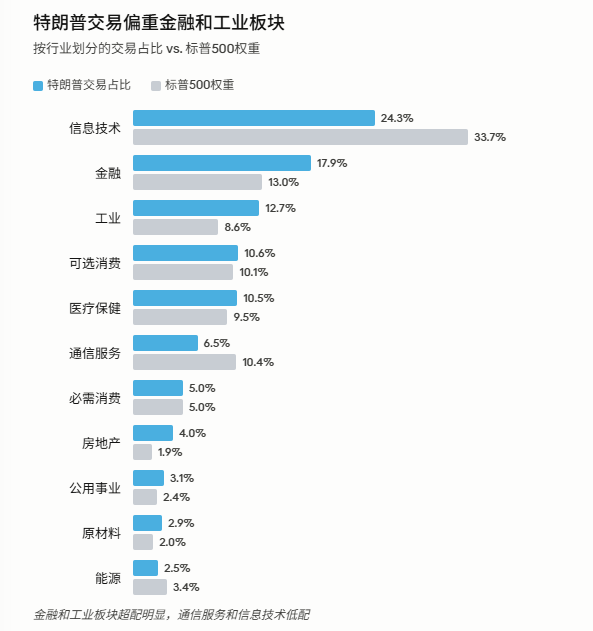
On the selling side, Trump also engaged in large-scale divestitures during the quarter. His single sell-offs of Amazon, Meta, and Microsoft fell within the highest disclosure range—between $5 million and $25 million—while retaining smaller-scale purchases, reflecting a "large sell, small buy" active exposure management model.
Compliance Controversy
Trump's assets are currently held in a trust managed by his son, Donald Trump Jr., rather than being fully isolated from the beneficiary and investment decision-making involved in a compliant "qualified blind trust." In other words, there are no legal or practical barriers preventing Trump from intervening in asset management.
Kedric Payne, the chief legal counsel for the Campaign Legal Center, plainly stated: "The president holding individual stocks itself is an inherent problem—the public will assume he is using his position for profitable investments. The president should not have any appearance of using his office for economic gain."
Under federal law, Trump is required to report trades within 45 days of their occurrence, but multiple trades were not reported on time, resulting in a fine of $200.
Bipartisan lawmakers have begun pushing for legislation. Senator Warren has called such trades "should be illegal"; Representatives Magaziner and Republican Representative Roy jointly proposed a bipartisan bill prohibiting stock trading by congressional members, and another bill extends the ban to the president and vice president. Senator Gillibrand labeled Trump's operations as a "profound betrayal of the citizens he serves," stating, "Elected officials—especially the president—should not trade stocks."
However, Professor Bruce Sacerdote of Dartmouth offered an intriguing finding in academic research: despite the "staggering" trade volume, he found no clear evidence that Trump outperformed the market—"even under policy changes or tweet occurrences."
However, for the market, how much the president earns has never been the core issue. When investors begin to position based on the president's statements rather than fundamentals, the long-upheld principles of fair trading in the U.S. capital markets face a crisis of trust.
免责声明:本文章仅代表作者个人观点,不代表本平台的立场和观点。本文章仅供信息分享,不构成对任何人的任何投资建议。用户与作者之间的任何争议,与本平台无关。如网页中刊载的文章或图片涉及侵权,请提供相关的权利证明和身份证明发送邮件到support@aicoin.com,本平台相关工作人员将会进行核查。


