撰文:Patrick Bush
原文:《VanEck Mid-May 2026 Bitcoin ChainCheck》
Please note that VanEck has exposure to bitcoin.
Key Takeaways
- Spot rally without the leverage: bitcoin (BTC) recovered +11.8% m/m to ~$78,272, but options open interest stayed flat and put premiums collapsed -51%, indicating the rally is spot-driven, not levered.
- Hashrate drawdown sets a record: the 30-day MA hashrate sits -13.2% below its November 11, 2025 peak at 964 EH/s, with 187 days elapsed, the longest and deepest sustained decline in bitcoin’s industrial mining era.
- US public miners exit; sovereigns inherit: the 11 largest US public miners shed ~7 EH/s in Q1 2026 as power capacity moves to AI hyperscalers under 10-to-15-year leases. Government-owned stranded hydro and gas assets become the natural successor.
Funding Rates Hold Tepidly Positive
Bitcoin price action over the past 30 days stabilized after a deep prior-month drawdown, with the 30-day moving-average (MA) price recovering to ~$78,272 ( +11.8% m/m ) and the spot close on May 14 at $81,394 . Despite the price recovery, perpetual-futures sentiment remains outright cautious. The 30-day moving average of the annualized basis has slipped to -0.45% , down from 1.27% a month ago and well below the 3.16% reading from a year ago. The current 30-day MA sits in the 15 th percentile of all observations since November 2020. The 7-day moving average sits higher at 3.13% , a rebound from April's negative territory but still well short of levels typically associated with bullish positioning.
Options Positioning: Hedging Unwinds as Vol Collapses to Historic Lows
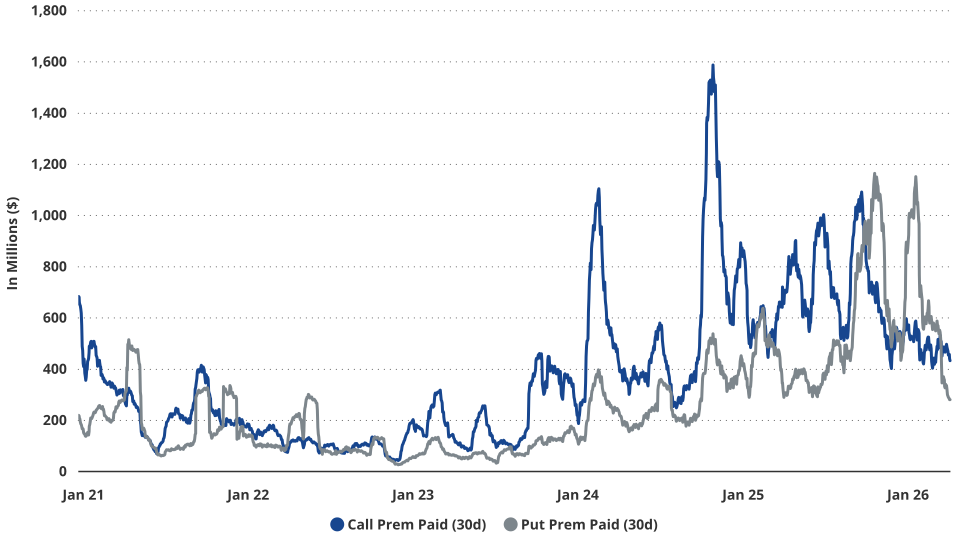
Bitcoin Put Premiums Collapsed -51% Month-Over-Month as Hedging Demand Unwound
Source: VanEck Research, Glassnode as of 5/18/2026. Past performance is not a guarantee of future results. Not intended as a recommendation to buy or sell any securities named herein.
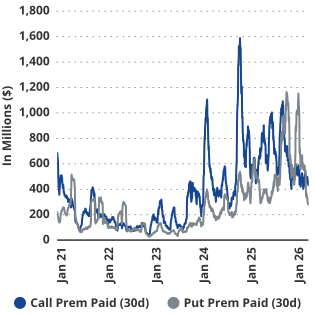
The options complex rotated sharply over the last 30 days as hedging demand collapsed amid the price recovery. Put premiums paid dropped -51% m/m to $281.8M , while call buying fell a far more modest -8% . The Call/Put premium ratio swung from 0.82 last month to 1.54 , signaling a decisive rotation out of downside protection and into upside positioning. Despite the move, the Call/Put ratio is arguably neutral and sits at only the 46 th all-time percentile.
Options open interest has remained flat as BTC recovered, confirming the rally is spot-driven rather than leveraged-options-driven. Total options OI grew +0.8% m/m to $33.0B and sits at the 18 th percentile of the trailing year versus a 1-year average of $40.3B .
Implied volatility (IV) is historically cheap across the 1-month options curve. The 1-month Call IV of 37% was down -8.2 percentage points m/m and now sits at the 3rd all-time percentile. Meanwhile, 1-month Put IV at 44% is -12.2 percentage points m/m and sits at the 12th percentile. IV Skew, or the Put/Call IV differential, remains defensive despite the IV collapse. The 1-month put/call skew fell to +6.9 percentage points from +10.9 percentage points a month earlier, sitting at the 72 nd all-time percentile. This suggests that BTC puts are still richer than calls on a relative basis. Traders are not paying up for downside protection using puts, but the fear bid is structurally present.
1-Month Options Snapshot: Volatility Sits at Multi-Year Lows
| Metric | Last 30 Day | Prior 30 Day | All-Time Percentile |
| 1m Call IV | 37% | ~52% | 3rd |
| 1m Put IV | 44% | ~60% | 12th |
| 1m Put/Call Skew | +6.9pp | ~+9pp | 72nd |
| Call/Put Premium Ratio | 1.54 | 0.82 | 46th |
| Put Premiums Paid (30d sum) | $281.8M | ~$575M | -- |
| Total Options OI | $33.0B | ~$32.7B | 18th (1-yr) |
Source: VanEck Research, Glassnode as of 5/14/2026. Past performance is not a guarantee of future results. Not intended as a recommendation to buy or sell any securities named herein.
Onchain Activity and Network Usage
Network throughput has accelerated over the past 30 days. Daily transactions averaged ~590k , up +9.2% m/m and +46.4% y/y , sitting at the 99th percentile of all-time history and the 99.7th percentile of the trailing year, running about +33% above the trailing 12-month average. Daily active addresses ( 644.6k ) and new addresses ( 287.5k ) ticked up +4.7% and +2.5% m/m respectively but remain well below year-ago levels ( -13.2% and -7.5% y/y ) and in the 20th and 12th percentiles, indicating throughput is being driven by repeat users rather than new entrants. Daily inscriptions ( 49.8k ) faded another -5.7% m/m and are -47.6% y/y , continuing the trend of ordinal-driven activity declining on the network.
Transfer volume in BTC terms ran at 782k/day ( +13.7% m/m ); in USD terms ~$61.1B/day ( +26.5% m/m , -0.8% y/y ), with the price recovery doing most of the dollar-denominated work. The share of active supply in the last 180 days slipped -160 bps m/m to 28.4% ( 56th percentile), echoing April’s holder dynamics. Holders appear to be growing more dormant even as price recovers. The percentage of supply in profit climbed to 78.9% ( +5.7% m/m , 24th percentile), and the unrealized P/L ratio rose to 0.307 ( +37.0% m/m , -41.9% y/y , 23rd percentile).
Miner revenue averaged ~$35.4M/day ( +12.6% m/m , -17.5% y/y ), and miner-to-exchange flows in USD ran at ~$10.5M/day ( +9.5% m/m , -18% y/y ). BTC dominance closed the period at 59.9% ( +254 bps m/m , 67th percentile), a partial reversal of the altcoin rotation earlier in the quarter.
Long-Term Holder Behavior
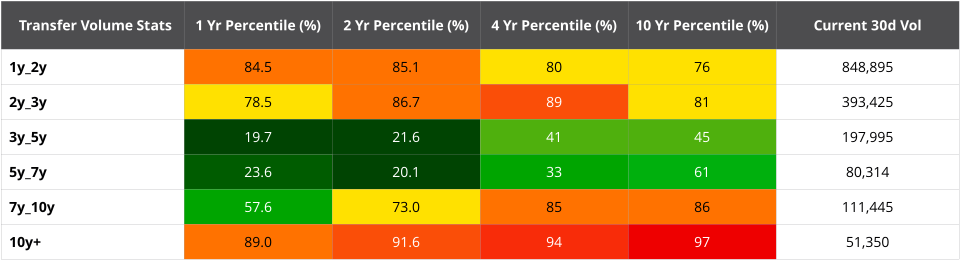
The cohort picture has shifted decisively toward the long end and the youngest long-term cohorts. The April note flagged elevated transfer activity among 5y-7y, 7y-10y, and 10y+ holders while younger long-term cohorts pared back. Over the last 30 days the long-end story has intensified and broadened: the 10y+ cohort moved 51.3k BTC (+30% m/m), placing it in the 89th percentile of all rolling 30-day windows over the past year and the 92nd over the past two years.
The 1y-2y and 2y-3y cohorts sit at the 84th-87th percentiles on both bases, with 2y-3y up +132% m/m. The 7y-10y cohort prints a 58th percentile over the past year. The genuine quiet spots are 3y-5y and the 5y-7r cohorts which made transfer activity in the 20th and 24th percentiles over the past year.
Despite the elevated transfer activity amongst longer term holders, the 5y-7y, 7y-10y, and 10y+ age groups’ total token balances sit at the 48th, 93rd and 99th percentiles over the past 4 years. Likewise, not all spent volume represents selling: some flows reflect migrations to quantum-resistant addresses, digital asset treasury (DAT) contributions, or routine wallet maintenance. However, the younger cohorts of long-term holders have seen substantial churn. The 1y-2y, 2y-3y, and 3y-5y maturity brackets holdings sit at the 42nd, 10th, and 2nd percentiles over the past 4 years!
Realized P/L confirms the easing of distribution pressure. The 30-day average net realized P/L flipped from -$139M/day in the prior 30-day window to +$26M/day in the most recent window, indicating that on net, coins moving onchain are no longer locking in losses. From April 15 – May 15, 19 out of the 30 days saw hodlers realized positive profit on their Bitcoin transfers.
Long-Term Holder Spent Percentiles (Last 30 Days, Share of Supply Spent):
Oldest LTH Cohorts Reactivate, Oldest Quiet Down
Source: VanEck Research, Glassnode as of 5/19/2026. 'Last 30d share' = sum of supply spent by cohort over trailing 30 days as a fraction of cohort supply. Not all spent volume represents selling. Past performance is not a guarantee of future results.
Mining Dynamics: Hash-Rate Drawdown Signal Still Active
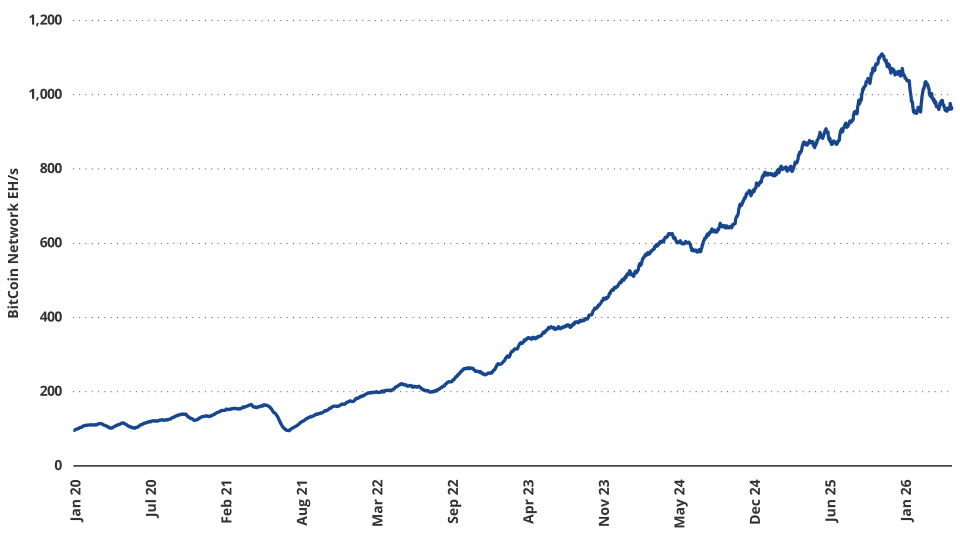
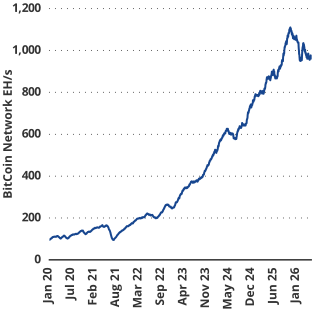
Bitcoin Hashrate Suffers Longest Sustained Drawdown in Industrial Mining Era
Source: VanEck Research, Glassnode as of 5/18/2026.
The hash-rate drawdown that began in mid-November is no longer a blip; now represents the longest and deepest sustained decline in Bitcoin's industrial mining era. The 30-day MA hashrate sits at 964 EH/s , -13.2% below the 1,110 EH/s peak set November 11, 2025, a drawdown that's already run 187 days with a peak intra-episode trough of -14.5% . Momentum readings reinforce the picture: the 30-day change in the hash-rate MA sits in the 19th percentile of all rolling 30-day moves, and the 90-day change in the 16th percentile. In Bitcoin's history, contractions of this magnitude are uncommon. Mining difficulty tells the same story, since it tracks hashrate. Currently, its 30-day change sits in the 10th percentile, the 90-day change in the 8 th, and difficulty itself is -12.7% below its November 27, 2025 high.
US Public Bitcoin Miner Hashrate: Q4 2025 vs Q1 2026
| Company | Ticker | Q4 2025 (EH/s) | Q1 2026 (EH/s) | Change (EH/s) | y/y % | Status |
| Riot Platforms | RIOT | 34.0 | 42.3 | +8.3 | +24% | Partial AI Pivot |
| Bitdeer | BTDR | 43.2 | 50.2 | +7.0 | +16% | Partial AI Pivot |
| MARA Holdings | MARA | 51.9 | 55.5 | +3.6 | +7% | Partial AI Pivot |
| Hut 8 | HUT | 1.8 | 1.8 | - | - | AI pivot — winding down |
| American Bitcoin | ABTC | 20.2 | 20.2 | - | - | Mining — growing fast |
| Core Scientific | CORZ | 10.9 | 9.7 | -1.2 | -11% | AI pivot — exiting mining |
| CleanSpark | CLSK | 47.0 | 44.5 | -2.5 | -5% | Partial AI Pivot |
| TeraWulf | WULF | 6.8 | 4.0 | -2.8 | -41% | AI pivot — winding down |
| Cipher Digital | CIFR | 15.6 | 11.1 | -4.5 | -29% | AI pivot — winding down |
| IREN | IREN | 43.0 | 35.8 | -7.2 | -17% | AI pivot — winding down |
| Keel | KEEL | 19.5 | 12.0 | -7.5 | -38% | AI pivot — winding down |
| Total (11 miners) | 293.9 | 287.1 | -6.8 | -2% |
Source: VanEck Research, 8-K / 10-K quarterly production disclosures, Q4 2025 & Q1 2026 earnings releases as of 5/18/2026.
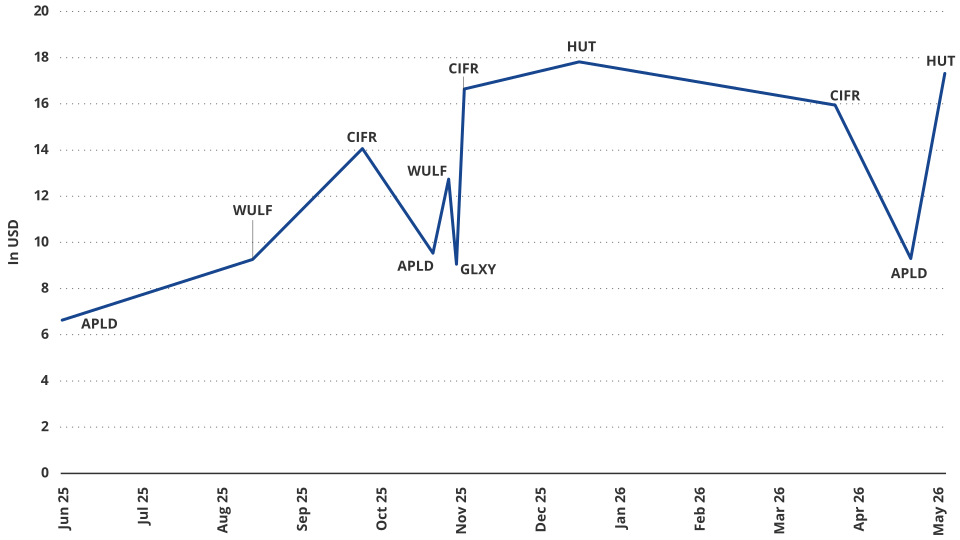
The US public miner cohort is undergoing a structural reorientation that is reshaping the composition of global Bitcoin hashrate. The logic driving the pivot is financially compelling. AI and high-performance computing (HPC) data center infrastructure commands valuations per megawatt that are multiples of what Bitcoin mining has historically attracted, and that gap has widened sharply. The gross valuation afforded per MW of AI capacity has grown roughly 3x since the summer of 2025, creating a powerful incentive for any miner sitting on contracted power to reconsider how that megawatt is best monetized.
The trend became impossible to ignore in Q1 2026. Across the 11 largest publicly traded US Bitcoin miners, aggregate installed hashrate declined by roughly 7 EH/s between Q4 2025 and Q1 2026, as companies began physically decommissioning mining fleets and repurposing substations, cooling systems, and data hall layouts for GPU workloads. This is not a temporary curtailment but a full pivot away from Bitcoin mining that permanently removes these power sites from the Bitcoin network.
The exits are coming in waves and on different timelines. CORZ will be a near-pure-play AI infrastructure company by early 2027 , having already reduced its mining footprint to one or two sites by year-end 2026. CIFR is running its last remaining Odessa mine to exploit a favorable fixed-price power purchase agreement (PPA), with CEO Tyler Page citing the end of July 2027 as an outside date for full exit. WULF has told investors it will be out of Bitcoin mining by the next halving, roughly April 2028 . IREN and KEEL have both committed to multi-year exits without specifying hard dates, though KEEL is arguably the furthest along, having already sold its Latin American Bitcoin operations, rebranded, redomiciled to the US, and halted all new mining capital expenditure.
What makes this wave distinct from prior cycles of miner capitulation is the permanence. Miners are not switching off rigs because Bitcoin economics are temporarily unattractive. They are signing 10-to-15-year leases with investment-grade hyperscalers, locking in contracted revenue streams that dwarf anything the mining business could offer, and structurally committing the underlying power capacity to AI for a generation.
US Public Bitcoin Miners Shed ~7 EH/s in Q1 2026 as AI Pivot Accelerates
Equity Value Creation ($mm/MW)
Source: VanEck Research, Corporate disclosures, as of 5/18/2026.
We believe that the most logical successor to the departing corporate fleet is the sovereign miner. Nation-states face no quarterly earnings pressure, no institutional shareholder base demanding an AI multiple, and no cost of capital in the conventional sense. Government-owned stranded hydro or gas assets should continue to prove appealing as Bitcoin mining sites.
Russia is a significant example, running an estimated 13-17% of global hashrate anchored by Siberian hydro and natural gas, though rising domestic energy costs have stalled its hashrate growth since 2025. BitRiver operates with implicit state backing, and Moscow formalized mining as a legally taxable activity in 2024, but grid power has climbed above $0.06/kWh in many regions, squeezing margins and pushing some operators to relocate abroad.
The Gulf states represent the most consequential emerging vector, with Saudi Arabia sitting on roughly 1.5 billion cubic feet per day of flared Aramco gas and the UAE already hosting licensed sovereign-backed programs through Abu Dhabi Global Market (ADGM). Bhutan accumulated over 13,000 BTC against Himalayan hydro surplus through its sovereign wealth fund Druk Holding, representing the purest early proof of concept for state-directed mining. Holdings have since dropped to roughly 3,121 BTC , a -76% reduction in 18 months, with onchain data showing no significant new mining inflows for over a year, though officials deny any sales. Ethiopia's sovereign wealth fund signed a $250 million memorandum of understanding (MOU) with Hong Kong-based West Data Group in February 2024 to mine against GERD hydro overflow, with foreign currency generation the explicit motivation.
These are countries with stranded energy surplus that would be best monetized by Bitcoin mining.
To receive more Digital Assets insights, sign up in our subscription center .
免责声明:本文章仅代表作者个人观点,不代表本平台的立场和观点。本文章仅供信息分享,不构成对任何人的任何投资建议。用户与作者之间的任何争议,与本平台无关。如网页中刊载的文章或图片涉及侵权,请提供相关的权利证明和身份证明发送邮件到support@aicoin.com,本平台相关工作人员将会进行核查。


