Author: Changan I Biteye Content Team
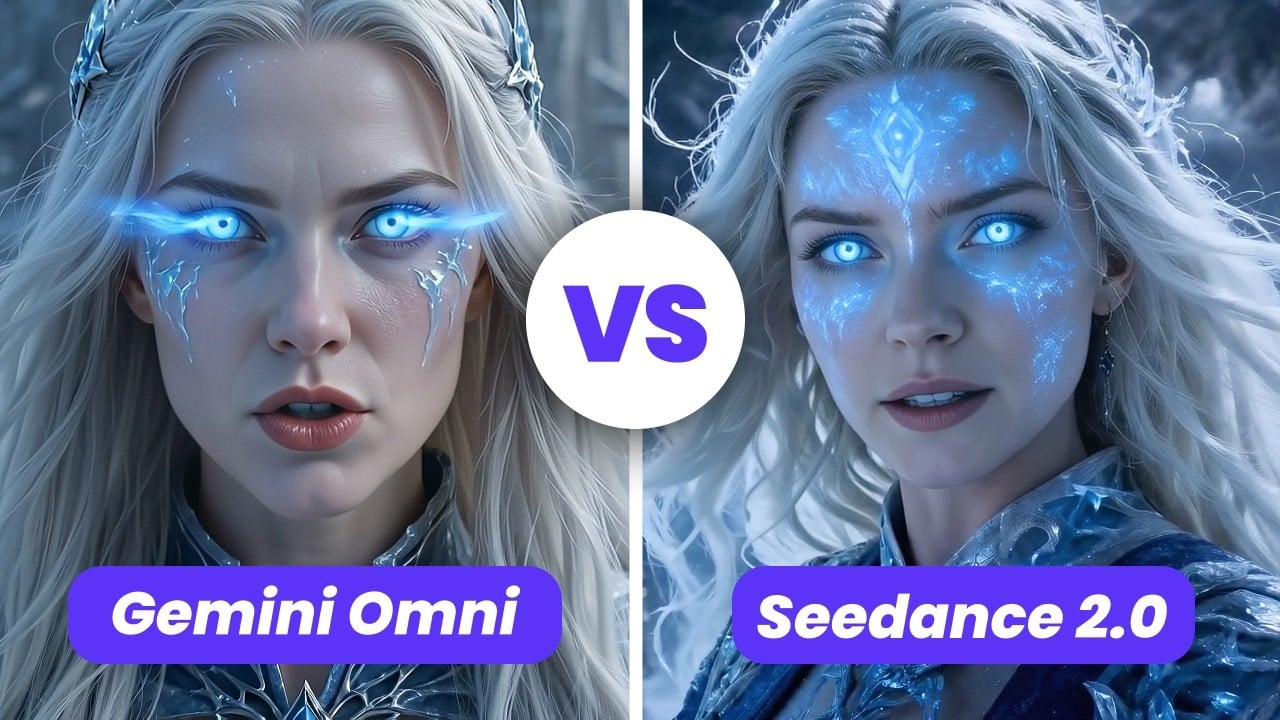
Google showcased the capabilities of Gemini Omni at its press conference. It can generate videos from text, images, audio, and video inputs, and it can continue to make modifications through conversation. The official statement indicates that it will replace Veo in the Gemini App, supporting 10-second videos, native audio generation, reference image generation, and video-to-video editing.
Prior to this, in the creator community, discussions about AI video were largely centered around Seedance 2.0, which has clear advantages: motion stability, strong lens feeling, combined audio and visuals, and a good sense of completion for short videos.
So the question arises:
Where do Gemini Omni and Seedance 2.0 differ? Which one is more suitable for creators? This article compares them from three practical angles: cost, product experience, and video quality.
1. Price Comparison: The True Cost of Video Models Lies in "Waste Production Costs"
Let's start with the most realistic question: how much does it actually cost to use once?
In comparing Gemini Omni and Seedance, pricing should not just focus on subscription fees, but on two questions:
What is the one-time cost to generate a video?
How many retries are needed to produce a usable video?
1. Gemini Omni: More like "Subscription + Flow Credits" Model
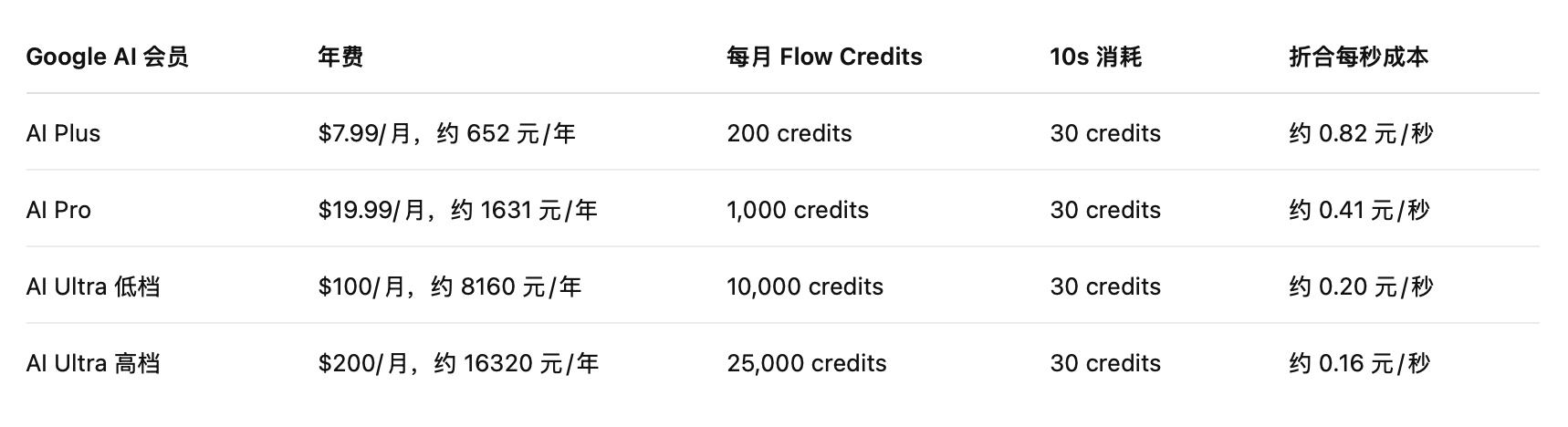
Gemini Omni adopts the approach of Google AI Membership + Flow Credits.
According to the high-tier AI Ultra calculation, 25,000 credits per month can generate approximately 8,333 seconds of video. From this perspective, Gemini's pricing structure is clear: the higher the tier, the more pronounced the decrease in cost per second.
The cost of AI Plus is around 0.82 yuan/second, which is not particularly low; but with AI Pro, the cost drops to 0.41 yuan/second. If it’s Ultra tier, as long as the monthly quota is fully used, the cost per second can be suppressed to about 0.2 yuan/second.
Therefore, Gemini Omni is more suitable for two types of users:
Users who are already using Google AI Pro/Ultra, as the video capabilities are equivalent to directly entering the existing subscription system.
High-frequency video creators, as the larger the generation volume, the lower the average cost.
⚠️ However, it’s important to note: this cost calculation is based on prices in the US region. For users in China, actual use must also consider account region, payment methods, and access stability.
2. Seedance: Based on Ji Dream Membership Original Price, 10 Seconds Consumes 140 Credits
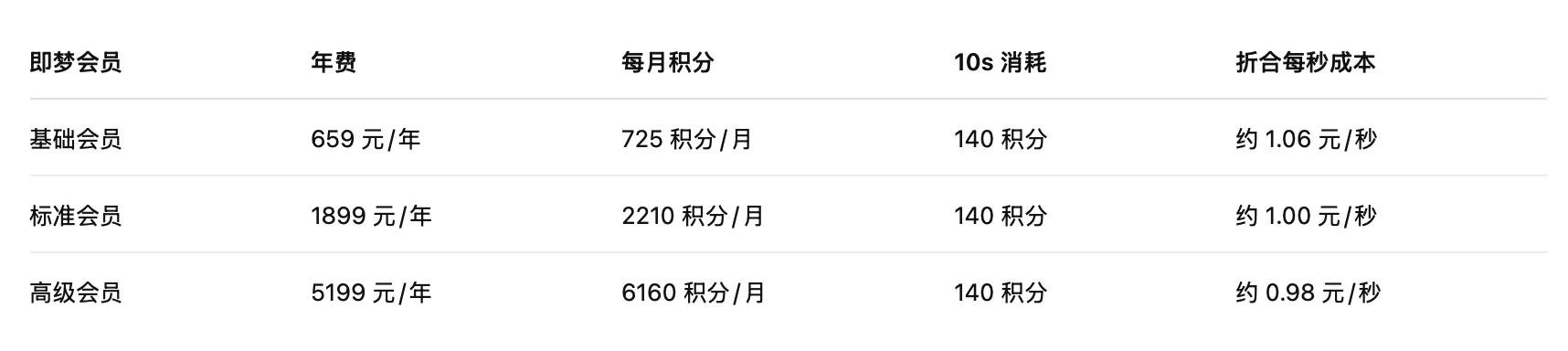
Ji Dream operates on a membership + points system: members receive a certain number of points each month, and when generating videos, points are deducted according to the model, duration, and clarity.
According to high-tier calculation, members receive 6,160 points monthly, which can generate approximately 440 seconds of video.
From this perspective, Seedance's cost stabilizes around 1 yuan/second. Basic membership is about 1.06 yuan/second, standard membership is about 1.00 yuan/second, and premium membership is about 0.98 yuan/second.
Unlike Gemini, the difference in cost per second between tiers in Seedance is not significant. Although premium membership is cheaper, its main advantage is not the drastic drop in cost per second, but rather the greater amount of video duration that can be generated each month.
Its advantages lean more towards domestic product experience: the entry is more direct, payment is more convenient, the Chinese environment is friendlier, and it is easier for domestic creators to get started quickly.
2. Product Experience: Gemini is More Like a Workflow, Seedance is More Like a Creative Tool
1. Generation Efficiency: Gemini is Faster, Seedance has Longer Wait Times
First, let’s look at generation speed.
From my actual tests, it takes about 2 minutes for Gemini Omni to generate a video, while Seedance usually takes longer, typically around 5-6 minutes.
Gemini's advantage lies in: faster trial-and-error speed. You can see the results more quickly and maintain a creative state more easily.
Seedance's issue is that wait times are longer. If the results are unsatisfactory and a new version needs to be generated, the time cost increases rapidly.
So from an efficiency perspective, Gemini is more suitable for rapid prototyping and inspiration testing, while Seedance is better suited for generating videos once the visuals are clearly thought out.
2. Candidate Versions: Gemini Can Generate Multiple at Once, Ji Dream Is More Single Generation Oriented
Gemini Omni provides options for x1 / x2 / x3 / x4, for example, a 10-second video consumes 30 credits; if x2 is selected, it will consume 60 credits.
Due to the high degree of uncertainty in AI video, the results from the same prompt can vary greatly. Generating 4 versions at once allows users to directly choose the best one from those without waiting in line for each individual generation.
In contrast, Ji Dream leans more towards single generation.
Therefore, it can be judged as follows:
Gemini is more suitable for rapid card drawing and screening.
Ji Dream is better for producing single pieces after clear parameters are defined.
3. Video Duration: Ji Dream is Up to 15 Seconds, Gemini is Up to 10 Seconds
The third difference is video duration.
Based on the current product experience, Gemini Omni can generate a maximum of 10-second videos, while Ji Dream can generate a maximum of 15-second videos.
For making a slightly more complete shot, such as a person entering and sitting down, a product transition from a long shot to a close-up, or a short narrative action, 10 seconds can sometimes feel insufficient.
Although 15 seconds is not very long, the additional 5 seconds can allow for the completion of another action or a change of shot in the video.
So in terms of duration:
Gemini is more suitable for short shots and quick materials.
Ji Dream is more appropriate for slightly more complete video segments.
If you are working on webisodes, advertising storyboards, or emotional narratives, the 15-second limit of Ji Dream will be more practical.
4. Video Editing: Gemini Allows Further Edits, Seedance is More Like Regenerating
In video generation, a very practical question is: What to do if the first version is unsatisfactory?
Image generation is better; the cost of redoing is not very high. However, once it involves video duration, queueing, points, and review, every redo will increase costs.
From a product experience perspective, Gemini Omni emphasizes "editing" capabilities. It doesn’t just require users to rewrite prompts and regenerate, but places the video's generation in a more continuous creative process: generate a version first, then continue to modify based on the existing results, such as adjusting visuals, changing styles, replacing certain elements, or further optimizing shots.
Gemini's advantage lies in: it makes video generation a “continuously communicable” process.
Seedance’s current experience leans more towards traditional generation tools. Its strengths are focused on the generated results themselves, especially in visuals, motion, and the sense of finishing. But if the first version is unsatisfactory, it often requires adjusting prompts, reference images, parameters, and regenerating a new version.
5. Review Mechanism: Both Have Different Restrictions
Review is also an unavoidable issue in actual use. From my tests, the review focus on both sides is somewhat different.
Gemini Omni tends to have stricter reviews of video content. A notable point is that even if some content is made into a Q-version or cartoonized expression, it may still fail review. In other words, the limitations do not automatically loosen just because the art style becomes more "fictional".
Interestingly, regarding some real-life related content, Gemini is actually not as strict as I imagined. As long as it does not clearly involve sensitive figures, infringement, misleading content, or high-risk material, some real-life style videos can still be generated.
Seedance's review direction is more focused on real-life and portrait risks. Especially when it involves real persons, celebrity faces, likenesses of famous people, film characters, and public figures, it is easier to trigger restrictions. Even if creators simply want a more entertaining expression, they might still get blocked.
3. Video Quality: The Real Difference is Not in Single Frames, But in "Motion"
When it comes to video aspects, the most critical question becomes: Can the generated video actually be used?
This time, I did not conduct especially complicated tests, but focused on the most commonly used scenarios by creators, generating several sets including characters fighting, reference images generating videos, and character consistency.
Currently, the most obvious feeling is:
Gemini Omni's video capabilities are very strong, but the expression style leans more towards overseas contexts; Seedance fits better within the visual styles, character movements, and second-dimensional contexts familiar to Chinese creators.
1. Content Understanding: Gemini Allows More Creative Freedom, But Tends to Favor English Contexts
I tested a relatively typical video scenario:
Generating a video of two characters fighting.
This test seems simple but is actually suitable for observing the model's "creative freedom" ability.
Since I did not strictly limit what the characters would say, nor did I specify the language for the dialogue. The result is that Gemini Omni tends to actively complete the video content, even auto-generating lines and sounds.
However, the issue lies here: Gemini's creative freedom clearly leans more towards overseas contexts.
In the absence of language restrictions, the characters in the generated video spoke English. This indicates that Gemini's default expressions are more aligned with English content production logic. If you want to create Chinese short videos, Chinese adaptations, or narratives within a Chinese context, it is necessary to specify limitations in the prompt.
2. Character Consistency: Gemini Has Reference Image Capabilities, But Characters Still Have Deviations
I also tested reference image video generation.
This test mainly examines one question:
After providing a reference image, can the characters maintain consistency in the generated video?
The result is that, although Gemini Omni can generate video based on a reference image, the characters in the final video still display differences from the original reference image and do not maintain complete character consistency.
The details of the characters will have subtle differences from the reference.
If it is just for creating an atmospheric video, comedic clip, or creative short, slight character changes are acceptable. However, if fixed IP characters are to be created, Omni would be entirely inadequate.
3. Action Coherence: Gemini Sometimes Resembles Fragmented Scenes, Seedance is More Like Complete Action
In the fighting video, another obvious issue is that character actions are not coherent enough.
The actions of characters in the fighting videos generated by Gemini are relatively stiff in their transitions, giving the impression that they are not continuous movements captured in a single scene but rather a patchwork of several action segments.
For example, the transition from a character’s preparation stance to attacking, dodging, and moving contains actions, but the transitions in between are not natural enough, making the video appear as if "AI pieced together several key frames" rather than showing a genuine continuous movement.
This is particularly evident in scenes involving fighting, running, jumping, turning, and group interactions. If it is simply a straightforward shot with mild character movements or product display, the problem is less pronounced.
Seedance tends to align more closely with creators' expectations in such scenarios. Its actions and shots typically resemble a complete video segment, especially in second-dimensional, fighting, or short-action scenarios, where the overall rhythm feels more natural.
4. Video Editing: Gemini Can Modify Existing Videos, This is One of Its Greatest Advantages
However, Gemini also has a very important advantage in the realm of video: It supports AI modifications to existing videos.
This means you can upload a real video and allow Gemini to AI edit the content within it. For example, modifying visual elements, replacing parts, changing styles, or combining live-action footage with AI-generated content.
This differs from the product boundaries of Seedance.
If you want to do a "real scene + AI scene" combination, Seedance's conventional approach still relies more on transitions: first shoot a segment of real footage, then generate a segment of AI video, and use editing transitions to connect them.
4. Final Thoughts: Seedance is Better at Generation, Omni is More Like a Video Editor
From this comparison, the biggest impression is that Seedance and Gemini Omni serve different focuses.
Seedance is more like a mature AI video generation tool, with its core ability to turn text or images into video.
In the commonly used scenarios of text-to-video and image-to-video, Seedance is currently more stable. Its visuals align better with the aesthetics of Chinese creators, actions are more coherent, and it produces scenes more easily in the second dimension, fighting, and short videos.
If your need is to turn prompts into videos or transform an image into dynamic visuals, then Seedance is currently the best choice.
But the highlight of Omni lies in its ability to support AI modifications to existing videos.
This means users do not necessarily have to start from a blank prompt but can continue processing based on existing materials: changing backgrounds, altering styles, replacing elements, or even blending real footage with AI visuals.
If you want to generate videos, Seedance is currently stronger.
If you want to edit videos, Omni's direction holds more potential.
The next stage of AI video might not just be about "generating a video," but enabling videos to be modified by AI like images.
From this perspective, Seedance represents a more mature generation capability, whereas Omni appears to be exploring the future workflow of video editing.
免责声明:本文章仅代表作者个人观点,不代表本平台的立场和观点。本文章仅供信息分享,不构成对任何人的任何投资建议。用户与作者之间的任何争议,与本平台无关。如网页中刊载的文章或图片涉及侵权,请提供相关的权利证明和身份证明发送邮件到support@aicoin.com,本平台相关工作人员将会进行核查。


