Author: Shen Chao TechFlow
On May 15, Google quietly released an official guide titled "Optimizing your website for generative AI features on Google Search." This is Google's first formal response to the much-debated topic of GEO (Generative Engine Optimization) over the past year.
If you only look at the quick news from the English SEO circle, you would come to a simple conclusion: "Google officially says GEO does not exist, that is SEO."
This conclusion is both correct and incorrect.
The correct part is that Google has indeed almost denied all the "tricks" related to GEO in the past year within this document: llms.txt, chunking content, rewriting copy for AI, chasing "mentions"… Google's attitude can be summed up in two words: useless.
The incorrect part is that Google can only represent itself. A crucial fact that is never articulated in this guide is: The AI search market does not solely belong to Google. Perplexity, ChatGPT, Claude, Gemini API, and various vertical AI assistants have their own different retrieval systems, different citation logics, and different content preferences. Taking Google's position as the stance of the entire AI search market is the most dangerous misreading of this guide.
What did Google say?
The core logic chain of Google's document is very clear, consisting of only three steps.
Step One: The foundation of AI search is SEO.
Google explicitly states that the workings of AI Overviews and AI Mode are based on two technologies, RAG (Retrieval-Augmented Generation, also known as grounding) and query fan-out. The former is responsible for pulling relevant web pages from Google's search index to serve as the basis for AI responses, while the latter breaks a user's query down into multiple related queries for parallel searching.
The key point is: The "R" (retrieval) in RAG relies on Google's existing search ranking system. For a page to be cited in the AI Overview, a prerequisite is that it can rank well in traditional Google search. AI does not create a new paradigm; it adds a layer of generation on top of the existing SEO index.
Step Two: Since the foundation is SEO, then best practices for SEO are also best practices for GEO.
Google repeatedly emphasizes the importance of writing "non-commodity content" (content that is not generic) with independent perspectives, firsthand experiences, and expert insights; maintaining a clear technical structure (crawable, indexable, good page experience); and using structured data where applicable. These are things that SEO circles have been discussing for twenty years, and Google's message is to continue doing these; that's enough.
Step Three: Explicitly deny a series of popular GEO practices.
This section contains the most informative content of the entire guide. Google rarely lists out "what you do not need to do":
- No need for llms.txt or any dedicated files for AI; Google will not treat them specially;
- No need to chunk content; Google’s system can understand the nuance of entire pages;
- No need to rewrite copy for AI; AI can understand synonyms and semantics;
- No need to pursue insincere "mentions"; generating fake mentions will be penalized by anti-spam systems;
- No need to excessively pile on structured data; it’s not a necessary condition for AI searches.
The end of the document also introduces a new concept: agentic experiences. Google mentions that in the future, AI agents will access websites through DOM structures, accessibility trees, and page screenshots, hinting at the next wave of "optimization," but Google does not elaborate.
This is the entirety of Google's official stance.
Why does Google say this?
Most translated articles in the Chinese SEO circle end at the previous section. However, understanding Google's motivation is more important than remembering what Google says.
Why did Google release this guide at this point in time and in this tone?
Motivation One: Suppress the market narrative that "GEO is an independent discipline."
Over the past year, "GEO/AEO services" have formed a small gray industry in the English market: consulting firms sell GEO audits, SaaS tools sell "AI visibility monitoring," and marketing agencies sell "AI citation optimization packages." The underlying message of these services is that SEO is outdated, and you need new methodologies, new partners, and new budgets.
If this narrative grows, it poses a dual threat to Google: First, it undermines the stability of the SEO ecosystem (from which Google profits through search ads and tool ecosystems), and second, it presents AI search as an independent market separate from Google (thereby making competitors like Perplexity and ChatGPT appear more threatening). Thus, Google must come out and say: this is the same thing, stop digging, return to the SEO framework.
Motivation Two: Prevent websites from "over-optimizing" for AI, polluting index quality.
If the entire internet starts producing content according to the llms.txt standard, chunking paragraphs, and rewriting copy for "AI readability," the quality of Google’s index would decline because this content is optimized for machines, making it harder to read for human readers. Google has been combating "writing for search engines" for the past ten years, and it cannot allow "writing for AI" content to pollute the index.
Motivation Three: Protect its own voice.
Google does not want the "GEO circle" to become a space where rules are defined by someone other than Google. Therefore, the real message of this document is: When it comes to optimizing Google AI searches, only Google has the final say; other opinions are untrustworthy.
Understanding these three motivations allows you to comprehend why this document simultaneously appears "open" yet "reserved."
What are truths: where Google is correct?
Google's position is not entirely wrong; in fact, regarding Google's own AI search functions, the judgments in this guide are fundamentally sound.
Truth One: Being cited in Google's AI Overview is indeed an SEO issue.
The retrieval layer of Google's AI Overview is based on Google's search ranking system. This means that websites performing well in traditional SEO have a naturally higher probability of being cited in the AI Overview. There’s no such thing as "special optimization for Google AI," as the underlying system is the same.
Truth Two: llms.txt is an ineffective signal.
This point needs elaboration because many GEO services in the Chinese circle consider "helping you deploy llms.txt" as a selling point. llms.txt is a community-driven proposal that essentially lets websites inform AI crawlers "what content is available and how to read it." However, no mainstream AI company has publicly committed to reading llms.txt; OpenAI hasn’t, Anthropic hasn’t, and Google has now explicitly stated it won’t either. This is a one-sided standard; its greatest use currently is to provide SEO agencies with an additional revenue stream.
Truth Three: Chasing "mentions" is inefficient.
In the past six months, some companies have been selling "AI citation enhancement" services, essentially hiring people to mass insert brand names in Reddit, Quora, and blog comment sections, betting that AI will pick them up during training or retrieval. Google points out that this approach is not only useless but also subject to penalties from anti-spam systems, which is true. AI models are becoming increasingly sophisticated in judging source quality, and the weight of low-quality mentions is rapidly declining.
Truth Four: Content quality is always foundational.
The "non-commodity content" that Google emphasizes has independent perspectives, firsthand experiences, and expert insights. This is content preferred by all AI search engines. Whether it's Google's AI Overview, Perplexity, or ChatGPT, they tend to cite sources with clear viewpoints and exclusive information rather than AI-generated secondhand overviews.
What are talking points: what Google did not say or avoided?
However, if you only see the above "truths," you have completely fallen into Google's narrative trap.
Talking Point One: Google can only represent itself.
This is the most critical blind spot in the entire document. Google repeatedly states, "AI search = SEO," but this equation only holds true in Google's AI Overview and AI Mode.
Let's take a look at the real AI search market:
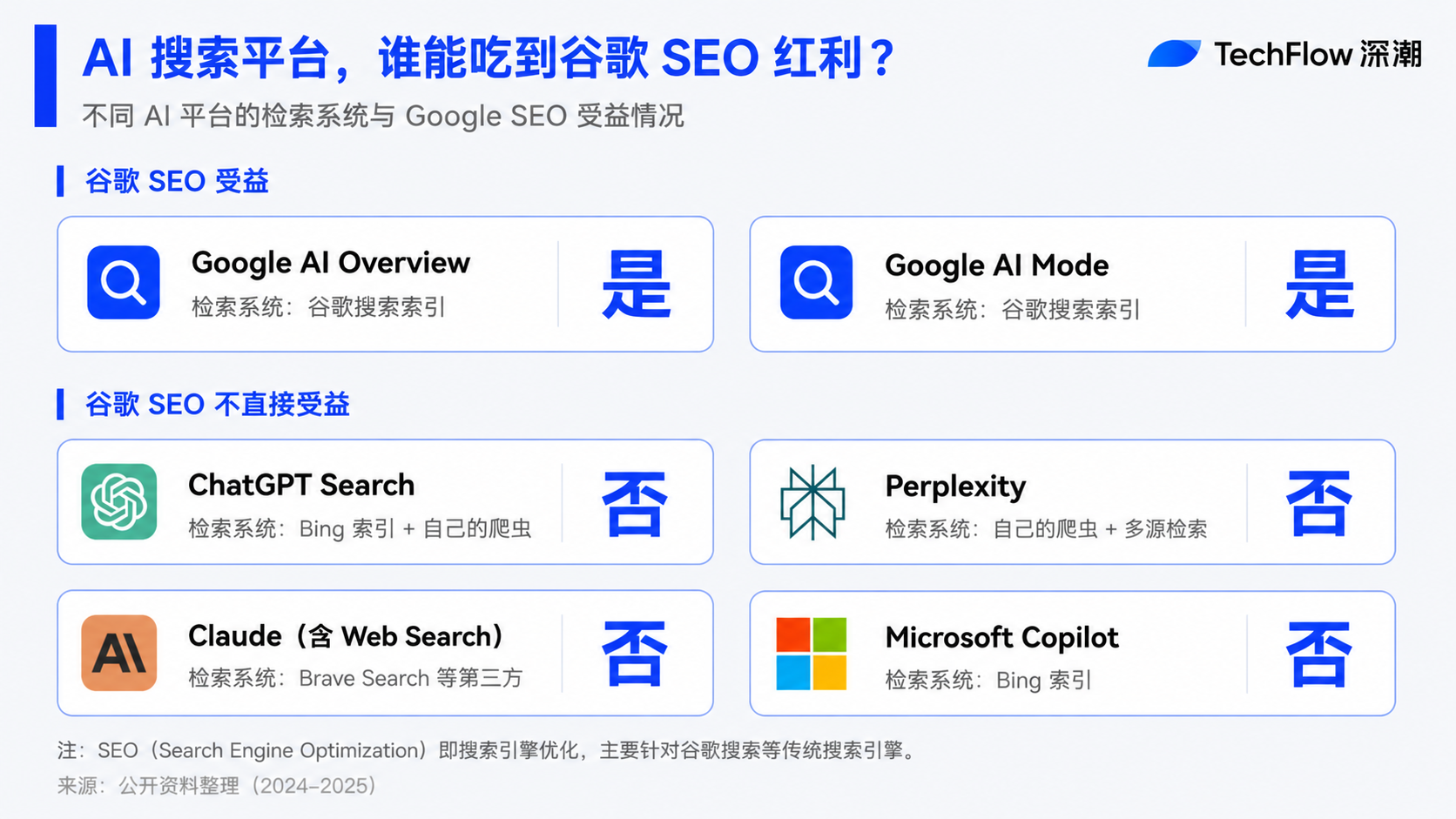
ChatGPT, Perplexity, Claude—these three products together cover a significant portion of high-value users (investors, researchers, decision-makers), and their retrieval systems are completely independent of Google's SEO system. The optimization of visibility on these platforms is not mentioned a word in Google's guidelines.
This is where GEO can truly stand as an independent service.
Talking Point Two: The standard for "non-commodity content" is not that objective.
When Google says "create unique and valuable content," who would argue against it? But what content qualifies as "non-commodity" is determined by models, and those models are biased.
Take an example from the crypto industry. Established English media outlets like Coindesk and The Block are cited significantly more in the AI Overview than equally capable emerging media. This is not because their content is more "unique" but because they have historically built up greater weight in Google search. During AI retrieval, content from "high-authority sites" is prioritized, creating a chicken-and-egg scenario. New entrants, even with higher quality content, find it hard to be cited quickly.
Google won't tell you this because it exposes how AI Overview's algorithm tends to reinforce existing search head effects.
Talking Point Three: Agentic experiences are the next variable, but Google downplays it.
The document’s ending mentions that AI agents will access websites via DOM and accessibility trees. This is the most informative but least acknowledged part of the guide.
Why? Because the rise of AI agents will disrupt the very nature of "search." When users no longer search themselves but have agents complete tasks for them (such as having an agent research a crypto project, compare exchange rates, or monitor market movements), websites need to be designed to be "agent-friendly," rather than "human SEO-friendly."
Google only briefly mentions this, but it is the most important direction for changes in the next 12-24 months. Google is reluctant to elaborate because its own product layout in this direction is still in the early stages and does not want to set premature market expectations.
Talking Point Four: "You don’t need to do anything" is itself a stance.
If you read through this document, you will find that Google's core recommendations actually boil down to just two: Create good content and establish a solid SEO foundation. This sounds like it's helping content creators, but in reality, it is protecting Google's own central position in the index.
If Google acknowledges that "AI search requires new optimization methods," it would mean admitting the end of the SEO era. Thus, Google’s strategy is to push all optimization for AI search back into the SEO framework, allowing website owners to continue playing by Google’s rules. This is a reasonable business strategy, but readers should understand that this is a position-laden official document, not a neutral industry guide.
What does this mean for the Chinese crypto industry?
Returning to the specific context of the Chinese crypto industry, there are a few key takeaways from the guide:
First, the "GEO project demands" in the Chinese community over the past year are real, but the methodology of the services needs reconstruction.
Many crypto projects have asked the same question: "Why is the description given by ChatGPT when users search for our project name incorrect/old/negative?" This is a genuine pain point, especially for those in early stages where information sources are dominated by KOL tweets and small blogs.
However, the correct way to address this issue is not to deploy llms.txt, not to chunk the site, and not to chase mentions on Reddit. The right approach is:
- Publish structured factual content (team background, technical architecture, funding history, product milestones) on mainstream crypto media (give yourself a shoutout, such as Shen Chao TechFlow) to ensure that AI can find clear, consistent, and verifiable information.
- Proactively monitor the descriptions of the project on multiple AI platforms like ChatGPT, Perplexity, and Claude, promptly covering erroneous information with new content.
- Optimize the factual content on the project’s official website (not just marketing copy), especially the FAQ, documentation, and blog content that AI prefers to cite.
Second, Google's AI Overview has relatively low importance in the Chinese crypto context.
This is a reality that needs to be acknowledged: the information consumption habits of Chinese crypto users have a far lower share attributed to Google search than the English market. WeChat official accounts, Twitter/X, Telegram, Binance Square, and vertical media like Shen Chao have significantly more influence collectively than Google search.
Thus, for Chinese crypto projects, the visibility on Perplexity and ChatGPT is far more important than Google's AI Overview. The former is a tool increasingly used by Web3 founders, VCs, and researchers; the latter is still a secondary touchpoint in the Chinese crypto context.
The direct guiding significance of Google’s guide for the Chinese crypto industry is actually limited.
Third, the value of multilingual and cross-platform distribution is being reinforced.
Google emphasizes that "AI primarily cites high-quality, unique content." This content must exist in multiple AI-accessible forms across platforms, not just on Chinese sites, but also have English versions and be visible to multiple AI platform crawlers. Multilingual distribution is not just a brand expansion tool but an essential strategy for preserving content assets in the AI era.
In Conclusion
The most valuable part of Google’s guide is ironically not about what it says about "what to do" or "what not to do."
Its most valuable part is that it clarifies one thing for the market: The "optimization" of the AI search era is diversifying into two distinctly different layers.
One layer is Google's definition of "AI search = SEO," where the rules are relatively stable, requiring good content quality and a solid technical foundation.
The other layer is one that Google hasn’t mentioned and doesn’t wish to discuss: "optimization for non-Google AI platforms." Perplexity, ChatGPT, and Claude each have different retrieval logics, citation preferences, and content standards. This layer currently lacks official guidelines and unified standards and is genuinely in an early stage.
For project owners, recognizing the difference between these two layers is more important than remembering any specific advice.
免责声明:本文章仅代表作者个人观点,不代表本平台的立场和观点。本文章仅供信息分享,不构成对任何人的任何投资建议。用户与作者之间的任何争议,与本平台无关。如网页中刊载的文章或图片涉及侵权,请提供相关的权利证明和身份证明发送邮件到support@aicoin.com,本平台相关工作人员将会进行核查。


