Author: Kuri, Shen Chao TechFlow
The excitement around $CBRS hasn't completely dissipated; Trade.xyz launched its second Pre-IPO perpetual contract on Hyperliquid this morning.
This time, the target is SpaceX.
According to Bloomberg and Reuters, SpaceX secretly submitted an S-1 registration document to the SEC on April 1, targeting a valuation of $1.75 trillion and planning to raise up to $75 billion. If successful, it would be 2.5 times the $29 billion IPO of Saudi Aramco in 2019, making it the largest single public offering in recorded human capital markets.
The whole world is waiting for this stock. Now on-chain, there’s no need to wait.
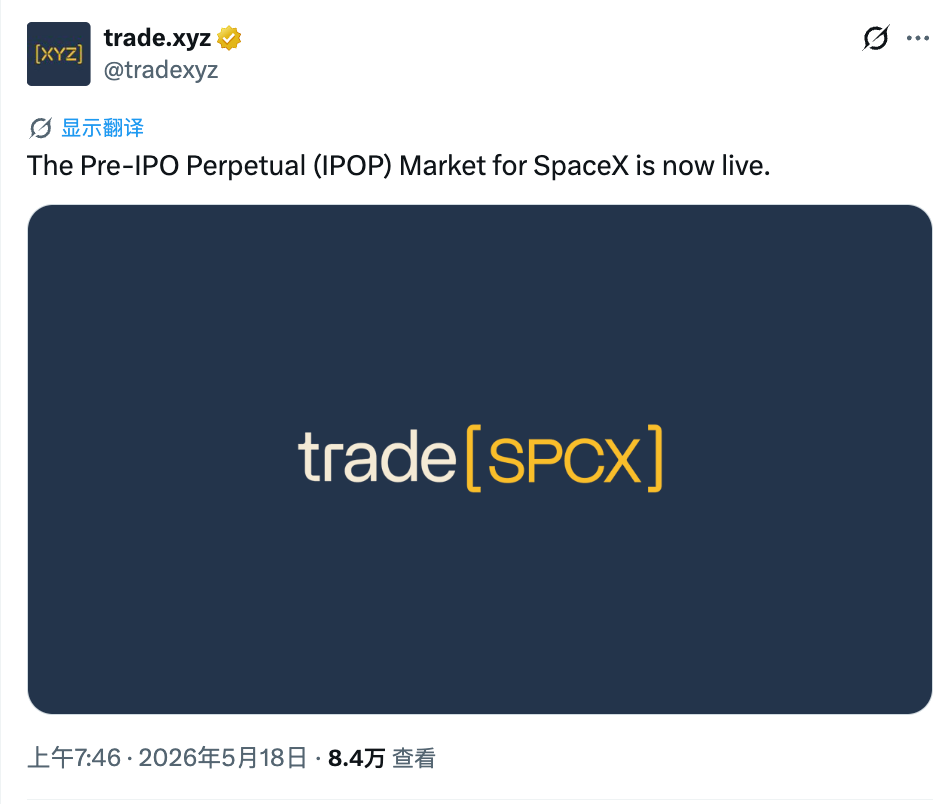
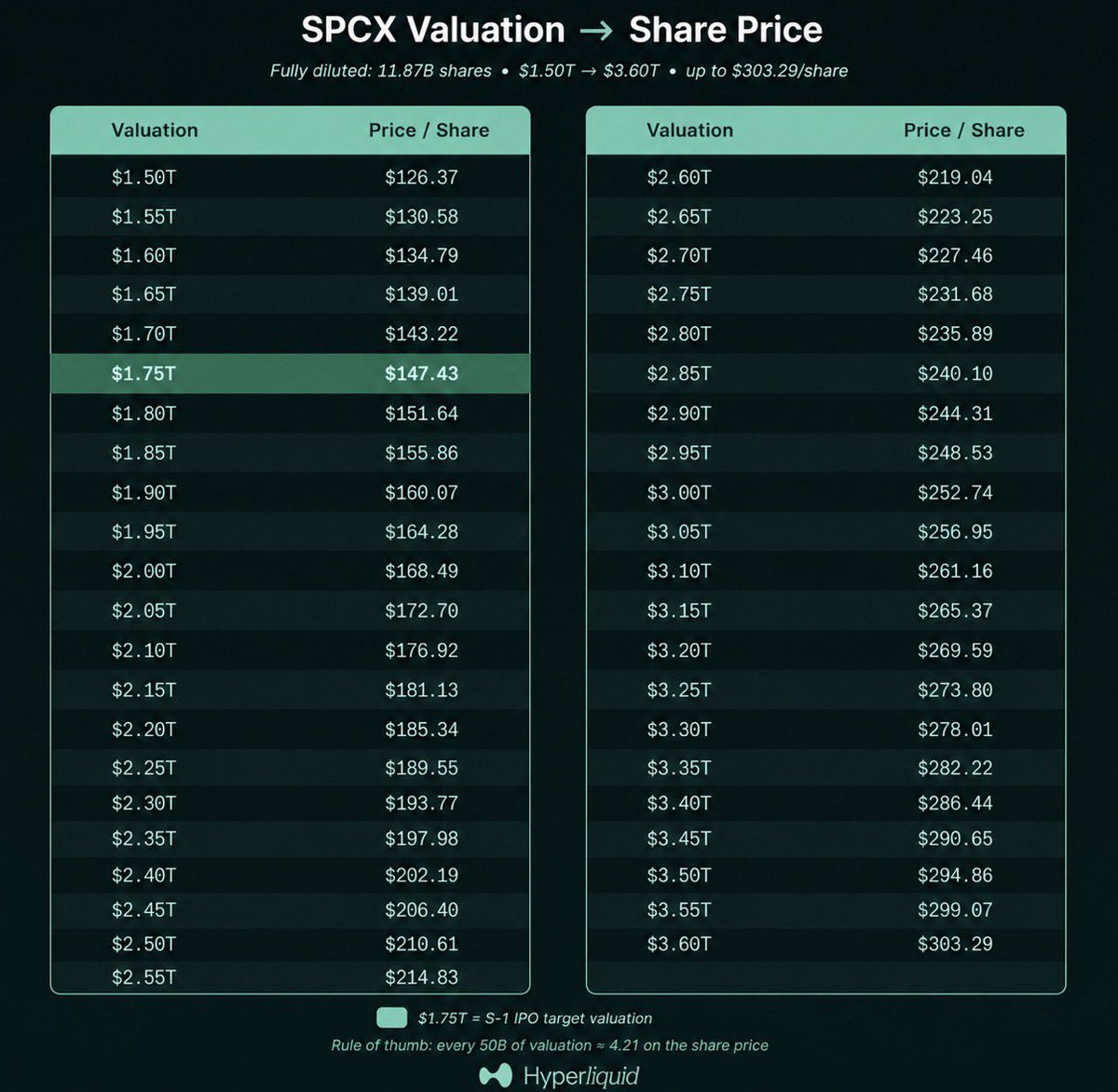
According to an announcement from Trade.xyz, $SPCX is priced based on 11.87 billion fully diluted shares, starting at $150.
Based on the registration application document that SpaceX submitted to the SEC, the target valuation of $1.75 trillion corresponds to about $147 per share. That is to say, Trade.xyz set the starting line for $SPCX close to the valuation given by SpaceX itself.
However, the on-chain sentiment clearly feels that this price is too low.
Within a few hours of $SPCX being launched, the price jumped from $150 to $216, an increase of 44%. Based on the same share count, the valuation corresponding to $216 is approximately $2.56 trillion, nearly 50% higher than SpaceX's own target.
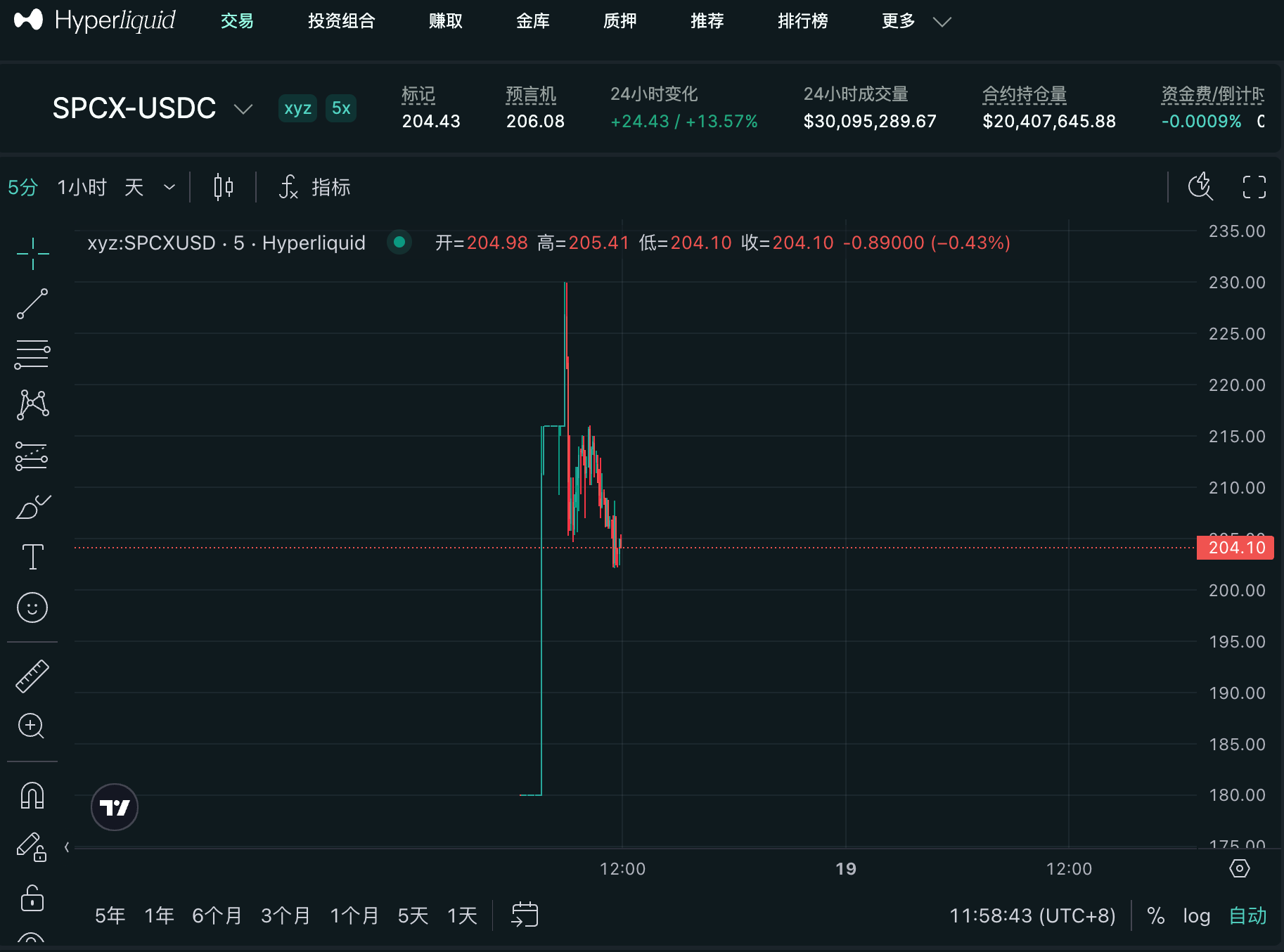
Based on the current situation, is $SPCX expensive or cheap before trading?
Tiered pricing control, the on-chain volatility of $SPCX is not that large
The last experience with pricing a Pre-IPO contract came from the $CBRS three weeks ago.
According to data from Hyperliquid News, the trading price of CBRS on-chain remained stable around $277 before the IPO, about 50% higher than Cerebras' final issuance price of $185.
Many at the time thought the on-chain price was high, but Cerebras opened directly at $350, which was 26% higher than the on-chain price.
The on-chain traders correctly identified the direction and provided a pricing that was more aggressive than the underwriters, but even so, they still underestimated the actual opening madness.
The situation with $SPCX feels a bit familiar. The on-chain price is nearly 50% higher than the target valuation in SpaceX's registration application, almost the same percentage as the on-chain premium for $CBRS at that time.
However, I feel cautious about directly applying the experience of $CBRS. Cerebras raised $5.5 billion, while SpaceX plans to raise $75 billion; one is a mid-sized tech IPO, and the other is the largest public offering in history. The larger the size, the heavier the institutional pricing power, and how far on-chain retail sentiment can lead institutions is uncertain.
There’s also a variable that didn't exist during $CBRS. According to Trade.xyz documentation, this time, the SPCX pre-market has implemented a tiered price control mechanism:
The deviation between the oracle price and the market price cannot exceed 20%, and once it reaches that point, trading is locked until the oracle catches up before the next round opens, with a maximum of 7 steps up and down. After 7 steps up, the price caps out; after 7 steps down, the price floors out, until the IPO officially launches or the contract expires on August 29.
This design means that the price of SPCX is framed within a calculable range. Unlike $CBRS, where prices were completely free to set, there is a ceiling above and a floor below.
For traders, the nature of the game has changed; both the upside space and downside risk are limited.
So, is there an off-chain reference to check if the on-chain pricing is outrageous? According to Bloomberg, Brookfield disclosed on May 14 that it held $2 billion in SpaceX Pre-IPO shares, corresponding to a valuation already exceeding $2 trillion.
This means that institutional investors are quoting prices in the private market that are already much higher than the $1.75 trillion stated in the registration document. The roughly $2.5 trillion valuation currently given on-chain is about 25% higher than the private market.
Whether this premium is reasonable, no one can provide a definite answer at the moment. But at least there are two coordinates to reference: the private market has already valued SpaceX above $2 trillion; and the experience from $CBRS indicates that a 50% on-chain premium has ultimately proven to be insufficient.
Everything may have to wait until June 12 for $SPCX to actually open.
CEX joins the battlefield, hunting for pre-market US stocks
Three weeks ago when $CBRS launched, Pre-IPO perpetual contracts were basically Hyperliquid's exclusive business.
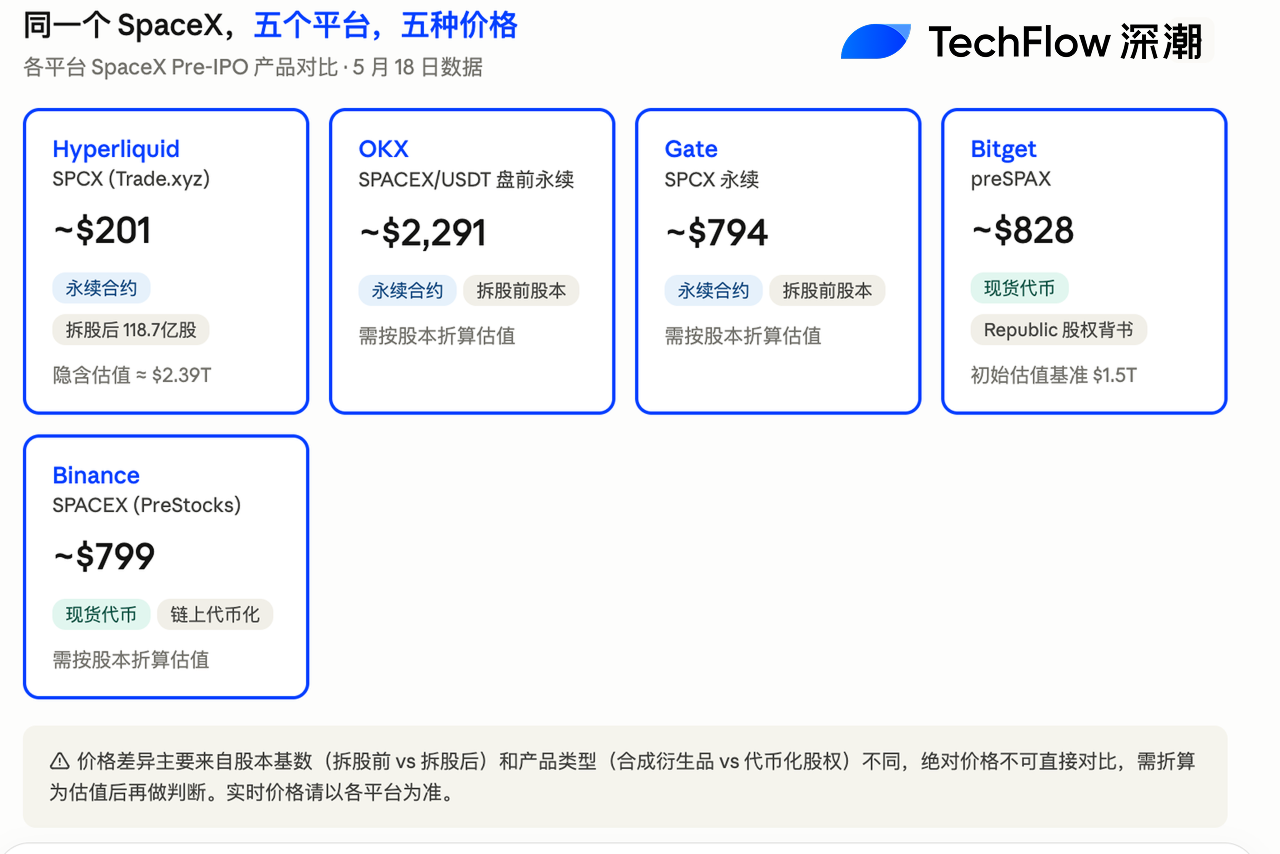
SpaceX is different; all major platforms have jumped in. According to BitMart's statistics, the SpaceX perpetual contract on OKX is quoted at around $2,000, Gate around $1,908, Bitget's preSPAX at about $680, and Binance Wallet at around $720. On Hyperliquid, SPCX is quoted at $216...
The same SpaceX, with prices ranging from $216 to $2,000—nearly a 10-fold difference?
This isn't because someone set the wrong price. Different platforms are using completely different capital bases for their quotes; Hyperliquid's SPCX is priced based on the split-adjusted 11.87 billion shares, while many CEXs use the pre-split share count, naturally resulting in higher unit prices.
According to a Bitget announcement, preSPAX claims to have real equity support issued by Republic, while most other platforms are purely synthetic derivatives with different underlying asset types.
For those unfamiliar with the gameplay, there's an easy pitfall here. Seeing $216 on Hyperliquid and $2,000 on OKX, the first reaction might be to think Hyperliquid is ten times cheaper, but in reality, when calculated into valuations, they might be similar, with differences only in capital base and product structure.
Ordering without considering valuation is clearly the quickest way to lose money.
The fragmentation of prices itself indicates one thing. When $CBRS was launched, only Hyperliquid was offering Pre-IPO contracts, and less than a month later, SpaceX's Pre-IPO products have flooded mainstream exchanges. This category is transforming from an experiment of one platform into the infrastructure of the whole industry.
For Hyperliquid, the good news is that it has verified a category. But the bad news is that anyone can do this category.
Everyone is scrambling for this category, and the reasons behind it may be more important than the category itself.
Over the past six months, the narrative in the crypto market has weakened. The excitement around meme coins has been increasingly short-lived, altcoins lack new stories, on-chain trading volumes are shrinking, and many platforms have started to see declines in active user numbers. Everyone is looking for the next thing that can bring real trading volume.
Star IPOs in the US stock market happen to fit this gap. SpaceX, OpenAI, Anthropic—these companies come with global-level attention and do not need any platform to create hype; the attention is naturally there.
More crucially, unlike meme coins, these targets have real revenue, a comparable valuation system, and a clear timeline for listing. Traders are not speculating on an abstract narrative, although there are emotional factors involved, but the targets themselves are genuine and verifiable.
This certainty is a rare commodity in today's crypto market.
Thus, various platforms are competing to get on SpaceX Pre-IPO, not just for one product, but for the entry point of the next stage of trading activity. When the native narrative of crypto cannot move, bringing the world's hottest traditional assets onto the chain for pricing, trading, and speculation could be a new path that the entire industry is exploring.
The US stock Pre-IPO is becoming a new battlefield for the crypto industry, and embracing change is the more pragmatic choice.
免责声明:本文章仅代表作者个人观点,不代表本平台的立场和观点。本文章仅供信息分享,不构成对任何人的任何投资建议。用户与作者之间的任何争议,与本平台无关。如网页中刊载的文章或图片涉及侵权,请提供相关的权利证明和身份证明发送邮件到support@aicoin.com,本平台相关工作人员将会进行核查。


