
Author: Auren Hoffman, CEO of NQB8
Translated by: Felix, PANews
If you have a college education but can't find a job in 2026, it’s your own problem. I’m sorry, but that is indeed the case.
Currently, there is a rumor circulating about a weak job market where no one can find work. But the data does not support this claim. The unemployment rate in the United States remains at 4.3%, close to a 50-year low. The National Association of Colleges and Employers (NACE) has raised its hiring forecast for the class of 2026 to 5.6%, a significant increase from the 1.6% forecast last fall. The number of entry-level job postings from large companies (with over 5,000 employees) has increased by 8.7% this year. IBM has even tripled its hiring for entry-level positions. The market for AI programming tools has doubled in two years, reaching $12.8 billion. Almost every tech company's talent budget is on the rise.
Companies are hiring. They are investing more in talent, not less.
The fact is that the job market has changed. Specifically, the standard of what is considered “qualified” has changed. Most job seekers have not yet adapted to this change.
The "Brand Effect" of Schools is Essentially Ineffective
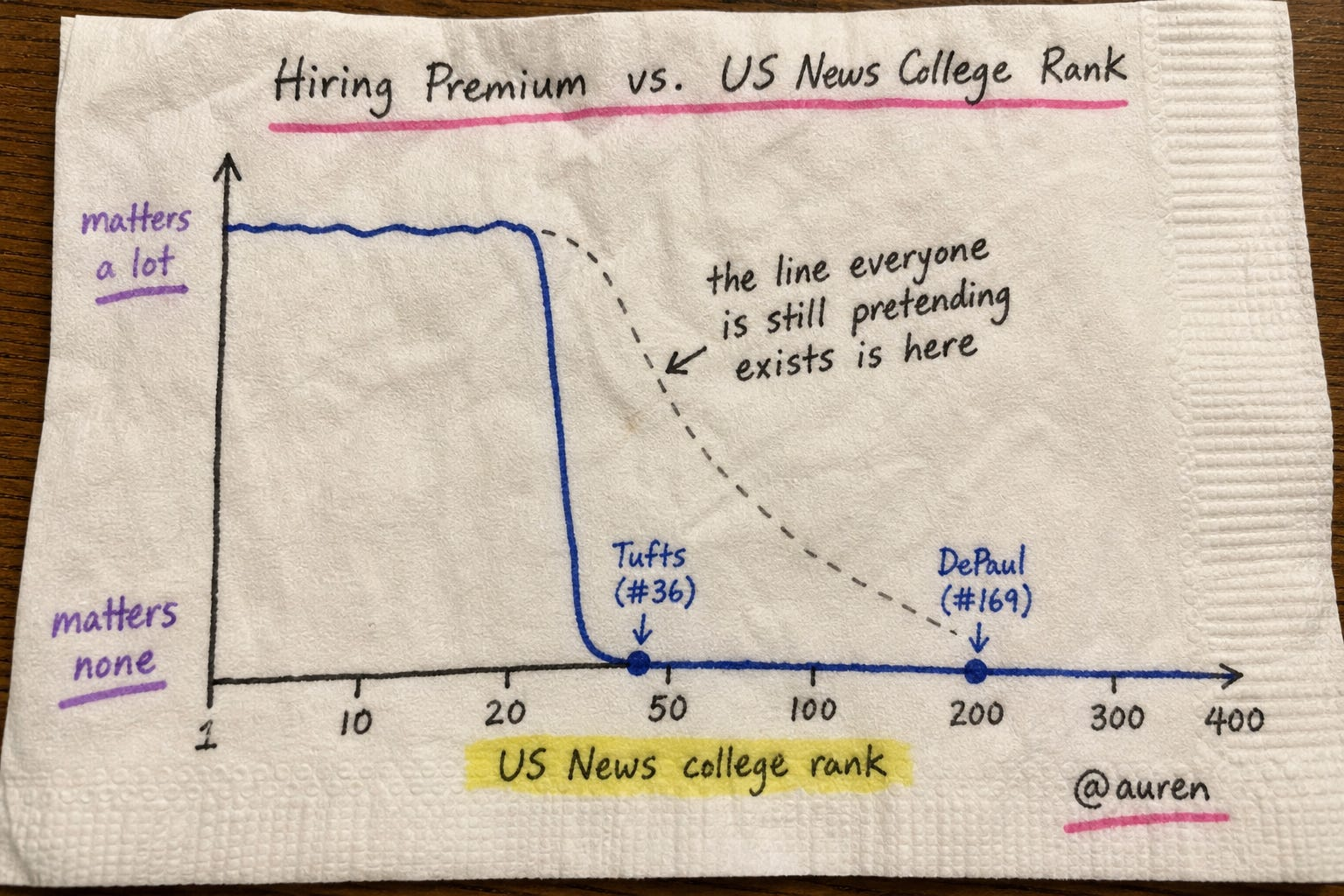
Until recently, American companies primarily recruited recent graduates based on the rankings from "U.S. News & World Report." Did you graduate from a top 20 school? Google, JPMorgan, and McKinsey would be clamoring for you to interview. Graduated from a school ranked 50th? There will be jobs waiting for you. What about a school ranked 400th? There are jobs as well, just not as prestigious as those from the 50th place.
The degree brand effect from top 20 schools is still strong. Graduates from these schools are still highly sought after. They have extensive networks, and the admission screening process is very strict. A degree from Stanford University can open more doors for you, while a degree from a less prestigious state university does not.
After the 20th rank, this system collapses. In the eyes of hiring managers, there is almost no difference between a school ranked 35th and one ranked 350th. The brand value has completely collapsed, and most parents and students are unaware of this.
A high school student desperate to get into Tufts University (ranked 36th by US News) essentially no longer has an advantage over students from DePaul University (ranked 169th) in the job market, despite the fact that the median SAT scores of students from the two schools differ by nearly 300 points.
This 300-point difference used to represent two entirely different starting points for careers. Today, it simply means two students are throwing the same number of resumes into the same black hole.
This is not to undermine Tufts University, nor to belittle DePaul University. Both schools provide a high quality of education. It’s just that in the eyes of recruiters, the brand value of these two institutions has become nearly equivalent.
Spending $80,000 a year to acquire a brand that no longer provides any recruitment advantage is one of the worst deals in the consumer economy. And every year, thousands of families remain oblivious to this, squandering this money.
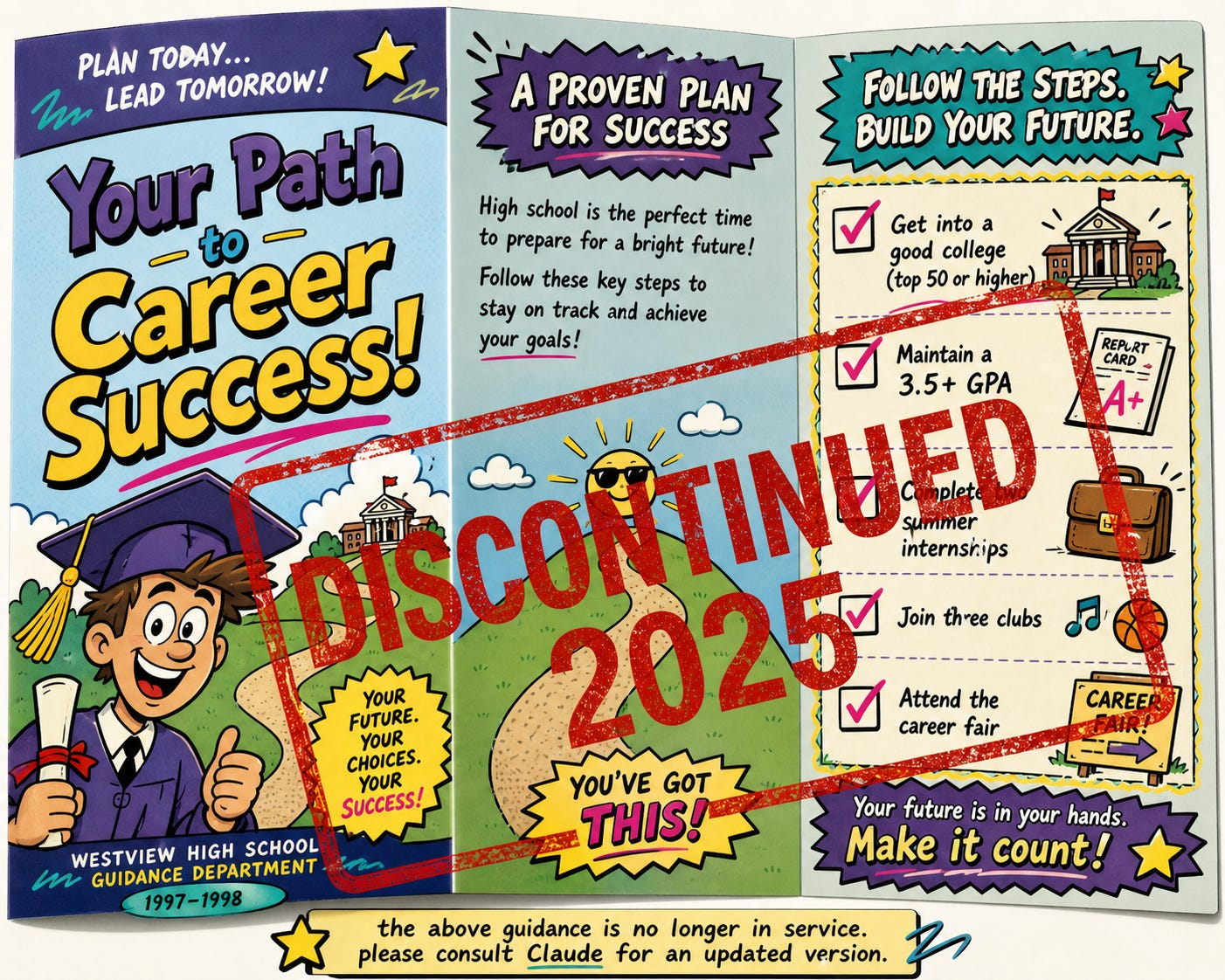
The Old System is a Signal, and This Signal Has Completely Failed
First, let’s clarify the essence of the old system.
The brand of a university has never been about the courses offered. No one hires graduates from the University of Pennsylvania because they teach macroeconomics better than Penn State University. They hire graduates from Penn because of the extremely strict admissions process. If you got in, it indicates that you are likely smart and likely diligent. The school helps companies with the initial screening.
The collapse of this system has three reasons.
First, admission standards are no longer able to predict anything. SAT scores still represent their original meaning: pure cognitive ability. But other factors (such as alumni connections, athletic talent, geographic distribution, and narrative writing skills) are gaining more weight, diminishing the final signal presented.
Secondly, most universities almost never give grades lower than an A-. Therefore, when everyone has a GPA of at least 3.8, grades themselves lose their meaning.
The third reason is even more significant. AI has made knowledge acquisition completely free (or rather, you only need to pay for a Netflix subscription). The real product that universities have sold for the past 800 years is access to professors, library resources, and other specific knowledge that is hard to find elsewhere. And this product has been discontinued within a mere 24 months. Any concept in the tech field can now be found on YouTube. Every framework offers free courses. Every textbook chapter can be easily accessed through a 5-minute online Q&A.
If knowledge is free for everyone, then the school you attended no longer represents "this person once had learning resources." Everyone now possesses learning resources. What remains important is how you utilize these resources.
What Can Make You Hired?
If it’s not the university’s brand, then what is it?
You must prove that you can create value. That’s it. It’s the only important factor.
In 2026, the test used by excellent hiring managers is very simple: can you learn independently? Can you see a task through to completion? Can you follow through on what you say? These have always been core skills, but the difference now is that they have become the only important skills, as degrees no longer serve the initial screening function.
If you have a few years of work experience, your resume can showcase that you possess these skills. If you are a recent graduate, you must demonstrate what you have created and built.
The "Resume of the New Era" is the Product You Build
In 2026, the most valuable thing a 22-year-old can do is create something. An app, a screenplay, a side hustle, an internal tool written for a club, a series of dinner parties, a script to automate mundane tasks, a website, a Chrome extension, a sculpture, a party, a Discord bot, a Substack column with only 32 readers but strong viewpoints.
Anything that turns an idea into reality.
Can it make money? Maybe not. But that’s not the point.
The point is: you learned things on your own, you completed it, and you can describe what you learned, what went wrong, how you solved it, and why you made those decisions. This story is the resume of the new era.
Any hiring manager would prefer to interview someone who has built an app, with a GitHub filled with various quirky projects, than a candidate from a top 50 school with a GPA of 3.9 but just a transcript. When one candidate has tangible results and another only has a transcript, the transcript will always pale in comparison.
Over the past three years, the profile of successful job seekers has completely changed. It used to be: school tier + GPA + extracurricular activities. Now it is: whether you have done something on your own in your spare time without being asked.
Learning is Free, Willingness is the Bottleneck
The most underestimated change of the past three years is that the cost of learning anything has dropped to nearly zero. With just a little time spent on the weekend, YouTube can teach you almost any technical skill. Claude can explain any problem in easy-to-understand language. GitHub can host your portfolio. Vercel can host your projects. Stripe even allows you to collect payments on a Sunday afternoon. Supabase, Replit, and all the other tools you might need offer generous free versions or are open-source.
Today, the cheapest thing in the world is knowledge, and the rarest is the willingness to apply that knowledge.
Most job seekers do not apply knowledge. They still submit 500 resumes with a copy of the resume they wrote in their final year of college. They have done no practical work and have not learned any knowledge beyond what was assigned. Then they are surprised as to why they don’t hear back.
Those who apply their knowledge receive three job offers by the third week. The difference is obvious.
The Most Important Skill is Also the Simplest: Follow Through
In 2026, the trait that determines whether a person can be hired and retained is not their background, not their tech stack, nor their raw IQ. It is whether you can deliver what you promised.
No one expects you to be a genius. What they demand is execution.
Someone who can reliably fulfill promised tasks is the most valuable employee in any position within any company.
Three Typical Profiles That Can Be Hired in 2026:
- Builders: Those who have developed usable products in their spare time. They can talk fluently for ten minutes about the details of where the product went wrong and how to fix it. They may have opened a channel on Substack or YouTube, devoted to discussing problems they have been passionate about. They breeze through interviews with conversations that directly go into strategy.
- Operators: Those who have actually managed operations. They have founded clubs, run small businesses, organized competitions, created travel budgets, or fixed broken reservation systems. They have stories of collaborating with others and generating tangible results.
- Executors: Those who have consistently delivered on their promises over the years. Teachers, coaches, and former bosses would affirm this. By the time of the interview, background checks have already confirmed this.
There is overlap between these types. Those who have built usable products are often also those who are capable of seeing things through to completion. These are not three separate categories. These three aspects are the three key signals every hiring manager will use to assess job-seeking success.
If you cannot demonstrate any of these three points, you will not be hired. That is the whole truth.
Why do Old Job-Seeking Strategies Keep Failing?
Every spring, 3 million college graduates flood the job market with their parents and high school counselors giving them job-seeking guides: submit 500 resumes, carefully revise your resume, write cover letters, follow up politely, attend job fairs, join alumni LinkedIn groups.
This method no longer works. Most of the reasons for its failure stem from the same shift.
Remember: when schools prohibit grades below an A-, GPA is no longer a key screening indicator. Companies that genuinely value GPA will prioritize hiring students from the top 20 schools. Other companies have long stopped caring about GPA.
Internship experience is also no longer an effective signal. There are too many internship opportunities, often with administrative duties, and most job seekers can easily write on their resumes "interned at a well-known company." Those signals that are easy to fabricate will no longer be effective.
Young people who persist in old patterns do not fail due to laziness. Some of them do work hard. But the direction of their effort is no longer relevant. This is painful but entirely solvable, assuming there is a willingness to change strategies.
Second-Order Effects
If "your achievements" replace "your experiences" as the primary recruitment criteria, many things will collapse.
- Colleges ranked beyond the top 20 will face enrollment crises. A four-year degree worth $320,000 will struggle to survive in a job market that no longer values degrees. A wave of college mergers, closures, and shifts to non-degree certificate programs is expected.
- The student loan industry will contract sharply. You cannot take out a loan of $200,000 for a certificate that no longer comes with a wage premium. This equation does not add up.
- Human resources and recruiting will suffer severe blows. "Screening 1,000 resumes for relevant qualifications" is now entirely done by AI. The real meaning of recruiting is "finding those who have genuinely created results," which requires different skills: judgment, networking resources, and the ability to assess work outcomes. Most HR professionals in 2026 will still not excel in these areas (if they ever did).
- The position of middle management will be squeezed. When a junior employee can accomplish work that five years ago was not possible even for a director using Claude, the value of intermediaries diminishes.
- Traditional parenting models will no longer apply. Those parents currently forcing their children to participate in various sports events, SAT prep, and college admissions competitions to secure a place at a college that can no longer guarantee employment are adhering to an outdated educational model. Wise parents have already shifted their mindset. They guide their children to undertake small businesses in their spare time instead of engaging in more extracurricular activities.
Conclusion
The entry-level job market is not weak; it is mismatched in supply and demand. Companies are hiring aggressively, with salaries higher than ever, yet they cannot find candidates who can deliver on their promises.
Job seekers have not adapted; they continue to adhere to a system that has not been evaluated by these standards for over a year. Those who have adapted to the new environment have found work, while those who have not can only throw the same resumes into the same black hole.
You can sympathize with them. A generation was promised that if they met the requirements, they could secure jobs, but that promise has expired, and sympathy cannot help you find work.
You have no excuses.
The tools are there, the information is there, and the cost of starting any project is nearly zero.
If you cannot find a job today, it is not the fault of a weak market, nor AI, and certainly not your being ranked 35th (after all, no recruiting company pays attention to that ranking anymore); it is the fault of the candidate who failed to adjust when the rules changed.
Show your results, demonstrate what you've learned, and show up on time.
Further Reading: a16z partner's lengthy article debunking the "AI job apocalypse" myth suggests that technological change will ultimately enlarge the pie
免责声明:本文章仅代表作者个人观点,不代表本平台的立场和观点。本文章仅供信息分享,不构成对任何人的任何投资建议。用户与作者之间的任何争议,与本平台无关。如网页中刊载的文章或图片涉及侵权,请提供相关的权利证明和身份证明发送邮件到support@aicoin.com,本平台相关工作人员将会进行核查。


