
Author: Spinach Spinach
On the morning of May 14, 2026, the Senate Banking Committee was marking up a 309-page text—the Senate substitute amendment to the CLARITY Act. This is the most crucial step the bill has taken in ten months since it passed the House last July by a vote of 294 to 134.
But if you strip away all the legal jargon, the text is actually doing just one thing:
- Acknowledge that crypto assets fit the definition of "securities," and then build a separate set of rules for them that does not fall under securities law.
This sounds like a paradox. But it is precisely the spirit of this bill—not overturning Howey, not rewriting securities law, not eliminating bank deposit protections, but rather carving out a new category alongside these existing rules.
The entire text is a repetition of this "carving out" technique.
Strictly speaking, this is no longer "that" CLARITY Act. The version passed by the House last July did not contain the category of "ancillary asset," did not have the ban on interest for stablecoins, nor did it reclaim so much jurisdiction for the SEC from the CFTC.
This Senate alternative version is the result of Tim Scott and Cynthia Lummis substantially rewriting it over the past ten months.
To understand the new CLARITY substitute version, Spinach has outlined three underlying logics behind it.
Understanding these three, you will grasp the entire chessboard of U.S. crypto regulation for the next two years.

1. Not overturning Howey, but carving out a hole next to it
Over the past decade, the biggest trouble for U.S. crypto regulation has been the Howey Test of 1946—"a reasonable expectation of profits to be derived from the efforts of others." This test is an unassailable cornerstone in case law, yet it conveniently boxes in almost all tokens within the realm of securities.
The SEC's lawsuits against Ripple, Coinbase, and Binance all stem from this.
The CLARITY substitute version does not seek to overturn Howey. It does the following:
- Creates a brand new legal category called ancillary asset—literally translated as "ancillary asset."
In simpler terms: if a token's value relies on the "entrepreneurial or managerial efforts" of the issuer or core team, then it is an ancillary asset.
Note this definition—it acknowledges the existence of that "dependence on the efforts of others" relationship mentioned in Howey.
Acknowledge! Then, the bill separately builds a rule for this kind of thing:
- The act of issuance itself is legally recognized as "involving securities," but once the token is issued, it is no longer a security. It is an ancillary asset, governed by disclosure rules rather than registration rules.
It's like a legal guardian saying, "I acknowledge this child is yours, but from the first second of its birth, it is no longer your responsibility."
Isn't that a bit absurd? Yes. But this is the standard operating procedure of American legislation in addressing the "wanting both ways" situation: not overturning the cornerstone of case law (which cannot be overturned, nor is it necessary), but using a new statutory category to circumvent it.
So the rumor that CLARITY makes tokens "no longer securities"—that's a lazy summary. The accurate statement is: CLARITY creates an "intermediate layer with a disclosure obligation density lower than securities but higher than commodities," specifically designed to accommodate those things that are neither stocks nor corn.
The downstream impact of this logic is structural. The legal pathway for project parties distributing tokens within the U.S. will become clearer, no longer needing to rely on SAFT, Reg D, and Reg S.
More importantly—the U.S. is finally going to give tokens a legal identity.
No longer will it be in the "If the SEC sues you today you are a security, if you settle tomorrow you are not" Schrödinger's state.
As an interesting detail: there is a precisely worded clause in the bill—that a token will not be considered an ancillary asset if it is a primary asset of an ETF listed on a U.S. national securities exchange as of January 1, 2026.
Allow me to pause for a laugh. BTC and ETH spot ETFs are approved in January and July 2024, respectively, and will have been stable running well before early 2026.
This clause is effectively a legislative "confirmation": you two are not only not securities, but you also do not even fall into the secondary category of ancillary assets.
The legal status is the cleanest. No names were mentioned, but it hits precisely. An extremely American-style solution.

2. The compliance watershed of DeFi: code belongs to code, operators belong to operators
This is the most lethal logic of the entire bill for practitioners—and also the most frequently misread one. On the surface, it differentiates "true DeFi" from "false DeFi," but the real distinction lies in another set: the protocol itself and those operating the protocol.
- Code, nodes, wallets, and pure algorithmic logic belong to the former, are not subject to securities law;
- Those who control, modify, or review the protocol belong to the latter and are subject to regulation.
This sounds simple, but it did not exist over the past decade.
The SEC's arguments in the Coinbase, Binance, and Uniswap cases have always been: "the protocol is the product, the product is an extension of the issuer"—in this logic, there is no distinction between "protocol" and "operator."
The CLARITY substitute version draws this line for the first time at the legislative level.
How is it specifically drawn? Two directions.
The first direction is towards "false DeFi"—drawing a warning line for operators.
The bill gives a textbook definition of DeFi protocols: participants execute financial transactions based on predetermined, non-discretionary algorithms, and no one other than the users themselves holds or controls the assets.
Then it defines what constitutes "false DeFi"—if any of the following conditions are met:
- There exists a person or group that can control or significantly change the protocol's functionality, operation, or consensus rules;
- The protocol does not operate solely based on pre-set, transparent rules in the source code;
- There exists someone or a group that can review, restrict, or prohibit the use of the protocol.
Once you are deemed "false DeFi," and your activities fall within the realm of securities, you must register, disclose, and regulate under the 1934 Act, and meet anti-money laundering obligations.
Please ask yourself: does that DEX you claim is governed by DAO have the admin key in a multisig? Are most of the multisig members from the core team? Is the upgrade of protocol parameters proposed and voted through only by the core team? Is the front end operated by the core team?
If the answer to any of the above is "yes," then according to this bill's standards, you likely fall into "false DeFi."
The bill has left a very clever safe harbor—the emergency safety committee exception.
You can retain an emergency pause mechanism to protect users in the event of hacking, as long as this power is pre-public, regulated, only used to respond to specific cybersecurity incidents, with the scope and duration strictly limited, and no individual has unilateral control.
However, you cannot use this pause to upgrade the protocol, change economic parameters, or make governance decisions. This line is drawn exceptionally well, almost tailor-made for protocols with security councils like Compound, Aave, and Uniswap.
The second direction, aimed at "the protocol itself"—drawing a protective circle around the code.
The bill grants exemptions for several matters that have kept developers on edge over the past years:
- Compiling, relaying, and validating network transactions; operating nodes or oracles;
- Developing distributed ledger systems;
- Developing wallet software for users to safeguard their private keys.
Simply engaging in these activities does not constitute jurisdiction under securities law. Those who have experienced the Tornado Cash incident in 2018, sanctions on code in 2022, and the prosecution of Samourai Wallet developers in 2023 can surely appreciate the weight of this clause.
It directly translates the long-held proposition that "writing code is free speech," which has been supported by the legal academia but not acknowledged by the DOJ, into legislative wording.
But note the detail: the bill retains the SEC's anti-fraud and anti-manipulation enforcement powers. In other words—while writing code is no longer a crime, using code to deceive still is.
These two directions together form the complete second logic:
- The protocol itself is legislatively protected, but those operating the protocol are regulated according to their actual control level.
- Truly decentralized protocols earn a respectable legal status, but "half DeFi" will be assimilated.
A large number of so-called decentralized DEXes, lending protocols, and derivatives platforms, still holding an admin key within the team's hands, will face a painful choice in the next two years—either genuinely decentralize power or register as broker-dealers or exchanges.
The highest costs of capital and compliance lie in this middle gray area. 
3. Stablecoins cannot act like banks, but DeFi can—a carefully maintained narrow boundary
If there is a most dramatic chapter in the entire bill, it is the ban on interest for stablecoins.
In one sentence: it prohibits digital asset service providers from paying U.S. users interest or returns on stablecoins.
However—the devil is in the list of "allowed returns."
Allowed returns that do not constitute "functional bank interest equivalents" include:
- Rebate incentives related to transaction payment settlements;
- Returns obtained from market making liquidity, collateral, or otherwise placing assets at credit or investment risk;
- Participation in governance, validation, staking, loyalty programs, etc.
Moreover—these returns can be calculated based on balance, duration, or tenure.
When I read "placing assets at credit or investment risk," I couldn't help but laugh.
What is this? It's a compliance channel tailor-made for the entire DeFi lending market.
“Depositing USDC into Morpho, Aave, Compound, and similar protocols to earn returns, as long as that return originates from the credit or investment risk exposure of the assets, rather than the interest on the stablecoin's balance, is not within the ban's scope.”
The banking industry, of course, saw right through this. On May 9, the three major American banking associations (ICBA, BPI, ABA) jointly issued a letter rejecting this compromise, specifically calling it a "loophole."
On May 11, Mother's Day, the CEO of the American Bankers Association, Rob Nichols, wrote to all bank CEOs across the nation demanding "immediate action" to lobby senators.
Their core argument is straightforward: about 80% of U.S. banks' loan funds come from customer deposits; if stablecoins can provide users with a reason to keep their money in USDC wallets instead of checking accounts through "activity-based rewards," then banks lose a cheap source of funds.
Tillis's response translated to: "a loophole is a loophole, let's agree to disagree."
The logic behind this game is the most important part to understand.
Washington is making a bet—leaving a narrow, carefully maintained boundary between stablecoins and bank deposits: stablecoins cannot directly pay interest like banks (protecting the deposit base), but stablecoins can serve as an entryway to DeFi returns (allowing capital market pricing).
It pretends to protect banks while actually opening up a more flexible product space for the crypto industry than banks.
The most noteworthy implication of this clause is: the law draws a line between "deposits" and "credit risk exposure," which just happens to be drawn at the boundary of DeFi lending protocols.
The legality of the USDC lending market has been further solidified—not because stablecoins paid interest, but because users placed stablecoins into a “vehicle at credit or investment risk.”
The downstream impact of this logic: compliant issuers like Circle and Paxos cannot directly pay interest, but users can place stablecoins into DeFi protocols, on-chain lending markets, and tokenized money market funds—these "vehicles at credit risk exposure" to earn returns.
The legal foundation of real-world asset lending markets and on-chain credit markets has been further solidified.

The three logics are underpinned by the same legislative philosophy
When you put the three underlying logics together, you will find a hidden common structure—each one is "the law does not overturn X, but carves out a new passage next to X":
The first one, not overturning Howey, carves out ancillary assets.
The second one, not overturning securities intermediary regulations, carves out the distinction of "protocol vs. operator."
The third one, not overturning bank deposit protection, carves out the "credit risk exposure" channel.
Together, these three embody the spirit of this bill: it is not overturning the existing rules, but carving out new categories in the seams of those existing rules.
Case law cornerstones remain unchanged, securities laws are not abolished, and bank deposit protections are not eliminated. Yet crypto assets, DeFi protocols, stablecoin activities, and on-chain lending returns are all specially, separately, embraced by this new logic in law.
This represents a very American-style legislative philosophy—it hates revolutions, but is good at putting new patches on old frameworks; once enough patches are applied, the world becomes different.
But the costs must also be acknowledged
Up to this point, representing this bill too gloriously would seem disingenuous. Each of the three logics has its drawbacks, and professional practitioners should clearly see them:
The cost of the first logic is that the ultimate form of disclosure obligations for ancillary assets will be entirely determined by the SEC through rulemaking.
If the disclosure form is overly burdensome—for example, requiring project parties to quarterly update token economic models, detail all holders with over 4% positions’ unlocking and changes, and provide continuous "entrepreneurial progress" reports—then this set of disclosure obligations will practically approach the cost of a complete securities registration.
The law gives you a new passage, but how wide it is will depend on how the regulatory body interprets it.
The cost of the second logic is that the "true DeFi" test is very stringent, but the execution power lies with the SEC.
The boundaries around terms like "having control or significant changes to the protocol's functions" and "reviewing, restricting, or prohibiting the use of the protocol" need to be defined by the SEC through cases and rules.
If the next SEC chair is not friendly towards DeFi, they can interpret these standards very narrowly.
The legislation provides a safe harbor, but who gets to draw the boundaries of that safe harbor remains an open question.
The cost of the third logic is rather straightforward—will this wide-open "credit risk exposure" channel give rise to another round of Celsius/BlockFi-style gray yield products?
The line between the "activity-based rewards" permitted by the law and the substantial "interest" is clear in the text, but can easily become blurred in product design. Regulatory bodies will inevitably face a set of products that skirt the boundary—they seem to be "placing assets at credit or investment risk," but feel no different from term deposits to users.
This game has just begun.
The real battleground in the next stage is not in Congress, but in regulatory agencies.
The phrase "the Commission shall adopt rules…not later than 1 year" has appeared dozens of times in the bill.
Who becomes the SEC Chair, who becomes the CFTC Chair, and how they respond to industry opinions during the notice-and-comment period will determine the final texture of these provisions. What we see today is a skeleton; the muscles will take 12 to 18 months to develop.
Conclusion
Back to the markup this morning.
Even if it smoothly passes the committee, this bill will still need to go through a full Senate vote, merge with the agriculture committee version, coordinate with the House version, return to both chambers for voting, and finally go to the president for signing—any one of these links could lead to changes in the language.
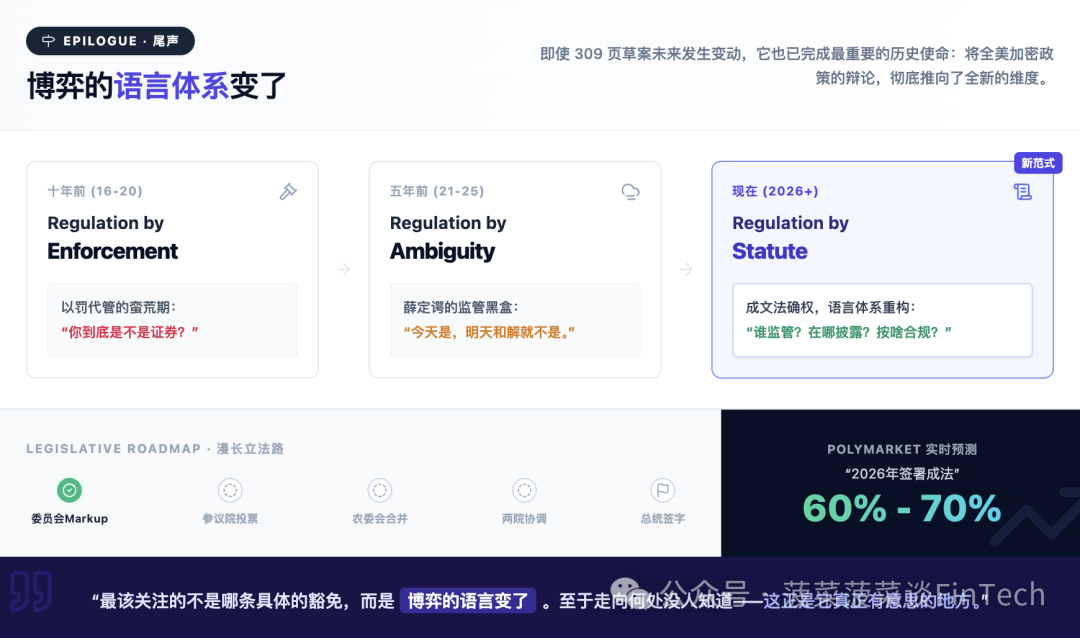
Polymarket has fluctuated the probability of "CLARITY being signed into law in 2026" to around 60–70% in recent weeks.
However, even if the final legal text differs from today's draft, this 309-page text has already accomplished its most important task:
It has shifted the language of the crypto policy debate in the United States from "is this a security" to "at what level to disclose, who regulates, and what standards to comply with."
Ten years ago, regulating this industry relied on "regulation by enforcement," five years ago it relied on "regulation by ambiguity," and now it is finally moving towards "regulation by statute."
What practitioners should focus on is not which specific exemptions apply, but rather that the language of the game has changed. As for where this game will ultimately lead, no one can provide an answer now—this is precisely what makes it truly interesting.
免责声明:本文章仅代表作者个人观点,不代表本平台的立场和观点。本文章仅供信息分享,不构成对任何人的任何投资建议。用户与作者之间的任何争议,与本平台无关。如网页中刊载的文章或图片涉及侵权,请提供相关的权利证明和身份证明发送邮件到support@aicoin.com,本平台相关工作人员将会进行核查。


