Author: New Intelligence
It's too crazy! A chip the size of a dinner plate directly created the largest tech IPO of 2026. On the first day, it surged 108%, not only allowing Ultraman to earn nearly ten times his investment but also marking the first shot in the tsunami of over 30 trillion IPOs in the ASI era.
In 2026, the largest tech IPO in the United States has arrived!
Today, AI chip company Cerebras officially landed on Nasdaq, with a first-day surge of 108%.
The IPO was priced at $185 per share, jumping directly to $385 at open, and closing at $311, with a valuation peaking at $100 billion.

Cerebras sold 30 million shares in one go, raising $5.55 billion.
This is one of the largest IPOs for a U.S. tech company since Uber went public in 2019, with momentum even stronger than that of Snowflake that year.

In the Nasdaq trading hall, Cerebras founder and CEO Andrew Feldman rang the opening bell.
Now, a large group of VC investors have become overnight millionaires, with Ultraman holding 89,000 shares, making a profit of ten times to around $30 million.
Cerebras had a stunning start, successfully igniting the first AI IPO of 2026, with OpenAI, SpaceX, and Anthropic next in line.


The explosion of AI IPOs is about to begin.
The largest AI IPO of 2026, with a first-day surge of 108%
It must be said, a year ago, no one believed this day would come.
In 2015, semiconductor industry veteran Andrew Feldman teamed up with senior chip industry experts to establish Cerebras.
When they started selling chips in 2019, Feldman remarked, "No one cares; the market is not ready."

But saying that the road to Cerebras’ IPO is a mystery thriller is not an exaggeration.
In September 2024, Cerebras submitted its first IPO application.
As a result, it was targeted by the U.S. Foreign Investment Committee (CFIUS)—
the reason being that their major client and investor G42 is based in Abu Dhabi, and at the time, G42 contributed 87% of Cerebras's revenue.
National security reviews were delayed again and again, investor confidence collapsed, and the IPO plan was forced to be shelved.
One year later, the plot completely reversed.
AI models finally became "smart and useful," and Cerebras’s business exploded:
In 2025, revenue reached $510 million, a year-on-year increase of 76%. More critically, it turned from a loss of $482 million to a profit of $238 million.

In just one year, from huge losses to immense profits, this turnaround made investors restless.
The client list expanded from mainly G42 to include OpenAI, AWS, G42, and MBZUAI simultaneously.
More importantly, two heavyweight new clients appeared—
OpenAI signed a multi-year contract worth over $20 billion, locking in 750 megawatts of Cerebras computing power to be deployed in stages starting in 2026.
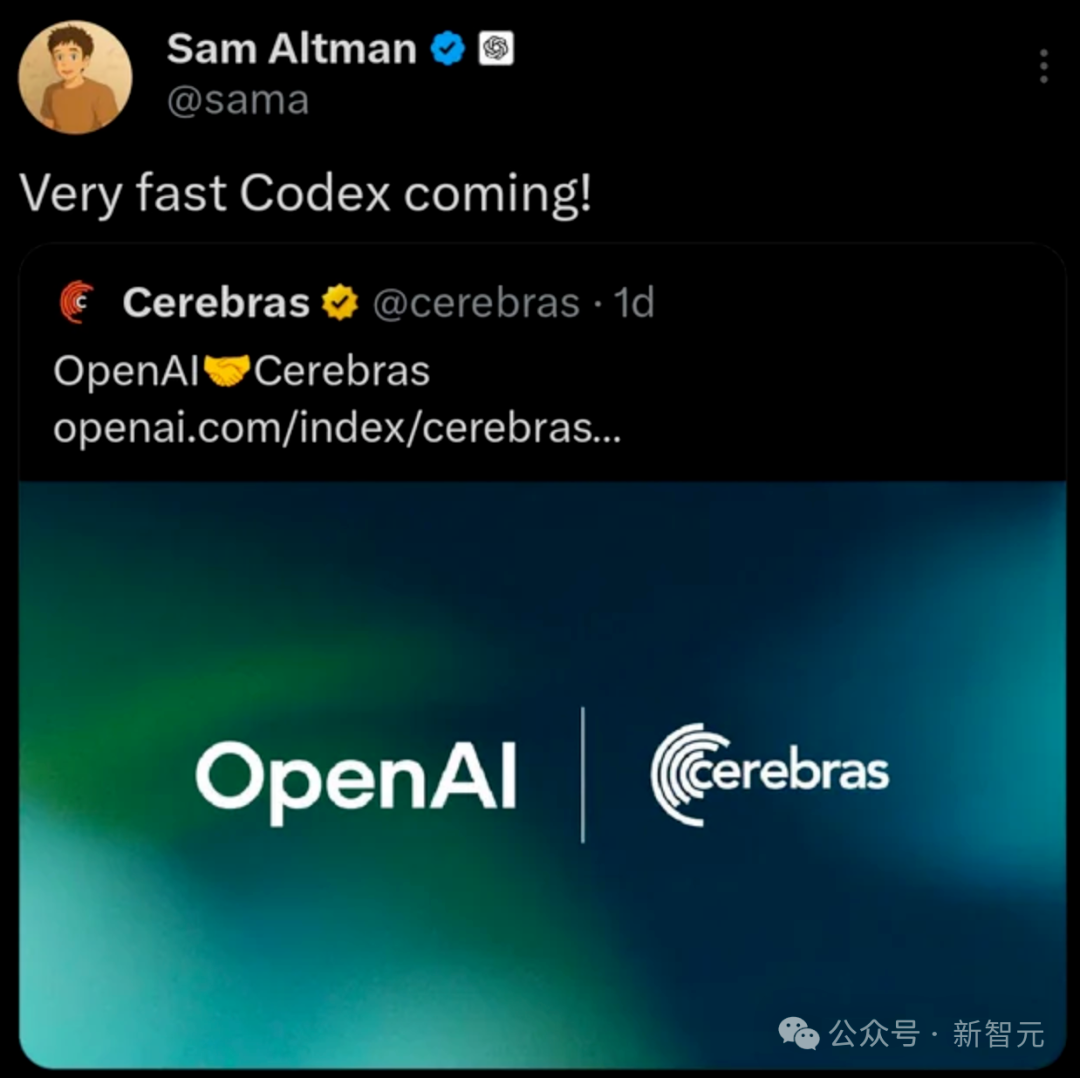
AWS announced the deployment of Cerebras CS-3 chips in its data centers, making them available to developers through Amazon Bedrock.
In a recent interview, Feldman revealed that during the roadshow, he needed to convince investors of three core points:
First, the demand for inference will increase a millionfold;
Second, computing power isn't solely dependent on GPUs;
Third, the moat of CUDA is actually exaggerated.
This time, Cerebras successfully kicked off the artificial intelligence IPO curtain-raiser, and its debut was stunning.
In the ASI era, OpenAI has also become a "big winner"
Cerebras' IPO created a textbook-level VC exit feast.
From seed rounds to ringing the bell, these institutions waited a full ten years.
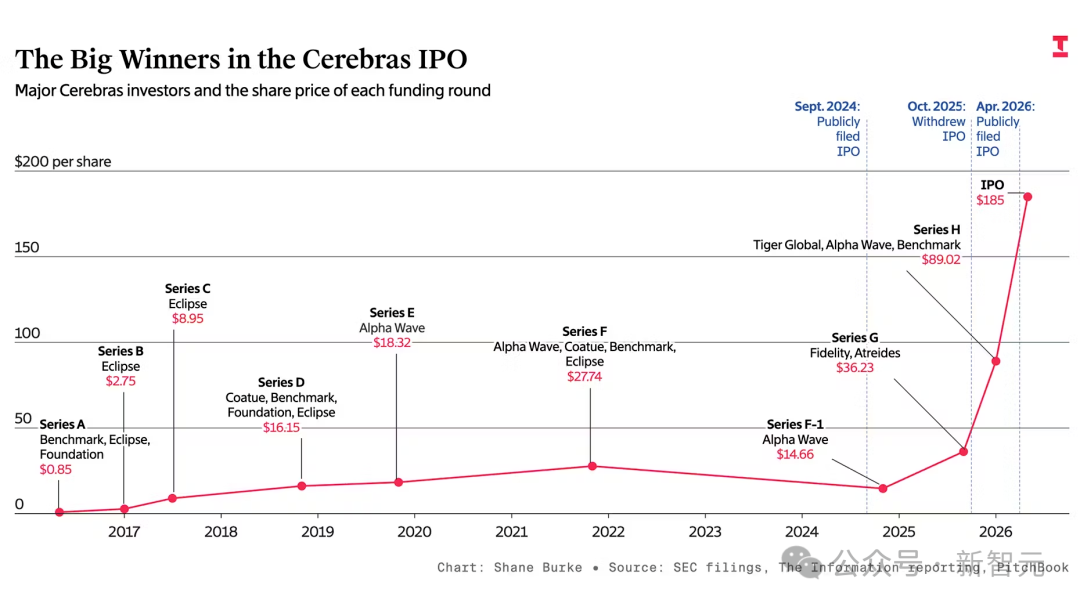
Foundation Capital: $37 million → $2.8 billion, 76-fold return
Foundation Capital invested about $37 million for a 7% stake, worth $2.8 billion at the IPO price of $185, resulting in a 76-fold return.
At the first-day closing price of $311, this is approximately $4.8 billion.
Benchmark: $268 million → $3.3 billion, 12-fold return
Benchmark also entered during the A round in 2016, led by partner Eric Vishria.
It total invested $268 million for an 8.1% stake, corresponding to $3.2 billion at the IPO price, representing a 12-fold return. By the closing price, it soared to $5.5 billion.
Eclipse Capital: $146.5 million → $2.5 billion, 17-fold return
Eclipse Ventures invested $146.5 million for a 6.2% stake, corresponding to $2.5 billion at the IPO price, achieving a 17-fold return.
Eclipse's story is even more legendary, with the investment decision being made by 95-year-old veteran Pierre Lamond from "Fairchild Semiconductor."
Lamond invested in Feldman's former company SeaMicro while at Khosla Ventures and then joined Eclipse.

In 2016, a year after the establishment of Cerebras, he decided to invest again. This was like stamping Cerebras with the approval of Silicon Valley's chip godfather.
He stated in 2017, "Feldman is probably one of the few entrepreneurs I would invest in twice."
Ultraman earns ten times "lying down," invested at one cent
If we talk about the most outrageous returns among all VC investments, it's OpenAI!
First, let's discuss Ultraman personally.
According to exposed court documents, Ultraman personally invested in Cerebras back in February 2017, long before ChatGPT even existed.
By the end of 2025, he held 89,373 shares, worth about $3.2 million at that time.
On the first day of trading, the value of these shares surged to approximately $30 million.
This money quietly multiplied by ten.

Previously, OpenAI had once considered directly acquiring Cerebras.
Although the acquisition did not materialize, the two parties reached a "mysterious agreement" on a Christmas Eve—
In the coming years, if OpenAI purchases billions of dollars worth of inference computing resources from Cerebras, it could gain up to 11% of the shares.
And OpenAI paid less than one cent per share for these shares.

With the IPO price set at $185, OpenAI’s stake value instantly inflated. Currently estimated, OpenAI has an unrealized profit of about $1.8 billion.
It's worth mentioning that OpenAI co-founder Greg Brockman also personally held about 77,000 shares of Cerebras.
Based on a closing price of $311, Brockman's personal holding is valued at approximately $24 million.
Technical trump card: A chip the size of a dinner plate
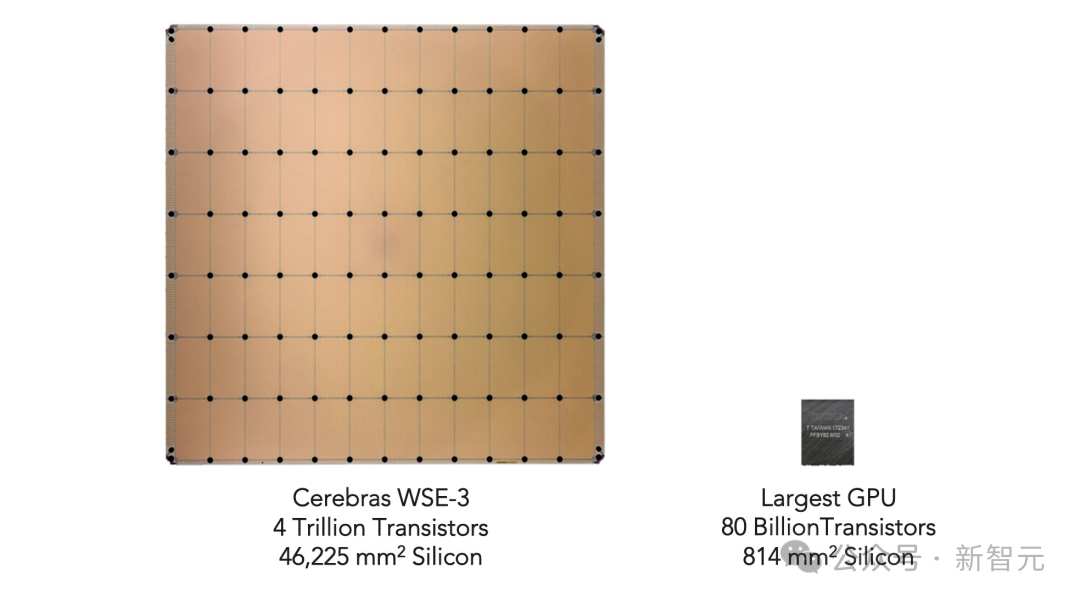
It is well known that Cerebras's core weapon is the WSE-3 (Wafer Scale Engine 3).
A chip that fills an entire 300mm wafer, with an area of 46,225 square millimeters, roughly the size of a dinner plate.
An average chip is about 800 square millimeters, while WSE-3 is nearly 60 times that.

In terms of parameters, WSE-3 achieves crushing superiority—
40 trillion transistors (19 times that of Nvidia B200)
900,000 AI-optimized cores
125 petaflops AI computing power (28 times that of B200)
5nm process, manufactured by TSMC
While others use "multi-card parallelism" to solve computing power issues, Cerebras directly turns the entire wafer into a giant processor.
Behind this violent aesthetics is a key judgment: inference is the future battlefield of AI.
Training a large model may be sufficient to do it once.
But inference—making the model answer every question, performing every Agent task—is a continuous, non-stop demand for computing power.
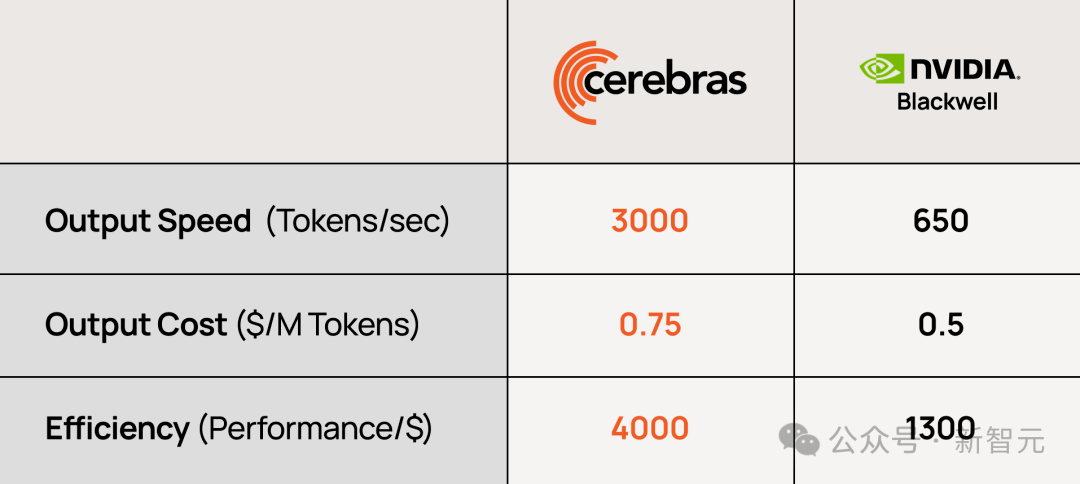
Cerebras claims that their inference speed is 10 to 20 times faster than Nvidia GPU clusters.
A tsunami of AI IPOs worth $30 trillion is on the way
It should be noted that Cerebras's IPO is just the appetizer.
The main event is still to come—
SpaceX (including xAI): A roadshow could happen as early as June, with a valuation target of $1.75 trillion, planning to allocate 30% for retail investors, which is unprecedented in IPO history.
If realized, it will be the largest IPO in human history.
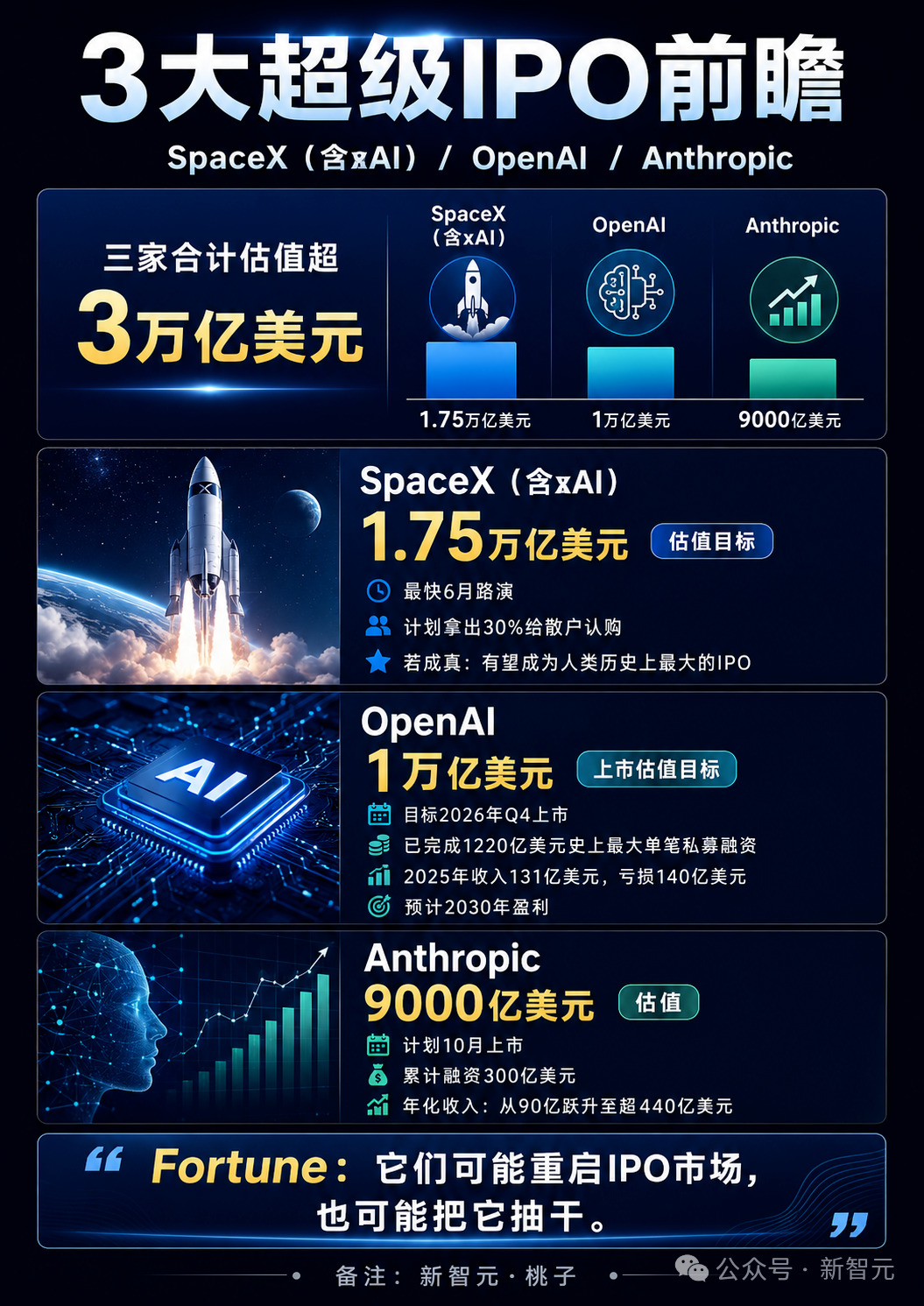
OpenAI: Aiming for an IPO in Q4 2026, targeting a valuation of $1 trillion.
Having just completed the largest single private equity financing of $122 billion in history. However, in 2025, it reported revenues of $13.1 billion but incurred losses amounting to $14 billion, without profitability expected until 2030.
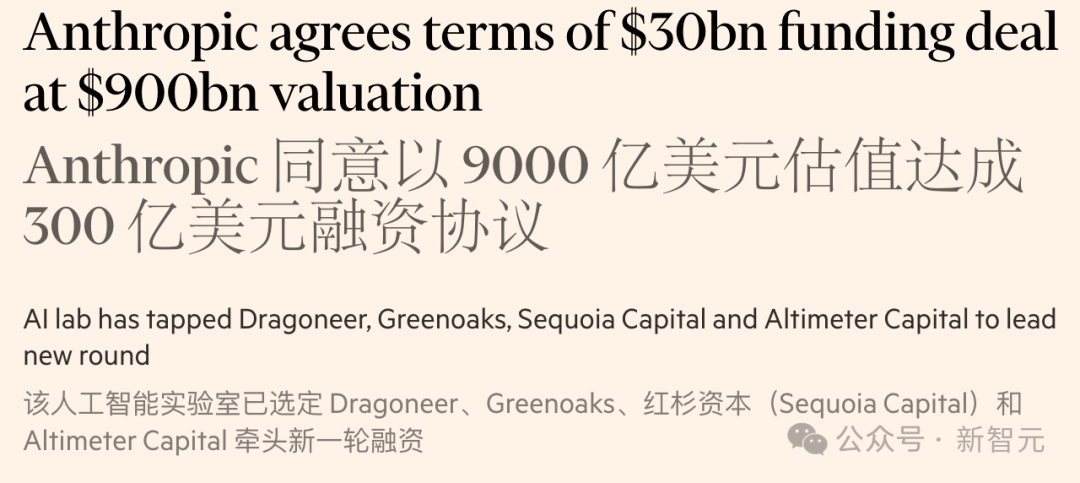
Anthropic: Planning an IPO in October, has secured $30 billion in financing, with a valuation of $900 billion, likely raising over $6 billion in its IPO.
Latest data shows its annual revenue has skyrocketed from $9 billion at the end of 2025 to over $44 billion.
The combined valuation of the three exceeds $30 trillion.
Fortune has made a bold statement: "SpaceX, OpenAI, and Anthropic may either restart the IPO market or completely drain it."
|
|
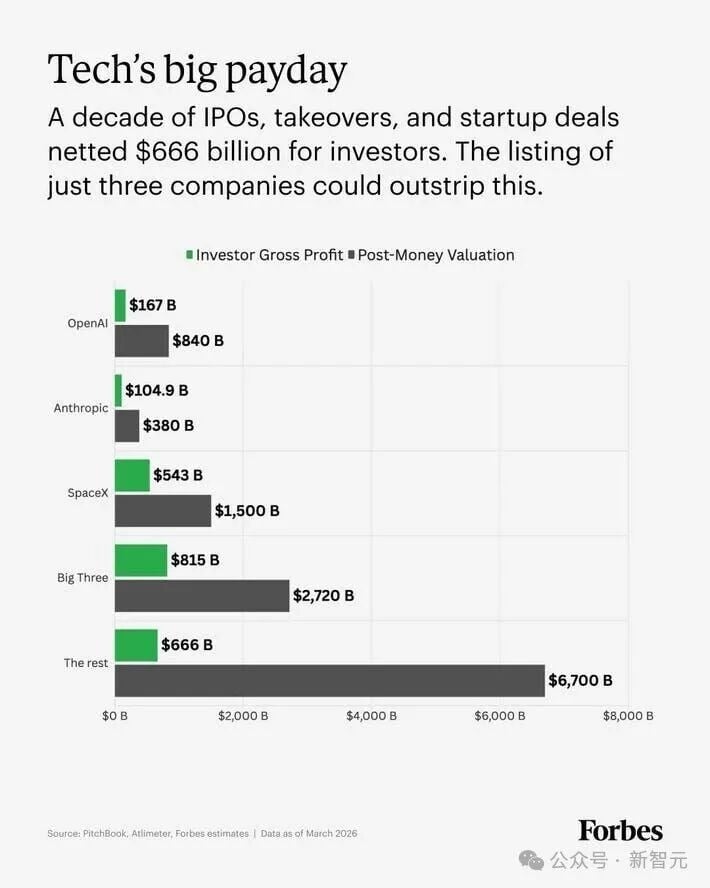
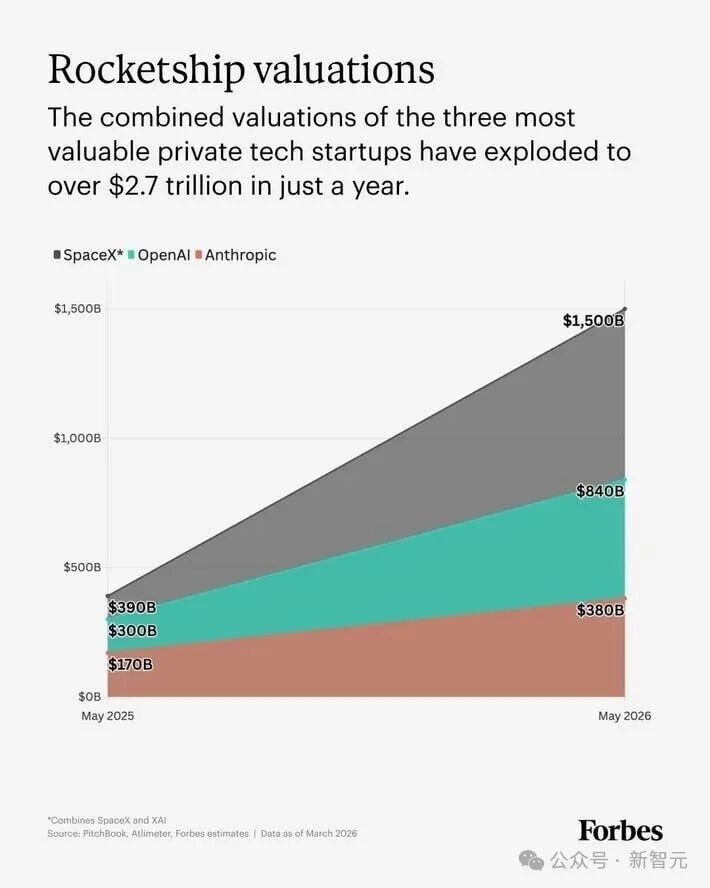
If all three companies go public within half a year, total financing could exceed $240 billion, surpassing the total IPO financing amount of most recent years in the U.S.
The final battle: When capital begins to bet on ASI
But if you think Wall Street is betting only on the financial statements of a chip company, that would be too naive.
Looking at the timeline, the story of Cerebras reveals a deeper logic: capital is betting on ASI ahead of time.
Back in 2017, Greg Brockman wrote in an email to the OpenAI team:
Owning Cerebras's hardware will give OpenAI an overwhelming advantage over Google in computing power.
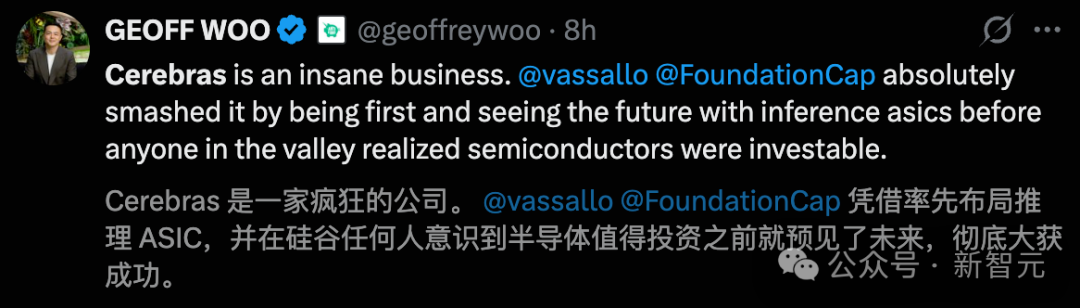
At that time, ChatGPT did not exist, and LLM was still a concept in academic papers, but OpenAI's core team clearly understood one thing:
The path to AGI and even ASI will ultimately be an arms race for computing power. As of 2026, this judgment is being crazily validated.
What this IPO is truly betting on has never been just the price-to-earnings ratio of one company.
It is betting on the next form of intelligence that humanity is building. And the scale of computing power required for this intelligence far exceeds everyone's imagination today.
When capital starts to price a 10-year-old chip company at $66 billion, when OpenAI is willing to spend $20 billion just to lock in 1/40 of the computing power gap, when SpaceX, OpenAI, and Anthropic line up for trillion-dollar IPOs—
This is humanity's civilization laying the groundwork for the arrival of superintelligence.
Whoever lays the foundation well will win the ticket to enter the ASI era. Those who hesitate will forever remain spectators.
免责声明:本文章仅代表作者个人观点,不代表本平台的立场和观点。本文章仅供信息分享,不构成对任何人的任何投资建议。用户与作者之间的任何争议,与本平台无关。如网页中刊载的文章或图片涉及侵权,请提供相关的权利证明和身份证明发送邮件到support@aicoin.com,本平台相关工作人员将会进行核查。


