Author: Raoul Pal, Macroeconomist
Translator: Felix, PANews
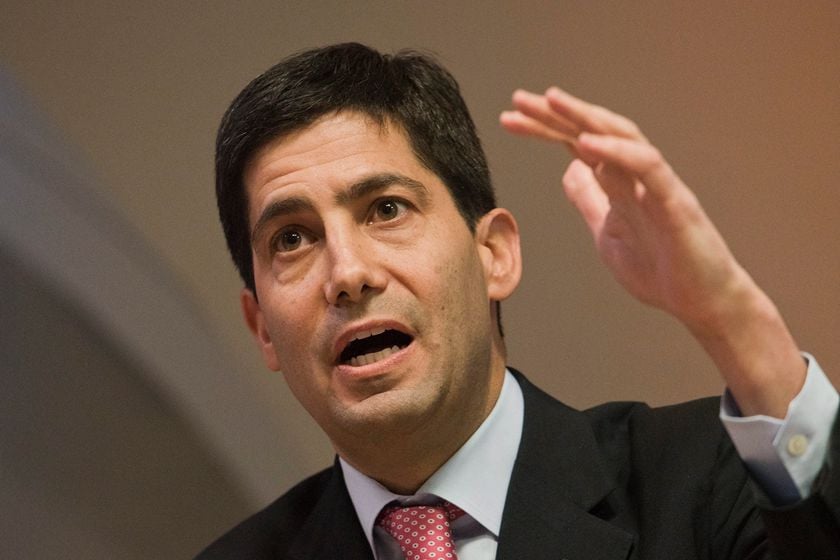
Editor's Note: The market currently generally views the new Federal Reserve Chairman Kevin Walsh as a "puppet" of Trump, but macroeconomist Raoul Pal analyzes that this is not the case. Walsh is the structurally optimal choice who matches the AI productivity miracle with the needs of debt management. How did Raoul Pal reach this conclusion? Here are the details.
This is just the surface and not the whole story. The real story is much more complex, but almost no one interprets it correctly. To see the truth, you must stop evaluating this vote through the lens of left and right battles, and instead ask another question: Who chose Walsh? What were their reasons for choosing him? What does this mean for the market in the next two years?
Why Walsh?
I want to approach this from an unusual angle, as the framework is crucial.
They are manifestations of the same gradient in different dimensions. Countries and alliances that align with this gradient will achieve compound growth. Those that oppose it will face decline.
Kevin Walsh is the candidate for Federal Reserve Chairman with the deepest personal experience regarding this trend. For most of the past decade, he has not been a central bank official but a director and technology investor. He has served on multiple boards and invested in AI infrastructure as a private investor. He has personally participated in the construction of AI infrastructure rather than merely understanding the situation through Federal Open Market Committee (FOMC) briefings. Walsh states that he believes the flourishing of productivity will lead America to win the 21st century, which is not an optimistic forecast but a firm belief based on outcomes he has witnessed firsthand and invested in as an investor.
This makes Walsh a candidate who fits the "first law." He is a pragmatist whose public beliefs and personal investment portfolio point toward the same goal: to keep the fastest-growing channel of intelligence compound growth open.
Walsh's Remarks
Greenspan's Strategy is the Real Template
Here are Greenspan's actions between 1996 and 2000. The economy was overheating, and unemployment was below the natural rate as defined by traditional models. There was a brief spike in overall CPI due to fluctuations in oil and food prices during this period. The key data point is that the core inflation rate, excluding food and energy prices, did not accelerate in the context as predicted by the Phillips curve. Greenspan analyzed productivity data and concluded that a structural change was occurring.
Benton and Trump hope to replicate this action from 2026 to 2030. AI equates to the IT cycle but at a much larger scale. AI capital expenditure is multiples of the tech capital expenditure of the late '90s. If the wave of productivity is real, the Federal Reserve could adopt a more accommodative policy than traditional models predict because even if the economy overheats, productivity can suppress unit labor costs. A slight rate cut, with no need for aggressive measures, allows productivity to fill the gap, achieving a deflationary effect that rate hikes cannot accomplish.
The script of Greenspan only works if the operator executing it truly believes in the existence of the productivity miracle. This is the test. Powell's belief is not deep enough. Waller might interpret data, but he will not have the investment faith that Walsh possesses. Walsh is the only available candidate who has personally bet on it.
Why Must This Happen?
This practice works in a world where foreign buyers are structurally overexposed to dollars. But in this world, China has been a net seller of government bonds for years, and Japan has faced a very different situation by holding significant amounts of bonds that cannot expand efficiently to counteract currency weakness. Long-term yields have continued to rise, the term premium has widened, and the cost of refinancing debt is growing faster than economic growth. Each year's situation becomes increasingly complex.
The framework that is currently being constructed is essentially a financial repression scheme dressed in modern institutional clothing, integrated with Greenspan's productivity bets, allowing it to sustain itself socially. The Treasury issues bonds at the front end of the yield curve, which lacks structural elasticity of demand. Banks are restructuring their balance sheets under the new regulatory framework to absorb duration at the back end. The Federal Reserve's stance is not to aggressively raise rates to counter this structure. Stablecoin issuers incorporate hundreds of billions of government bonds into their reserves. The dollar depreciates enough to attract foreign duration buying to complete the entire scheme.
Benton's Work on the International Stage
The framework requires foreign buyers to absorb a significant portion of long-term government bonds to achieve acceptable real yields on rollovers. Foreign buyers will only intervene if three conditions are met:
- The dollar must weaken rather than strengthen; otherwise, they will incur forex losses.
- They must have strategic reasons beyond yield to hold U.S. government bonds, as the yield alone cannot justify taking on foreign exchange risk.
- They need an institutional channel to reinvest excess dollars back into U.S. government bonds.
This is where Walsh and Benton coordinate, and this is the essence of the Treasury-Federal Reserve agreement that Walsh repeatedly mentions. Benton ensures the foreign duration demand for bonds through bilateral arrangements and foreign exchange management. Walsh ensures that the Federal Reserve's policy does not disrupt this bidding due to excessive tightening. If the Federal Reserve adopts a tight monetary policy, actual U.S. yields will rise, and foreign holders will face more significant currency losses, making it harder to achieve foreign duration bidding. If the Federal Reserve pursues an accommodative monetary policy, actual U.S. yields will decline, the dollar will weaken, and foreign buyers can absorb U.S. government bonds under acceptable conditions. This agreement is a institutional document allowing the Federal Reserve to pursue the latter policy rather than the former.
Funding Coalition
The Trump administration is the operator. Treasury Secretary Benton is the builder of the international-level architecture. Federal Reserve Chairman Walsh is the institutional anchor on the domestic level. The Republican-controlled Senate is the formal execution mechanism. And the funding coalition is a deeper support beneath all of this.
This Means for the Market
The inaugural Federal Open Market Committee (FOMC) meeting under Walsh will take place from June 16 to 17. Given high energy prices and an overall CPI rise of over 4%, any rash rate cut would likely cause him to lose credibility immediately. Therefore, there will be no rate cut at this meeting. The meeting will send a signal, and that signal will be more specific than the media expects. Walsh will begin to shift the institutional focus from overall CPI to core CPI and describe the energy price surge triggered by Iran as temporary, which is the intended meaning of the term "transitory." He will imply that the 2% target has more room for maneuver than the market currently expects, considering it as a long-term average rather than a hard ceiling that must be followed by every month's CPI data. He will loosen forward guidance. He will take a more flexible tone regarding measures. He will almost certainly initiate a formal review of the monetary policy framework with a target for completion in 2027. None of this is a rate cut. All of these are adjustments within the institution intended to let future rate cut actions not be interpreted as capitulation by the bond market.
There is one variable that could overturn the entire scenario. It is not Walsh's policy preferences but the bond market itself.
This is why the next six months are so crucial. This period will determine whether the bond market provides the new Federal Reserve Chairman with the space to build a new system or does not provide that space. If the bond market provides space, this cycle could extend at least until 2027, and possibly into 2028. Risk assets will compound growth. Cryptocurrency and AI capital expenditure assets will be the biggest beneficiaries. If in the next six months the bond market rebounds due to high inflation data, the system could collapse before it officially operates.
First, Walsh is not as the media reports. He is not Trump's "puppet." Structurally, he is the most suitable person to execute their actual plans. Their goal is to run Greenspan's late 1990s policies based on the financial repression framework from 1946 to 1955, using AI to replace the IT cycle as the productivity engine. The truly important qualification is his background as a technology investor, not the record during his tenure as a Federal Reserve governor from 2006 to 2011. He has long awaited the occurrence of this miracle.
Third, the real test is not Walsh's first FOMC meeting but the bond market's performance over the next two quarters. Watch closely for the yields on ten-year government bonds, term premiums, and real yields. These variables will determine whether this framework can successfully operate or ultimately collapse.
Further reading: The Richest Federal Reserve Chairman in History? Three Challenges Kevin Walsh is About to Face
免责声明:本文章仅代表作者个人观点,不代表本平台的立场和观点。本文章仅供信息分享,不构成对任何人的任何投资建议。用户与作者之间的任何争议,与本平台无关。如网页中刊载的文章或图片涉及侵权,请提供相关的权利证明和身份证明发送邮件到support@aicoin.com,本平台相关工作人员将会进行核查。


