A revolution in blockchain is unfolding in critical areas outside of the public eye.
Author: Anna Irrera, Bloomberg
Translation: Chopper, Foresight News
JPMorgan has invested hundreds of millions of dollars over a decade to develop blockchain systems, an innovation previously believed to potentially upend the financial markets, which has yet to spark significant industry change. However, now, in a key area, banks and blockchain technology are making substantial breakthroughs: the repurchase market.
With a scale of nearly $13 trillion, the repurchase market is not the shiniest track on Wall Street, but it is a financial artery that supports global capital circulation. A repurchase agreement, simply put, is when institutions borrow cash by using government bonds as collateral, mostly for overnight short-term trades. It provides underlying short-term funding support for trading, settlement, and market-making activities across the financial system.
Currently, JPMorgan and its Wall Street peers have found that the blockchain technology underlying cryptocurrencies is highly compatible with repurchase transactions. It enables precise, customizable transactions, allowing funds and collateral to circulate faster and with greater flexibility, helping traders activate idle funds and enhance capital efficiency, while also hedging market risks.

JPMorgan's Global Head of Digital Markets, Eddie Wen, stated, "The logic of applying blockchain solutions to repurchase transactions is perfectly valid." JPMorgan is one of the largest banks in the repurchase transaction field, and Eddie added that clients are using this product daily.
Six years ago, JPMorgan officially launched its blockchain-based financing product. To date, this platform has processed approximately $30 trillion in repurchase transactions. Currently, the platform handles client repurchase financing amounts reaching hundreds of millions of dollars daily, with an average daily cross-departmental trading volume within JPMorgan of about $5 billion.
For this traditional giant, which sees daily trading volumes in the repurchase market reaching hundreds of billions of dollars, this volume may still be small, but it marks a crucial step for industry leaders to officially embrace blockchain technology.
The Entire Industry Is Flocking to Tokenized Repurchase
In addition to JPMorgan, HSBC, market makers DRW Holdings, Virtu Financial, as well as financial infrastructure service provider Broadridge and trading platform Tradeweb are collectively ramping up efforts in the tokenized repurchase sector. Currently, major blockchain platforms are seeing daily tokenized repurchase transaction volumes reaching hundreds of billions of dollars. Although each institution's participation depth and trading frequency vary, entering the field has become a consensus within the industry.
Objectively speaking, the market will not undergo a complete transformation overnight, and there remains a significant gap between the scale of blockchain-based repurchase transactions and the traditional market. For widespread adoption, more banks, traders, and financial infrastructure service providers must adopt compatible systems. Meanwhile, the industry also faces regulatory new rules mandating central clearing for repurchase agreements, and for the time being, most institutions still need to prioritize adapting to existing operational processes.
However, even in its early stages, the growth momentum of the sector has already taken shape. Most other blockchain applications in the capital markets remain in pilot or concept-testing stages, whereas the scale of blockchain implementation in the repurchase market has far surpassed most mainstream financial scenarios. Consequently, tokenized repurchase has become one of the most solid and potentially far-reaching applications of blockchain in traditional finance.
Elisabeth Kirby, who leads market structure at Tradeweb, which launched a blockchain repurchase platform late last year, candidly said, "This is not a proof of concept or a pilot project set aside for observation; this is a real growth track."
Why Is This Explosion Happening Now?
In the past year, tokenized repurchase transactions have significantly accelerated, bringing together multiple favorable factors. The blockchain network has transitioned from testing to actual business implementation; the regulatory acceptance of migrating repurchase business to blockchain has significantly improved, and considering the important role of institutions like the Federal Reserve during market turbulence, a flexible regulatory attitude is crucial. The friendlier digital asset policy environment during the Trump administration has also pushed Wall Street institutions to ramp up their involvement.
At the same time, an increasing number of clients are genuinely experiencing the advantages of blockchain, fundamentally shifting industry perceptions: blockchain is no longer just a niche tool for the cryptocurrency circle, but a universal financial infrastructure capable of optimizing transaction processes and reducing operational costs.
Yuval Rooz, CEO of digital asset company Digital Asset Holdings, stated, "The biggest change is that the industry is no longer concerned about whether the technology works, but is focused on how quickly it can scale for implementation." The Canton network created by the company, which includes investments from JPMorgan, Goldman Sachs, DRW, Castle Securities, and Virtu, has already become one of the most mainstream underlying blockchain infrastructures in traditional finance.
In February of this year, the Canton network completed multiple cross-border repurchase transactions using tokenized UK government bonds as collateral; its technology also supports Broadridge's distributed ledger repurchase platform, serving institutions like UBS, HSBC, and Société Générale.
Bloomberg News's parent company, Bloomberg L.P., has recently partnered with data service provider Kaiko to connect Bloomberg data to the Canton network, servicing tokenized U.S. Treasury bonds and on-chain repurchase transactions.
Operation Logic: Traditional Repurchase vs. Tokenized Repurchase
Different platform models have slight variations, but the core difference lies in how funds and securities circulate.
The traditional repurchase market has fixed opening, ordering, and closing times, with trading paused overnight and on weekends; business heavily relies on intermediaries to handle collateral and settlement processes, leading to many intermediaries and high fees; temporary changes often can only be coordinated through phone communication. Cross-border transactions can become particularly cumbersome due to mismatched time zones and holidays, with idle funds often being occupied for hours; transactions can also be interrupted or canceled due to missed deadlines, insufficient collateral, or system failures.
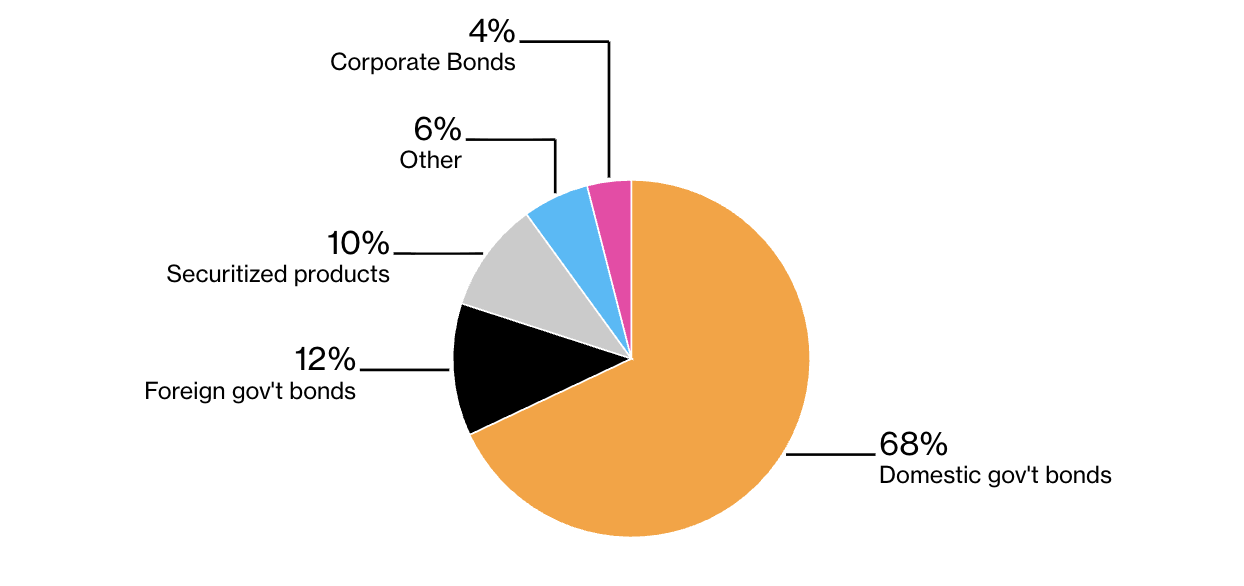
Types of collateral in global repurchase transactions
Tokenized repurchases perfectly solve the above pain points. Borrowers initiate financing needs through a digital interface, and once the funding party confirms, cash and collateral securities are all mapped as on-chain tokens; once both parties confirm, the accounting is recorded on the chain, transaction terms are automatically executed as agreed upon, and the entire process is auditable for traceability. The core advantage is the ability to trade 24/7, unrestricted by traditional business hours.
Sonali Das Theisen, Head of Electronic Trading and Market Strategy for Fixed Income, Foreign Exchange, and Commodities at Bank of America, commented, "Blockchain can effectively reduce friction in capital flows, and the industry moving in this direction is an unstoppable trend."
Tangible Benefits
For giants in the repurchase market, the implementation of blockchain can bring real financial benefits. Banks like JPMorgan not only save on transaction fees and time but also reduce capital reserves required for trading under strict regulatory frameworks.
Broadridge's latest analysis shows that if large banks migrate 15% of their repurchase business to blockchain, daily liquidity buffer funds could be reduced by 8%–17%. The specific savings depend on the institution's size, business region, asset structure, and risk preferences, but overall, it can greatly activate idle funds.
A Broadridge research report cited data from an unnamed large European bank, which requires setting aside about €1.1 billion (equivalent to $1.3 billion) daily to meet intraday liquidity needs; if buffer funds are reduced by 15%, approximately €175 million could be released for other businesses or reduce reliance on external financing.
Horacio Barakat, Global Head of Digital Innovation at Broadridge, stated, "The amount of capital savings is quite substantial; even a slight optimization can save tens of millions of dollars each year." During April, the platform's average daily repurchase transaction volume reached $368 billion, with monthly volumes approaching $8 trillion, representing a 268% increase from last year.
The industry ecosystem is also beginning to move towards unification. Wall Street's core clearing agency, DTCC, recently announced that it would tokenize highly liquid assets under its custody, covering U.S. Treasuries, Russell 1000 constituents, and ETFs. This move will greatly expand the pool of eligible collateral for tokenized repurchase, allowing institutions to directly reuse existing custody assets to access blockchain ledgers, significantly lowering entry barriers.
Supporting 24/7 Trading of Traditional Assets
Industry insiders believe that new financing models like tokenized repurchase are important supports for traditional assets moving towards 24/7 trading. Nasdaq has already announced plans for around-the-clock trading, and the New York Stock Exchange is also developing a tokenized continuous trading platform.
Don Wilson, founder of DRW, pointed out, "In the future, if the market moves to 24/7 trading, we must achieve the ability to lend cash at any time, and on-chain repurchase is the core infrastructure supporting this transformation." As an early investor in Digital Asset, DRW has completed multiple tokenized transactions on the Canton network over the past year.

Don Wilson, founder of DRW
Any new technology faces the same challenges, and the large-scale application of blockchain in repurchase transactions is no exception. Although Canton has become mainstream, the industry still has multiple disconnected independent on-chain systems. Institutions need to adapt to multiple platforms, invest a lot of human resources in operations and maintenance, and trading volumes are fragmented; additionally, blockchain systems have not yet experienced a complete market cycle or extreme stress testing. The traditional repurchase market has faced multiple risk shocks since 2008, while on-chain systems have yet to be tested in real scenarios such as late-night sudden failures or extreme market volatility.
Moreover, traditional traders are already accustomed to existing inefficient but mature processes, where rules, error tolerance mechanisms, and emergency plans have become routine; in contrast, on-chain transactions follow code as rules, leaving no room for flexibility.
Sandy Kaul, Head of Innovation at asset management giant Franklin Templeton, admitted, "Traditional business leaves a lot of flexible buffers, while on-chain has absolutely no error tolerance; everything is written in the code, and there's no way to negotiate for a few more minutes of grace."
Even so, the industry generally believes these are just landing issues to be resolved, rather than reasons for regression. "We are at a crucial turning point; the entry of blockchain into the traditional financial repurchase market is officially beginning."
免责声明:本文章仅代表作者个人观点,不代表本平台的立场和观点。本文章仅供信息分享,不构成对任何人的任何投资建议。用户与作者之间的任何争议,与本平台无关。如网页中刊载的文章或图片涉及侵权,请提供相关的权利证明和身份证明发送邮件到support@aicoin.com,本平台相关工作人员将会进行核查。


