
Author: Nancy, PANews
On the evening of May 11, a conventional financial report was used by Circle to tell a future story that excited the market.
The night before the release of Circle's financial report, investors were quite anxious. On one hand, the CLARITY Act was about to challenge the Senate, and the provisions restricting interest on stablecoins could impact Circle's business model. On the other hand, with the upcoming change of the Federal Reserve Chairman, expectations for interest rate cuts were rising, which might gradually end the high-interest dividend period for stablecoins.
However, with the heavyweight narrative of the AI agency economy and the ARC stablecoin public chain, Circle quickly shifted market attention from current performance to growth expectations, successfully igniting market sentiment and driving a significant rise in stock prices.
USDC continues to capture market share, but interest rate benefits have begun to decline
According to the financial report, Circle's revenue in the first quarter reached $694 million, a year-on-year increase of 20%, but below Wall Street's expected $715 million; adjusted EBITDA was $151 million, up 24% year-on-year.
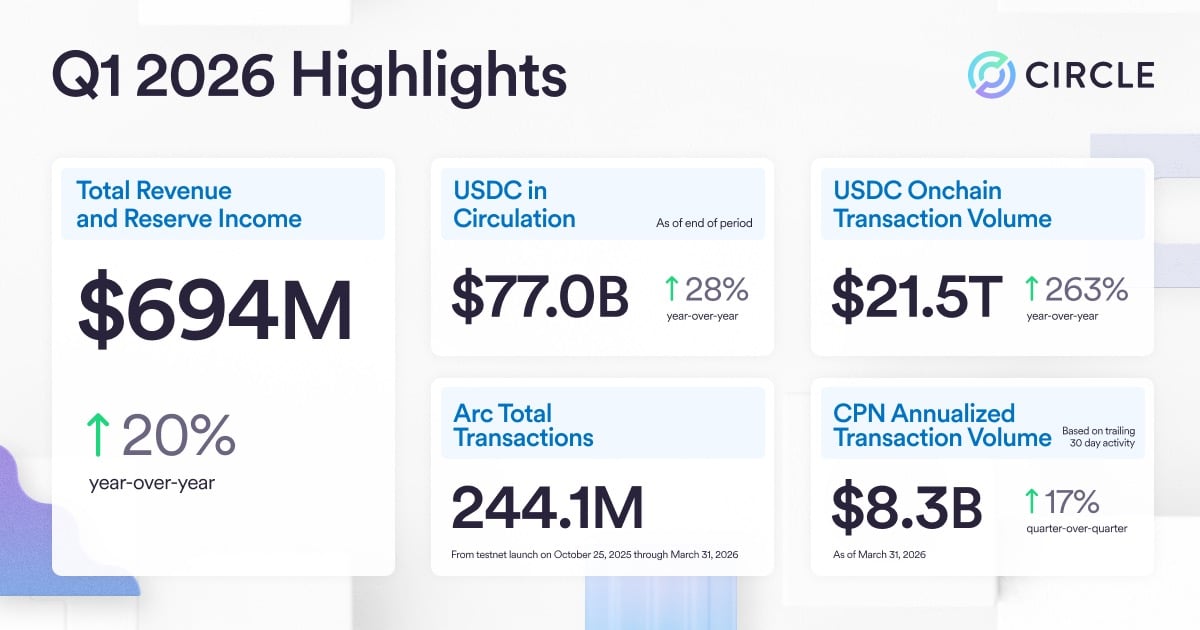
Despite strong growth in its core business, Circle's net profit in this quarter fell 15% year-on-year to $55 million. The profit pressure primarily came from a significant increase in operating expenses, which rose 76% to $242 million, mainly due to a substantial rise in stock-based compensation and related payroll tax expenses after the IPO. However, diluted earnings per share (EPS) reached $0.21, exceeding analysts' expectation of $0.17.
From a core business perspective, USDC continues to act as the growth engine. In the first quarter, the circulation of USDC reached $77 billion, a year-on-year increase of 28%; on-chain transaction volume soared to $21.5 trillion in a single quarter, a staggering increase of 263%; the USDC holdings on the platform reached $13.7 billion, a year-on-year increase of 254%.
It is noteworthy that, according to an analysis by Mizuho Securities in March this year, USDC has surpassed Tether's USDT in transaction volume for the first time, with the former's adjusted transaction volume at approximately $2.2 trillion, compared to $1.3 trillion for the latter. Visa also disclosed data stating that USDC continues to gain market share in the stablecoin trading market, currently accounting for 63% of all stablecoin transactions.
Thanks to the expansion of USDC, Circle's reserve income reached $653 million, a year-on-year increase of 17%, accounting for 94% of Circle's total revenue. However, affected by the downward interest rates, the reserve return rate decreased by 66 basis points year-on-year to 3.5%. This indicates that although USDC's scale continues to grow, the yield contribution per USDC is declining.
At the same time, USDC's growth has also driven up distribution costs. Distribution and trading costs in this quarter reached $405 million, a year-on-year increase of 17%, still the largest expense item for Circle. The partnership with Coinbase remains the main distribution channel. According to Coinbase's Chief Financial Officer Alesia Haas, during a Coinbase earnings call, the collaboration agreement automatically renews every three years and is permanently valid and irrevocable.
Top institutions form a group with a $3 billion valuation, ARC specifies airdrop plan
Market attention has shifted from Circle's quarterly data to its future narrative. To break away from the overly reliant single growth model of USDC reserve interest income, Circle is actively building a diversified income structure, of which ARC is a core component.
As an institution-level Layer 1 public chain designed specifically for stablecoin finance under Circle, ARC focuses on services for payment, foreign exchange, asset tokenization, capital markets, and AI agency economy scenarios. Its core positioning is as an internet-native economic operating system, aiming to become the foundational infrastructure for global on-chain finance. This L1 natively uses USDC as a gas token, is EVM-compatible, supports sub-second settlements and configurable privacy features, and cross-chain transfers are completed through Circle's CCTP.
According to the white paper, ARC's initial supply is set at 10 billion tokens, of which 60% will be used for the ecosystem, specifically including token sales, developer incentives, airdrops, and other network growth plans, 25% for operational validator infrastructure and generating staking rewards, and the remaining 15% allocated to long-term reserves, with an initial annual inflation rate set at 2-3%. The ARC mainnet is expected to launch in the summer of 2026, and the testnet was activated in October 2025, having processed 244.1 million transactions as of May 5.
The reason ARC is issuing its ARC token, according to official disclosure, is that although USDC is suitable as a medium of exchange and asset swapping, it cannot effectively coordinate the incentives and alignment of long-term network participants. Therefore, ARC is designed as a native coordination layer for the protocol, aimed at aligning the long-term interests of validators, developers, institutions, and other participants, supporting network governance, economic rule enforcement, and ecological incentives.
Currently, according to the latest report from CNBC, the ARC token has completed pre-sale financing of $222 million, with a fully diluted valuation of approximately $3 billion. This valuation is nearly three times the current FDV of the Plasma L1 supported by Tether.
Moreover, the investment lineup is quite impressive, with a16z leading with $75 million, joined by top institutions like BlackRock, Apollo Funds, Intercontinental Exchange (ICE), SBI Group, Janus Henderson, Standard Chartered Ventures, General Catalyst, Marshall Wace, ARK Invest, IDG Capital, Haun Ventures, and Bullish. This also makes Circle the first publicly traded company to conduct a token pre-sale.
Behind the high valuation and top endorsement is the market pricing of multiple certainties. On one hand, ARC directly enters the growth track of stablecoin infrastructure; on the other hand, it comes from market pricing regarding gradually clarified regulations, the expansion of USDC's scale, and Circle's compliance capabilities.
A16z Crypto pointed out in explaining its investment logic that currently most blockchain infrastructure still serves crypto-native users and individual developers, lacking native support capabilities for large institutional demands. The reason for participating in the ecological construction related to the ARC token is mainly that as global finance gradually moves on-chain, in the future, only a few public chains will be able to support the foundation of on-chain economic systems.
Additionally, Circle also stated in the latest financial report that this quarter’s performance does not yet include ARC-related token sales, ecological incentives, and potential revenue contributions, and will update the latest profit guidance including ARC in the next financial report, expecting it to have a significant positive impact on revenue, profit margins, and EBITDA. This suggests that ARC can become a new growth curve in Circle's future finances.
Building a financial operating system for the AI agency economy
AI is another key battlefield for Circle's strategic transformation.
According to reports, Circle’s Circle Agent Stack provides native infrastructure support for the rapidly rising AI agency economy. It allows AI agents to hold assets, discover services, execute transactions independently, with USDC as the core settlement currency. Meanwhile, the system incorporates permission management, expenditure controls, and compliance safeguards to fundamentally solve problems related to manual key management, security risks, and human intervention.
The Circle Agent Stack has officially launched, consisting mainly of five core modules: Agent Wallets allow AI agents to build on-chain wallets, conduct transactions, access USDC, and operate under preset policies and security safeguards; Agent Market allows both humans and AI agents to browse, evaluate, and programmatically integrate services; Circle CLI is a command line tool for developers and AI agents, enabling quick wallet creation, policy definition, service discovery, and transaction execution; Circle Gateway powered Nanopayments supports fee-free, high-frequency transfers as low as 0.000001 USDC, designed specifically for machine-to-machine (M2M) payments, and integrates the x402 protocol; Circle Skills provides coding tools and best practices for AI integration with Circle infrastructure.
The launch of the Agent Stack marks an important step for Circle in expanding towards an AI financial operating system. Citibank noted in related research that this product reinforces Circle's transition from a single stablecoin issuer to a provider of agency economy infrastructure.
Increased by nearly 60% this year, the market casts a confidence vote
The market chose to pay for the story first. After the financial report was released, Circle's stock price soared nearly 16% during trading on Monday, approaching the high point of March this year, with a year-to-date cumulative increase of over 57.8%. As per the latest data, CRCL’s market capitalization reached $32.572 billion.
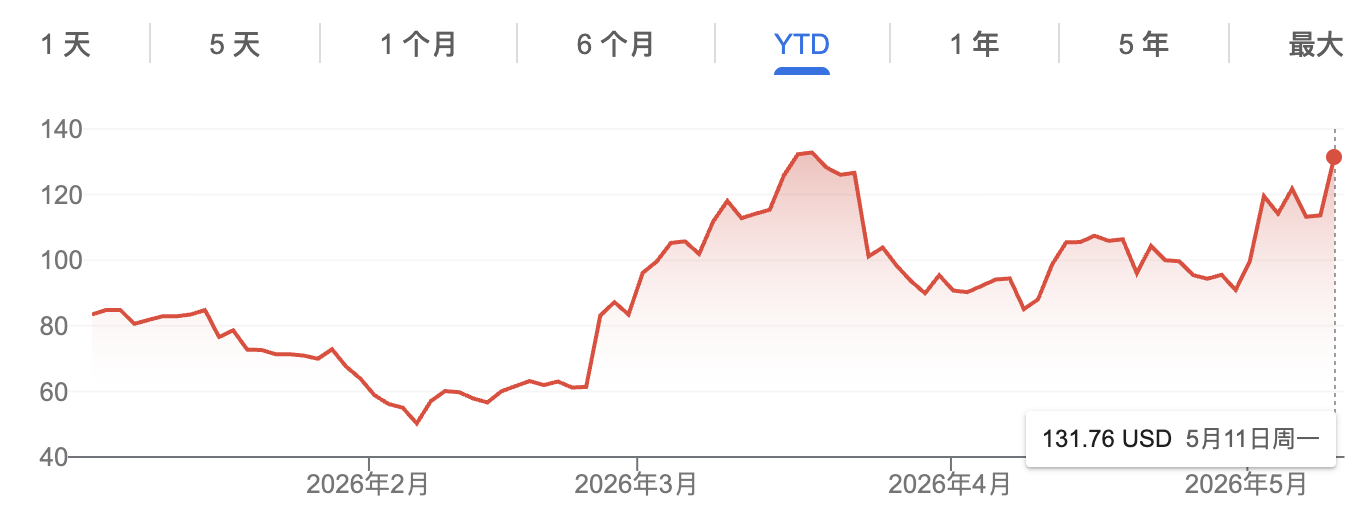
As a hot stock in the stablecoin concept, Circle is also receiving a confidence vote from the market. For example, Cathie Wood's Ark Invest recently bought approximately $5.5 million of Circle Internet Group stock through three ETFs: ARKK, ARKW, and ARKF, totaling 41,904 shares. ARK has been increasing its position multiple times during the previous stock price correction phase, and Circle has now become the sixth largest holding in the ARKK ETF, with a weight of 4.6%, corresponding to a market value of about $306.5 million.
Well-known domestic investor and Chairman of Dongfang Harbor, Dan Bin, also recently stated that he has built a position in CRCL. He believes that one of the core catalytic factors for the increase is the imminent key progress of the CLARITY Act in the U.S. This Act is seen as an important legislative branch to promote the implementation of a crypto regulatory framework, which may help alleviate the long-term regulatory uncertainty in the industry and open up long-term growth space for compliant stablecoin leaders like Circle. Additionally, Circle’s core business is entering an explosive period, with USDC circulation surpassing $79 billion, setting a new historical high. With the growth of reserve asset interest income, the company’s profit expectations for the first quarter of 2026 are clear, and the business fundamentals continue to solidify.
Although the strategic transformation direction is clear, Circle still heavily relies on USDC reserve interest income, and the transition to programmable payments and L1 infrastructure is still in its early stages, without forming a scalable, predictable growth curve. Whether the current high valuation ceiling can truly be opened remains to be seen over time.
免责声明:本文章仅代表作者个人观点,不代表本平台的立场和观点。本文章仅供信息分享,不构成对任何人的任何投资建议。用户与作者之间的任何争议,与本平台无关。如网页中刊载的文章或图片涉及侵权,请提供相关的权利证明和身份证明发送邮件到support@aicoin.com,本平台相关工作人员将会进行核查。


