Author: Claude, Deep Tide TechFlow
Deep Tide Introduction: Last week, Bitmine, the world's largest Ethereum-holding listed company, saw its purchasing volume plummet from 100,000 coins per week to 26,000 coins, reaching a historic low for weekly purchases. However, Chairman Tom Lee's statements at Consensus 2026 are not bearish; rather, they are due to nearing the target of 5% of total supply, prompting a proactive control of the pace. Meanwhile, Ethereum spot ETFs recorded a net inflow of $356 million in April, ending a continuous five-month outflow; on-chain whales bought 140,000 ETH within 96 hours. The institutional consensus of "slow buying but continuous buying" is taking shape.
Ethereum is undergoing a rare multi-layer buying resonance.
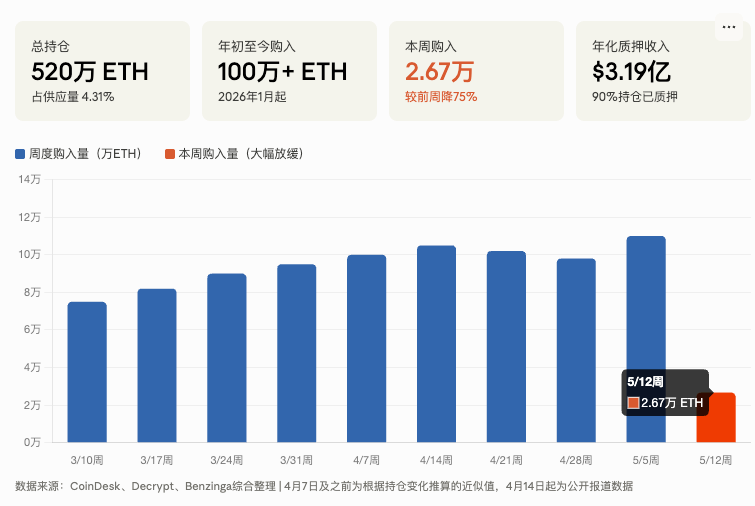
According to CoinDesk's report on May 11, Bitmine Immersion Technologies (BMNR) bought only 26,659 ETH last week, valued at approximately $63 million, a drop of about 75% from the previous weeks where the average weekly purchases exceeded 100,000 coins. This marks the lowest weekly buying volume since this Ethereum treasury company, led by Fundstrat co-founder Tom Lee, adopted its token accumulation strategy last June.
However, the reason for the slowdown is not bearish. Tom Lee stated at the Consensus 2026 conference in Miami that Bitmine is nearing its core goal of holding 5% of Ethereum's total supply, which, at the previous rate of 100,000 coins per week, would be met by mid-July. "We decided to slow down," Lee said, "because there are other things to do in the crypto world."
Bitmine: Ethereum's version of "Strategy," having accumulated over 1 million coins this year
Bitmine's aggressive accumulation of Ethereum is comparable to Strategy (formerly MicroStrategy) regarding Bitcoin. As of May 11, Bitmine holds over 5.2 million ETH, accounting for about 4.31% of Ethereum's circulating supply, with total assets reaching $13.4 billion. Since the beginning of the year, the company has accumulated over 1 million ETH.
What’s even more noteworthy is its staking layout. Bitmine has staked over 4.71 million ETH (over 90% of its holdings), which, at the current approximately 2.86% seven-day annualized yield, can generate about $319 million in staking revenue per year, equivalent to about $1 million daily. The institutional staking platform MAVAN launched earlier by the company, initially serving its treasury operations, is now planning to open up to external institutional clients.
This year, Bitmine has also directly purchased ETH from the Ethereum Foundation multiple times through over-the-counter (OTC) transactions. In March, Bitmine bought 5,000 coins at an average price of about $2,043; at the end of April, it bought 10,000 coins at an average price of $2,387; and in early May, it bought another 10,000 coins at an average price of $2,292. The three transactions totaled about $47 million, all executed through the Ethereum Foundation's Safe multi-signature wallet. The Ethereum Foundation stated that the proceeds from the sale would be used for protocol development, ecosystem development, and community grants.
Tom Lee defined the current market phase at the Consensus conference as "crypto spring." He provided a specific judgment criterion: “If ETH closes above $2,100 at the end of May, it will be the third consecutive month of increase. This trend has never occurred in previous crypto bear markets.”
ETF Fund Flow Reversal, BlackRock and Fidelity Account for 90% of Inflows
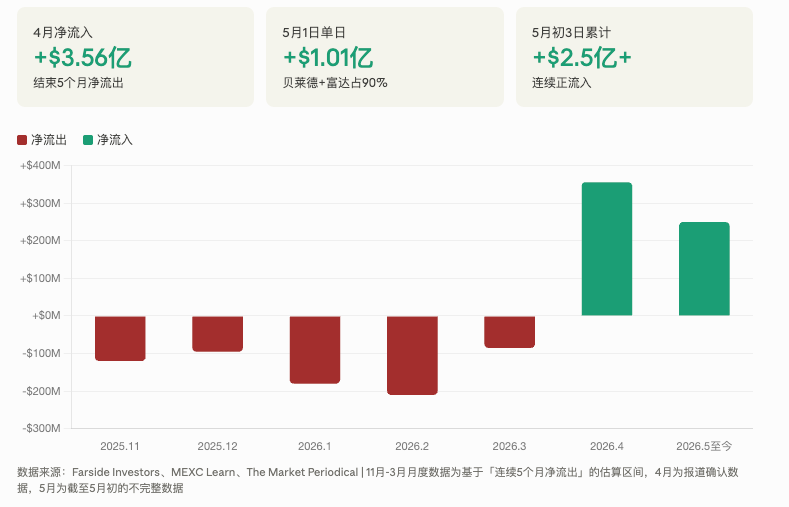
Bitmine is not the only buyer. After five months of continuous net outflows, Ethereum spot ETFs recorded a net inflow of $356 million in April, achieving a directional reversal.
According to Farside Investors data, buying accelerated further after entering May. In the first three trading days of May, the US Ethereum spot ETFs had a cumulative net inflow of over $250 million. On May 1 alone, the inflow reached $101.2 million, with BlackRock's iShares Ethereum Trust (ETHA) contributing about $69.48 million, and Fidelity's FETH contributing about $49.4 million, together accounting for over 90% of the day's inflows.
BlackRock is also operating a staking Ethereum product, ETHB, which had a net inflow of about $2.45 million on May 5. However, most small and medium-sized Ethereum ETF products recorded zero net inflow during the same period, indicating a high concentration of funds in leading issuers.
The significance of ETF fund flows lies in their mechanical nature: every dollar of net inflow requires the fund to buy a corresponding quantity of spot ETH in the open market, directly reducing the available supply in circulation. This structural buying overlaps with Bitmine's bulk accumulation to create a cumulative effect.
However, ETF fund flow is not a one-way street. In early May, Ethereum spot ETFs experienced a net outflow of about $75.9 million in a single day, ending a prior streak of ten consecutive days of net inflows. Institutional sentiment remains divided rather than overwhelmingly bullish.
On-chain Whales Bought $322 Million in 96 Hours, But Large Holders Are Also Selling
On-chain data provides another dimension.
According to on-chain analyst Ali Martinez's monitoring, from May 1 to 3, whale wallets holding large amounts of ETH net bought over 140,000 ETH within 96 hours, valued at about $322 million. The total holdings of these whales increased from about 13.78 million to about 13.98 million.
Arkham Intelligence also identified two newly created whale wallets that withdrew about $94.6 million in ETH from Kraken exchange, showing trading patterns highly similar to Bitmine's previous on-chain activities, although this has not been officially confirmed.
However, selling is also ongoing. According to on-chain tracking platform Lookonchain, Bitcoin OG Garrett Jin deposited about 578,000 ETH into Binance over four days in early May, indicating a potential loss of about $1.3 billion at the time. This suggests that there are real divergences in sentiment among institutions, and not all large holders are betting in the same direction.
Control Group: Strategy Suggests Possible Bitcoin Sales
Putting Bitmine in the larger picture of crypto treasury companies, its "slow but continuous buying" stance stands out sharply.
As the largest publicly traded Bitcoin holding company, Strategy (MSTR) hinted this week that it might sell some Bitcoin to meet dividend obligations. Executive Chairman Michael Saylor's statement contrasts sharply with Tom Lee's strategy of "slowing down but continuing to hold." Bitmine emphasizes maintaining operations through staking income and cash reserves, without being forced to liquidate crypto holdings in a volatile market.
Bitmine currently holds about 201 BTC and approximately $775 million in cash and equity investments, with its business line expanding from purely an Ethereum treasury to institutional staking services and AI investments. Lee stated at the Consensus conference that the company’s strategy is now built on three pillars: Ethereum treasury, institutional staking operations, and investments related to AI and the creator economy.
免责声明:本文章仅代表作者个人观点,不代表本平台的立场和观点。本文章仅供信息分享,不构成对任何人的任何投资建议。用户与作者之间的任何争议,与本平台无关。如网页中刊载的文章或图片涉及侵权,请提供相关的权利证明和身份证明发送邮件到support@aicoin.com,本平台相关工作人员将会进行核查。


