Kalshi and Polymarket's survival crisis: Robinhood is entering the prediction market + full asset integration, building an unreplicable distribution moat.
Written by: @Decentralisedco
Translated by: AididiaoJP, Foresight News
In a previous article, we explored how HIP-4 brings structured products to Hyperliquid. Robinhood is also operating similarly by recently entering the prediction market, and the following table provides some background.
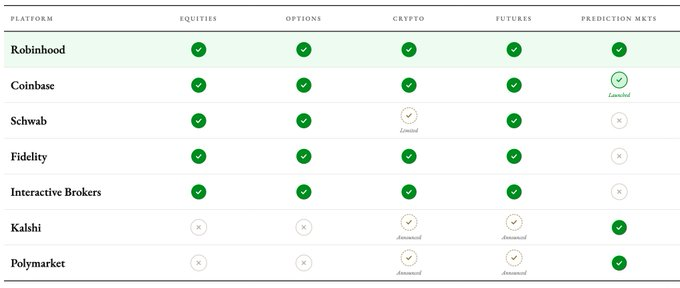
Fidelity, Schwab, and Interactive Brokers grew up in an era before prediction markets existed. Even spot cryptocurrencies only make up a small fraction of their overall products. In contrast, Robinhood serves a younger demographic that may want to bet on sports events, go long on semiconductor stocks, trade Solana frequently, while holding crude oil positions in the futures market. A generation that grew up "monitoring the situation" will move to platforms like Polymarket or Kalshi if Robinhood cannot provide the same risk assets.
One way to mitigate this risk is by offering event contracts. These are binary tools that settle with a "yes" or "no" outcome. Each contract is priced between $0 and $1, reflecting the market's real-time probability of the event occurring. If you judge correctly, the contract settles at $1; if incorrect, it settles at $0. The cost to users upon entry reflects the probability of the event occurring. For example, a $0.60 contract for the Strait of Hormuz open before May 30 indicates the market's belief. If most people are confident something will happen, the profit potential from that event becomes minimal.
On Robinhood, these tools can serve as hedging instruments. You can go long on the Strait of Hormuz while also going long on crude oil prices, assuming that if the strait does not open, oil prices will remain high.
Robinhood launched its prediction market business in March 2025, providing routing services for customers through KalshiEX. Within nine months, users had traded 12 billion contracts, with approximately 70% of the annual trading volume concentrated in the fourth quarter. In the first quarter of 2026, Robinhood recorded 8.8 billion event contracts.
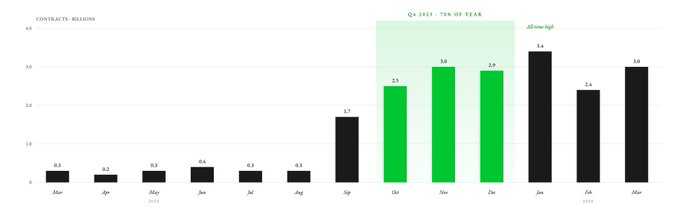
In 2025, more than 1 million Robinhood customers traded event contracts. Robinhood did not launch these markets and establish liquidity on its own but directly integrated Kalshi's prediction market. Robinhood acts as a distribution layer by providing dashboards for its customers. The entire infrastructure is currently supported by Kalshi (to be detailed later).
Kalshi and Polymarket dominate the market, accounting for over 90% of the total trading volume in the prediction market. Robinhood distributes Kalshi's contracts to its 27.4 million paying users, who invest across various asset classes including stocks, cryptocurrencies, futures, options, and others. Kalshi is merely a prediction market platform that cannot compete with this distribution capability.
In fact, Robinhood contributed 50% of Kalshi's trading volume in its first year.
While Coinbase allows users to trade stocks, cryptocurrencies, futures, and options (via the acquisition of Deribit), it only launched its prediction market in January this year. In contrast, Robinhood's prediction market business has been operational for over a year, generating annual revenues exceeding $415 million. Robinhood's monthly active user count also far exceeds Coinbase's, reaching 13.5 million compared to Coinbase's 9.2 million.
Prediction markets can further evolve on Robinhood. Currently, they exist as a standalone hub within the app, disconnected from other parts of the platform. But soon, they can be cross-linked with assets such as stocks, options, and cryptocurrencies—Robinhood's stock traders could directly purchase prediction market event contracts.
Imagine you're on Nvidia's stock page before its earnings report. You would see the usual information: the stock price and options chain. But now, you'd also see an event contract beside it: "Will Nvidia exceed Q2 revenue expectations?" The contract trades at $0.72, implying the market believes there is a 72% chance it will exceed expectations. You think the market is underestimating the demand for Nvidia's products.
In this case, Robinhood allows you to buy stocks, buy call options, or purchase 500 "Yes" contracts for $360—if you judge correctly, you can earn a profit of $140 ($0.28 profit per contract × 500 contracts).
Robinhood puts these three tools on the same screen, eliminating the need to switch tabs.
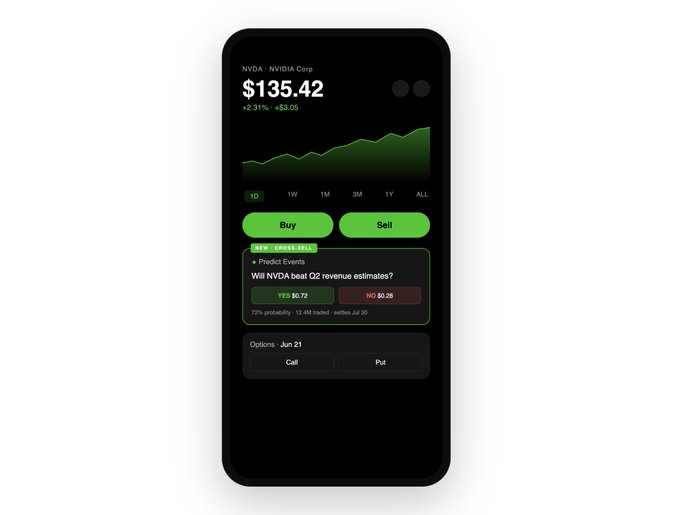
Just like in the crude oil example, you can also use these tools to hedge your positions. You can bet that Nvidia will exceed expectations while shorting the stock to hedge your prediction market bet. Therefore, Robinhood allows you to create cross-asset hedging strategies on the same screen in under a minute.
So far, this integration on the stock trading page has worked well for Robinhood, but it is still leaving money on the table. That is about to change, as Robinhood is poised to take the next step.
Richer information pricing context
Robinhood's moat lies in providing all relevant information at the exact time and place users need it. The era of buying Bitcoin on Coinbase, trading options on Deribit, holding stocks on Robinhood, and trading crude oil futures with IBKR is over. Users want to avoid switching contexts and platforms.
Once Robinhood embeds prediction markets into all asset pages, it transforms from a passive brokerage into an information pricing platform. In addition to prices and analyst ratings, Robinhood will provide real-time probability markets for relevant events affecting that stock. Event contracts reflect real-time consensus among participants who have real money at stake. These contracts can help users make better decisions, even if they have never traded a prediction market contract before.
Take Nvidia as an example. Stock prices at any moment reflect the sentiments of those holding the underlying equity. Accompanying the equity are legal rights, shareholder reports, analyst questions, and a framework developed over 400 years to protect investors. But most of the time, traders may not care about these aspects. The information they want to price might simply be "Will Nvidia exceed revenue expectations?" In such cases, prediction markets can arguably provide better pricing information than stock prices. Robinhood's attempt to integrate derivatives, event contracts, and equities under one roof is for the purpose of capturing value from all possible users interested in trading that event.
But Polymarket and Kalshi have been doing this for many years; where is Robinhood's moat? Why not simply integrate third-party markets into its interface to increase revenue rather than own these markets? Cross-selling and trading volumes can more clearly showcase the incentive mechanisms.
Cross-selling as a regulatory moat
In March 2026, two bipartisan bills were introduced aimed at federally banning event contracts related to sports. There are also legal barriers at the state level. This poses a survival crisis for platforms like Kalshi, which derives 89% of its fee revenue from sports-related event contracts in 2025. About 60% of Polymarket's open interest also comes from sports-related event contracts.
If sports contracts face legal setbacks, Kalshi and Polymarket will be hit hardest. Without this dominant category, they cannot sustain valuations over $20 billion. While Robinhood initially started with a heavy focus on the sports market, its cross-selling capabilities enable it to diversify revenue into stocks and macro events (such as earnings reports, Federal Reserve decisions, CPI data, and employment reports).
For Robinhood, sports is just one aspect of its revenue. For Kalshi, the sports category is nearly everything. Any regulatory crackdown on sports-related markets could affect Kalshi and Polymarket's claims for valuations above $20 billion. Robinhood now occupies a higher position in its value chain through a joint venture named Rothera.
In November 2025, Robinhood established a joint venture called Rothera LLC. This venture subsequently acquired MIAXdx—a designated contract market (DCM), derivatives clearing organization (DCO), and swap execution facility (SEF) licensed by the CFTC. This fundamentally changed the economics, control, ownership, and clearing and settlement processes of event contracts.
Relying on Kalshi to provide event markets limits the types of contracts Robinhood can list in its prediction market. Rothera allows Robinhood to list any event contract at any time.
From an economic perspective, this could mean Robinhood can capture the one-cent currently given to Kalshi and double the event contract revenue. If Robinhood can funnel half of that revenue into its own entity, at the current event contract fee rate, its prediction market revenue could increase by 50%, reaching $620 million.
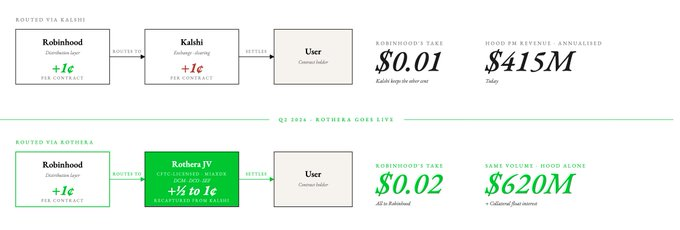
We have reasons to remain optimistic about this joint venture, as its latest quarterly performance has revealed that Robinhood has begun investing in Rothera. The first quarter of 2026 included $14 million of joint venture-related costs. There is another small benefit: once event market contracts are routed through Rothera, the collateral supporting the open positions will be counted on Robinhood's balance sheet, adding interest income to its revenue. When the collateral scale corresponding to open interest reaches about $100 million, this could add approximately $4-5 million in additional revenue annually.
Every trading platform has a simple mission: to get traders to move funds as frequently as possible and charge a small fee on each trade; or to have them store large amounts of idle capital and retain interest income. For Robinhood, it seems the latter strategy is being pursued.
Robinhood's cross-selling moat through prediction markets is analogous to the moats Hyperliquid believes it enjoys through HIP-4 event contracts. Hyperliquid's unified risk engine integrates primitives such as spot, perpetual contracts, deployed markets, and prediction markets to ensure efficient capital utilization within decentralized markets. The same logic applies to Robinhood, albeit within a centralized market.
Kalshi lacks Robinhood's distribution moat across different asset classes. A standalone prediction market product is valued far lower than a prediction market embedded within all other trading products. Coinbase has just entered the prediction market space, while Robinhood’s full asset stack advantage of integrating event contracts on one screen gives it a lead over Coinbase in the prediction market arena.
Let the numbers speak
Any discussion comparing valuations of Coinbase, Kalshi, and Robinhood is essentially trying to answer the same question: what is the lifetime value of a user on each platform? Kalshi may have fewer users, but they pay significantly higher fees. The same user who, if Robinhood can match Kalshi's liquidity at a lower fee, would trade completely on Robinhood.
The market has already seen this disparity. Kalshi and Robinhood's valuation multiples are similar (both are 15 times), while Coinbase’s multiple is lower at 7.5 times. For Kalshi, prediction markets account for all their revenue. For Robinhood, it only accounts for 7%. For Coinbase, this figure is negligible.
Once Rothera is live, Robinhood can price more competitively than any standalone prediction market platform. It can lower Kalshi's fees, absorbing margin hits, while still achieving growth because every prediction market user could also potentially be a customer for stocks, options, and cryptocurrencies. Kalshi has not remained quiet, reportedly planning to launch cryptocurrency trading, starting with perpetual contracts. But transforming from a prediction market to a multi-asset platform is significantly harder than integrating prediction markets into a multi-asset trading platform.
Robinhood has spent over a decade garnering 27.4 million paying users, establishing deep liquidity, market makers, compliance infrastructure, and user trust. Kalshi will have to start from scratch.
One way to gauge the value of the business is to spin off Robinhood's prediction market operations and list them independently. If it has $415 million ARR and the same growth trajectory, how much would it be worth? The simplest answer might be Kalshi's 15 times, i.e., $6.2 billion. But under the same conditions, having Robinhood’s revenue stream would raise Kalshi's valuation significantly higher.
We constructed an estimated model for the next three years based on the following assumptions:
- Contract volume: A baseline scenario of 70 billion event contracts by 2028. This assumes a compound annual growth rate of about 40% over the next two years, based on Robinhood recording 8.8 billion contracts in the first quarter of this year (annualizing to about 35 billion).
- Rothera economics: We expect effective revenue per contract to rise from $0.01 to $0.015 in a bear scenario, or to $0.02 in a baseline/bull scenario (three years out).
- Cross-selling uplift: 1.0x for 2026 (cross-links not yet launched), 1.1x for 2027 (initial roll-out of stock pages), and 1.2x for 2028 (mature adoption). This assumes cross-selling brings only a 10-20% incremental trading volume on top of organic prediction market growth.
- Robinhood total revenue: Using consensus estimates, $5.4 billion in 2026, $6.4 billion in 2027, and $7.2 billion in 2028.
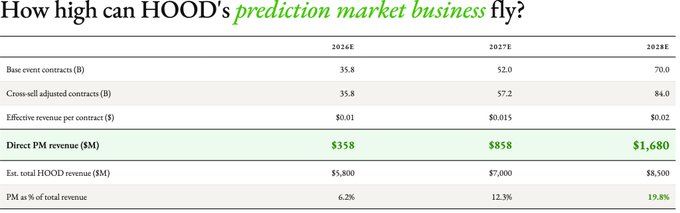
We then stress-tested for bear, baseline, and bull scenarios for 2028.
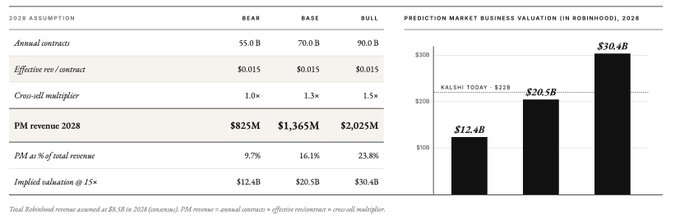
Even in a bear scenario, Robinhood's prediction market business revenue by 2028 is projected to reach $825 million, more than three times Kalshi's 2025 revenue ($260 million). Using Kalshi's current revenue multiple (15 times), Robinhood's prediction market business would value at $12 billion under this scenario. In the most optimistic scenario, it could be worth $30 billion by 2028.
What we are likely to see is a company with a distribution moat that is exploring a whole new market while leaving most of the value for itself. The pending question is whether Polymarket and Kalshi will play out like OpenSea did in 2021 or successfully reinvent themselves in the face of new threats. Polymarket recently expanded into perpetual products, but its users are unlikely to pivot to perpetual trading simply because prediction markets were their initial intent. In contrast, Robinhood benefits from a core user base that has always come for its high-risk, zero-commission trading tools. The latter seems to have an edge over the former.
Today, the market views Robinhood as a traditional financial broker with an added prediction market product, which is why prediction markets only account for 7% of its revenue. But if Robinhood CEO Vladimir Tenev delivers on his stated direction, Robinhood will become a platform that prices financial perspectives for every earnings report, interest rate, election, and commodity in real-time, while also providing trading services for the assets driven by those perspectives.
An independent prediction market would only attract people who already trade event contracts. In contrast, a prediction market integrated into a retail broker would become an information pricing machine for everyone else. The vertical integration of capital aggregators is seen everywhere.
免责声明:本文章仅代表作者个人观点,不代表本平台的立场和观点。本文章仅供信息分享,不构成对任何人的任何投资建议。用户与作者之间的任何争议,与本平台无关。如网页中刊载的文章或图片涉及侵权,请提供相关的权利证明和身份证明发送邮件到support@aicoin.com,本平台相关工作人员将会进行核查。


