Author: Tian Mi
Using AI is now a hard requirement in the workplace.
The rule of “Token consumption counts towards KPI” has permeated down from Alibaba and ByteDance, even small firms of just dozens of employees are following suit, forcing everyone to embrace AI.
No one can calculate how much efficiency has increased. The wallets of workers have shrunk first.
Not all companies are like Alibaba, offering Token quotas as free office benefits. More bosses only accept results without reimbursing costs. To avoid being left behind or optimized, workers have no choice but to dig into their own pockets, recharging one after another.
AI members have become the most covert assassins in the workplace.
Wallets can't hold up
With April not yet halfway through, Long Shan's AI tool account is about to run dry again.
Long Shan is a front-end programmer at a major e-commerce company, hired through campus recruitment in 2024 and is one of the first "AI native employees" in the company. Since starting, he has been trying to use AI to assist in coding. Last year, he began paying for AI tools.
The first amount he spent was on the hottest Cursor in the programmer community. This is an AI programming tool, with a regular monthly fee of 20 dollars on the official website, which can be reduced to 16 dollars per month with an annual subscription.
This 16 dollars does not buy unlimited usage rights but a monthly reset quota pool. Cursor charges based on actual Token consumption, and encountering complex requirements that require multiple long context dialogues, 16 dollars' worth of calling volume can run out in just a few days.
The money is spent for work, but there is no place to reimburse. At the large company where he works, the slogan of “AI efficiency improvement” is shouted to the skies, and internal emails are full of grand statements about “intelligent transformation,” yet when it comes to specific execution, no one has mentioned how to allocate Token quotas or how much can be reimbursed monthly. Workers can only dig into their own pockets.
Long Shan skillfully opens Xianyu and types “Cursor” in the search box, and a bunch of products pops up: “White account,” “Fast brush finished account,” “Exclusive account.” Like an underground meeting, he clicks on a link, and the seller responds immediately: “Brand new exclusive, proportional refund for account bans within 30 days.”
Behind these links are mostly shared accounts or recharge amounts from gray areas. Long Shan sometimes doubts: this account isn’t charged with a stolen foreign credit card, right?
He has thought about directly purchasing from the official website. But once work gets busy, Token consumption is like cash flow. To ensure output, his “arsenal” is far beyond just Cursor. ChatGPT Plus, Midjourney, various API interfaces, it is common to spend thousands a month, and in the month with the highest expenses, he spent a full 2000 yuan on various AI tools.
Paying to work, he saves wherever he can. Long Shan hesitated for a moment but still clicked “purchase,” risking getting his account banned.
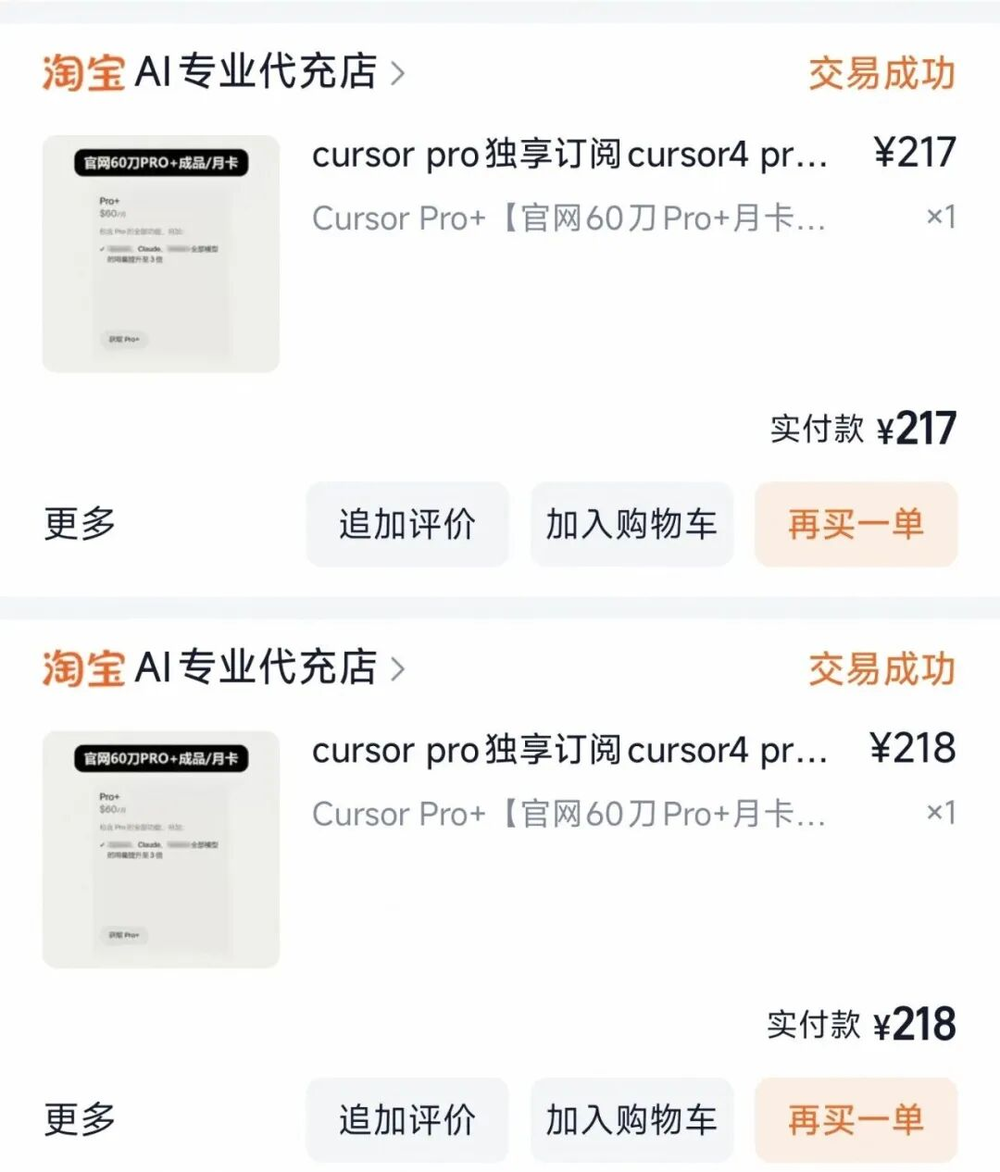
Image | Some of Long Shan's payment records
Spending this money was a bit painful, but he calculated in his mind: spending an extra 1000 a month only accounts for about 3% of his monthly salary yet can help complete 80% to 90% of coding tasks at work; with such cost-effectiveness, there’s nothing to hesitate about.
After paying, Long Shan's work style changed entirely. He took over a graphics-related project. This field has a high threshold for most front-end engineers and is rarely encountered. He had almost a zero foundation when he took over, but without explaining much to his leader, he directly relied on AI to work for three months.
“The leader doesn’t read the code; he just checks if the page can run and if the functions are correct.” The project eventually landed smoothly, and Long Shan gained recognition from his leader. Only after everything stabilized did he slowly go back and complement the relevant foundational knowledge.
The company does provide free internal programming tools, but Long Shan found them less convenient after trying them for a while. That set of tools only integrated domestic models, lacking the top core capabilities, resulting in limitations everywhere. After struggling for a while, he completely gave up and continued to pay out of pocket for external tools.
He also tried to promote Cursor within the department. But when colleagues used up the free quota, no one was willing to continue paying.
A colleague who is almost 40, waited until this year when the company mandated everyone to fully commit to AI, before hurriedly coming to ask him, “How do you use this thing? Teach me.”
Not everyone is as willing to spend as Long Shan.
“Sometimes I really feel that life without AI is pretty good.” Peng Peng thought about the recharge amount while dodging between the company's AI ban and the leader's requirements.
She works in the design department of an automotive enterprise, where the confidentiality regulations are strict, and all external AI websites are directly blocked. If she tries to access them with her work computer, it will show “Cannot connect.”
Last August, after her leader was introduced to ChatGPT, things changed. Ever since seeing AI-generated images, he classified all materials downloaded from Pinterest and Instagram as “second-hand goods” — those images have circulated everywhere online and are easy to clash with.
The leader feels that AI images inherently have a forward-looking quality, which perfectly meets the design requirement of being avant-garde and eye-catching. In meetings, he began directly demanding AI-generated images, with a tone that assumes it’s just a matter of clicking a finger.
Caught in the middle, Peng Peng can only log into AI to generate images using her personal devices, save them, send them to her personal email, and then transfer them to the company computer for organization and use. This process is a roundabout, cumbersome, and time-consuming one, yet there is no other way.
She subsequently subscribed to Midjourney, AIDream, and Keling, and slowly figured out the temper of each tool. The most commonly used are Doubao and Midjourney: Doubao is free and user-friendly, suitable for simple color changes and basic adjustments, but aesthetically rather flat; Midjourney delivers strong visual quality, perfect for high-quality effect images, but is particularly hard to control, often ruining the whole picture when modifying a detail.
In one month, she spent about five to six hundred yuan across several accounts. When she tried to request reimbursement from her leader, all she got in response was, “There is no budget for this.”
Money must come from her own pocket, yet the workload keeps increasing. After experiencing the benefit of AI-generated images, the leader’s appetite grew larger. Where he used to allow a two-day leeway for a design revision, now he thinks that with AI, efficiency should double, and the changes proposed today should show a new version by tomorrow morning. If he requested 10 images, he now expects 20.
“But people aren’t AI, and they’re definitely not machines.” Peng Peng complains out loud but knows deep down that the leader only cares about results, not the process, and he definitely won’t care how much she spends behind the scenes.
Sometimes she wonders: Edison invented the light bulb, yet life at night didn’t become any easier, it just meant more work after dark.
One time, the leader requested a specific material effect image. Peng Peng input the requirements into AI repeatedly and generated more than thirty images, yet none fully met the standards.
In the end, she simply shut down AI and opened Photoshop, manually piecing together and color correcting parts of several images. After over two hours of labor, she dared to submit the final version.
Subscription assassins disrupt the workplace
Li Huahua has recently become increasingly paranoid.
Initially, the emergence of AI did not bring her pressure. She works as a programmer at a state-owned enterprise where strict confidentiality rules limit the use of external tools. She only viewed AI as someone else's concern, unrelated to herself.
Until a late night not long ago, a friend suddenly reached out to complain. The friend works at a private company and, to boost efficiency, secretly activated an AI subscription this month. After achieving results, he excitedly ran to report to the boss, but instead of praising him, the boss directly raised the department’s KPI. Now everyone has to do at least the work of two people.
After listening to her friend's woes, Li Huahua remained silent for a long time before exclaiming, “Aren’t you just the type of ‘code traitor’ that people talk about online? Only caring about your own glory, dragging the entire department down.”
The friend, annoyed, retorted, “Then why don’t you use it?”
After hanging up, Li Huahua couldn’t sleep well all night. The next day, she spent the entire day researching how to recharge for a Codex membership.
But after activating the membership, she became even more anxious. Her friend’s experience served as a mirror, showing her that using AI to improve efficiency might not necessarily be a good thing. She might also one day be considered an example of improving efficiency, at which point her KPI would surely be raised, and some people might even be optimized out. Additionally, due to her poor relationship with her leader over the past two months, she has already received continual low performance ratings.
“When I didn’t use it, I was afraid of being left behind; now that I have, I worry that everyone else is using it. I constantly sense crises lurking but don’t know where they come from.”

Image | After using AI, Li Huahua always feels crises lurking
Since then, she began to secretly observe her colleagues around her. As soon as anyone’s work pace suddenly sped up, she couldn’t help but guess: Has this person also secretly subscribed to an AI membership? She had never asked anyone, and of course, even if she did, no one would tell the truth.
While Li Huahua worries about being laid off, the company where Long Shan works has begun to grandly recruit AI talent this year.
Long Shan briefly participated in recruitment, receiving a headache from all the resumes. The company clearly requires candidates to have AI project experience and implementation cases, yet the interviewers were a group of engineers with over a decade or two of experience. Their entire understanding of AI might just be letting their kids chat with Doubao about Ultraman.
After AI improved efficiency, Long Shan had more time to think, yet he discovered that the company was essentially having outsiders guide the insiders.
But for the management, this isn't a problem at all. They hold large meetings, conduct presentations, break down KPIs into layers, and let the engineers below explore, produce, and report, all while not needing to learn anything or pay for memberships themselves.
“They see us as agents,” Long Shan said helplessly, “just give commands and consume us; they do nothing themselves.”
AI indeed helped him save time, but that time turned into another form of invisible labor — performing as if he’s working hard.
Now he can basically finish all-day work in one morning. To prevent leaders from seeing him idle and assigning new tasks, he pretends to be busy, sitting at his workstation. The company’s computers are monitored, so he doesn’t even dare to connect to freelance work. Often he has nothing to do but cannot leave.
This emptiness makes him particularly uncomfortable, his mind constantly wandering: Should I invest in stocks? Should I buy gold? Will I just work until I’m 35 and get optimized out?
He is well aware that the dividend period of AI is rapidly fading. In 2024, he can still rely on AI to gain recognition from leaders; by 2026, with the entire company using AI, individuals will no longer be able to gain advantages through it.
It’s like when everyone goes to cram school; efficiency rises, but the homework also increases, and no one gets to leave school early.
At another major company, programmer Zhang Mu has fallen into the embarrassing situation of being “promoted to death by AI” by his leader.
One day, the big boss of the department suddenly threw out the Token consumption rankings for March in the work group, announcing that confirmations, KPIs, and promotions all depend on Token usage, with those who use less possibly being replaced.
Zhang Mu inexplicably became the top of the list. The boss publicly praised him and asked him to share his efficient use of AI after the holidays. His scalp instantly went numb: over half of his Token consumption was spent on organizing personal data and taking notes, things unrelated to work.
This put him on the hot seat. He had to brace himself to prepare a presentation but never dared to share the truly efficient methods of use. Those were core advantages he had accumulated after weeks of exploration. “Now I feel like I'm getting closer to being replaced; once I share it, it will be completely lost as a competitive edge.”
This pressure extends from the company's internal dynamics to the entire industry. Previously, everyone could barely manage with free tools like Doubao and Kimi, chatting, editing materials, and handling daily work.
But this retreat is rapidly narrowing. Kimi started charging in September last year, with a minimum of 39 yuan a month; Doubao also had a paid page listed on the App Store in May this year, with a standard version for 68 yuan, an enhanced version for 200 yuan, and a professional version for 500 yuan.
The era of “free little assistants” is visibly coming to an end. If you want to use it, you have to pay.
Can't stop
Before starting a business, Jin Tu never thought he would spend so much money on AI.
He had worked in the brand marketing field for many years, and like most people, he used Doubao and Kimi to chat, edit drafts, and search for information, basically managing his daily work.
Until one day, he saw a friend talking to AI in a code editor and realized that AI could generate documents locally, saving each version without having to repeatedly search, copy, and paste in a chatbox.
After trying it, he opened a new world.
Since then, he has started using AI for more creative and systematic tasks. He wanted to organize all the public account articles he had previously written into a knowledge base to feed to AI, but WeChat has strict anti-scraping measures and cannot be directly fetched. He shared his需求 with Codex, and they customized a browser plugin for him in just 2 minutes and 25 seconds. By opening any public account article and clicking the plugin, he could quickly export it as a local MD document.
Later, he created a private knowledge base workflow for himself. Tweets, excerpts, and long-form opinions he comes across can be casually thrown in, and AI automatically organizes them into systematic notes, also providing his analysis and commentary.
What shocked him the most was that his personal website was entirely built from scratch by AI, and he hadn't written a single line of code. The site has now gone through 577 iterations and received thousands of visits. Every time he updates, he only needs to tell AI one thing: “Alright, move forward.” AI automatically checks, modifies, submits, and generates a detailed operation log.

Image | Jin Tu's website designed with AI
Thanks to this website, Jin Tu achieved a good ranking in an AI entrepreneurship competition and received entrepreneurial support resources from the local government.
To maintain this entire tool chain, he spends a considerable amount each month on AI memberships, but he finds it very worthwhile. He quotes an AI entrepreneur: “We buy the top membership for Claude at 200 dollars a month, which is like hiring a million-dollar-a-year developer for the team.”
“You have to pay to access real AI.” In his view, most who refuse to pay have only come into contact with AI that has been neutered and discounted. Using “real AI” is like buying a nice bag; you feel it’s different from an ordinary one, but you can’t quite pinpoint why it’s better.
Currently, he has planned his next steps. Soon, he will head to Hangzhou to start a business.
Peng Peng still occasionally recharges her AI membership.
The leader specifically praised her for becoming better at using AI and encouraged her to keep it up. However, Peng Peng feels conflicted; half of what is generated by AI doesn’t fully belong to her. The inspiration is her own, but the credit for the final image can easily be attributed to AI. For a designer, the recognition of a chosen proposal is critically important.
What the leader is truly satisfied with — is it her ideas or AI’s ideas? She can never quite articulate it.
Li Huahua's “suspended heart” has recently finally calmed down.
Even their leader, who is nearly fifty, has recently begun to talk extensively about AI improving efficiency in meetings. Although he hasn't temporarily mentioned “one person doing the work of two,” Li Huahua knows that direction isn’t far off. Now she secretly opens her membership when she goes to work, waiting for that day to come.
Long Shan is still purchasing accounts on Xianyu. With the help of AI, he has been promoted three times in a year and a half since starting, received an A-grade performance rating last year, and has received nine months of year-end bonuses.
And this is where AI truly excels. It gives you a taste of sweetness bit by bit, gradually eating away at your work rhythm, making you willingly fork over the money, and slowly creates dependency.
After writing tens of thousands of lines of code with AI, Long Shan finds himself unable to live without it.
“I can’t possibly read through all the tens of thousands of lines of code written by AI before taking over; once this cycle begins, it's very hard to exit.”
What he faces now isn’t merely a question of spending money, but a formed dependency on technology. The maintenance work can only continue to be handed over to AI, and the cost of stopping is much greater than continuing to spend money.
免责声明:本文章仅代表作者个人观点,不代表本平台的立场和观点。本文章仅供信息分享,不构成对任何人的任何投资建议。用户与作者之间的任何争议,与本平台无关。如网页中刊载的文章或图片涉及侵权,请提供相关的权利证明和身份证明发送邮件到support@aicoin.com,本平台相关工作人员将会进行核查。


