Author: Claude, Deep Tide TechFlow
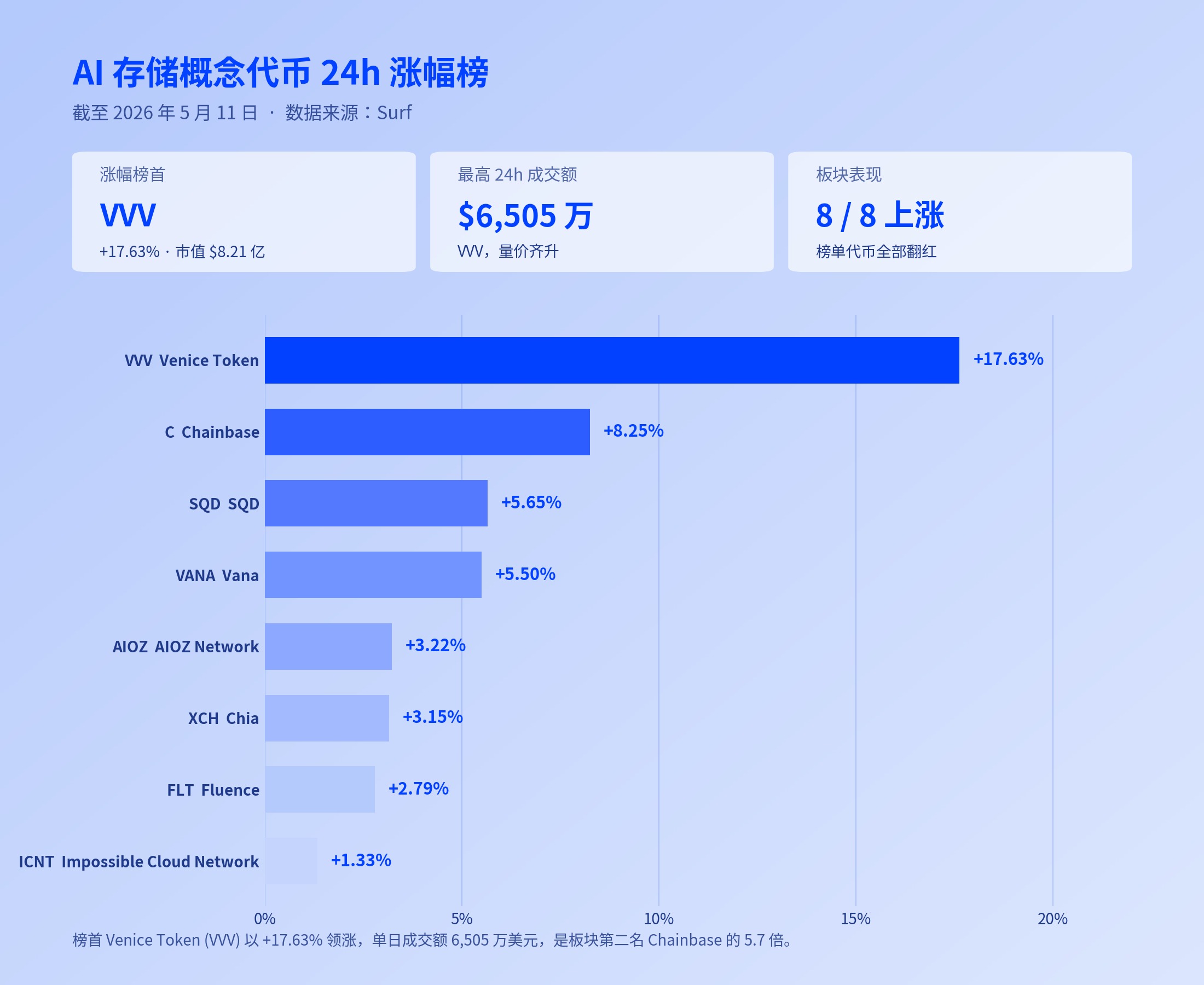
Deep Tide Introduction: The capital spillover effect of the "supercycle" in US storage chips is repeatedly erupting in the cryptocurrency market at a frequency of three times a week. On May 11, the "AI data infrastructure" sector Venice Token (VVV) surged 17.63% in a single day, with a trading volume of 65.05 million dollars leading the charge; Chainbase, SQD, and Vana followed closely with increases of 5% to 8%. Meanwhile, the fuel on the US stock side has not been extinguished; on May 8, SanDisk surged 16.60%, and Micron Technology rose 15.49%, with a market value surpassing 842.2 billion dollars, accumulating nearly 38% growth in a single week. From FIL breaking the range on May 6, to IO soaring 69% in one day on May 7, to this Monday's VVV spreading the momentum, the market has extended from a single storage leader to the entire "AI data + inference computing" infrastructure sector.
The crypto AI sector rose again today, but the narrative is quietly shifting.
If the narrative a week ago was still "FIL, AR, STORJ, the three storage leaders following the rise of US stocks SanDisk and Micron," then entering this week, the main line has expanded from pure storage to a broader concept of "AI infrastructure": AI inference computing (VVV), on-chain data networks (Chainbase), data indexing (SQD), user data DAO (Vana) taking turns leading the charge. However, the source driving all this has not changed: the ongoing fervor for storage chips in US stocks.
First Wave Transmission: May 6, FIL/AR/STORJ Three Consecutive Gains
The first follow-up in the crypto market occurred on May 6.
According to BanklessTimes on May 6, Filecoin opened at $0.975, peaked at $1.161 during the day, and closed at $1.122, with a daily increase of 15.08%, breaking out of the sideways range that had lasted for more than three months since early February. FIL's spot trading volume reached 372 million dollars in a single day, surging 260.22% compared to the previous day; futures trading volume was 816 million dollars, up 213.63% month-on-month. In the same sector, Storj rose 40% in a single day, and Arweave rose 20% in a single day.
The Chinese crypto news channel Followin forwarded the analysis of analyst Ao Ying that day, attributing this round of price rise directly to the capital spillover from US stock storage trading, stating, "The capital for storage trading in the equity market is re-evaluating FIL." The logical chain is that the absorption of storage capacity by AI infrastructure has already booked capacity for 2026, and this supply-demand logic was first priced on the US stock market and then transmitted to the crypto tokens that benchmark "on-chain storage."
Second Wave Continuation: May 7, IO Soared 69%, DePIN Sector Followed
The market did not stop at a single day. According to CoinMarketCap CMC AI citing TradingView data, on May 7, FIL rose again by 15.5%, breaking the key resistance level of $1.08 that had not been breached since February.
The spread in the same sector was even more intense, with IO surging 69% in a single day and STORJ rising again by 30%. The second wave increase indicates that this is no longer a "leading stocks rising while the long tail remains calm" localized market, but that the DePIN (Decentralized Physical Infrastructure Network) sector is being systematically re-priced by the market.
However, CoinMarketCap CMC AI also cited a pessimistic analysis on the same day, labeling FIL as a "dead asset," because the token has fallen cumulatively by 99% from its all-time high. This contradiction reflects the current dislocation in the crypto storage sector: the short-term beta market driven by foreign capital transmission, and the medium to long-term doubts about the business model coexisting at the same time.
Third Wave Spread: May 11, VVV Leads "AI Data + Inference Computing"
This week's surge expanded the main line from "pure storage" to a broader "AI infrastructure."
Data shows that VVV's current price is $17.83, with a market cap of 821 million dollars, and a single-day trading volume of 65.05 million dollars, which is 5.7 times that of the second-ranked Chainbase. The second to fourth positions in the sector are Chainbase (C, +8.25%), SQD (+5.65%), and Vana (VANA, +5.50%), with market caps ranging from 14 million to 54 million dollars.
However, VVV is strictly speaking not a storage token. According to The Block's report from January 2025 and Venice's official documentation, VVV is the native token of the decentralized AI inference platform Venice founded by Erik Voorhees, positioned as "providing private and uncensored inference services for AI agents." Staking VVV allows users to proportionally gain a share of the computing power revenue from Venice API, without needing to pay each time for a request.
VVV's leadership is also catalyzed by its fundamentals. According to an analysis by Phemex on April 7, Venice will permanently reduce its annual token inflation by 25% (from 80 million to 60 million) on February 10, 2026, and after OpenClaw announced on March 2 that it chose Venice as its main inference model supplier, it surged 20% in a single day. According to Messari data, Venice officially launched the "programmatic VVV buy and burn" mechanism on April 15, where each Venice Pro subscription triggers a $1 on-chain token repurchase and burn. CMC AI data shows that as of March, approximately 33 million VVV (42% of the initial supply) had been burned.
At this point, the story of the crypto AI sector can be broken down into two layers: external factors are the spillover of the US stock storage fever, and internal factors are the tokens like VVV that have real deflation mechanisms and specific cooperation implementations that are self-catalyzing. The assets able to achieve excessive returns in this round of the market are almost all those that possess both layers of logic.
The Four True Storage Tokens Today Rose Less Than 4%
It is worth noting that today, the true storage projects are not among the top gainers on the Surf rankings. AIOZ Network (+3.22%), Chia (+3.15%), Fluence (+2.79%), and Impossible Cloud Network (+1.33%), the four traditional decentralized storage projects, all rose less than 4%. Meanwhile, last week's leaders FIL, AR, and STORJ are not even present on this list.
This structural difference reveals a signal: the pure "storage beta transmission" market may have entered its second phase. The first phase (from May 6 to 7) was the leading storage stocks catching up, while the second phase (this week) has seen more tokens with their own narrative catalysts take the lead. VVV has a buy-and-burn mechanism, Chainbase has an "AI data" label, and both SQD and Vana fall under the "data network" concept. Funds are beginning to select "story-laden assets" within the sector, rather than indiscriminately pouring money.
Historically, this kind of three-stage process of "leading stocks catching up → concept diffusion → funds picking stocks" usually indicates that the sector's market has entered the second half. The sustainability going forward will depend on whether the storage chip craze in US stocks can continue to sustain, and based on the current supply-demand pattern where DRAM contract prices have risen by 58% to 63% and HBM capacity is sold out until 2026, at least from a fundamental perspective, the story is not over yet.
免责声明:本文章仅代表作者个人观点,不代表本平台的立场和观点。本文章仅供信息分享,不构成对任何人的任何投资建议。用户与作者之间的任何争议,与本平台无关。如网页中刊载的文章或图片涉及侵权,请提供相关的权利证明和身份证明发送邮件到support@aicoin.com,本平台相关工作人员将会进行核查。


