Funding is concentrating on AI narratives at an unprecedented scale amid macro turbulence.
Written by: Zhang Yaqi
Source: Wall Street Journal
More than two months into the outbreak of the Middle East conflict, the AI boom has overshadowed the shadows of war—with the market capitalization of the world's largest companies increasing rather than decreasing, accumulating more than $5.4 trillion.
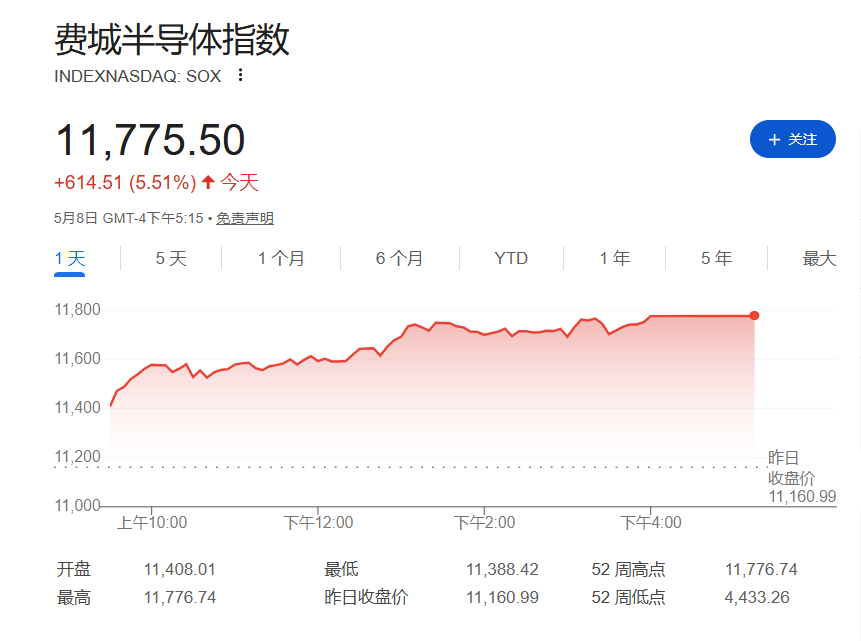
Since the U.S.-Israel joint attack on Iran ignited the flames of war, the semiconductor sector's market value has surged by 26%, with an increase of up to $3.7 trillion, becoming the main engine driving global market growth. Tech giants like Intel and TSMC have seen their stock prices soar, bolstered by strong performance from large tech companies in the first quarter, with the AI narrative dominating market trends. Luca Paolini, Chief Strategist at Pictet Asset Management, said that investors have returned to tech stocks in an environment of "extreme macro uncertainty," seeking "earnings certainty" from the U.S. tech sector, and "after the ceasefire, all market focus has returned to AI."
In contrast, airlines have cut flights, consumers have reduced spending, and companies have issued price increase warnings— the impact of the war on the real economy is spreading. The energy, consumer goods, automotive, mining, and even defense sectors have all experienced varying degrees of declines, with the rift between the AI narrative and the realities of war clearly presented in global stock markets.
The deeper logic of this divergence is that when the market faces macro uncertainty, funds concentrate on assets with higher earnings visibility. AI provides that certainty, while war does not.
AI Narrative Overwhelming War Topics
According to AlphaSense data, in the earnings conference calls during the first quarter of this year, nearly two-thirds of large-cap companies mentioned AI, roughly twice the number discussing companies related to the Middle East conflict. This ratio reflects the allocation of market attention—though war exists, AI is currently the core variable dominating investor thinking.
John Lamb, an investment expert at Capital Group, stated: "An increasing amount of evidence shows that this AI cycle is real. This is not a fleeting cycle, but a genuine and lasting investment cycle."
Historically, this rebound's resilience is particularly striking. Companies with market capitalizations exceeding $10 billion collectively appreciated by $5.6 trillion in the first 10 weeks following the outbreak of the war. In contrast, during the Russia-Ukraine conflict, companies in the same category saw their market value decline by $2.5 trillion; during the initial outbreak of the COVID-19 pandemic, more than $9 trillion evaporated. AI-driven tech stocks are acting as a "shock absorber" for global stock markets.
Energy Sector: Some Happy, Some Sad
Since the outbreak of war, oil prices have risen by about 50%, boosting the overall strength of the energy sector, but company performances are markedly divergent.
Saudi Aramco's market value increased by $144 billion during the war, despite its oil fields and refinery facilities suffering missile and drone attacks, and its main export routes being cut off. For every $1 increase in oil prices, Saudi Aramco can add approximately $1 billion in free cash flow. Norway’s Equinor, with relatively low exposure to the Middle East, saw its stock rise by 24%, while BP and TotalEnergies increased by 14% and 16%, respectively; companies with large trading departments that can capture market volatility opportunities also performed well.
In contrast, companies in the Persian Gulf oil and gas production sector face bleak circumstances. ExxonMobil and Shell both face repair bills in the billions of dollars, involving damaged facilities in Qatar's Ras Laffan Industrial City. ExxonMobil's market value has dropped about 4% since the conflict erupted, shrinking by $28 billion.
Consumer, Automotive, and Mining: Multiple Pressures Accumulate
The closure of the Strait of Hormuz has driven up logistics costs and suppressed consumer confidence. Procter & Gamble and Kimberly-Clark have both warned of product price increases. Luxury goods group LVMH and Hermes are under pressure due to declining demand; automakers like Nissan, Toyota, and Stellantis are facing multiple blows from supply chain disruptions, rising prices for raw materials like aluminum, and a sharp drop in demand from Middle Eastern markets.
Håkan Samuelsson, CEO of Volvo Cars, expressed that his biggest concern is the decline in U.S. consumer confidence: "This puts pressure on the whole economy, and people start to worry about whether they will lose their jobs… so now is not the time to buy a car or anything else."
Mining companies are encountering a double whammy: rising diesel prices are pushing up input costs, while expectations of a potential global economic slowdown are lowering the outlook for commodity prices. Companies like Agnico Eagle and Zijin Mining, which previously benefited from historically high gold prices, are now experiencing the most significant declines.
Defense Stocks: Benefits from Expectations Fall Short
Despite governments worldwide extensively consuming strategic ammunition reserves, the market capitalizations of major defense companies in Europe and the U.S. have generally declined since the outbreak of the Iran war. Analysts believe this sell-off reflects investor concerns about whether the defense industry can rapidly scale up production amid existing supply chain bottlenecks.
This trend reveals another aspect of the current market logic: under the optimistic sentiment driven by AI, even sectors directly related to wartime demand have not gained sustained recognition from capital. Capital is gathering towards those technology companies that can provide predictable earnings growth. The war has reshaped the fundamentals of certain industries, but in the face of the AI cycle, the valuation effects of this reshaping seem insignificant.
免责声明:本文章仅代表作者个人观点,不代表本平台的立场和观点。本文章仅供信息分享,不构成对任何人的任何投资建议。用户与作者之间的任何争议,与本平台无关。如网页中刊载的文章或图片涉及侵权,请提供相关的权利证明和身份证明发送邮件到support@aicoin.com,本平台相关工作人员将会进行核查。


