Author: Kuri, Deep Tide TechFlow
Is crypto still worth it?
In the past two weeks, the crypto market has seen some recovery, with the narrative around Uniswap Hook V4 emerging alongside a resurgence of several old tokens.
Among them, the L1 sector has performed well, with remarkable increases seen in ZEC, TON, and SUI. We introduced ZEC last week, and both SUI and TON developed independent trends against a backdrop of a flat overall market: TON surged from $1.35 to $2.89 in three days, and SUI rose over 24% to surpass $1.24 in one week.
(Reference reading: "30 Days to Double, 15 Times Increase This Year: Why Is the English Zone Starting to FOMO $ZEC Again?")
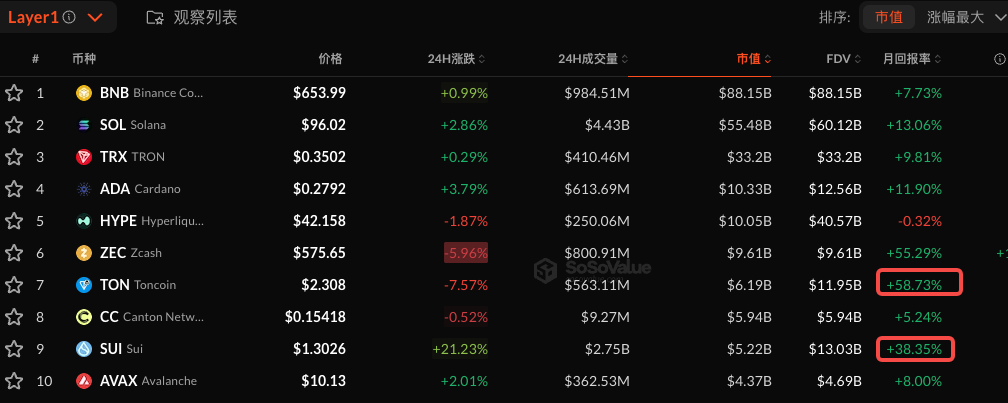
Each chain has its own verifiable catalysts based on news and fundamentals. Meanwhile, with the L1 track moving first, does this suggest that a broader altcoin rotation is about to begin?
BTC Dominance Hits Yearly High, But L1 Sector Moves First
First, let’s look at the macro background.
According to Bitget data, as of May 9, BTC dominance rose to 60.3%, the highest level since 2026. The altcoin season index from Blockchaincenter reads about 35, far below the 75 threshold needed to confirm an altcoin season, and the market remains in a "Bitcoin season."
However, structural signals are emerging. BTC dominance has been oscillating in the 58%-60% range for nearly eight months (from August 2025 to April 2026), while the RSI shows signs of stagnation.
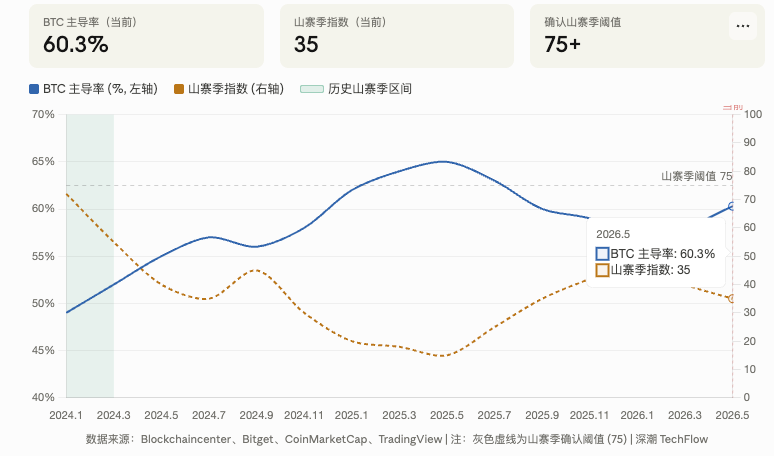
Analyst el_crypto_prof noted that the weekly structure of the total market cap of altcoins (excluding BTC) closely resembles the patterns leading up to the start of altcoin seasons in 2016-2017 and 2020-2021. In both historical instances, the combination of high dominance with a low altcoin season index appeared 2 to 6 months prior to the most profitable altcoin rallies.
It is in this “macro not yet confirmed, individual stocks starting first” window that SUI and TON have each developed independent trends.
TON: Telegram Goes from "Partner" to "Actual Controller"
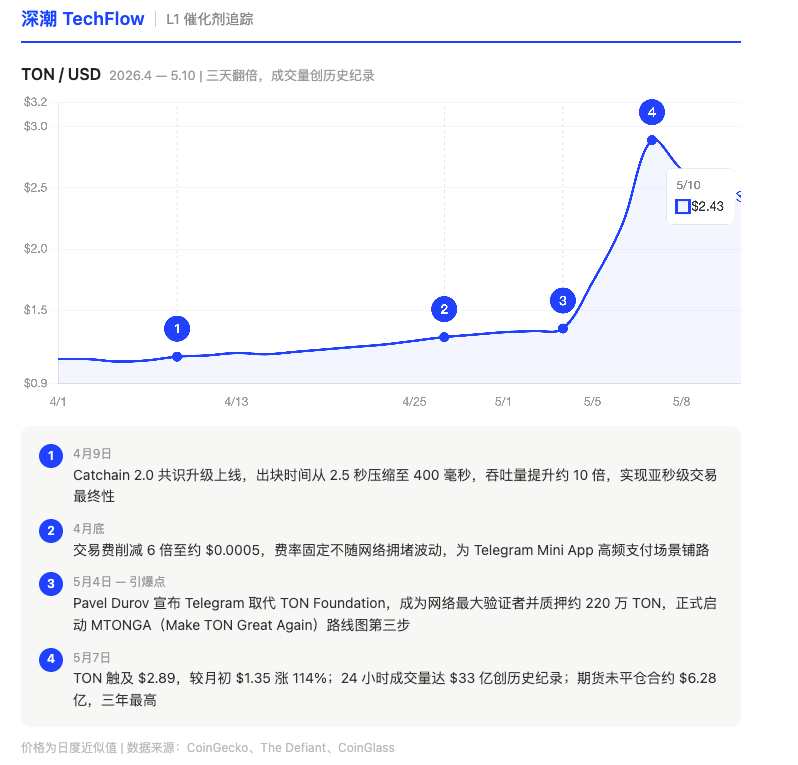
The recent trend of TON has a precise trigger: On May 4, Telegram founder Pavel Durov announced on X that Telegram will replace the TON Foundation to become the largest validator and main driver of the TON network.
The significance of this event needs to be viewed in a historical context.
In 2020, Telegram was forced to withdraw from the TON project due to SEC enforcement actions, refunding $1.22 billion to investors and paying a $18.5 million fine, with Durov announcing the project’s termination on his blog. Since then, the TON Foundation has operated independently for five years.
Six years later, Durov returned personally, staking about 2.2 million TON, and the ton.org domain switched to the MTONGA (Make TON Great Again) themed page.
According to The Defiant, TON surged 33% on that day, reaching a high of $1.90 during trading. By May 7, the price skyrocketed from $1.35 at the beginning of the month to around $2.89, marking a 114% increase over three days, with a 24-hour trading volume of $3.31 billion, the highest in TON's history. According to CoinGlass data, the open interest on futures simultaneously rose to $628 million, setting a three-year record.
Before Telegram took over, Durov completed a month-long intensive technical upgrade:
- On April 9, the Catchain 2.0 consensus upgrade went live, reducing block times from 2.5 seconds to 400 milliseconds, improving throughput by about 10 times. According to Durov's own words on X, TON is now "the fastest chain in terms of finality among all mainstream L1s."
- By the end of April, transaction fees were reduced from about $0.0023 to about $0.0005, a drop of 6 times, with rates fixed regardless of congestion. Durov stated that "most transactions will be completely free" going forward.
Institutional participation is also following suit. Japan's Rakuten Wallet launched TON spot trading in mid-April, and CoinShares introduced a TON staking ETP on the Swiss SIX exchange. Reports indicate that the USDT supply on the TON network has exceeded $500 million, and the monthly trading volume of perpetual contracts in Telegram's built-in wallet has surpassed $1 billion.
TON's technical updates and upgrades are ongoing, with Durov’s goal to turn Telegram into a super application that integrates payments, DeFi, AI agents, and privacy communication, with TON serving as the underlying financial layer.
However, I believe that Telegram becoming the largest validator essentially increases the network's dependence on a single entity. If Telegram faces regulatory scrutiny again (the remnants of the SEC's previous case still linger), the impact on the network and token price will be much greater than if it were under a decentralized architecture.
SUI: Gathering Institutional "Trifecta" Within a Month
The catalyst for SUI comes from another direction, an intensive rollout of institutional infrastructure within a month.
If we compile a list of which crypto assets simultaneously have US spot ETFs, CME futures contracts, and large staking by publicly listed companies, previously only BTC and ETH held such a structure. Starting in May, SUI has joined the ranks:
- Spot ETF Cluster (late February): 21Shares TSUI (Nasdaq, fee 0.30%), Canary Stake SUI ETF, Grayscale SUI Staking ETF were listed within a week. Bitwise, Franklin Templeton, and VanEck also have related layouts.
- CME Futures Onboard (May 4): Standard contracts of 50,000 SUI, micro contracts of 5,000 SUI, cash settled. On May 6, FalconX completed the first large transaction with G-20 Group. From May 29, all CME crypto derivatives will be traded 24/7.
- Large Staking by Publicly Listed Companies (May 9): Nasdaq-listed SUI Group Holdings converted 108.7 million SUI (2.7% of circulation) into native staking, pushing the price up 13% that day.
- Emerging Market Payment Launch (May 9): At Sui Live in Miami, Nigerian fintech company Paga announced deep integration with Sui, planning to use the native stablecoin USDsui to offer users dollar accounts and tokenized bonds. Paga processed $11 billion in transactions in 2025.
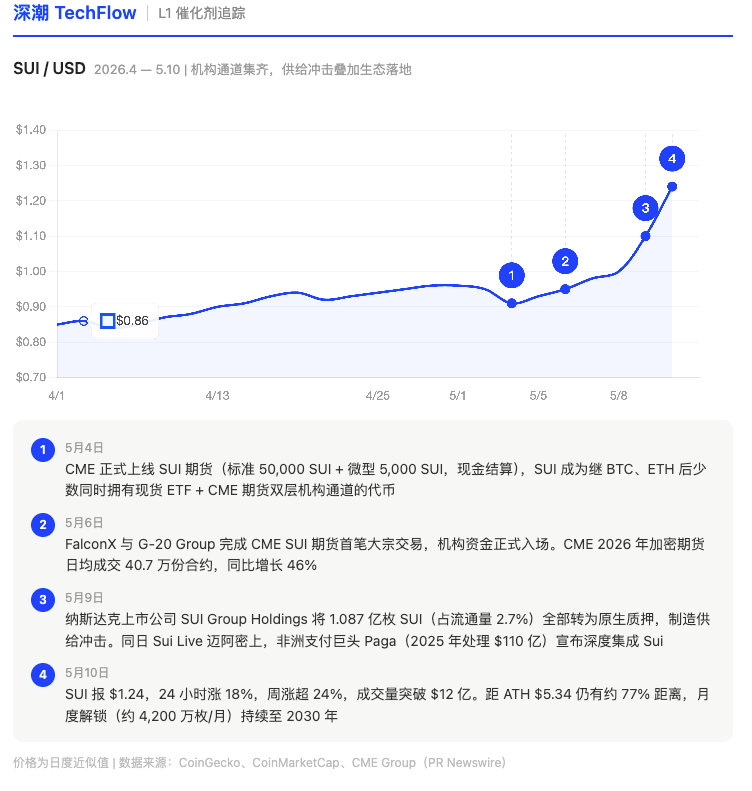
According to CryptoNews analysis, SUI currently has a complete "three-tier institutional access structure": spot ETFs provide passive allocation, CME futures provide active hedging, and staking products offer yield. This structure was previously only available to BTC and ETH 18 months ago.
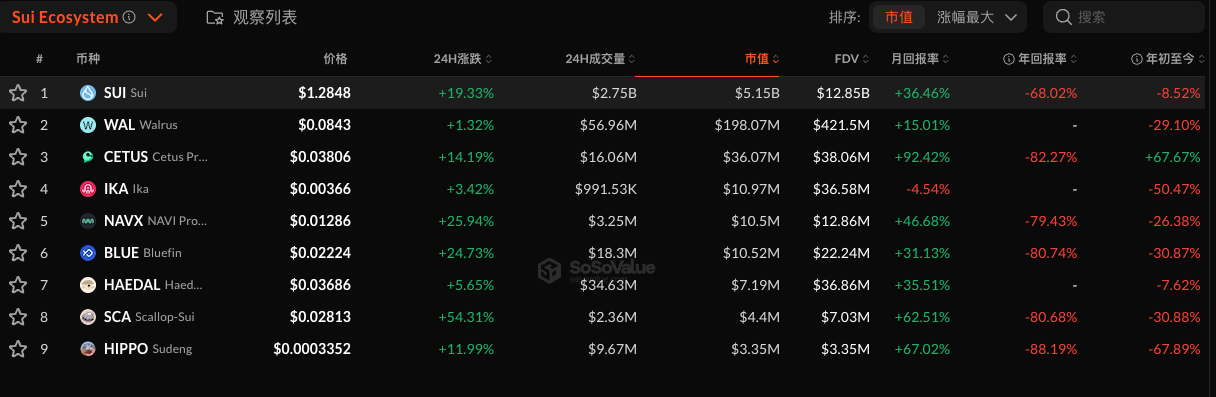
As of May 10, SUI was priced at $1.24, with a weekly increase of over 24%, and trading volume surpassed $1.2 billion. On the day CME futures launched, SUI actually dipped to $0.91, but its real uptrend began five days later when the staking lockup and collaboration with Paga took effect; concurrently, coins within the SUI ecosystem also saw substantial increases.
L1 Heats Up, Can It Spread to Altcoins?
Looking at SUI and TON together, the catalysts for both are distinctly different, but they share the commonality that both are project-specific, verifiable fundamental events driving the market, rather than macro liquidity or emotional beta.
Returning to the macro level, the confirmation conditions for a broad altcoin season have not yet been met. According to historical patterns compiled by Phemex, BTC dominance needs to drop below 54% and stay below that level for more than two weeks, while the altcoin season index must break 75 to form a reliable rotation signal. The current 60% dominance and a 35 index reading are still clearly distant from these two thresholds.
A historical reference provided by data is:
At the end of 2019 and 2020, the combination of high BTC dominance and low altcoin season index ultimately led to large-scale altcoin rallies 2 to 6 months later.
At that time, the projects that started first also had independent catalysts, and only then did funds gradually expand to mid- and small-cap projects. The moves of SUI and TON may be in the "individual projects lead, overall rotation awaiting confirmation" stage.
The spring river water warms, the ducks have already moved. But the ice on the river has not completely melted yet.
免责声明:本文章仅代表作者个人观点,不代表本平台的立场和观点。本文章仅供信息分享,不构成对任何人的任何投资建议。用户与作者之间的任何争议,与本平台无关。如网页中刊载的文章或图片涉及侵权,请提供相关的权利证明和身份证明发送邮件到support@aicoin.com,本平台相关工作人员将会进行核查。


