Annualized at 11.5%, cash dividends paid monthly.
Written by: James Lavish, hedge fund manager, independent director at Strive
Translated by: Luffy, Foresight News
Imagine a security that pays you an annualized return of 11.5% in cash every month. Real money deposited directly into your account every month, while the stock price barely budges. The performance remains uneventful, but the returns are very appealing. And this entire product is backed by Bitcoin.
Michael Saylor defines this new type of asset as Digital Credit and recently likened it to a commercial airliner in a tweet, with the underlying asset being STRC. Frankly speaking, this is the most innovative income-generating financial instrument I have seen in years.
Strategy was the first to introduce such products, followed by Strive, which issued a similar asset called SATA. Now both products are on the market, continuously attracting Bitcoin investors.
However, mainstream financial media is either confused or outright dismissive. The same asset is evaluated in starkly opposing ways: some consider it an innovation, while others view it as a scam or bubble.
This high-yield product, which should not exist, is publicly listed, yet professional institutions cannot consistently determine its worth.
Over the past few months, my inbox has been filled with reader questions, with a common core inquiry: Is this type of product reliable? Are the returns real or a trap?
This Tuesday, I participated in Strategy's first-quarter earnings call as an analyst, and STRC became the focus of the entire discussion. Coupled with my experience as a Strive director participating in the design of the SATA product over the past year, I am writing this lengthy article to clarify its underlying logic in one go.
What is Digital Credit?
For ease of understanding, this article will primarily focus on STRC. The Strive’s SATA mentioned earlier has a nearly identical product structure. The subsequent sections will compare the differences, with an overall focus on STRC.
Digital Credit is essentially a type of permanent preferred stock backed by Bitcoin reserves. It can be broken down into three core keywords: stock, preferred stock, and fixed income, plus one underlying innovative design. Let's analyze them one by one.
STRC is essentially an equity; holding STRC is equivalent to holding a portion of the issuing party, Strategy's, shares. It can be freely traded on the exchange, following the same trading rules as ordinary stocks.
In terms of the company’s capital structure and repayment priority, STRC has a higher priority than common stocks. The repayment priority order from top to bottom is: senior debt → preferred stock → common stock; only residual value belongs to common shareholders. This priority difference is not strongly perceived during good market conditions; however, it becomes crucial in times of crisis.
In other words, STRC ranks higher than MSTR common stock but lower than convertible bonds, on par with other preferred stocks. The asset's claim rights are solid, providing strong protection, especially suitable for investors with a long-term bullish outlook on Bitcoin's value.
This structure is a win-win design for the issuer. During a downturn, the company can defer dividend payments; compared to issuing more common stock, the cost of financing through preferred stock is lower and does not dilute common shareholders' equity.
Preferred stock dividends are calculated based on the face value at a fixed proportion, rather than based on your purchase cost, which is consistent with bonds.
The face value of STRC is $100, and the current dividend rate is 11.5% of the face value. Regardless of fluctuations in the secondary market share price, each share provides a fixed annual dividend of $11.5 in cash.
If you buy at a stable $100, the annualized return is exactly 11.5%. If you buy at a discounted price of $90, you still receive $11.5 in dividends annually, resulting in an actual annualized return of 12.78%. Even better, if Strategy redeems at the $100 face value in the future, you will earn an additional $10 per share from the sale price on top of the stable dividends.
This highlights the difference between the face yield and the current yield. One major advantage of permanent preferred stock is that being patient in the discounted range can naturally boost the actual yield. However, for STRC, the impact of this characteristic is smaller compared to most preferred stocks, which will be explained later.
Now let's discuss the new part: the underlying Bitcoin reserves.
One year ago, all preferred stocks in the market had traditional company assets backing them: bank loan portfolios, REIT properties, and operating cash flows from telecom companies. Dividends relied on profits from main business operations.
Digital Credit completely changes the underlying collateral assets: employing publicly auditable Bitcoin reserves on-chain as the value backing.
Strategy has previously issued other structured, differently purposed preferred stocks, but only STRC is uniquely positioned as the only one designed as a perpetual preferred stock that adopts a floating rate dividend. The original intention is to anchor the price close to the face value and provide stable cash dividends. This special structure is the true meaning of digital credit assets, while other similar products do not belong to this category.
Brief Comparison with Similar Assets: SATA
The SATA issued by Strive last year serves as a benchmark for digital credit products, and its structure is nearly identical to STRC, differing only in three aspects: scale, liquidity, and yield.
Strive's balance sheet is more streamlined with almost no debt; the total circulation scale of SATA is $496 million; the company holds 15,000 Bitcoin (worth $1.2 billion) and $148 million in cash reserves. The cash reserves can cover approximately 2.3 years of dividend payments.
Due to its smaller overall scale, SATA has weaker liquidity; as compensation for liquidity discounts, SATA offers a higher dividend, currently annualized at 13%.
Many investors choose to allocate both STRC and SATA, diversifying single-asset risk while further boosting overall portfolio returns.
The subsequent sections discussing STRC's product design, target audience, and risk logic also fully apply to SATA, with only slight differences in scale, liquidity, and yield.
Now, let's return to STRC.
At this point, we have established three things. STRC is a type of permanent preferred stock; dividends are paid in cash, with a face value of $100, currently with a dividend rate of 11.5%; and the underlying assets supporting the entire structure are the Bitcoin reserves on the issuer's balance sheet.
This leads us to the most important question: How does Strategy sustain the stable monthly cash dividends of 11.5% each year in the long term?
Understanding the Underlying Design Logic
To understand this product, you might imagine yourself on a commercial airliner.
Saylor likens STRC to a commercial airliner, which is very straightforward: the greatest characteristic of civil aviation is stability. Passengers can sit back, read books, and drink coffee, barely feeling any turbulence. Behind the scenes are countless engineers' precise designs and layered system guarantees to achieve this surface-level smoothness.
In the same vein, STRC type earning tools aim for an extremely stable product experience, underpinned by a meticulously structured architecture.
The entire design can be broken down into four core modules: fuel, autopilot, fuselage structure, and seatbelts. After reading this section, you will understand its profit and dividend logic.
Fuel: The Actual Returns for Investors
The basic yield has already been calculated: face value of $100, annualized at 11.5%, with an annual dividend of $11.5 per share, distributed monthly in cash, approximately $0.96 per share each month.
According to Strategy's first-quarter 2026 earnings report, STRC nominal issuance reached $8.54 billion. Based on an 11.5% dividend rate, the company needs to spend nearly $982 million in dividends annually, with almost $1 billion flowing directly to the holders each year.
This is the fuel cost to keep this “airplane” running. The core question remains: Where does the company get nearly $1 billion every year to sustain the dividends? Let's look at the second major design, which answers another question in your mind:
Since it's just preferred stock, why does the STRC price hardly fluctuate?
Autopilot: Floating Dividend Mechanism Anchoring to Face Value
Ordinary preferred stock behaves similarly to long-term bonds: fixed dividends mean that market interest rate increases cause prices to drop, and falling rates push prices up, forcing investors to endure substantial price fluctuations.
However, the design of STRC is entirely different; the dividend rate employs a floating mechanism, allowing the board of directors to adjust the rate monthly. The prospectus clearly states the intention: to keep the STRC trading price close to the face value of $100.
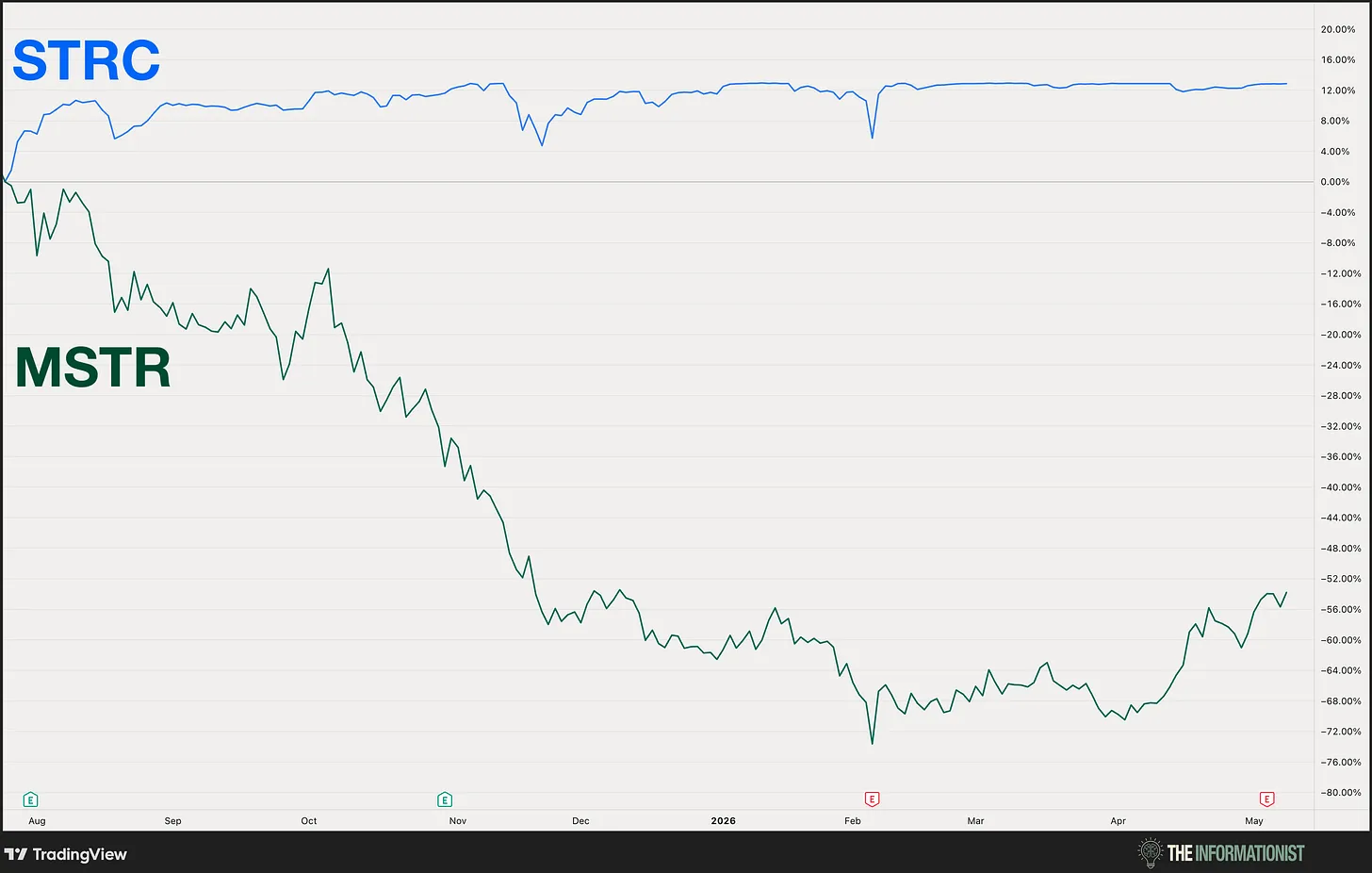
The actual operational logic is as follows: when STRC was listed in July 2025, the dividend rate was only 9.0%; by May 2026, it was raised to 11.5%. During the first nine months of price pressure, the company gradually increased the dividends to attract market buyers and pull the price back near $100.
From the trends, it is clear that STRC behaves like a stable cruising commercial airliner; after a slight rise upon listing, it maintains a stable, long-term plateau; whereas MSTR common stock is more like a rocket, experiencing sharp gains and losses. Both have the same Bitcoin balance sheet yet display completely different market behaviors.
The underlying Bitcoin price still experiences significant volatility; the product design doesn't eliminate fluctuations but rather shifts them.
In MSTR common stock, volatility manifests on the price charts, where prices can rise sharply, drop significantly, stabilize for months, and then rise dramatically again. Your trading experience reflects the volatility itself.
In STRC, the floating interest rate absorbs the same volatility and converts it into dividends. The stock price remains stable near $100, while the dividend rate truly fluctuates. You receive cash dividends monthly, while the price of the stock you purchased remains mostly unchanged.
Reinforcing the Fuselage: What Supports All This
The safety of the airliner depends on its fuselage structure, while the underlying support of Digital Credit completely differs from traditional preferred stocks.
Traditional preferred stocks rely on main business cash flows for dividends: bank credit operations, stable revenues from public utilities, and rental income from REITs depend on operational profits to distribute dividends.
STRC's logic is entirely different: Strategy is fundamentally a Bitcoin reserve-based enterprise. It recently disclosed holdings of 818,334 Bitcoin, valued at approximately $66 billion at current prices. This vast asset serves as the solid fuselage supporting all capital structures, including STRC.
Returning to the core question: How does it sustainably support a monthly dividend of 11.5%? In Strategy’s first-quarter earnings presentation, they provided two conservative assumptions for the long-term annualized returns on Bitcoin:
- Optimistic equity estimation (MSTR appreciation logic): Bitcoin annualized compound return of 30%;
- Conservative credit stress test (STRC risk estimation): assessed at an annualized rate of only 10%.
Currently, the company's total annual dividend and interest expense for all preferred stocks + convertible bonds is $1.488 billion. And with $66 billion in Bitcoin assets:
- At the conservative 10% annual value increase: annual asset increment approximately $6.6 billion;
- At the optimistic 30% annual value increase: annual asset increment nearly $19.8 billion.
For either assumption, the asset appreciation magnitude exceeds the annual fixed expenditure by several times.
But wait, the 11.5% dividend rate of STRC is 1.5 percentage points higher than the conservative assumption of 10% annualized return. This is precisely the significance of the company’s additional cash reserve of $2.25 billion.
If Bitcoin enters a prolonged deep correction, significantly slowing value appreciation, this cash reserve can support full dividends for 18.1 months without needing to sell Bitcoin or issue common stock at unfavorable prices, thereby weathering the downturn smoothly.
This structure is effective because it layers three parts together:
- A vast Bitcoin asset base far exceeding annual expenses ($66 billion);
- A cash buffer reserve in USD to handle bear market corrections ($2.25 billion);
- The long-term appreciation of Bitcoin that far exceeds the dividend costs.
Seatbelts: The Bottom Mechanism in Extreme Conditions
Beyond fuel, autopilot, and fuselage structure, the fourth layer of protection is hidden in the legal clauses of the prospectus, much like the seatbelts in an aircraft.
STRC is categorized as a cumulative preferred stock; this attribute is crucial: if the company defers dividend payments, the unpaid dividends do not vanish but instead accumulate interest; they will compound monthly at the current rate until fully paid.
At the same time, the clause clearly states: no dividends or earnings can be paid to MSTR common shareholders until all accrued unpaid STRC dividends are fully paid. This provides a legal safety net for investors.
Many might ask: Will this safety net mechanism ever be activated? The company possesses $2.25 billion in cash reserves, with assets far exceeding annual liabilities; it is likely that it will never need to use it. However, the clauses are stated plainly in black and white, preparing thoroughly for extreme black swan events.
Tax Logic Supplement
STRC investors do not have to pay full taxes for each dividend in the year received. Strategy classifies STRC dividends as capital returns: dividends are not taxed as ordinary taxable income but instead reduce your holding cost, deferring tax payment.
For high-tax-rate investors, deferring tax payments significantly enhances actual returns. The only tax cost arises upon selling the asset: the holding cost is reduced, and capital gains tax will be incurred upon sale; if held for more than a year, the long-term capital gains tax rate applies.
Here’s a simple example (with price maintaining at face value of $100):
- Buy at $100;
- Hold for two years, receiving $11.5 in dividends each year, totaling $23;
- No taxes owed for each dividend received during the holding years;
- Finally sell for $100, only paying capital gains tax on the $23 profit.
This is very favorable for long-term holders and investors in higher tax brackets.
At this point, the internal logic of the entire "commercial airliner" has been fully dissected. The fuel is the real monthly cash dividend of 11.5%; the autopilot is the floating dividend mechanism that transforms price fluctuations into dividend fluctuations and stabilizes the stock price; the fuselage is the tens of billions of Bitcoin holdings on Strategy's balance sheet; the seatbelt is the cumulative dividend and repayment priority legal safety net. As long as Bitcoin’s long-term annualized returns remain close to the conservatively estimated 10%, the entire yield logic can function coherently.
Who is STRC Suitable For?
After understanding the operating logic, the next crucial question is: Is this product suitable for you?
Every mature financial product has a precisely fitted audience; it is not suitable for everyone.
Target Audience One: Income-Replacing Investors
This is the largest fitting group and the most aligned investor demographic. Individuals with idle cash, newly liquidated assets, a history of long-term investments in money market funds and short-term US Treasury bonds; or retirees dependent on cash flow income, witnessing traditional fixed incomes continuously lagging behind inflation and assets quietly shrinking.
If you hope for stable asset growth that outpaces the depreciation of the dollar and real inflation, STRC is precisely designed for this. The core goal of the entire structure is to provide stable cash dividends far exceeding traditional fixed income, while also presenting the additional advantage of price stability.
Target Audience Two: Bitcoin Supporters Unable to Withstand High Volatility
After years of being bullish on Bitcoin’s long-term logic, you have made small allocations to spot Bitcoin or Bitcoin ETFs; however, you cannot fully accept the extreme price volatility of MSTR common stock and would not dare allocate large amounts of retirement funds to spot Bitcoin, fearing nighttime market watching anxiety.
STRC offers you a new choice: you can engage in Bitcoin reserve logic without enduring the severe volatility typical of Bitcoin. It’s like taking a smooth commercial flight through the same Bitcoin market airspace without riding a rollercoaster. For many who are optimistic about Bitcoin but fear volatility, this is the first asset that allows for long-term holding without worry and provides peace of mind for sleep at night.
Target Audience Three: High-Net-Worth Investors Focused on Tax Optimization
If you are in a higher federal tax bracket, the previously discussed capital return treatment will greatly change your actual returns. High tax-rate investors find STRC's tax advantages significantly more apparent compared to ordinary taxable fixed income products. With the assumption of long-term holding, post-tax actual returns far surpass those of comparable taxable yield products, making it a focal point for professional financial advisors.
Target Audience Four: Rational Investors Willing to Deeply Understand Product Logic
Those willing to carefully read the prospectus, fully comprehend product terms; understand cumulative dividends, capital structure priorities, perpetual attributes, floating rates, and cash reserves' foundational logic; and can clearly view the entire structure's advantages and protective mechanisms without blindly chasing after yields.
If you belong to this group and truly understand the essence of the product, then STRC can definitely be included in your portfolio. Understanding before investing is the most critical threshold in investing.
Not Suitable for Audience One: Investors Seeking High Growth and Exponential Returns
If you expect to double your investment during a Bitcoin bull market, STRC is completely unsuitable. The product design itself actively eliminates the potential for price surges in exchange for stability. The floating mechanism can anchor prices during downturns but suppresses upward potential. If you want to profit from Bitcoin's growth, MSTR common stock is the choice; STRC was designed with stability in mind, which is not a defect but rather its positioning.
Not Suitable for Audience Two: Investors Pursuing Absolute Zero Risk
To be frank, there are no assets with absolutely zero risk in the market, including US Treasury bonds. STRC's ability to offer high yield inherently corresponds to the acceptance of higher risks. Strategy has also clearly indicated: STRC is not a bank deposit, has no deposit insurance, and is not subject to the same regulatory protections as money market funds or short-term debts; it cannot be equated to capital-preserving products directly.
The suitable positioning is a high-yield asset with comprehensive risk control but still containing risks; the architecture ensures sufficient risk management but cannot entirely eliminate risks. For absolute capital preservation with government-backed security, one must choose US Treasury bonds or money market funds.
Not Suitable for Audience Three: Investors Who Do Not Understand the Underlying Logic and Blindly Chase After Yields
If you cannot explain what STRC is or how it generates dividends in plain language, then it is currently not suitable for your allocation.
Digital Credit is a new asset class that was only born a year ago, and there is no need to force yourself to follow the trend if you do not understand it. You can repeatedly read this article, consult official materials, or seek advice from financial advisors, and spend three months deliberating before making a decision; the asset will not disappear out of thin air.
The worst approach is "buy first, research later"; the correct sequence is always to understand first and then allocate. If you have reached this point and can discern the full design logic, you are equipped for allocation; if you still find it unclear, it may be best to deepen your understanding further.
Where are the Potential Risks?
Mature investors always begin by asking: What are the risks? All income-generating assets exchange risk for returns. Short-term bonds offer a 3.7% return with very low risk, whereas STRC's 11.5% high return necessarily entails higher risks. Let's objectively dissect the yield advantages and real risks.
Four Core Advantages
- High yield: annualized 11.5% paid monthly, exceeding traditional preferred stocks by 4–7 percentage points;
- Stable performance: implied volatility around 6%, while MSTR common stock is close to 59%, with a vastly different market experience;
- Tax optimization: capital return deferral of tax payments, with post-tax actual returns significantly ahead of similar taxable income products;
- Capital structure protection: cumulative dividend mechanism, priority over common stocks, and claims to Bitcoin assets during liquidation as clearly outlined in the prospectus.
These are the four core reasons why funds are flowing into this allocation, now let’s objectively consider the four real risks.
Four Real Risks
Risk One: Bitcoin may experience prolonged downturns lasting several years.
The company has a cash reserve of $2.25 billion, which can cover 18.1 months of full dividends without tapping into Bitcoin assets; the $66 billion Bitcoin holdings can sustain 44 years of dividend payments at current prices.
The official stance is also clear: in extreme market conditions, selling Bitcoin is an alternative tool for ensuring dividends, further strengthening structural protection.
Risk Two: Long-term loss of access to capital markets for financing.
The entire digital credit model operates on a flywheel logic: timely issuance of preferred stock → fundraising to buy more Bitcoin → expanding asset reserves → continuously supporting dividends.
If external factors such as regulation, credit cycles, or industry reputation prevent refinancing for an extended period, the flywheel will slow down. Fortunately, the existing asset scale far exceeds annual expenditures, and it won't disrupt the structure in the short term; however, permanently closing off financing channels would alter the existing yield assessment logic. My personal judgment is that the probability of this happening is low.
Risk Three: Cumulative dividends may be temporarily deferred.
In extreme pressure conditions, the board may choose to defer STRC dividends; unpaid dividends will accumulate interest and must be fully paid before any dividends can be distributed to common shareholders, ultimately safeguarding principal rights.
However, for income-dependent investors who rely on monthly cash flows, a dividend interruption could directly impact their daily cash flow. The safety net preserves principal rights but cannot guarantee uninterrupted monthly cash flow during downturns.
From the company’s perspective, arbitrarily deferring dividends would severely damage future financing and product credibility, and it would not occur unless under extreme duress, making the actual triggering probability very low.
Risk Four: Changes in tax and regulatory policies.
The capital return classification is reassessed each year, and there is no guarantee of its permanent continuation; the overall regulatory framework for Bitcoin reserve companies is still being developed. In the past two years, regulation has trended friendly, but future policy shifts or changes in regulatory focus still have uncertainties.
The short-term probability is low, but it is still a potential risk that must be considered.
In summary: Four advantages are clearly visible, and four risks can be quantified, all of which have been clearly indicated in official disclosures, with no hidden pitfalls.
Are You Fit to Board This "Income Aircraft"?
We have thoroughly analyzed the underlying structure of the product, the fitting and not-fitting audiences, yield advantages, and potential risks. Ultimately, the decision whether to allocate lies completely with you.
I won’t make investment decisions for you; my responsibility is to clarify the product mechanisms, weigh the pros and cons, and highlight the risks, leaving the rest for you to judge after considering your own portfolio and consulting financial advisors.
I would like to impart a long-term understanding to readers: Digital Credit is a new asset track that did not exist a year ago; currently, only STRC and SATA are in the market. Over the next year or two, more institutions will introduce similar products, with differences in structure, yield, and details.
When that time comes, you just need to apply today’s four core judgment standards to quickly understand any new product:
- What asset backs the dividends? Is it publicly transparent?
- How is the dividend rate set? What mechanisms stabilize the price?
- What is the repayment priority in the issuer's capital structure?
- In extreme market conditions, what legal and financial mechanisms are in place for protection?
This analytical framework is not only applicable to STRC and SATA today, but will also adapt to all similar new digital credit products in the future.
The greatest value in thoroughly comprehending the logic of a new product is not just in deciding whether to buy it but mastering a reusable evaluation framework that enables confident responses to the emergence of similar assets in the future.
免责声明:本文章仅代表作者个人观点,不代表本平台的立场和观点。本文章仅供信息分享,不构成对任何人的任何投资建议。用户与作者之间的任何争议,与本平台无关。如网页中刊载的文章或图片涉及侵权,请提供相关的权利证明和身份证明发送邮件到support@aicoin.com,本平台相关工作人员将会进行核查。


