Kuli, Deep Flow TechFlow
Are you still in FOMO for yesterday’s popular project Slonk on the Ethereum chain? Actually, a new narrative has arrived:
V4 Hook.
In the past two weeks, the Hook mechanism of Uniswap V4 suddenly became popular, SATO used Hook to create an on-chain bonding curve, and the market value surged to 40 million dollars. uPEG relied on the viral story of Uniswap's abandoned manuscript to achieve over 30 million in two weeks. Slonks stuffed AI models into smart contracts to mimic CryptoPunk, and in six days achieved a transaction volume of 586 ETH.
Although the three projects play differently, they all utilize Uniswap's V4 mechanism.
Now the fourth one has come.
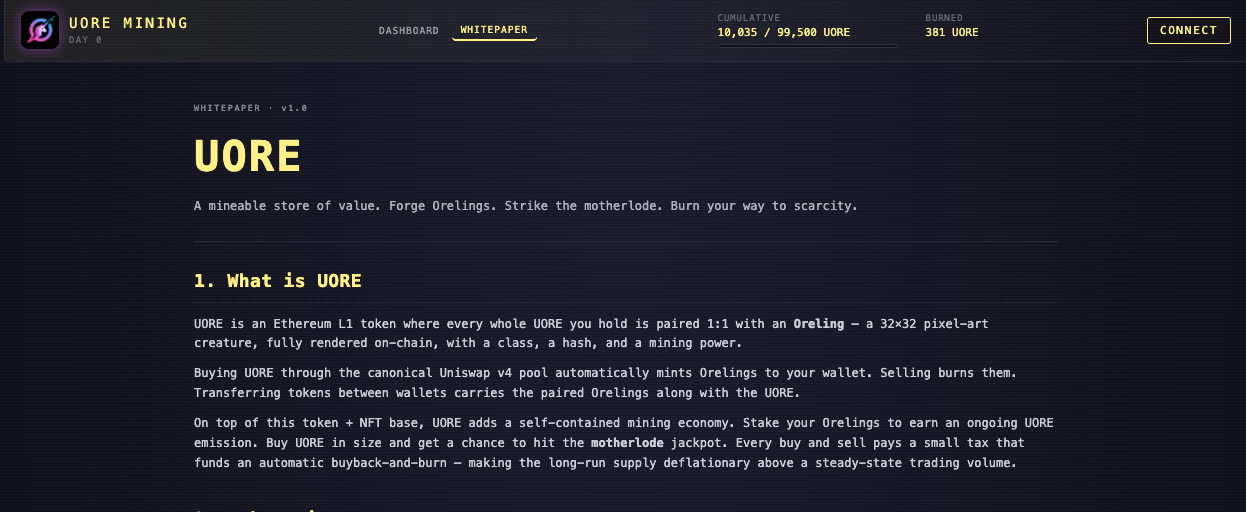
The new project is called $UORE, which just launched yesterday, and can be summarized in one sentence: It packages on-chain mining, coin buying lotteries, automatic pixel NFT generation, and deflationary burn mechanisms, all into a single trading pool of Uniswap V4.
Also, because when you buy a coin in this pool, the contract simultaneously completes these six tasks in the background, the Gas for one transaction is two to three times that of a regular swap...
Currently, if you open CT, you will find everyone is complaining about this high Gas fee.
In terms of tokens, as of the time of writing, GMGN data shows that just a few hours after $UORE went live, the market cap peaked at 1.2 million dollars, then quickly fell back to 440,000. The pool’s liquidity is only 64,000 dollars, but the 24-hour trading volume is 1.2 million, with money in the pool rolling over nearly twenty times.
However, there are only 741 holders, with a total supply of less than 10,000 coins.
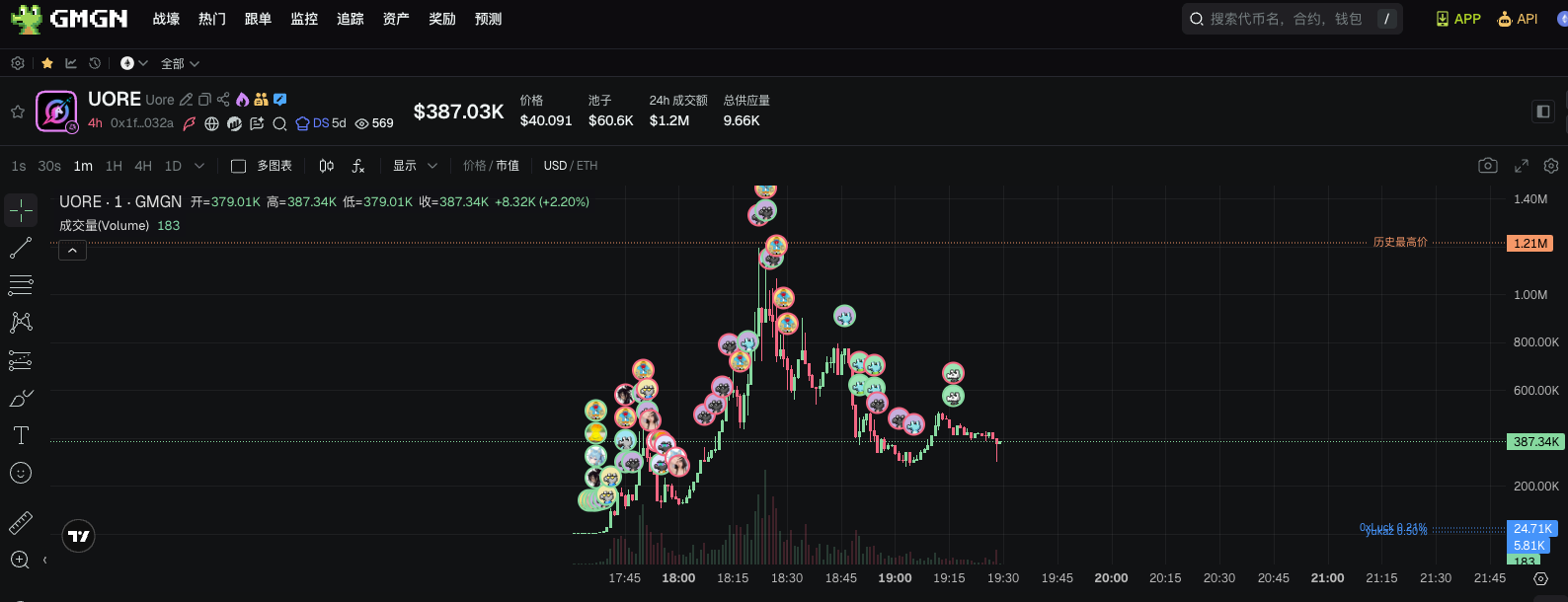
Currently, the risks seem extremely high. After simple research, I personally feel that this is the most complex project in the V4 Hook ecosystem (the new on-chain gameplay this round tends to be incomprehensible in mechanism...).
It is simultaneously a token, an NFT collection, a staking mining ground, and a lottery system. Moreover, these four elements are not independent of each other; they are welded together.
Four-in-One Mining Site
In most NFT projects, tokens and NFTs are two different things, bought and sold separately.
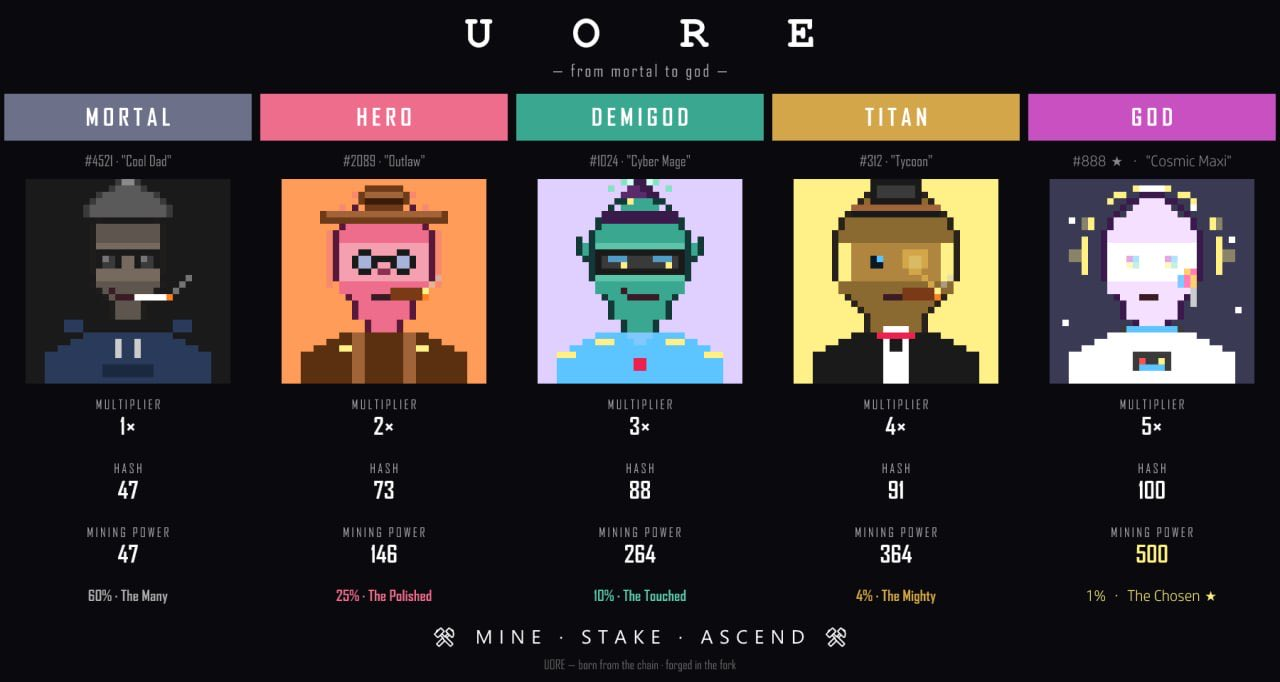
UORE is not. Its NFT is called Oreling, a 32×32 pixel miner, directly embedded within the token. For every whole UORE you hold in your wallet, it automatically corresponds to one Oreling.
When buying coins, the contract helps you mint, when selling coins, the contract helps you burn, and during transfers, Oreling moves along with it. You cannot buy an Oreling separately, nor can you extract it from UORE.
Each Oreling’s features are determined by the hash value of the next block at the moment of minting. This means you don’t know what kind of miner you will get when purchasing, not even the validators can see the result in advance.
The differences among these miners are not just about aesthetics.
Each Oreling has a Class (rarity) and a Hash (a random number between 1 to 100), and the product of the two is its Mining Power, which refers to its mining capacity.
The most common Mortal accounts for 60%, with a power multiplier of 1; the rarest God has only a 1% probability, with a multiplier of 5. If you are lucky enough to draw a God with Hash 100, the power is 500, more than ten times that of an ordinary miner.
What is the use of mining power? The old method: staking.
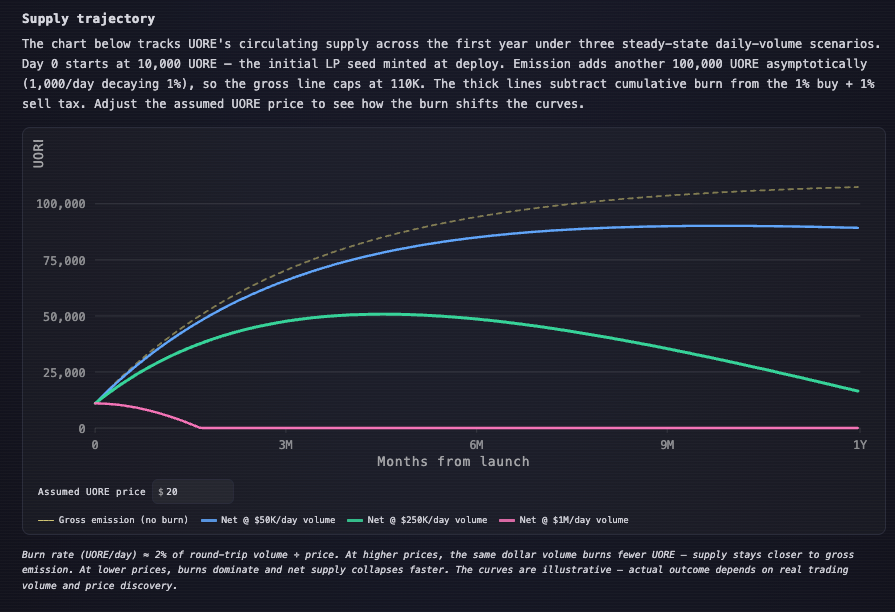
Stake your Oreling into the mining pool, and based on your power proportion, you will receive a share of UORE released daily. According to the official whitepaper, 1000 UORE will be released on the first day, then decreases by 1% daily, with a half-life of about 69 days. 80% of the released amount goes to stakers, while 20% enters the Motherlode prize pool.
This decay rate means that within a year, 97% of the total emission will be released. The earlier you start mining, the larger your share of the pie.
When claiming rewards, one design is worth noting: a 10% "refining tax" will be deducted and redistributed to all stakers who have not yet claimed. The whitepaper calls this the refined-ore boost.
In plain language, those who wait longer earn more from the taxes others pay. Those in a hurry to claim rewards are subsidizing those with patience.
Then there is the Motherlode, which translates to "mining prize".
Each time you buy UORE through official channels for ≥ 0.1 ETH, you automatically receive a lottery ticket. The winning probability is linked to the purchase amount: 0.1 ETH has roughly a one in six hundred chance, 0.5 ETH approximately one in two hundred, and 1 ETH tops at one percent. Buying more than 1 ETH does not increase the probability, to prevent large holders from gaming the system.
If you win, the prize pool splits in half: 50% goes directly to the buyer, and 50% is randomly allocated to a staker (weighted by power). As of this writing, there have only been four wins historically, with the largest being 6.4 UORE.
Finally, there is the deflationary flywheel.
A 1% tax is charged on buying, which is then burned, while another 1% tax is applied upon selling that goes into the buyback treasury. When the treasury accumulates to 0.1 ETH, anyone can trigger an automatic buyback, and all UORE bought back will be burned. As of writing, there have been 58 buybacks executed, accumulating 358 UORE burned.
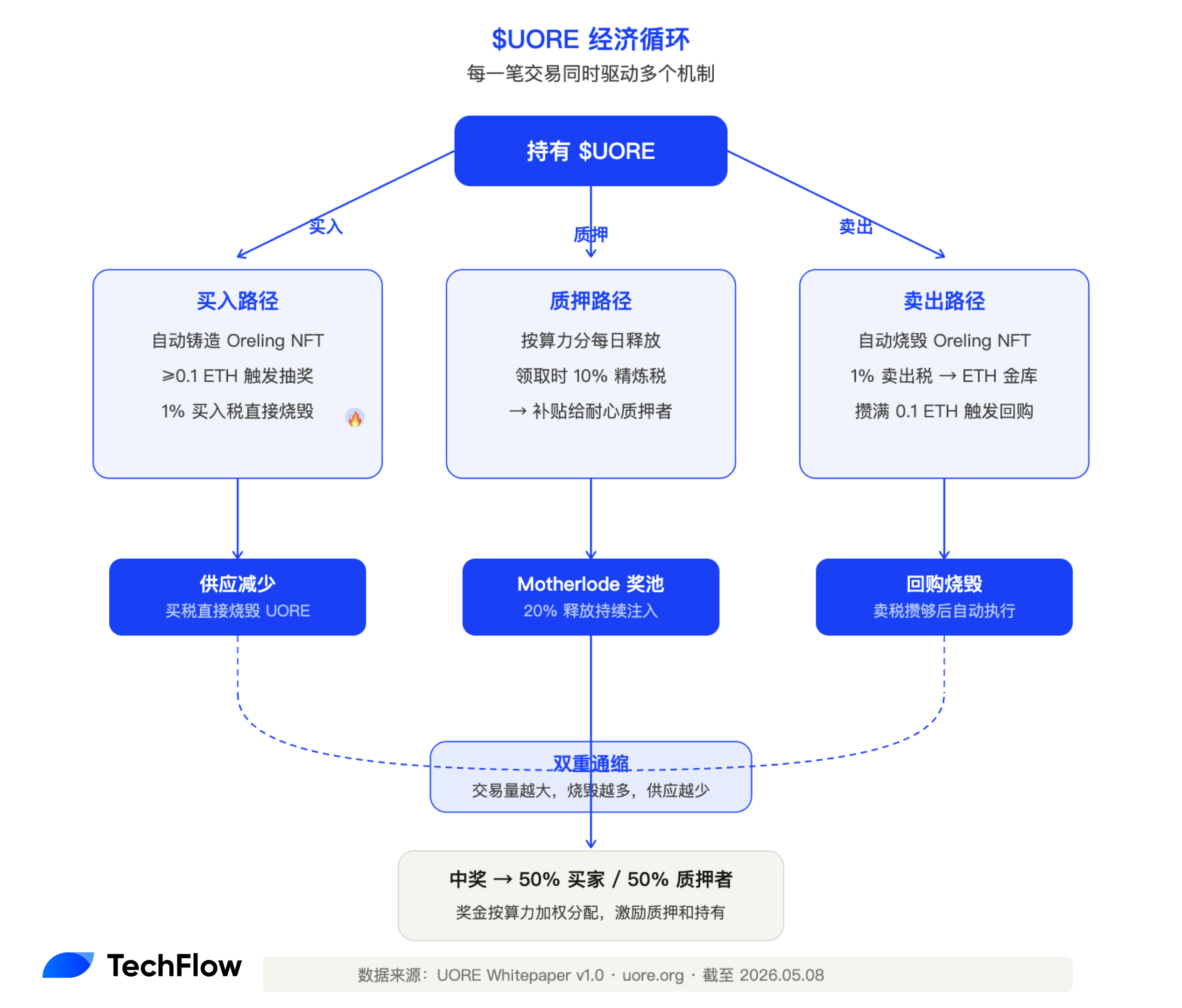
Looking at the whole design, it features minor innovations in gameplay, creating scarcity through old routines, and it represents another Ponzi in economic model design.
The project code is forked, and the gameplay is stitched together
UORE is not built from scratch.
Some in the community have checked the source code and found a folder in the code directory called reference/unipeg-hook-source/. The founder Noah has not hidden this either; he openly mentioned on Twitter that UORE's contract is a fork of uPEG, and he repaired two known issues of uPEG: NFT re-generation and flash loan rarity attack.
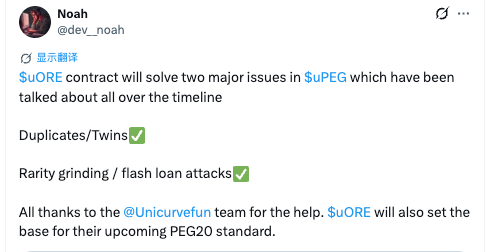
I checked this founder’s account; his personal profile says "Ethereum dev & BAYC holder". On May 2, he posted the first tweet about UORE, stating that this project combines the mining concept of ORE on Solana with the V4 Hook structure of uPEG.
He also proactively @ed Unicurvefun and Openpeg, asking if they could support Orelings trading once their market is live.
From this public information, the lineage of the UORE project is quite clear:
Solana ORE provided the gameplay template of "on-chain mining + lottery", while uPEG provided the code framework of V4 Hook, Noah made improvements and assembly on top of these two bases.
Forking itself isn't a problem. I think the current issues are:
- Gas. There have been reports on CT that each UORE transaction needs to complete six steps in the Hook, resulting in gas consumption two to three times that of a regular swap. After the round trip, you might find that profits have shrunk considerably.
- Time window. The V4 Hook narrative is influenced by the decline of uPEG, and the upper limits of subsequent projects will only get lower. UORE is the fourth project in this wave of Hook frenzy, and the enthusiasm for the first three has already cooled. The attention window for the track waits for no one.
- Complexity. UORE may have the most mechanisms among these four projects; an ordinary user needs to comprehend the entire set of rules including Oreling rarity, power calculation, staking decay, refining tax, Motherlode probability, and buyback trigger conditions, which is not easy to grasp, and the official website presents it like a riddle.
Moreover, the project whitepaper is also very interesting:
Read the contracts and understand the mechanics before deploying capital.
This sentence translates to “Understand it before coming; if you don't understand it, don't blame me.”
By combining the previous Hook projects, we can see that this wave of on-chain market is characterized by complex mechanism designs + significant information asymmetry, having potential alpha, but the shelf life of that alpha is getting shorter.
SATO gave one week, uPEG a few days, and by the time of UORE, the time left for you to understand the rules may only be a few hours...
By the time you understand it, the market may have already moved on.
免责声明:本文章仅代表作者个人观点,不代表本平台的立场和观点。本文章仅供信息分享,不构成对任何人的任何投资建议。用户与作者之间的任何争议,与本平台无关。如网页中刊载的文章或图片涉及侵权,请提供相关的权利证明和身份证明发送邮件到support@aicoin.com,本平台相关工作人员将会进行核查。


