Written by: Ada, Deep Tide TechFlow
In the early hours of May 7, GameStop CEO Ryan Cohen posted a screenshot on X.
eBay sent him a notice that his account has been permanently suspended, stating, “We believe this activity poses a risk to the eBay community.”
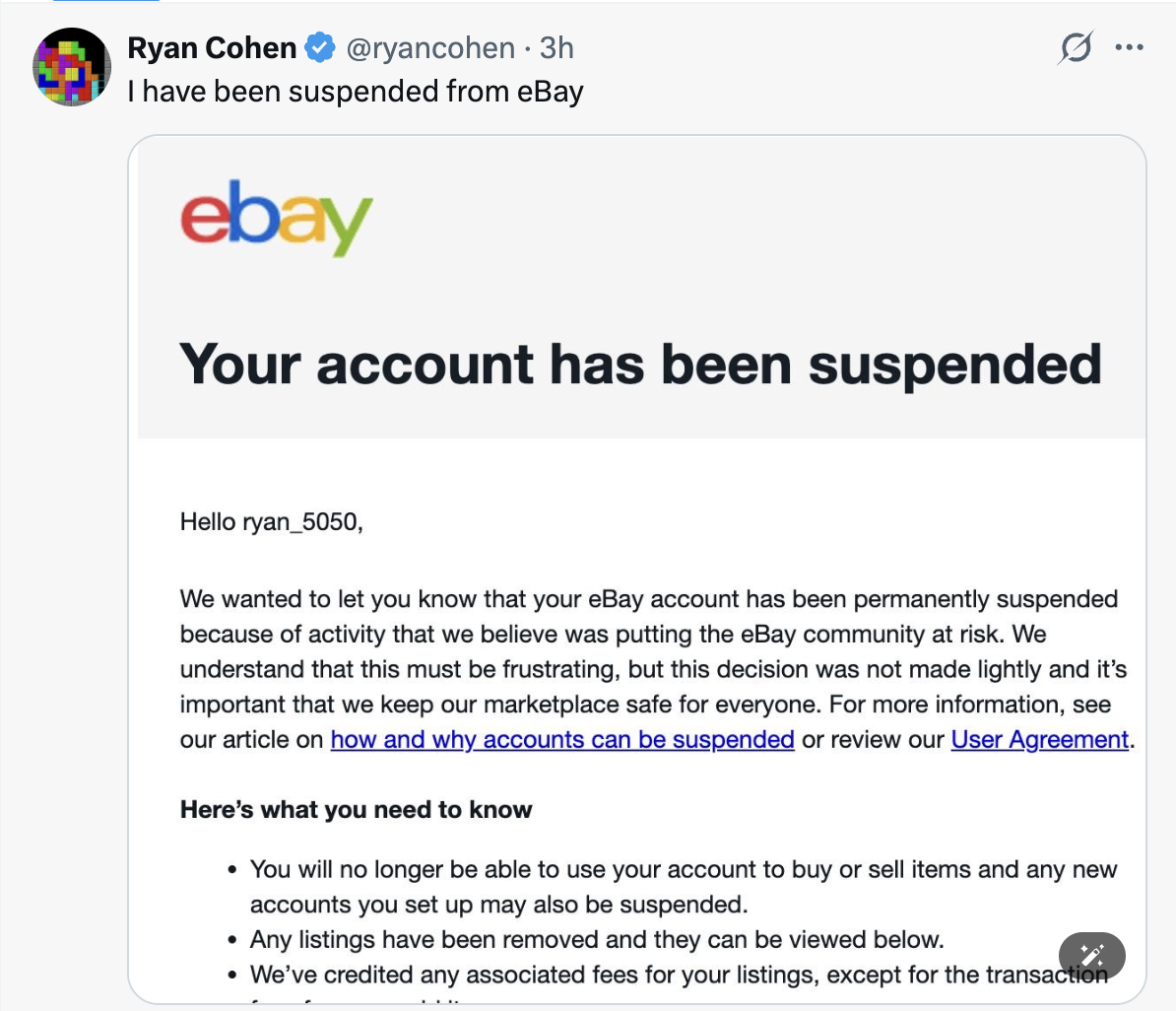
Just 24 hours earlier, he had listed a pair of socks on his personal eBay account, captioned: Selling items on eBay to gather money to buy eBay.
It sounds like a joke, but he is serious. Just three days prior, he had thrown a $56 billion acquisition offer at the eBay board.
An Unstable Offer
On May 4, GameStop announced a non-binding acquisition offer for eBay at $125 per share.
GameStop stated in its announcement that the acquisition would be paid with half cash and half GameStop common stock, offering a 20% premium over eBay's closing price of $104.07 on Friday, and a 46% premium over the closing price on February 4 (when the gaming retail giant began to increase its stake in the company).
On Monday, eBay's stock price rose by about 5% to around $109, well below GameStop's $125 acquisition offer. Meanwhile, GameStop's stock price dropped by about 10%, indicating that investors are skeptical about whether this deal can be completed.
GameStop's current market capitalization is about $11.2 billion, which is only a small fraction of the $56 billion transaction scale. Despite the company having received a $20 billion financing letter of intent from TD Bank, there remains a significant funding gap.
What’s left to do? Cohen provided an answer in front of CNBC's camera: “We offer a structure of half cash and half stock, and we have the ability to issue additional stock to complete this transaction.”
In other words, it's about printing stocks. Using the shares of a company worth $11.2 billion to exchange for equity in a company valued at $55.5 billion. To persuade eBay shareholders to accept GameStop stock as compensation, it seems that the prerequisite is for GameStop's stock price to rise fivefold first.
So how does the market view this?
Traders at Kalshi believe that the probability of GameStop completing the acquisition by 2026 is only 26%, although the total trading volume of the new contract is very low, just above $2,000.
On the Polymarket platform, traders are even more pessimistic. Traders on that platform believe the probability of GameStop completing the acquisition is only 15%.
Semafor cited insiders reporting that the eBay board is meeting this week to review the offer, but the deal “seems to be dead on arrival,” as Cohen failed to persuade any significant shareholder to publicly support him.
A Carefully Crafted Performance
On May 6, 48 hours after the offer was submitted, Cohen began listing items on his personal eBay account, socks, miscellaneous items, personal belongings, with total bids reaching tens of thousands of dollars.
He also intensely attacked the eBay board on Twitter, accusing them of mismanagement. That day, he first received a notification from eBay stating that he had hit the monthly listing limit. Then, his account was banned.
The phrase in the ban notification, “posing a risk to the eBay community,” paired with someone attempting to acquire eBay, makes for such an absurd picture.
But this is merely Cohen's performance. Since the bidding doesn't scare the board, then use noise to activate the retail investor base of GME. Let the stock price soar first, and only then can there be stock as compensation.
Why does Cohen want to initiate the acquisition?
Here's the background. In early 2026, the GameStop board adjusted Cohen's compensation plan, allowing him to earn as much as $35 billion in stock incentives if the company's market value reaches $100 billion. Yet GameStop’s market cap is only about $11.2 billion, making it nearly impossible to achieve $100 billion solely from selling game discs. The only way is to increase market value through acquisition.
Moreover, the entire script of Cohen “selling socks to acquire eBay” was never intended for the board; it was written for the retail investors on the WSB section of Reddit.
From Bitcoin to eBay
Pulling the view back a bit, you will find that from Bitcoin to eBay, Cohen's script has always been the same.
In February 2025, he flew to meet Saylor. Three months later, he announced his entry. According to Reuters, GameStop spent $513 million to buy 4,710 bitcoins, with an average cost of about $108,917.
While Saylor leveraged his entire balance sheet to issue bonds and increase leverage, buying weekly, Cohen stopped after buying $500 million, which only accounted for 10.4% of GameStop's cash reserves at the time. Strategy increased its holdings almost weekly, but GameStop did not add a single bitcoin.
Until around January 23, 2026, GameStop transferred all 4,710 bitcoins to Coinbase Prime, preparing to liquidate.
After transferring out the bitcoins, Cohen gave several consecutive interviews to various media, discussing acquisition plans and swearing to transform GameStop into an investment holding platform similar to Berkshire Hathaway. When reporters pressed him about the bitcoin strategy, he threw out that oft-quoted line: “This strategy is more attractive than bitcoin.”
What is the “more attractive strategy”? It seems to be acquiring eBay for $56 billion.
The chain of logic is thus closed: first use the bitcoin narrative to drive up the stock price and attention, once the paper loss appears, turn away, then switch to the next grand narrative, to acquire a holding platform and build a billion-dollar empire like Berkshire. Each story is bigger than the last, but none of them have truly landed.
Saylor is faith, but Cohen is the real performer. He doesn’t need a closed loop for trades; a narrative loop is enough. Once the bitcoin narrative is finished, he moves on to eBay. Once eBay is done, what will be next? No one knows, but there will definitely be a next.
Why eBay?
eBay has steady cash flow, stable GMV, and stable shareholder returns. It is a target with $31 billion in revenue. As long as the merged company maintains eBay's valuation multiple, it is possible for the market cap to break the threshold.
So what does Cohen aim for?
One explanation is that he needs a story larger than bitcoin.
The core issue with GameStop has never been a lack of cash; the $9.4 billion cash reserve on hand is real ammunition. However, as a game retailer that started with physical stores, physical games, and second-hand transactions, GameStop's traditional business has long been eroded by digital downloads, platform self-operated stores, and subscription services, which can no longer support an $11.2 billion valuation.
Retail investors are buying Cohen, the meme, the possibility of “the next Berkshire.”
But this possibility needs to be constantly fed.
The bitcoin treasury can feed it for a while. When the flywheel reverses, something more exciting is needed. Acquiring a publicly traded company five times its size is a story sufficiently thrilling.
As for whether the deal can go through? It doesn't matter.
What matters is that after this offer is submitted, CNBC will invite him on a program, The Wall Street Journal will write a feature interview, and Reddit will boil again; GME's stock price will experience several days of volatile swings. In the volatility, options bulls can make profits, retail investors can have the illusion of “we've won again,” and Cohen himself can cash out some equity incentives.
And selling socks and getting banned can bring a wave of free traffic.
When Performance Art Meets Capital Markets
It is important to note that Cohen is a serial entrepreneur with real achievements; he sold Chewy for $3.35 billion to PetSmart. He knows that the eBay board will never sell the company to a rival worth only one-fifth of themselves; a $56 billion acquisition is unlikely to succeed. He knows that the $20 billion from TD Bank isn't enough, and stock dilution through printing would be directly rejected by eBay shareholders.
But he doesn’t care; he only needs to perform.
The true audience of this performance is liquidity, the attention economy itself. In this era where all assets are priced by narrative, those who can create the loudest noise can short-term gain the most liquidity.
Listing socks and getting banned is a hundred times more effective than formally issuing a press release. Overnight, all financial media are writing about Cohen, and all social platforms are circulating that ban screenshot. The global exposure for free far exceeds the transaction volume of those listed items.
In today's capital markets, it is difficult to distinguish between performance art and investment actions. In the past, submitting an offer was for a genuine acquisition; now, submitting an offer is to induce stock price volatility. Volatility leads to profits, and profits are the exit path. Cohen and his crew are playing this the best.
Cohen will never truly bet, always preparing for the next performance. But one point can be seen clearly now. When a CEO of a listed company has to rely on listing socks on eBay to prove that he is serious about acquiring eBay, and then gets permanently banned by eBay for “posing a risk to the community,” this itself is already the most precise footnote about the capital market of this era.
When the tide recedes, the ones that run fastest are always the fleeting trend followers, while the true believers might also look down on the performance.
免责声明:本文章仅代表作者个人观点,不代表本平台的立场和观点。本文章仅供信息分享,不构成对任何人的任何投资建议。用户与作者之间的任何争议,与本平台无关。如网页中刊载的文章或图片涉及侵权,请提供相关的权利证明和身份证明发送邮件到support@aicoin.com,本平台相关工作人员将会进行核查。


