
Organization & Compilation: Deep Tide TechFlow

Hosts: Josh Kale; Ejaaz Ahamadeen
Podcast Source: Limitless Podcast
Original Title: Forget NVIDIA| This 24-Year-Old's $4.5B Bet on AI's Real Problem (Leopold Aschenbrenner)
Release Date: March 4, 2026
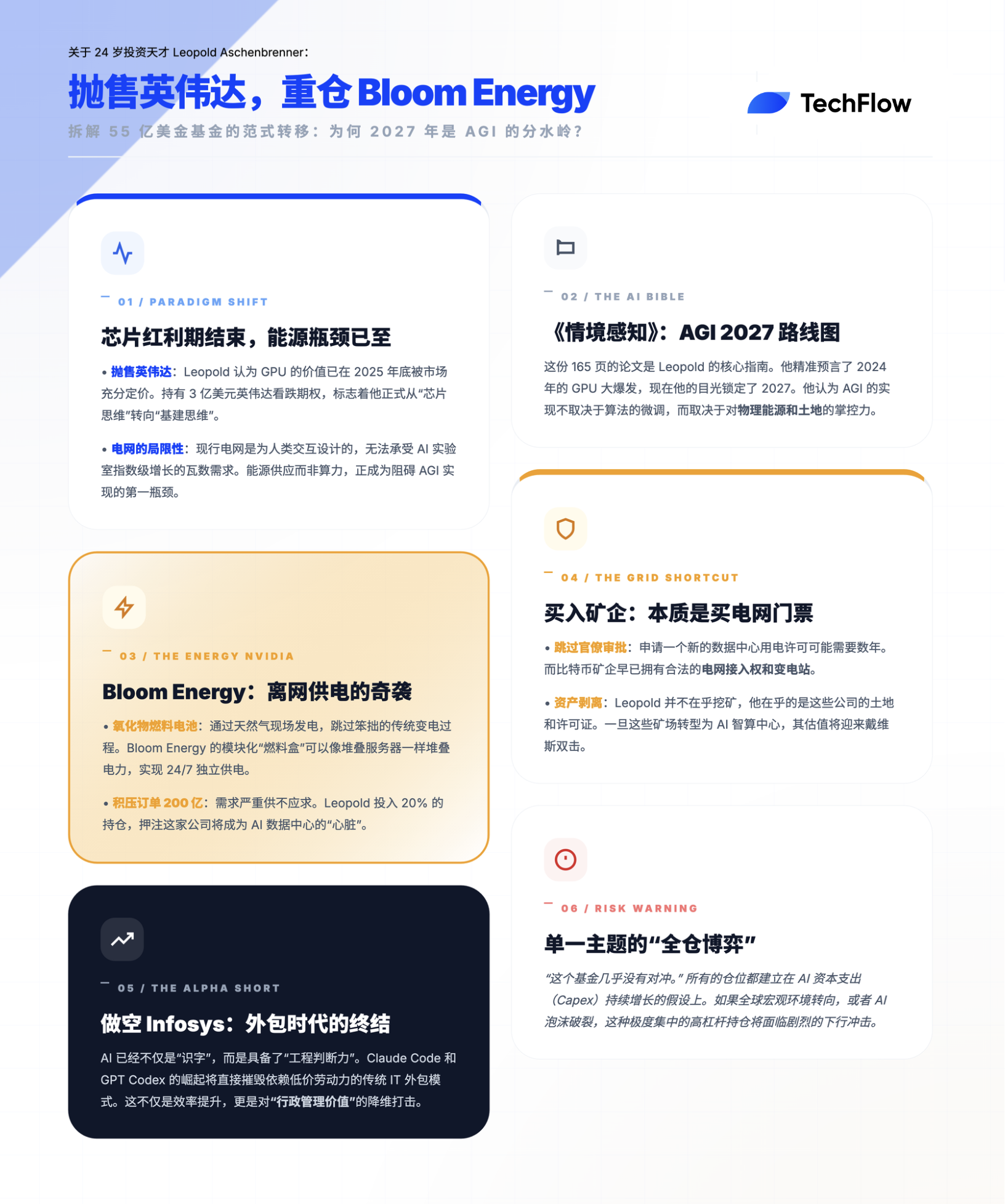
Key Summary
Recently, everyone has been talking about Leopold Aschenbrenner—24 years old, managing a $5.5 billion AI hedge fund, a child of the US stock market. However, most discussions have remained at the level of "he is amazing" and "he has made so much money," with little real decomposition of his position logic.
Two months ago, Limitless Podcast did an episode analyzing his 13F report line by line:
Why he liquidated NVIDIA, why he invested 20% of his position in a fuel cell company, why he bought up a bunch of Bitcoin mining companies, and why he shorted Infosys. At the time, this episode hardly received any discussion. Looking back now, many judgments made then have largely come true, warranting a revisit.
Highlights of Opinions
On Leopold Aschenbrenner's Investment Performance
“Last year he was managing $1 billion... today, just one year later, that $1 billion has grown to $5.5 billion.”
“His fund was established at the end of 2024, with an initial size of $255 million. And within just 6 months, his fund outperformed the S&P 500 index by 8 times.”
“He wrote a lengthy 165-page article titled ‘Situational Awareness’. In this article, he essentially predicted that we would reach Artificial General Intelligence (AGI) by 2027.”
Shift in Investment Paradigm: From Chips to Infrastructure
“He sold off NVIDIA, Broadcom, TSMC, and Micron. These are all major AI infrastructure companies.”
“By the end of 2025 or early 2026, he believes the market will have essentially fully reflected the value of GPUs.”
“He shifted focus to major bottlenecks that investors have not fully paid attention to—energy and infrastructure.”
“The existing power grid was designed for humans, not to meet the vast AI demands we face today. This is where his current investments lie.”
Core Holdings: Bloom Energy
“Bloom Energy is his largest investment target, accounting for 20% of the entire portfolio... he has built a massive position in this company, amounting to $855 million.”
“Bloom Energy has developed a device known as an oxide fuel cell... that can convert natural gas directly into electricity usable by data centers. It is modular and can be rapidly deployed.”
“They have a backlog of orders worth $20 billion. Revenues in 2025 grew by about 34%, while they expect revenue to grow another 40% in 2026.”
“If you use products like Bloom Energy’s natural gas turbine, you do not need to rely on the grid at all. You just need to install it next to the AI data center.”
Infrastructure and Bitcoin Mining 'Shortcuts'
“Leopold has heavily invested in CoreWeave. He has made leveraged investments in core GPU infrastructure and energy supply.”
“He invested in many Bitcoin mining companies... because these companies have two key elements needed to build AI infrastructure: land and power.”
“He acquires these companies to gain their permits and access to the power grid. Typically, gaining such permits can take months or even years.
“It’s a bit like taking over a bar that already has a liquor sales license rather than applying for a new one and waiting for years; it’s a very clever 'shortcut'.”
Short Position Logic and the End of IT Outsourcing
“He holds a short position in a particular company, which is Infosys... their business model completely relies on providing cheaper labor than Western countries.
“He realized that these models are now strong enough to automate not only simple tasks but also handle some very important IT processes, hence he shorted this company significantly.
Investment Philosophy: A Return to the Physical World
- “Companies that solely rely on software will find it very difficult in the future. His shift is not just about structuring around architecture, but investing in the physical world, such as manufacturing, factories, energy, and infrastructure.”
“These are fields that cannot be built through AI; they require human labor, permits, and legislation to create hardware and infrastructure.
“Energy is the only resource that everyone cannot get enough supply of... everything revolves around a core: powering the future.”
Young Investment Prodigy Leopold Ashbrer
Josh Kale:
There is a person named Leopold Ashbrer who is 24 years old this year. We reported on him in a past episode when he was just 23, managing $1 billion and focusing on investing in emerging frontier AI concepts and technologies. And today, just a year later, that $1 billion has grown to $5.5 billion.
This guy, much younger than both of us, has just delivered a groundbreaking performance, earning more money in the AI space than any other fund in the world. More importantly, AI is currently the hottest market, which means competition is incredibly fierce. So it’s clear that this guy named Leopold is doing something different.
Just last week, his new quarter 13F report was released, and we could finally catch a glimpse of his recent trading behavior. So next, we will closely analyze these documents to see what this person has done to propel his managed funds from $1 billion to $5.5 billion.
Insights from the 13F Report
Ejaaz Ahamadeen:
He has achieved these feats in just 12 months. His fund was established at the end of 2024, with an initial size of $255 million. And within just 6 months, his fund outperformed the S&P 500 index by 8 times, growing to $2 billion. Since we last discussed his third-quarter fund report on the show, his fund has grown an additional $1.5 billion. So he can now be said to be in a transformative explosive phase.
He is very young and has made a significant pivot, but it all aligns with what he refers to as his “Bible”—a 165-page article titled ‘Situational Awareness’. In this article, he essentially predicted that we will achieve AGI by 2027. In this grand piece, he elaborated on his views about how the AI revolution would unfold. His predictions were almost entirely correct, as he successfully foresaw the GPU infrastructure boom, and now he has proposed a very important shift that we will delve into next.
Shift from Chips to Infrastructure
Josh Kale:
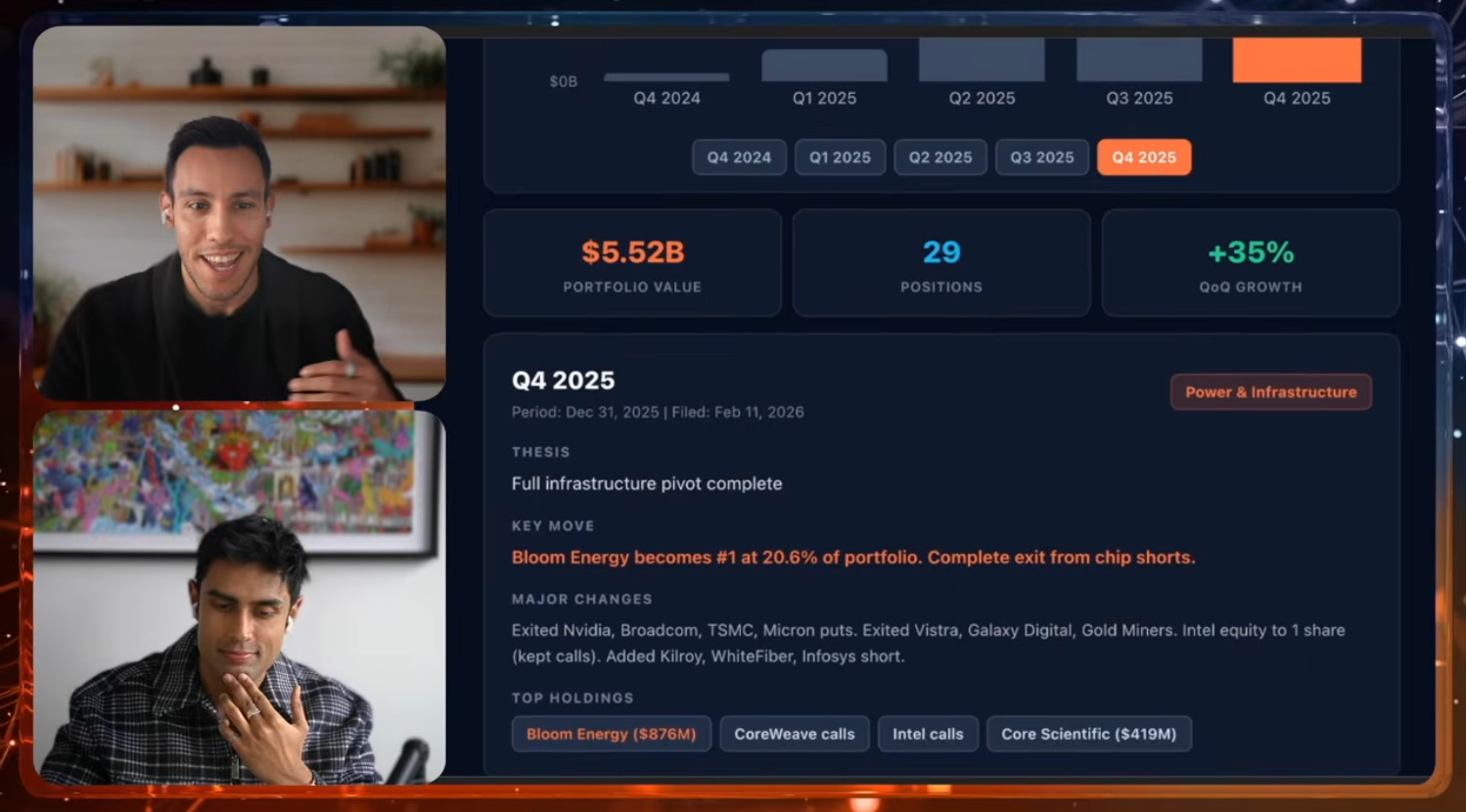
I think the entire investment thesis is shifting from chips to infrastructure. What we see on the screen right now is quite interesting. He created a document with Claude that will guide us through the entire change record from last year to this year. Perhaps we can start with the assets he sold, as the positions he sold were quite substantial, including NVIDIA, from which he sold $300 million worth of put options in a single quarter.
Ejaaz Ahamadeen:
You will see many of the stocks he sold are very popular companies that many people are currently investing in. So the question arises why did he sell $1 billion worth of stock in these companies? He sold NVIDIA, Broadcom, TSMC, and Micron. These are all major AI infrastructure companies.
His selling of NVIDIA stock was actually profitable; he held $300 million worth of put options, which means he likely profited from the drop in NVIDIA’s stock price over the past few months. So the question is, why did he do this?
In his 165-page paper, he mentioned that by the end of 2025 or early 2026, he believes the market will have essentially fully reflected the value of GPUs. This value primarily comes from companies like NVIDIA and Broadcom, which manufacture these chips and then stack them up for AI labs like OpenAI and Anthropic to train models.
Now, he has shifted focus to major bottlenecks that investors have not fully paid attention to—energy and infrastructure. Currently, a major issue faced by many AI labs is that: first, they have too many GPUs; second, the existing power grid was designed for humans, not to meet the vast AI demands we face today. This is where his current investments lie.
Selling NVIDIA Put Options
Josh Kale:
Seeing him sell NVIDIA put options and completely exit his investment in NVIDIA intrigues me. Because when I chat with friends or talk to ordinary people on Wall Street, NVIDIA is the company everyone talks about; it’s the biggest investment target. And seeing him pivot away from NVIDIA again proves that he is always a step ahead, always able to foresee future trends rather than getting stuck in past hotspots. In his view, the future focus is on infrastructure, shifting from a chip-driven approach to an informational approach.
This might be a place where we can drill down into his new investments, as these are the stocks you should be paying attention to. These are the assets he currently holds and believes will grow in the future. If his judgments are correct, we should see pretty substantial returns from it. So what new investments did he add this quarter?
Ejaaz Ahamadeen:
Here is a very neat investment portfolio chart categorizing all of Leopold Ashbrer's investments by AI technology stack. We can see that the investments are categorized into power production, real estate and facilities, computing and hosting, connectivity, storage and memory, chips and wafers, etc.
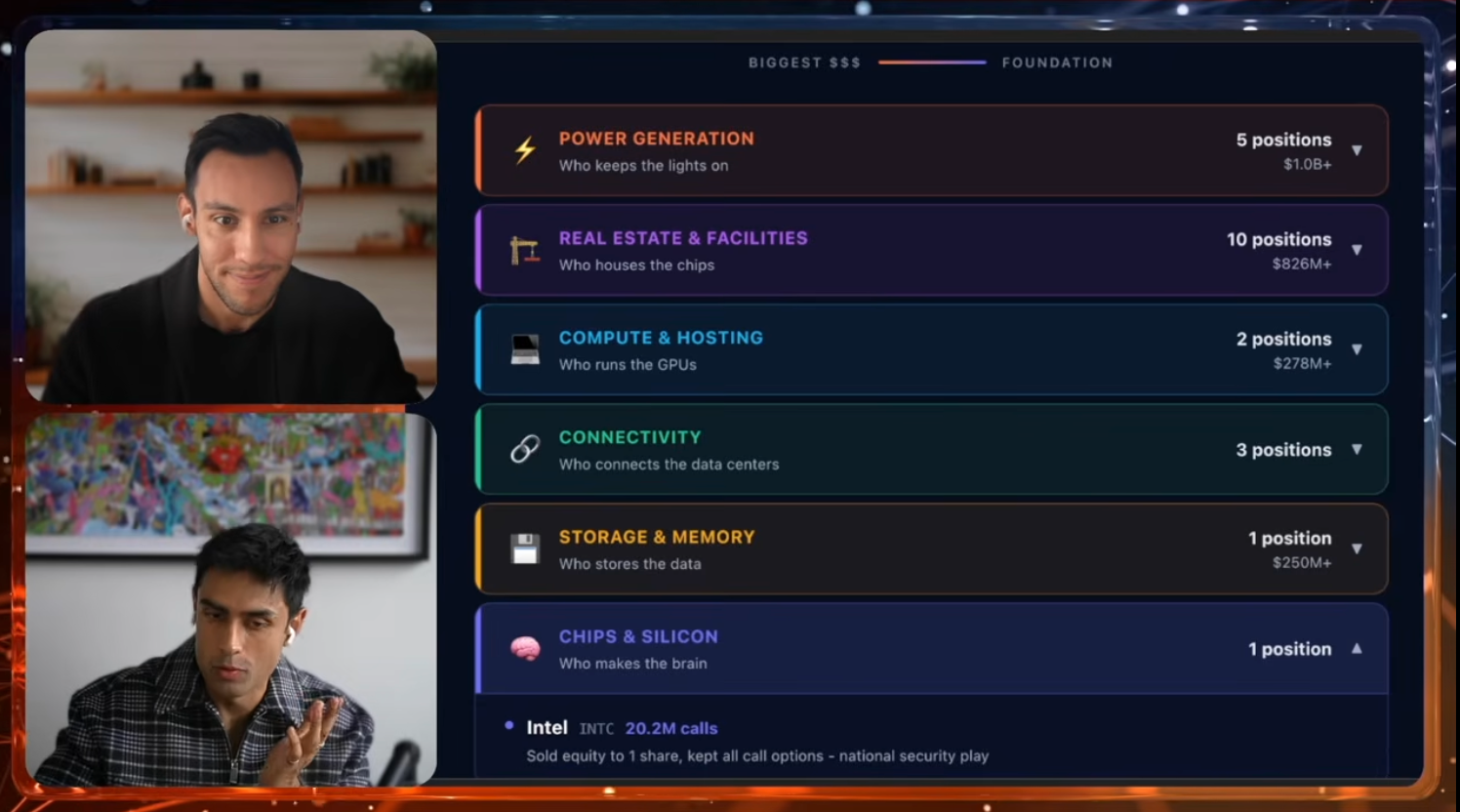
Actually, I also want to add something to what I just mentioned; I noticed he made a very clever trade with Intel. He sold his existing stock but simultaneously still holds a massive long position. He released liquidity in this way and directed funds towards other companies. The main company he invested heavily in is the power production sector, named Bloom Energy. This company was almost unknown around three months ago but specializes in manufacturing turbines for power supply to AI data centers.
He has built a huge position in this company totaling $855 million. Although here it shows $876 million, the report states $855 million.
Bloom Energy: The Power Innovator
Josh Kale:
Bloom Energy is currently his largest investment target, accounting for 20% of his entire portfolio. This has nothing to do with the chip sector, represents a completely different direction. I researched their business and found it quite interesting.
Bloom Energy has developed a device called an oxide fuel cell, a cutting-edge technology for generating power from natural gas on-site. Normally, the process of getting natural gas to data centers requires heating and cooling through turbines, which is a very clunky process for energy production. Bloom Energy’s “fuel boxes” can convert natural gas directly into electricity usable by data centers. They are modular, quick to deploy, and seem to have no supply shortage issues. As far as I know, they plan to produce 2 gigawatts of power this year.
This is a very interesting play in energy. I have been looking for the “NVIDIA of the energy sector”—that is, the "chip manufacturer in the energy sector." Currently, I haven’t found a company that completely fits that role, but perhaps Bloom Energy could become that company.
Ejaaz Ahamadeen:
I also checked their latest financial report because they are a publicly traded company. They have a backlog of orders worth $20 billion. Revenue increased by about 34% in 2025, and they expect revenue to grow another 40% in 2026; clearly, their demand is outstripping supply.
You mentioned the oxide fuel cell. Their natural gas turbines are particularly attractive because they do not need to rely on the existing power grid. As I mentioned earlier, the current power grid is under significant pressure because humans need energy and AI data centers also need energy, which has led to rising energy prices in areas where AI data centers are located. If you use products like Bloom Energy’s natural gas turbines, you do not need to rely on the grid at all. You just need to install it next to the AI data center and can obtain electricity at an efficient cost for training or inference of your GPUs and data centers.
Companies like Broadcom and CoreWeave will need this kind of energy, especially those oversized cloud computing providers and AI labs. This reminds me of the game Civilization; I don't know if you have played it, but the situation is similar to moving infrastructure and energy production facilities to your small settlement to drive its development, and what is happening here is very similar to that scenario.
Josh Kale:
It is evident that there is no shortage of energy; the question is who can produce the most energy. They indeed have a very large backlog of orders, but the question is whether they can produce enough products to meet these orders? Manufacturing capacity becomes a key issue here. In many such investments, we are entering a "atomic" world, where manufacturing becomes genuinely important. I would love to dive deeper into this in the future to see if they can genuinely scale production. But for now, this is undoubtedly a very significant investment area, accounting for 20% of his portfolio. So what other notable positions are in his new portfolio?
Ejaaz Ahamadeen:
He has also increased his investment in CoreWeave by about $300 million. Imagine being an AI lab; you need GPUs. However, buying GPUs from companies like NVIDIA is only part of the job. Deploying these GPUs into rack servers, providing power supply, technical engineering support, and maintaining GPU servers and cooling systems is an entirely different matter. So you can outsource these tasks to a company called “new cloud service providers,” which is CoreWeave, that specializes in handling these affairs.
Broadcom also provides similar services to some extent, but CoreWeave is a smaller company that originally focused on GPU gaming-era services but has now transformed to serve AI. Leopold has heavily invested in CoreWeave. In our previous discussion during the third quarter, he had already invested $500 million, and this time he added another $300 million. Now his total investment in CoreWeave may have reached $800 million, but the story runs deeper. He also holds about a 10% stake in CoreWeave's primary supplier, Core Scientific, a company that specializes in building the power grid for CoreWeave.
If you think about the betting strategy in investments, Leopold has likely made the largest leveraged investments in core GPU infrastructure (like CoreWeave’s new cloud services) and energy supply (like Bloom Energy), which are his two main holdings in the current fund.
Bitcoin Mining
Josh Kale:
I find it interesting that he has begun to hold enough shares in these companies to become an activist investor, capable of actually influencing their decisions. I think this is very interesting. In researching his portfolio, besides power production being the obvious direction, I noticed he has added the most to real estate-related investments, adding about 10 positions related to real estate, which relates to Bitcoin mining.
What we are seeing now is that he has invested in many Bitcoin mining companies. This looks a bit strange and illogical. After all, the cryptocurrency market is not thriving, and Bitcoin’s performance has not been good. Why would he buy into these Bitcoin mining companies? The reason is that these companies possess the two key elements needed to build AI infrastructure: land and power.
What does Bitcoin mining require? It needs a substantial amount of energy and enough space to place GPU racks. And while Bitcoin mining hasn’t completely declined, the real estate and power resources of these companies clearly offer a better risk-return ratio. It seems he is betting on these Bitcoin mining companies either selling their land use rights and permits or directly transitioning into AI data centers.
Ejaaz Ahamadeen:
It should be clear that his interest in these companies is not for mining; he acquires these companies to gain their permits and access to the power grid. Typically, obtaining these permits can take months or even years. This is also why we see companies like Meta, Microsoft, and OpenAI announcing $1.4 trillion computational partnerships, yet these partnerships have not fully translated into the models they have launched. This explains why the supply of GPUs always lags behind the latest generation; because they cannot get these permits in time.
Leopold turns to acquire these already licensed small companies, bypassing the entire licensing process. He completely strips away the crypto services of these companies, repurposing them for specialized training of AI models, and becomes the infrastructure provider for these AI labs. It’s a bit like taking over a bar that already has a liquor sales license, rather than applying for a new license and waiting for years; it’s a very clever “shortcut.”
AGI and Market Trends
Josh Kale:
One of the investment philosophies I admire most about him, along with how these ideas have been validated over the past year, is its simplicity and efficiency. For example, Bitcoin mining companies obviously have permits and energy, and clearly, every AI company needs these resources. So why isn't everyone buying these companies? I think it’s precisely because these ideas are too simple that many people are blocked from investing. But time and again, his simple ideas have proven correct.
Will Leopold's prediction about achieving AGI by 2027 also be correct? Will we really achieve AGI in 2027?
Ejaaz Ahamadeen:
To validate this prediction, we opened a prediction market on Polymarket to forecast whether OpenAI will announce that it has achieved AGI before 2027. Currently, it seems that when Leopold proposed this fund, many people were skeptical of his predictions, but now the probability in this prediction market is 13%. So this seems somewhat distant. His investment philosophy might be correct, but the timeline may be slightly inaccurate.
This probability is indeed quite low. However, I must say that he was initially criticized for this paper; many thought his views were too far-fetched and unrealistic. About 50% believed AGI would be achieved in the coming months, while others thought it wouldn’t happen until 2030. Leopold is the only one who proposed the 2027 prediction and is currently the closest to being accurate.
He predicted the significance of GPUs before the GPU boom, and now he has made predictions ahead of the energy infrastructure boom. So I think he is still ahead in this regard.
However, his portfolio contains not only long positions; he also holds a short position in a particular company, which is Infosys, an IT outsourcing company primarily based in India. Their business model completely relies on providing cheaper labor than Western countries (like the USA or Europe). Simply put, it is, “Outsource all your administrative IT work to us, and we will take care of it.”
I think his bet here is based on trends he has observed. He saw the rise of products like Claude Code and GPT Codex 5.3, realizing that these models are now strong enough to automate not only simple jobs but also handle some very crucial IT processes, hence he shorted this company significantly.
I believe this is one of his deeper investments and more aligned with the trends we currently see, which shows that he dares to put his money where his mouth is.
Bull Markets and Bear Markets
Josh Kale:
We can discuss the reasons for bull markets and bear markets. When you enter such a portfolio, what are the critiques or cautionary aspects? The first thought that comes to mind is that this investor is only 24 years old; I am not sure if he has the experience that many other investors possess, which could be an advantage to some extent; but at some point, could this advantage collapse?
Another concern I have is that the investment philosophy of this fund seems a bit like a single-theme bet. If the growth rate of AI infrastructure and related spending slows down, or if the macroeconomic environment changes, every position in this portfolio may be subject to downward pressure. There is hardly any hedging space here. So this strategy does have some potential vulnerabilities; however, as of now, all signals suggest that this fund's performance will continue to rise.
Ejaaz Ahamadeen:
If you look at some of the most famous investors of our time, their success has never been about how much they made in a certain year or quarter; it’s about whether they can achieve stable returns year after year, decade after decade, and compound growth. Leopold’s start has been stunning, and his performance has far exceeded the average of hedge funds in any industry, not just in AI, but he still needs to prove himself over a longer time span; time will tell the answer.
I just want to say that this person who was once fired by OpenAI has a profound insight into the future development of AI and has made the boldest predictions; he is the only one so far to have nearly all predictions accurate. He poured a lot of effort into that 165-page paper and is confident in his views, which so far seem to be paying off.
Will the future change? It might. But you can view these reports and investments as a real-time tracking tool for where the bottlenecks are in the AI race; I want to emphasize this. Initially, his fund investment philosophy centered around GPUs. He believed GPUs would become a hotspot for demand, and the market underestimated this opportunity. Now his view is that this opportunity has already been fully priced in by the market, and the next bottleneck he sees is shifting to energy infrastructure.
Look at Elon Musk; he is launching data centers into space. Why? Because the sun provides more energy. And companies like Google, Meta, Broadcom, and NVIDIA are all investing in data centers or data center infrastructure to gain access to the power grid. And he is just putting money where this demand is; I think that’s a smart move.
Josh Kale:
I recently read a great article by Naval, and its core idea is that companies that solely rely on software will find it very challenging in the future because developing and generating custom software has become straightforward. I believe his shift is not just about building architecture, but about investing in the physical world, such as manufacturing, factories, energy, and infrastructure. These are fields that cannot be built through AI, but require labor, permits, and legislation to implement hardware and infrastructure; I believe this is precisely the direction of future development.
Energy is the only resource that no one can obtain enough supply of. Whether in power generation or real estate investment, everything revolves around a core: powering the future. In the last earnings season, just Google, Amazon, and NVIDIA promised $650 billion in capital expenditures, which is enough to show that a lot of funds will be invested to solve this issue, and his portfolio is clearly well-positioned to capture all of this upside opportunity.
Ejaaz Ahamadeen:
Yes, he has indeed made some investments that you might consider high risk. For example, unless you are very familiar with the energy infrastructure sector, many might not have even heard of Bloom Energy. But this company can be seen as a top-tier energy company, especially in portable energy. He pieced these clues together, believing that the grid cannot support current demand, thus deciding to invest in this company. He invested with extremely high conviction. We’re talking about him putting almost one-fifth of his entire portfolio into this single asset.
This is an extremely concentrated, high-risk, high-conviction investment approach. But if successful, that is why his portfolio can achieve a return of 4.5 to 5 times in just a year and a half. We have to give him respect for growing $1 billion to $5.5 billion in just one year; it’s simply unbelievable.
The Future of Leopold's Investments
Josh Kale:
Overall, it’s truly remarkable that he has achieved such accomplishments, and his latest shift from hardware to infrastructure and then to energy looks to be the right direction with very promising prospects. If you agree with his portfolio, perhaps this is an opportunity worth watching. Of course, this is not investment advice; this is merely the portfolio of this person, but it does indeed look promising, and it may perform excellently this year.
Josh Kale:
I am also curious about what our listeners think. I want to know whether you think our investment analysis is at a professional level, whether it reaches the level of Leopold, or if you feel we are completely wrong and have overlooked some obvious stories.
Ejaaz Ahamadeen:
You know what I want? I want to know what you think is the best stock this year.
Josh Kale:
Yes, Leopold has bet on Bloom Energy. I want to know, what is your Bloom Energy? What have we missed that needs to be known to achieve another 5 times growth this year?
免责声明:本文章仅代表作者个人观点,不代表本平台的立场和观点。本文章仅供信息分享,不构成对任何人的任何投资建议。用户与作者之间的任何争议,与本平台无关。如网页中刊载的文章或图片涉及侵权,请提供相关的权利证明和身份证明发送邮件到support@aicoin.com,本平台相关工作人员将会进行核查。


