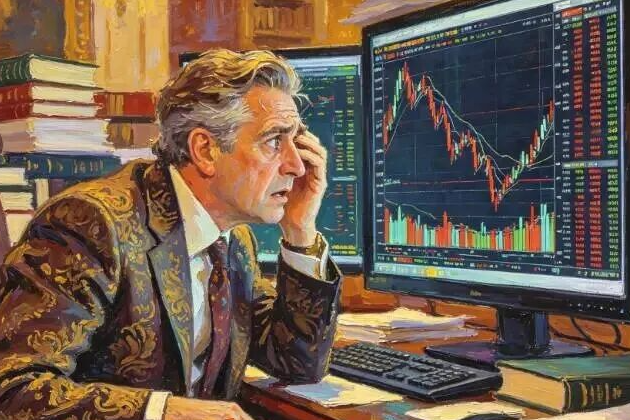
In the trading market, many traders have such a "mental illness": the account is profitable, which should make them happy, but instead, they become anxious and hesitant, ultimately closing their positions too early for a profit, only to find that the market has soared later, leaving them frustrated. Is this a poor mindset, or is there something else going on? Today, we will analyze this trading pain point and provide practical solutions.
1. The root of “inability to hold”: hidden dangers buried at the entry
Many people attribute “inability to hold positions” to a bad mindset, but that is not the case. The real root lies in the “lack of confidence” at the entry position. When you aren't looking for a signal but are blindly chasing trends out of fear of missing out, from the moment you enter, your inner confidence is lacking.
This “lack of confidence at entry” leads to a series of subsequent chain reactions: being worried about profit loss at the slightest floating gain is essentially finding reasons to retreat from an incorrect entry, appearing to take profits, but in reality, it is just “cleaning up” the problems caused by the wrong entry. If it’s a loss exit, at least it proves a judgment error, and you can accept it; the most painful feeling is when you correctly predict the market but don’t make a profit; this “missed opportunity” pain far exceeds that of a loss.
2. The solution: follow the big trends, counter the small ones, and take corrective trades
To get rid of the dilemma of “inability to hold”, we cannot just stubbornly focus on “how to hold” but should start with “how to enter”. The core strategy is to follow the big trends and counter the small ones, making corrective trades steadily.
1. Follow the big trends: define direction with larger cycles
First, we need to assess the trend direction on a larger cycle (such as the hourly chart) to confirm the “big directional team”. For example, on the hourly chart, when the market breaks through a long-term trading range, and the MACD shows no divergence, we can determine the big direction is bullish.
2. Counter the small trends: wait for pullbacks to find entry points
Once the big direction is determined, do not rush to enter, but wait for a pullback on a smaller cycle (such as the 15-minute chart). After the trend on the larger cycle is formed, a pullback on the smaller cycle is a normal phenomenon and also an opportunity for us to enter calmly.
For example, in a bullish trend on the hourly chart, we observe the pullback movement on the 15-minute chart; when we seea bullish engulfing pattern, SMS reversal structure, and other entry signals, that’s our entry timing.
3. Clearly define defense levels, manage risk-reward ratios
Before entering, we must determine a clear defense level (stop-loss level), such as using the start of the trend on a larger cycle or a crucial support level as our defense. Meanwhile, the risk-reward ratio of corrective trades is usually high, which allows us to be more tolerant in the face of normal pullbacks, stabilizing our emotions and making it easier to hold positions.
3. The three major advantages of corrective trades
More comfortable to enter
: Instead of following the trend blindly, we enter at positions with structure and support, which gives us more inner confidence.
Clearer defense
: Based on structure to enter, we know our reasons and where to accept mistakes if wrong, making us feel more secure.
Higher risk-reward ratio
: A high risk-reward ratio brings higher tolerance for drawdowns, allowing holding positions to be more comfortable and easier to capture the profits from trends.
4. The essence of trading: unity of direction and position
The core value of “follow the big trends and counter the small ones” lies in resolving the contradiction between direction and position. The larger cycle helps us determine whether to go long or short (direction), while the smaller cycle helps us find specific entry points (position). Without direction, even a precise position may go against the trend; without position, even the right direction may result in being unable to hold because of chasing highs.
Therefore, if you are also tired of the cycle of “anxiety over floating profits and regret after selling,” do not just get tangled in how to “endure,” but return to the fundamentals of trading, refine your entry methods, and learn to follow the big trends and counter the small ones with corrective trades. Only when the entry position is comfortable can holding positions have more confidence, and only then can you truly capture the portion of the profits belonging to the trend.
For more timely market interpretations and practical trading ideas exchanges, or to consult about the super membership service, you can like and follow, and apply to join the free 🐧 group: 746191163
免责声明:本文章仅代表作者个人观点,不代表本平台的立场和观点。本文章仅供信息分享,不构成对任何人的任何投资建议。用户与作者之间的任何争议,与本平台无关。如网页中刊载的文章或图片涉及侵权,请提供相关的权利证明和身份证明发送邮件到support@aicoin.com,本平台相关工作人员将会进行核查。